On This Page
Description
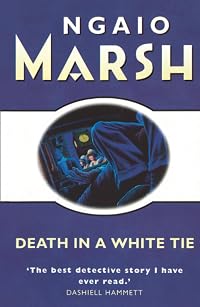
It's debutante season in London, and that means giggles and tea-dances, white dresses and inappropriate much too much champagne. And, apparently, a blackmailer, which is where Inspector Roderick Alleyn comes in. The social whirl is decidedly not Alleyn's environment, so he brings in an assistant in the form of Lord "Bunchy" Gospell, everybody's favorite uncle. Bunchy is more than lovable; he's also got some serious sleuthing skills. But before he can unmask the blackmailer, a murder is show more announced. And everyone suddenly stops giggling ... show lessTags
Recommendations



















Member Reviews
Having recently read biographies of Debra and Diana Mitford and being sick with sinusitis I decided to take the plunge into a fictional version of London Season between the wars and reread "Death in a White Tie". It's fascinating to see how well the outsider Marsh (she was a New Zealander) has captured the feel of the era of debutantes balls, chaperones, debs delights and it's underbelly of adultery, divorce, illegitimacy and remarriage. Things I thought far-fetched when I first read this story are rooted in reality! It's also a good murder-mystery with Roderick Alleyn seeking the help of Lord Robert "Bunchy" Gospell in identifying a society blackmailer - a request that led to murder. There's also a little romance with Alleyn wooing, show more and finally winning, painter Agatha Troy (who he met in "Artists in Crime"). Marsh creates some delightful cameo parts too particularly Alleyn's mother (making her first appearance in the series) and the truculent paying Jewish debutante Rose Birnbaum (who's hard-as-nails chaperone tells her "there was a good deal to be said for the German point of view"). Yes, there's a lot of class attitudes that perturb modern sensibilities but this book also paints us vivid picture of a time and place. show less
Summary: At a premiere debutante ball, Lord Robert Gospell’s call to Alleyn about a blackmail conspiracy is interrupted. A few hours later, Gospell turns up at Scotland Yard in the back of a taxi–dead!
It is the season of the debutante ball in London. Chaperoned young women are introduced to eligible young men–a high fashion and high pressure time for daughters and their mothers. Lady Alleyn’s niece Sara is one of those coming out as is Bridget O’Brien, Lady Carrados daughter by her first marriage to Paddy O’Brien and Miss Rose Birnbaum, the retiring protégé of the abrasive and ambitious Mrs. Halcut-Hackett.
Mrs. Halcutt-Hackett comes to Roderick Alleyn to report a blackmailer threatening one of her society “friends” and show more possibly others. He asks Lord Robert Gospell (aka “Bunchy”), a lovable “Victorian relic” who moves easily among these fashionable circles because he is the epitome of grace and empathy, especially for the scared young girls and their mothers confronted by the intimidating experience of “coming out.” He quickly intuits that there are at least two objects of blackmail–Mrs. Halcutt-Hackett herself and Lady Carrados, whose weariness, attended by Sir Daniel Richardson, doctor to the London elite, seems to stem from more than just the arduous efforts of hosting a ball, which is being capably handled by her quiet and efficient secretary, Violet Harris, who turns out to have a connection to the family going back to the death of her first husband, Paddy O’Brien.
“Bunchy” is a keen observer, and he notes that the hands of the caterer to the rich, Colombo Dmitri, are the very ones that purloin a handbag of Mrs. Halcutt-Hackett, sitting beside him in a darkened concert hall. Later, he witnesses Dmitri return a much thinner handbag to Lady Carrados at the debutante ball. The question is, is he doing this alone or with an accomplice who has access to the material being used to perpetrate the blackmail?
“Bunchy” thinks he has figured it out and calls Alleyn from an upstairs sitting room, but is interrupted as he is about to reveal his hunch. He covers up, discussing a lost item, and arranges to stop by and see Alleyn later that night. A few hours later, Alleyn sees him at Scotland Yard–dead. A cabbie picked him up, but before they set off, he was joined by another passenger in male dress. They stop at Bunchy’s address, and someone feigning Bunchy’s voice gets out wearing Bunchy’s cape. When they get to the other address given, the cabby finds Bunchy dead, and drives on to Scotland Yard. He’d been knocked unconscious by a cigarette case and suffocated, most likely with his own cape.
The delight of this mystery is Alleyn’s concerted effort to find the murderer of his dear friend which involves connecting a number of different pieces and eliminating suspects. Was it Donald Potter, Bunchy’s nephew, who has just been cut off because he prefers his dangerous association with Captain Maurice Withers, who is running an illicit gambling house? Is it Withers? Or Dmitri? Why did Sir Carrados hide a letter brought him by Violet Harris as a young girl, that had been in the coat of Paddy O’Brien when he died? And what was General Halcutt-Hackett doing when he was out walking near the ball at 3:30 in the morning? There were several, including Donald, Captain Withers, and Sir Daniel Richardson, who knew Bunchy suffered from a heart condition that would have made it easier to suffocate him. And what happened to Bunchy’s voluminous cloak?
There was one odd aspect of the novel for me. It was the scenes of Alleyn and Troy together. I think some modern readers would object to Alleyn’s breaking through the awkwardness between them by forcing a kiss upon her, to which she softens. It’s a classic trope, the idea of the male who is a bit “rough,” asserting his attentions. It surprises me that a female writer would write it this way and I wonder whether this reflects a perception of what her readers would want.
This aside, I think this is one of the most artfully plotted and tightly written of the Alleyn books I’ve read with a great classic climax scene with all the suspects present at Scotland Yard. We also get a glimpse into the frenetic character of the London “season” of the day and what seems an implicit criticism of its often fatuous character. show less
It is the season of the debutante ball in London. Chaperoned young women are introduced to eligible young men–a high fashion and high pressure time for daughters and their mothers. Lady Alleyn’s niece Sara is one of those coming out as is Bridget O’Brien, Lady Carrados daughter by her first marriage to Paddy O’Brien and Miss Rose Birnbaum, the retiring protégé of the abrasive and ambitious Mrs. Halcut-Hackett.
Mrs. Halcutt-Hackett comes to Roderick Alleyn to report a blackmailer threatening one of her society “friends” and show more possibly others. He asks Lord Robert Gospell (aka “Bunchy”), a lovable “Victorian relic” who moves easily among these fashionable circles because he is the epitome of grace and empathy, especially for the scared young girls and their mothers confronted by the intimidating experience of “coming out.” He quickly intuits that there are at least two objects of blackmail–Mrs. Halcutt-Hackett herself and Lady Carrados, whose weariness, attended by Sir Daniel Richardson, doctor to the London elite, seems to stem from more than just the arduous efforts of hosting a ball, which is being capably handled by her quiet and efficient secretary, Violet Harris, who turns out to have a connection to the family going back to the death of her first husband, Paddy O’Brien.
“Bunchy” is a keen observer, and he notes that the hands of the caterer to the rich, Colombo Dmitri, are the very ones that purloin a handbag of Mrs. Halcutt-Hackett, sitting beside him in a darkened concert hall. Later, he witnesses Dmitri return a much thinner handbag to Lady Carrados at the debutante ball. The question is, is he doing this alone or with an accomplice who has access to the material being used to perpetrate the blackmail?
“Bunchy” thinks he has figured it out and calls Alleyn from an upstairs sitting room, but is interrupted as he is about to reveal his hunch. He covers up, discussing a lost item, and arranges to stop by and see Alleyn later that night. A few hours later, Alleyn sees him at Scotland Yard–dead. A cabbie picked him up, but before they set off, he was joined by another passenger in male dress. They stop at Bunchy’s address, and someone feigning Bunchy’s voice gets out wearing Bunchy’s cape. When they get to the other address given, the cabby finds Bunchy dead, and drives on to Scotland Yard. He’d been knocked unconscious by a cigarette case and suffocated, most likely with his own cape.
The delight of this mystery is Alleyn’s concerted effort to find the murderer of his dear friend which involves connecting a number of different pieces and eliminating suspects. Was it Donald Potter, Bunchy’s nephew, who has just been cut off because he prefers his dangerous association with Captain Maurice Withers, who is running an illicit gambling house? Is it Withers? Or Dmitri? Why did Sir Carrados hide a letter brought him by Violet Harris as a young girl, that had been in the coat of Paddy O’Brien when he died? And what was General Halcutt-Hackett doing when he was out walking near the ball at 3:30 in the morning? There were several, including Donald, Captain Withers, and Sir Daniel Richardson, who knew Bunchy suffered from a heart condition that would have made it easier to suffocate him. And what happened to Bunchy’s voluminous cloak?
There was one odd aspect of the novel for me. It was the scenes of Alleyn and Troy together. I think some modern readers would object to Alleyn’s breaking through the awkwardness between them by forcing a kiss upon her, to which she softens. It’s a classic trope, the idea of the male who is a bit “rough,” asserting his attentions. It surprises me that a female writer would write it this way and I wonder whether this reflects a perception of what her readers would want.
This aside, I think this is one of the most artfully plotted and tightly written of the Alleyn books I’ve read with a great classic climax scene with all the suspects present at Scotland Yard. We also get a glimpse into the frenetic character of the London “season” of the day and what seems an implicit criticism of its often fatuous character. show less
Blackmail and Murder
Review of the Felony & Mayhem paperback edition (2012) of the 1938 original
Death in a White Tie is a fairly early work (No. 7 of 33) in the Chief Inspector Roderick Alleyn of Scotland Yard series by New Zealand writer Ngaio Marsh. Alleyn and his sidekick Fox are set on the trail of a blackmailer during the London season of debutantes and balls. Alleyn enlists the aid of his friend Lord Robert "Bunchy" Gospell who is adept and well-loved in the social circles of the season. Bunchy apparently uncovers the blackmailer but is murdered as a result and before he can pass on the info to the police. Uncovering the blackmailer and now murderer becomes a crusade for Alleyn who also feels guilty about enlisting his friend's show more aid.
I found Death in a White Tie to be a delightful golden age mystery with its social commentary on the old customs of debutantes coming out during the season. There are plenty of likely suspects and red herrings to keep you entertained and guessing. The book also has a subplot that continues Alleyn's courtship of painter Agatha Troy who will continue to play a prominent role in later books in the series. show less
Review of the Felony & Mayhem paperback edition (2012) of the 1938 original
Death in a White Tie is a fairly early work (No. 7 of 33) in the Chief Inspector Roderick Alleyn of Scotland Yard series by New Zealand writer Ngaio Marsh. Alleyn and his sidekick Fox are set on the trail of a blackmailer during the London season of debutantes and balls. Alleyn enlists the aid of his friend Lord Robert "Bunchy" Gospell who is adept and well-loved in the social circles of the season. Bunchy apparently uncovers the blackmailer but is murdered as a result and before he can pass on the info to the police. Uncovering the blackmailer and now murderer becomes a crusade for Alleyn who also feels guilty about enlisting his friend's show more aid.
I found Death in a White Tie to be a delightful golden age mystery with its social commentary on the old customs of debutantes coming out during the season. There are plenty of likely suspects and red herrings to keep you entertained and guessing. The book also has a subplot that continues Alleyn's courtship of painter Agatha Troy who will continue to play a prominent role in later books in the series. show less
Inspector Alleyn takes this case personally. The victim, Lord Robert Gospell, is a much-loved figure in society, who gets around to all the parties and knows everyone worth knowing, and also happens to be a friend of the Inspector. Lord Robert is using his position to help the Yard investigate a string of blackmail cases, so when he turns up dead in a taxi, it is presumed that he was on the right track and saw something he shouldn't have.
When I heard that there was an abridged audiobook edition of this book, I was outraged: "How dare they abridge a mystery novel! What possible purpose could that serve?" But after reading the original, I feel it did drag a bit in places. I just hope the abridgement trims the text in reasonable places. show more Anyway, even with the slightly laggard pace, I did not guess the solution, and I enjoyed the setting of London society. Another bonus is that Inspector Alleyn's mum appears in this one, as does Agatha Troy, the famous artist whom Alleyn loves.
I would recommend this installment of the series if you like stories featuring high society and mysteries that include a map of the murder venue on the front page so that you can follow along. I would also recommend reading it after Artists in Crime, which immediately precedes it. It's not mandatory but will give you a better introduction to Agatha Troy. show less
When I heard that there was an abridged audiobook edition of this book, I was outraged: "How dare they abridge a mystery novel! What possible purpose could that serve?" But after reading the original, I feel it did drag a bit in places. I just hope the abridgement trims the text in reasonable places. show more Anyway, even with the slightly laggard pace, I did not guess the solution, and I enjoyed the setting of London society. Another bonus is that Inspector Alleyn's mum appears in this one, as does Agatha Troy, the famous artist whom Alleyn loves.
I would recommend this installment of the series if you like stories featuring high society and mysteries that include a map of the murder venue on the front page so that you can follow along. I would also recommend reading it after Artists in Crime, which immediately precedes it. It's not mandatory but will give you a better introduction to Agatha Troy. show less
Not quite sure what I think about Ngaio Marsh. This was my first of her books. Especially since listening to the Shedunnit podcast, I've become aware that there are a few gaps in my knowledge of Golden Age mystery writers, and Ngaio Marsh was one of them. So I thought I'd just pick one that sounded interesting and give it a try.
And it was good, in a way! The solution was simple but easy to miss.
What I was a little flummoxed by was the fact that we spend so much time with the murder victim before he is killed. And I liked him! It changed the dynamic of the story from a mere puzzle to a tragedy, and that makes for heavier reading and a sadness that I don't usually equate with traditional mysteries. Surely that's a no-no on the list of show more Golden Age rules?
I also wasn't sure what Marsh was trying to accomplish in her barely-there side plot about the woman Inspector Alleyn loves. I think, if a writer is going to commit a character to a relationship that's supposed to carry some emotional heft, it probably deserves a fair amount of page time, as in the case of Dorothy Sayers' Lord Peter. Otherwise, what's the point? The detective could just as well remain unattached and in his own little world, as Agatha Christie's Poirot does.
The mystery made for good reading, so I would try another Ngaio Marsh book sometime. Because the jury's still out on what I think of her style. show less
And it was good, in a way! The solution was simple but easy to miss.
What I was a little flummoxed by was the fact that we spend so much time with the murder victim before he is killed. And I liked him! It changed the dynamic of the story from a mere puzzle to a tragedy, and that makes for heavier reading and a sadness that I don't usually equate with traditional mysteries. Surely that's a no-no on the list of show more Golden Age rules?
I also wasn't sure what Marsh was trying to accomplish in her barely-there side plot about the woman Inspector Alleyn loves. I think, if a writer is going to commit a character to a relationship that's supposed to carry some emotional heft, it probably deserves a fair amount of page time, as in the case of Dorothy Sayers' Lord Peter. Otherwise, what's the point? The detective could just as well remain unattached and in his own little world, as Agatha Christie's Poirot does.
The mystery made for good reading, so I would try another Ngaio Marsh book sometime. Because the jury's still out on what I think of her style. show less
I happened to watch the TV series before reading the book, so I knew whodunit. The clues to the mystery were legitimate. Sadly (for the murderer), the murder was probably unnecessary, and the murderer inadvertently provided incriminating clues. There is a Jewish connection: one of the debutantes coming out that season says that she is Jewish; her father is Jewish. She is not a success; she is shy and would much rather pursue her artistic interests.
Less artificial in its construction than some of her earlier books -- better characterization in general. Scary hints of the level of casual antisemitism of Britain at the time with an almost offhand comment about Germany's treatment of Jews -- this is written and set in the late 30s before the war but after the situation in Germany had become almost intolerable for Jews. Less rabid and knee jerk in its treatment of illegal drugs with hints of the changing sensibilities about sex.
Members
- Recently Added By
Lists

British Mystery
469 works; 14 members

A Rainbow of Books: Colors in the Title
570 works; 24 members

Books Read in 2021
5,361 works; 114 members

Best Mysteries With a Historical Setting
292 works; 160 members

Books We Love to Reread
688 works; 296 members

Books Read in 2025
4,091 works; 97 members
Author Information

127+ Works 31,538 Members
Ngaio Marsh was born on April 23, 1895 in Christchurch, New Zealand. She attended St. Mary's College and Canterbury University. She worked in the theater acting, producing, and even painting scenery. She was a partner in an interior decorating business in England from 1928 to 1932. She later returned to New Zealand and produced plays for a show more Shakespearean repertory company. She also worked with the Drama Department of Canterbury University. During World War II, she served in the New Zealand Red Cross Transport Unit. She traveled to England frequently and founded the British Commonwealth Theatre Company in 1949. Her first novel, A Man Lay Dead, was published in 1934. She wrote more than 40 books including the Roderick Alleyn Mysteries series and Black Beech and Honeydew. She also wrote theatrical and television plays. She was named to the Order of the British Empire in 1949 and was made Dame Commander of the Order of the British Empire in 1966. The Mystery Writers of America named her a Grand Master in 1977. She died on February 18, 1982 at the age of 82. (Bowker Author Biography) show less
Some Editions
Series

Belongs to Publisher Series
Fontana (388)
Work Relationships
Is contained in
Has the adaptation
Is abridged in
Common Knowledge
- Canonical title
- Death in a White Tie
- Original publication date
- 1938
- People/Characters
- Roderick Alleyn; Agatha Troy; Detective-Inspector Fox; Lady Helena Alleyn; Evelyn Carrados; Lord Robert "Bunchy" Gospell (show all 12); Sir Herbert Carrados; Sir Daniel Davidson; Donald Potter; Bridget O'Brien; Captain Maurice Withers; Violet Harris
- Important places
- London, England, UK
- Related movies
- Alleyn Mysteries: Death in a White Tie (1993 | IMDb)
- Dedication
- For
NELLY
To whom this book
owes its existence - First words
- "Roderick," said Lady Alleyn, looking at her son over the top of her spectacles, "I am coming out."
- Last words
- (Click to show. Warning: May contain spoilers.)"Wonder of the world!"cried Alleyn, and took her in his arms.
Classifications
Statistics
- Members
- 1,223
- Popularity
- 20,239
- Reviews
- 20
- Rating
- (3.91)
- Languages
- 7 — Danish, Dutch, English, French, German, Portuguese, Swedish
- Media
- Paper, Audiobook, Ebook
- ISBNs
- 38
- ASINs
- 34