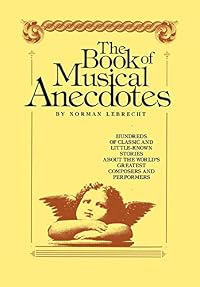
Book of Musical Anecdotes
by Norman Lebrecht
On This Page
Description
Here is one of the most enjoyable and illuminating books ever published for the music lover, a feast of delightful anecdotes that reveal the all-too-human side of the great composers and performers.There are stories of appetites (Handel eating dinner for three), embarrassments (Brahms falling asleep as Liszt plays), oddities (Bruckner's dog being trained to howl at Wagner), and devotions (a lovely admirer disrobing in tribute to Puccini). There are memorable accounts of Stravinsky telling show more Proust how much he hates Beethoven, of Tchaikovsky's first bewildering telephone call, of Dvorak's strange love of pigeons, and of Verdi's intricate maneuvering to keep the now-famous melody of La donna e mobile top secret.There is also wonderful trivia (Beethoven loved to cat bread soup made with ten raw eggs), along with eccentric strategies (Verdi, disturbed by the sound of street organs playing arias from his operas, hired them all for a season and kept them locked in a room). There are examples of musicians munificent generosity (Haydn called Mozart the greatest composer known to me, either in person or by name), and scathing dismissal (Have you heard any Stockhausen? the conductor Sir Thomas Beecham was asked. No, he replied, but I believe I have trodden in some).Collected from thousands of books, articles, and unpublished manuscripts (with historical sources provided in extensive notes), these anecdotes appear in their original form, throwing fresh light on familiar figures in the musical hall of fame. For browsing, reading, research and amusement, this book is a grand entertainment for concert-goers, record-buyers, operamanes, gossips and music lovers everywhere. show lessTags
Recommendations

















Member Reviews
Musical Anecdotes is a well-researched collection of snippets, at most a couple of pages long, about musicans (composers, mostly)--their foibles, performances, feuds, friends, habits--arranged in chronological order. Lebrecht is a serious writer on the arts and there's quite a long list of sources appended so in no way is this one of those insubstantial collections patched together for the sake of gee-whizzes. On the other hand a reader need have only an interest in and passing knowledge of classical music to enjoy the book: You probably would want to know, say, adagio from allegro, Bernstein from Boulez, to appreciate it but you certainly needn't be deeply knowledgeable about classical music to enjoy the book hugely. And perhaps one show more reason I so liked it is that I know very little about lives of most musicians and so most of the information about them was new to me.
As soon as my memory of Musical Anecdotes becomes a fuzzy one, the book will go back to the bedside table for a re-read. In the meantime I can't resist quoting from the entries I remember most vividly, one for its (possibly contrived) pathos and one for the sort of bolshiness that makes Roland Garros crowds smileworthy:
'If no one turned up for his class at the Paris Conservatoire, he [Cesar Franck] would open the door of Massenet's classroom and ask gently, "Isn't there anyone for me?" Alternatively he would say, "Perhaps one of you gentlemen would come to my room for a minute or two to keep me company?" '
'The Orchestre Colonne refused to take La Mer seriously and its conductor, Camille Chevillard, had to plead with the players not to argue over every bar. Pierre Monteux, first viola, says the musicians were so irritated by the sounds they were making that they fabricated diversion. "One jocular fellow concocted a small boat of music paper. With a slight push of the foot, it sailed on a wooden sea, from basses through the 'celli and violas, the length of the platform. This childish idea met with such success that there was soon a whole fleet of small ships made from all kinds of paper as Neptune, conceived by Claude Debussy, thundered his way to the end." ' show less
As soon as my memory of Musical Anecdotes becomes a fuzzy one, the book will go back to the bedside table for a re-read. In the meantime I can't resist quoting from the entries I remember most vividly, one for its (possibly contrived) pathos and one for the sort of bolshiness that makes Roland Garros crowds smileworthy:
'If no one turned up for his class at the Paris Conservatoire, he [Cesar Franck] would open the door of Massenet's classroom and ask gently, "Isn't there anyone for me?" Alternatively he would say, "Perhaps one of you gentlemen would come to my room for a minute or two to keep me company?" '
'The Orchestre Colonne refused to take La Mer seriously and its conductor, Camille Chevillard, had to plead with the players not to argue over every bar. Pierre Monteux, first viola, says the musicians were so irritated by the sounds they were making that they fabricated diversion. "One jocular fellow concocted a small boat of music paper. With a slight push of the foot, it sailed on a wooden sea, from basses through the 'celli and violas, the length of the platform. This childish idea met with such success that there was soon a whole fleet of small ships made from all kinds of paper as Neptune, conceived by Claude Debussy, thundered his way to the end." ' show less
Not much to fault in this book of musical anecdotes. It will have you looking up and listening to works you never heard before just to better understand the composers and performers mentioned here. Not exactly laugh out loud funny, however.
Quite entertaining collection of musical anecdotes, some of which might be true. Recommended by Robert Greenberg in the bibliography for the course, "The 30 Greatest Orchestral Works". My favorite, that I hadn't heard, is that when Rossini was asked, after seeing The Ring performed, what he thought of Wagner's music, he replied that he thought it would require many listenings to fully appreciate, and he would not be back.
[Note added later: I don't think Rossini could have seen The Ring performed in its entirety since it was completed years after his death. However, another similar frequently cited quote of Rossini's is,
"Wagner's music has wonderful moments and dreadful quarters of an hour."]
[Note added later: I don't think Rossini could have seen The Ring performed in its entirety since it was completed years after his death. However, another similar frequently cited quote of Rossini's is,
"Wagner's music has wonderful moments and dreadful quarters of an hour."]
Ratings
Members
- Recently Added By
Author Information

24 Works 1,542 Members
Norman Lebrecht is the author of nine books on music, including The Maestro Myth and The Companion to Twentieth-Century Music. He lives in London with his family. (Bowker Author Biography)
Common Knowledge
- Alternate titles
- Hush! Handel's in a Passion: Tales of Bach, Handel and Their Contemporaries
- Original publication date
- 1985
- Disambiguation notice
- Published as The Book of Musical Anecdotes (NY, 1985) as as Hush! Handel's in a Passion: tales of Bach, Handel, and their contemporaries(London, 1985)
Classifications
Statistics
- Members
- 140
- Popularity
- 232,580
- Reviews
- 3
- Rating
- (4.00)
- Languages
- English
- Media
- Paper
- ISBNs
- 6
- UPCs
- 1