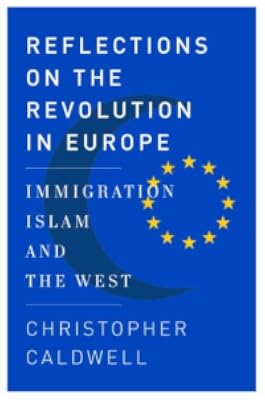
Reflections on the Revolution In Europe: Immigration, Islam, and the West
by Christopher Caldwell
On This Page
Description
Europe has undergone a demographic revolution it never expected. A half century of mass immigration has failed to produce anything resembling a melting pot. By overestimating its need for immigrant labor and underestimating the culture-shaping potential of religion, Europe has trapped itself in a problem to which it has no obvious solution. Journalist Christopher Caldwell reveals a paradox: since World War II, mass immigration has been made possible by Europe's enforcement of secularism, show more tolerance, and equality. But when immigrants arrive, they are not required to adopt those values--and they are disinclined to. Muslims dominate or nearly dominate important European cities. As increasingly assertive immigrant populations shape the continent, Caldwell writes, the foundations of European culture and civilization are being challenged--and replaced.--From publisher description. show lessTags
Recommendations














Member Reviews
A penetrating, erudite, and well-written look at the present-day situation in Europe as it relates to Islamic immigration from North Africa and the Middle East. Europe's civilizational exhaustion and confusion, characterized by its secularization and low birthrates, is in stark contrast to the hearty religious identity of its new arrivals, who are forming a distinct, often segregated, culture within its borders. And one that is antithetical to many traditional European values.
Caldwell delves into this situation by examining the historical background, and many of the more recent incidents that expose it for what it is, such as the Danish cartoon fiasco. What is most interesting in the account is Europe's own cognitive dissonance -- if show more not schizophrenia -- in how it responds to and understands mass Muslim immigration.
What Europe -- particularly its elite -- cloaks as broadness, openness, and tolerance is often a festering fear that they are losing their distinctive cultures and ways of life. Which non-elites worry about more openly, but whose fears and opposition never really manifest as policy, despite often representing majorities of their democratic populations. Diversity is touted, and 'integration' (rather than assimilation) is the program, and despite the glosses used to prop them up, they are manifest failures which undermine European national identities and traditions.
Post-colonial guilt gives way to anti-colonial, culturally suicidal tendencies. Caldwell, while not putting it in those terms exactly, perceptively grasps this. show less
Caldwell delves into this situation by examining the historical background, and many of the more recent incidents that expose it for what it is, such as the Danish cartoon fiasco. What is most interesting in the account is Europe's own cognitive dissonance -- if show more not schizophrenia -- in how it responds to and understands mass Muslim immigration.
What Europe -- particularly its elite -- cloaks as broadness, openness, and tolerance is often a festering fear that they are losing their distinctive cultures and ways of life. Which non-elites worry about more openly, but whose fears and opposition never really manifest as policy, despite often representing majorities of their democratic populations. Diversity is touted, and 'integration' (rather than assimilation) is the program, and despite the glosses used to prop them up, they are manifest failures which undermine European national identities and traditions.
Post-colonial guilt gives way to anti-colonial, culturally suicidal tendencies. Caldwell, while not putting it in those terms exactly, perceptively grasps this. show less
Trauma from past fascist regimes or colonial culpability, Europeans have serious issues dealing with immigration without being prey to the most vicious passions, when the topic is not plain and simply taboo. Christopher Caldwell demonstrates here that they are wrong. Facing migratory movements more and more important, and concerning populations those cultural heritage is often alien to ours, it's the essence of Europe itself, its identity and values, that are in question. Far from fleeing debates, Europeans should therefore embrace it and face facts which, from demography to multiculturalism, are certain to change the continent in decades to come. Well...
For sure, such a book is remarkable for dealing rigorously and without heated show more prejudices with various tendencies when it comes to Islam in Europe. For here's the core topic of it all: the powerful rise of a religion which, rightly or wrongly, never fails to stir controversies. Considered as the second religion after Christianity, it's a remarkable fact indeed that Islam has made its impact, because of the 'intensity of its disciples' convictions, its importance in pubic debates, the privileges it benefits under various legislations of many European countries, or its ability to intimidate its detractors'. Islam, it's true, had to be accommodated; either through just minor adjusting (e.g. swimming pools open for women only at certain times, prayers rooms made available in shops and working businesses...) or, at times, through whole new laws made necessary to deal with some sensitive issues (e.g. the question of the scarf in French schools, forced marriages and imported spouses in Germany and else...).
And... So what?
Follow a well rounded and vast overview of various topics that deserve to be addressed. Demographics and natality rates compared to native populations and other migrants, problems of assimilation and integration, debunking multiculturalism and immigrationism's many flaws (e.g. how the UK and Scandinavia went from welcoming workers for economical reasons to welcoming refugees and asylum seekers for humanitarian ones, and the impact this all had upon the relevance and future of welfare-states as we know them)… The author is everything but scared, and he delves right into topics that will make more than one uncomfortable. His stance is actually pretty strong: it's not only the fact that Europe welcomed so many Muslims that will impact on its future, but also the way such populations are treated and dealt with. Multiculturalism, by encouraging communautarism, is a case in point. Another one is how, in country where immigrants have been concentrated and excluded in ghettos for decades (e.g. the issue of French suburbs, already plagued by unemployment and criminality) a certain view of Islam became a counter-culture. The picture is therefore alarming: populations who have been excluded by, let's be honest, racist if not xenophobic politics, are now voluntarily excluding themselves.
Is all that a concern? You bet! Like parallel societies within our societies, the author sees Islam as a real challenge to Western values -from antisemitism ad women's rights to the identification with all sorts of extremists from abroad... Fair enough. But is that so?
Now, I cannot but agree completely with one of his strongest point that is, Europe became such a sick continent, crippled by guilt and burdened by political correctness and liberal censorship to such an extent that, it is now doubting its own values. Worst, such a weak state of affair and fear in political debates cannot but serve only extremists of all sides, from racists politicians using immigration as a scarecrow to a string of growing and virulent extremists, belonging them to very self-assured religious ideals and knowing perfectly well how to play the victim card (how on earth did criticising Islam became being islamophobic?). Here's a very dangerous cocktail.
However, the problem I had with this book is that it draws a vast panorama of a broad set of issues, based only on specific problems - specific not only to certain countries only, but also pertaining to a very specific part of a demographic within a demographic (it's cliches to say so, but not all Muslims are like he seem to depict them that is, bigots sympathisers of hate and violence). From then on, Christopher Caldwell just seems indeed to fall right into that well-known silly trap of calling out a supposed 'green peril'. That's too bad: relying on serious data is good; interpreting them correctly to give a true picture of the state of Islam in Europe would be even better. Sadly, then, I felt the author failed on this last point.
Multiculturalism might be a serious problem in the UK, but it's not in France (still a strong Republic). Forced marriages and spouses imported from abroad surely are issues in Denmark and Germany (and serious ones - legislations had to be passed to counter them!) but not elsewhere. As for the question of the scarf in schools, it's a very peculiar French problem that has to do with 'laicity', a cultural peculiarity barely relevant elsewhere. Plus, all these problems (and there is no denying that they exist and seriously need to be addressed) concern only a minority of individuals within strong populations. For instance, how many Muslims are there in the UK? Yet how many are known to be involved with terrorist organisations and/or the most radical forms of Islam? Here's another failure from the author: if there is one tendency common to all these countries, it's falling birth rates that doesn't seem to affect Muslims; and so, Muslim population seem to take over ('seem'!). Does that imply, though, an 'islamisation' of Europe? The author conflagrates demography with values, and to me it's a massive blunder. In fact, to me the question of the future of Europe given an increase of its Muslim population cannot be answered without comparing Islamic values and Western ones. Are they compatible? The author, focusing on extremists and extremists cases, fails to address this properly, simply because he assumes the majority of Muslims on our soils adhere more or less to anti-Western sentiments. Such reasoning is flawed, because his perspective is distorted.
In a word, Christopher Caldwell may be misguided in his conclusions, but I still very much enjoyed his book. At long last, someone offering serious data and statistics concerning issues that truly matters and, let's be honest, truly put Europe heads on against some of it most challenging ennemies (regardless of numbers, radical Islam or whatever you want to call it remains a serious problem). His dealing with immigrationism and bashing against the utter failure of multiculturalism is also more than welcome. I loved that he was not burying his head in the sand nor being politically correct, but, on the contrary, tried and put figures on topics that are alarming. You might not agree with his conclusions, but give him credit for not being xenophobic nor crassly ignorant of how immigration has worked and morphed during the past decades. Hence, here's a necessary read. show less
For sure, such a book is remarkable for dealing rigorously and without heated show more prejudices with various tendencies when it comes to Islam in Europe. For here's the core topic of it all: the powerful rise of a religion which, rightly or wrongly, never fails to stir controversies. Considered as the second religion after Christianity, it's a remarkable fact indeed that Islam has made its impact, because of the 'intensity of its disciples' convictions, its importance in pubic debates, the privileges it benefits under various legislations of many European countries, or its ability to intimidate its detractors'. Islam, it's true, had to be accommodated; either through just minor adjusting (e.g. swimming pools open for women only at certain times, prayers rooms made available in shops and working businesses...) or, at times, through whole new laws made necessary to deal with some sensitive issues (e.g. the question of the scarf in French schools, forced marriages and imported spouses in Germany and else...).
And... So what?
Follow a well rounded and vast overview of various topics that deserve to be addressed. Demographics and natality rates compared to native populations and other migrants, problems of assimilation and integration, debunking multiculturalism and immigrationism's many flaws (e.g. how the UK and Scandinavia went from welcoming workers for economical reasons to welcoming refugees and asylum seekers for humanitarian ones, and the impact this all had upon the relevance and future of welfare-states as we know them)… The author is everything but scared, and he delves right into topics that will make more than one uncomfortable. His stance is actually pretty strong: it's not only the fact that Europe welcomed so many Muslims that will impact on its future, but also the way such populations are treated and dealt with. Multiculturalism, by encouraging communautarism, is a case in point. Another one is how, in country where immigrants have been concentrated and excluded in ghettos for decades (e.g. the issue of French suburbs, already plagued by unemployment and criminality) a certain view of Islam became a counter-culture. The picture is therefore alarming: populations who have been excluded by, let's be honest, racist if not xenophobic politics, are now voluntarily excluding themselves.
Is all that a concern? You bet! Like parallel societies within our societies, the author sees Islam as a real challenge to Western values -from antisemitism ad women's rights to the identification with all sorts of extremists from abroad... Fair enough. But is that so?
Now, I cannot but agree completely with one of his strongest point that is, Europe became such a sick continent, crippled by guilt and burdened by political correctness and liberal censorship to such an extent that, it is now doubting its own values. Worst, such a weak state of affair and fear in political debates cannot but serve only extremists of all sides, from racists politicians using immigration as a scarecrow to a string of growing and virulent extremists, belonging them to very self-assured religious ideals and knowing perfectly well how to play the victim card (how on earth did criticising Islam became being islamophobic?). Here's a very dangerous cocktail.
However, the problem I had with this book is that it draws a vast panorama of a broad set of issues, based only on specific problems - specific not only to certain countries only, but also pertaining to a very specific part of a demographic within a demographic (it's cliches to say so, but not all Muslims are like he seem to depict them that is, bigots sympathisers of hate and violence). From then on, Christopher Caldwell just seems indeed to fall right into that well-known silly trap of calling out a supposed 'green peril'. That's too bad: relying on serious data is good; interpreting them correctly to give a true picture of the state of Islam in Europe would be even better. Sadly, then, I felt the author failed on this last point.
Multiculturalism might be a serious problem in the UK, but it's not in France (still a strong Republic). Forced marriages and spouses imported from abroad surely are issues in Denmark and Germany (and serious ones - legislations had to be passed to counter them!) but not elsewhere. As for the question of the scarf in schools, it's a very peculiar French problem that has to do with 'laicity', a cultural peculiarity barely relevant elsewhere. Plus, all these problems (and there is no denying that they exist and seriously need to be addressed) concern only a minority of individuals within strong populations. For instance, how many Muslims are there in the UK? Yet how many are known to be involved with terrorist organisations and/or the most radical forms of Islam? Here's another failure from the author: if there is one tendency common to all these countries, it's falling birth rates that doesn't seem to affect Muslims; and so, Muslim population seem to take over ('seem'!). Does that imply, though, an 'islamisation' of Europe? The author conflagrates demography with values, and to me it's a massive blunder. In fact, to me the question of the future of Europe given an increase of its Muslim population cannot be answered without comparing Islamic values and Western ones. Are they compatible? The author, focusing on extremists and extremists cases, fails to address this properly, simply because he assumes the majority of Muslims on our soils adhere more or less to anti-Western sentiments. Such reasoning is flawed, because his perspective is distorted.
In a word, Christopher Caldwell may be misguided in his conclusions, but I still very much enjoyed his book. At long last, someone offering serious data and statistics concerning issues that truly matters and, let's be honest, truly put Europe heads on against some of it most challenging ennemies (regardless of numbers, radical Islam or whatever you want to call it remains a serious problem). His dealing with immigrationism and bashing against the utter failure of multiculturalism is also more than welcome. I loved that he was not burying his head in the sand nor being politically correct, but, on the contrary, tried and put figures on topics that are alarming. You might not agree with his conclusions, but give him credit for not being xenophobic nor crassly ignorant of how immigration has worked and morphed during the past decades. Hence, here's a necessary read. show less
This reviewer has spent the last 30 years living in one of the prime destination countries of Arab Moslem immigration (Spain) and also one of their prime destination areas within that country (the Levante), so it's interesting to compare what's happening here with the account in Caldwell's book.
He mostly seems to get it right.
There are obviously many more North Africans living in the area than 30 years ago and they really do form a parallel society. They don't have problems with the local population (in this area half Spanish and half northern European residents) but equally they have very little social contact outside their group. The motive for the immigration seems to be mostly economic, to escape arbitrary and corrupt North African show more governments plus to take advantage of generous Spanish social services and free education. The idea seems to be to build a better Morocco in Spain with Spain being seen as a sort of Paradise on Earth (confirmed by Laila Lalami's interesting book "Hope and Other Dangerous Pursuits" - giving the rare Moroccan immigrant viewpoint).
Religion is getting stronger, not weaker. More head scarves, more beards and the non-integration is very noticeable with Arab women not working (i.e. not becoming more European) and having many more children than the local Spanish and also being very cognisant of their rights to healthcare, social services and schooling. Basically they seem to be a very happy group of people, with little money and no political pretensions (a low economic profile and non-existent political interest) who aren't planning to integrate and become Spaniards but who intend to live here permanently.
So, at a basic level Caldwell's question, "Can Europe be the same with different people in it?" is valid, and the answer seems to be a qualified "No" as Moslem immigrants aren't planning to integrate, intermarry and become first loyalty Spanish/ French/ Swedish etc. The qualification may be that small percentages of non-integrating immigrants don't seem to make much difference and they aren't (at present) seeking political power.
One problem with the book may be that the author doesn't spend much time on other writing concerning race/religion and majority/minority political power. If he had, an obvious 20th Century point of reference would have been German National Socialism from the 1920's and 30's. In, "Hitler's Table Talk"(conversation 109), Hitler is recorded as saying, "In the old Austria, nothing could be done without patronage. That's partly explained by the fact that nine million Germans were in fact rulers, in virtue of an unwritten law, of fifty million non-Germans. This German ruling class took strict care that places should always be found for Germans. For them this was the only method of maintaining themselves in this privileged situation.".
This doesn't describe the Moslem minority in Europe but it's a good description of the Jewish ethic/religious minority on the U.S. who make major efforts of patronage to gain and hold powerful economic and political positions for their group (e.g. the Federal Reserve, Treasury, Media, lobbies etc.).
So, it's a worthwhile book, but I'm not expecting the author to write anything about the more relevant subject of Jewish racial patronage in the U.S. (Title? Reflections on the Revolution in America. Can America be the same with different people in it?). On this subject the "daring" author will likely turn wobbly and engage in, "the pre-emptive grovelling that characterizes most writing about matters touching on ethnicity". show less
He mostly seems to get it right.
There are obviously many more North Africans living in the area than 30 years ago and they really do form a parallel society. They don't have problems with the local population (in this area half Spanish and half northern European residents) but equally they have very little social contact outside their group. The motive for the immigration seems to be mostly economic, to escape arbitrary and corrupt North African show more governments plus to take advantage of generous Spanish social services and free education. The idea seems to be to build a better Morocco in Spain with Spain being seen as a sort of Paradise on Earth (confirmed by Laila Lalami's interesting book "Hope and Other Dangerous Pursuits" - giving the rare Moroccan immigrant viewpoint).
Religion is getting stronger, not weaker. More head scarves, more beards and the non-integration is very noticeable with Arab women not working (i.e. not becoming more European) and having many more children than the local Spanish and also being very cognisant of their rights to healthcare, social services and schooling. Basically they seem to be a very happy group of people, with little money and no political pretensions (a low economic profile and non-existent political interest) who aren't planning to integrate and become Spaniards but who intend to live here permanently.
So, at a basic level Caldwell's question, "Can Europe be the same with different people in it?" is valid, and the answer seems to be a qualified "No" as Moslem immigrants aren't planning to integrate, intermarry and become first loyalty Spanish/ French/ Swedish etc. The qualification may be that small percentages of non-integrating immigrants don't seem to make much difference and they aren't (at present) seeking political power.
One problem with the book may be that the author doesn't spend much time on other writing concerning race/religion and majority/minority political power. If he had, an obvious 20th Century point of reference would have been German National Socialism from the 1920's and 30's. In, "Hitler's Table Talk"(conversation 109), Hitler is recorded as saying, "In the old Austria, nothing could be done without patronage. That's partly explained by the fact that nine million Germans were in fact rulers, in virtue of an unwritten law, of fifty million non-Germans. This German ruling class took strict care that places should always be found for Germans. For them this was the only method of maintaining themselves in this privileged situation.".
This doesn't describe the Moslem minority in Europe but it's a good description of the Jewish ethic/religious minority on the U.S. who make major efforts of patronage to gain and hold powerful economic and political positions for their group (e.g. the Federal Reserve, Treasury, Media, lobbies etc.).
So, it's a worthwhile book, but I'm not expecting the author to write anything about the more relevant subject of Jewish racial patronage in the U.S. (Title? Reflections on the Revolution in America. Can America be the same with different people in it?). On this subject the "daring" author will likely turn wobbly and engage in, "the pre-emptive grovelling that characterizes most writing about matters touching on ethnicity". show less
A detailed, painstaking and painful review of how the massive islamic immigration to Europe over the past half century has challenged and successfuly subverted traditional western values of freedom of speech, gender equality and rule of law. The book, at 349 pages, often fails to adequately cover the issues it attempts to address. But it accuraely confronts the threat to western values and freedoms presented by political Islam.
I have read one chapter of this book. I am not finishing it because as best I can tell, it continues to be an obnoxious, stomach-turning screed against not just Islam, but diversity in general, and I have better things to do with my time.
This is a good summary of the cataclysmic changes that are taking place in Europe. Based on immigration patterns and child-bearing statistics Europe will be Islamic in the not-too-distant future which portends ill for the U.S. to have allies in the region. As Europe goes, so will go the U.S., unless we are alert to the warnings heading our way from Europe.
Enoch Powell (pp. 4-7) first warned Europe in 1968 about the coming crisis of Muslim immigration into Europe. He stated that Europe must be mad "to be permitting the annual inflow of some 50,000 dependents (p. 5)." Powell was correct.
Ernest Renan warned in 1883:
"Those liberals who defend Islam do not know Islam. Islam is the seamless union of the spiritual and the temporal, it is the show more reign of dogma, it is the heaviest chain mankind has ever borne. In the early Middle Ages, Islam tolerated philosophy, because it could not stop it. It could not stop it because it was as yet disorganized, and poorly armed for terror. . . . But as soon as Islam had a mass of ardent believers at its disposal, it destroyed everything in its path. Religious terror and hypocrisy were the order of the day. Islam has been liberal when weak, and violent when strong. Let us not give it credit for what it was merely unable to suppress (p. 114)."
Likewise, Hilaire Belloc noted in 1938 that Westerners:
"have forgotten all about Islam. They have never come in contact with it. They take for granted that it is decaying, and that , anyway, it is just a foreign religion which will not concern them. It is, as a fact, the most formidable and persistent enemy which our civilization has had, and may at any moment become as large a menace in the future as it has been in the past. . . . . It has always seemed to me possible, and even probable, that there would be a resurrection of Islam and that our sons or our grandsons would see the renewal of that tremendous struggle between the Christian culture and what has been for more than a thousand years its greatest opponent (p. 112)."
Central to this important, but neglected strain in the European tradition, has been Benedict XVI. Whereas John Paul sought dialogue, Benedict does not (p. 185). Western secularists and believers have more in common since they both share the Western intellectual heritage. These individuals agree that Christianity is the "ultimate foundation of liberty, conscience, human rights, and democracy" (p. 186). Juergen Habermas summarizes this important point: "We continue to nourish ourselves from this source. Everything else is postmodern chatter (p. 186)."
Secularists, and Benedict, agree that reasoning, modern people "had a natural home in Christianity (p. 187)."
Benedict had actually elaborated on his points already in: Pera, Marcello, and Joseph Cardinal Ratzinger. Without Roots: The West, Relativism, Christianity, Islam. New York: Basic Books, 2006.
The contemporary Islamic world is well represented by Tariq Ramadan. According to Caldwell, "As soon as the practice of Islam is constrained, the social contract is null and void. Muslims' acceptance of the European countries in which they live can only ever be provisional, contingent on Europe's willingness to give Islam free rein. The integration of Muslims into Europe will happen on Muslim term . . . . Only when Europe's ways are understood as Islam's will Muslims obey them. And if not, not (p. 298)." Caldwell summarizes: "What Islam will contribute to the West is Islam (p. 299)."
This book deserves a wider reading. show less
Enoch Powell (pp. 4-7) first warned Europe in 1968 about the coming crisis of Muslim immigration into Europe. He stated that Europe must be mad "to be permitting the annual inflow of some 50,000 dependents (p. 5)." Powell was correct.
Ernest Renan warned in 1883:
"Those liberals who defend Islam do not know Islam. Islam is the seamless union of the spiritual and the temporal, it is the show more reign of dogma, it is the heaviest chain mankind has ever borne. In the early Middle Ages, Islam tolerated philosophy, because it could not stop it. It could not stop it because it was as yet disorganized, and poorly armed for terror. . . . But as soon as Islam had a mass of ardent believers at its disposal, it destroyed everything in its path. Religious terror and hypocrisy were the order of the day. Islam has been liberal when weak, and violent when strong. Let us not give it credit for what it was merely unable to suppress (p. 114)."
Likewise, Hilaire Belloc noted in 1938 that Westerners:
"have forgotten all about Islam. They have never come in contact with it. They take for granted that it is decaying, and that , anyway, it is just a foreign religion which will not concern them. It is, as a fact, the most formidable and persistent enemy which our civilization has had, and may at any moment become as large a menace in the future as it has been in the past. . . . . It has always seemed to me possible, and even probable, that there would be a resurrection of Islam and that our sons or our grandsons would see the renewal of that tremendous struggle between the Christian culture and what has been for more than a thousand years its greatest opponent (p. 112)."
Central to this important, but neglected strain in the European tradition, has been Benedict XVI. Whereas John Paul sought dialogue, Benedict does not (p. 185). Western secularists and believers have more in common since they both share the Western intellectual heritage. These individuals agree that Christianity is the "ultimate foundation of liberty, conscience, human rights, and democracy" (p. 186). Juergen Habermas summarizes this important point: "We continue to nourish ourselves from this source. Everything else is postmodern chatter (p. 186)."
Secularists, and Benedict, agree that reasoning, modern people "had a natural home in Christianity (p. 187)."
Benedict had actually elaborated on his points already in: Pera, Marcello, and Joseph Cardinal Ratzinger. Without Roots: The West, Relativism, Christianity, Islam. New York: Basic Books, 2006.
The contemporary Islamic world is well represented by Tariq Ramadan. According to Caldwell, "As soon as the practice of Islam is constrained, the social contract is null and void. Muslims' acceptance of the European countries in which they live can only ever be provisional, contingent on Europe's willingness to give Islam free rein. The integration of Muslims into Europe will happen on Muslim term . . . . Only when Europe's ways are understood as Islam's will Muslims obey them. And if not, not (p. 298)." Caldwell summarizes: "What Islam will contribute to the West is Islam (p. 299)."
This book deserves a wider reading. show less
I have read one chapter of this book. I am not finishing it because as best I can tell, it continues to be an obnoxious, stomach-turning screed against not just Islam, but diversity in general, and I have better things to do with my time.
Members
- Recently Added By
Published Reviews
In a week in which the European election results have shown the potency of the anti-immigrant vote in many countries, including Britain, Christopher Caldwell's contention that immigration has not only changed Europe but revolutionised it has a topical plausibility. Immigration, he says, and above all Muslim immigration, has planted in the heart of a weak and confused civilisation communities, show more rapidly growing in number, that have already changed Europe to suit their needs and beliefs. And the chances are, he insists, that in the future we will bend to their will rather than that they will bend to ours.
Rightwing rubbish? Caldwell cannot be so easily dismissed. True, he is a luminary of the Weekly Standard, the American neoconservative magazine Rupert Murdoch finances, but he is one of its more urbane and interesting voices. He knows Europe, especially France, better than most American and British commentators. His columns in the Financial Times frequently dispense a sharp common sense that many liberals find salutary, although not all might say so. He is very good at pinpointing denial and flight from reality, less good at offering convincing and practical alternatives.
Where he is right is in underlining the fact that immigration was encouraged by elites who took a ludicrously short-sighted view of its costs and consequences. The idea was to prop up industries already in decline and, later, to staff industries, such as health and tourism, the full cost of which our societies refused (and continue to refuse) to pay. The manning of underpaid and menial positions could be maintained only by a constant influx of new migrants, since people in established migrant communities either got better jobs or chose, like many in the native white population, to depend on the welfare state and to have no jobs at all. More recently, immigration has been defended as a way of making up for falling birth rates when, as Caldwell points out, it would have to be multiplied an unfeasibly large number of times to have that effect.
This inherently unstable and dysfunctional system was set in motion, in other words, for no good reason. Those who started it off did not foresee how big it would become, nor the mechanisms of family reunion and arranged marriages that would drive it on even when restrictions were belatedly imposed. Most of them did not imagine, says Caldwell, that the newcomers would "retain the habits and cultures of southern villages, clans, marketplaces, and mosques".
Either that, or they welcomed such retention. It was right and proper that the people Europe had lorded over should now come to the metropolitan countries: they would change us for the better. Not only were all cultures equal, but their cultures were more equal than ours. Caldwell quotes the philosopher Pierre-André Taguieff, who uses the term "immigrationisme" to describe the position that immigration is both inevitable and good. The truth is that immigration was not inevitable on the scale on which it took place, and that its effects have ranged from the pleasing - more ethnic food - to the positive - more cultural diversity - to the truly terrible - race riots, social tension, terrorist attacks.
Caldwell is good on the distorting effect of the universalist code that European politicians and intellectuals impose on discussion of immigration and the making of policy about it. Thus immigration is too often treated as one thing - as if New Zealand computer experts, American bankers and Polish plumbers fell into the same category as villagers from Pakistani Kashmir. Thus any trouble in immigrant communities must be understood in terms of alienation and exclusion, never in terms of aggression. Thus any restriction of rights must be cast within a general framework, so that, for instance, in order to ban headscarves from schools, the French government had to ban yarmulkes and "large crosses" as well, a transparent rigmarole.
When the Danish cartoons furore was at its height, newspapers the length and breadth of Europe upheld the right of free speech - yet the vast majority of them somehow neglected to reprint the offending sketches. The code insists, says Caldwell, that Islam must always be defined as a peaceful religion, yet ignores the way in which Muslim leaders in Europe lay down red lines that the non-Muslim majority is not supposed to cross. Once Muslim majorities emerge in certain towns and areas, Muslims will demand the right to live not only differently, but also separately, and Europe will lose control, Caldwell believes, of significant chunks of its territory. He ignores, in this worrying forecast, the diversity of Islam in Europe, and the often hidden ways in which Muslims in Europe are changing, as well as the strength of the secular European reaction if such developments threatened to become reality. One might reflect on the anxiety over black immigration a generation ago, and note how overdone it turned out to be.
It is not Islam's strength, however, that is at the core of Caldwell's analysis, but Europe's weakness. Like others of neoconservative bent, he has a Spenglerian sense that Europe has lost its sense of purpose. His book, one has to say, is not sure in the end of its own purpose. Is it a call for Europeans to look clear-sightedly at what immigration has wreaked and, in particular, to resist the overweening demands of some Muslims? Or is it a despairing commentary on the weakness of a Europe that has lost the capacity to do so?
But he is right to argue that immigration on the scale that Europe has experienced constitutes a risky experiment to which we need not have submitted ourselves, and of which the final result is not yet clear. He is right that we frequently talk about it in stupid and dishonest ways. If his book sharpens a so far sluggish debate, it will have served an important purpose. show less
Rightwing rubbish? Caldwell cannot be so easily dismissed. True, he is a luminary of the Weekly Standard, the American neoconservative magazine Rupert Murdoch finances, but he is one of its more urbane and interesting voices. He knows Europe, especially France, better than most American and British commentators. His columns in the Financial Times frequently dispense a sharp common sense that many liberals find salutary, although not all might say so. He is very good at pinpointing denial and flight from reality, less good at offering convincing and practical alternatives.
Where he is right is in underlining the fact that immigration was encouraged by elites who took a ludicrously short-sighted view of its costs and consequences. The idea was to prop up industries already in decline and, later, to staff industries, such as health and tourism, the full cost of which our societies refused (and continue to refuse) to pay. The manning of underpaid and menial positions could be maintained only by a constant influx of new migrants, since people in established migrant communities either got better jobs or chose, like many in the native white population, to depend on the welfare state and to have no jobs at all. More recently, immigration has been defended as a way of making up for falling birth rates when, as Caldwell points out, it would have to be multiplied an unfeasibly large number of times to have that effect.
This inherently unstable and dysfunctional system was set in motion, in other words, for no good reason. Those who started it off did not foresee how big it would become, nor the mechanisms of family reunion and arranged marriages that would drive it on even when restrictions were belatedly imposed. Most of them did not imagine, says Caldwell, that the newcomers would "retain the habits and cultures of southern villages, clans, marketplaces, and mosques".
Either that, or they welcomed such retention. It was right and proper that the people Europe had lorded over should now come to the metropolitan countries: they would change us for the better. Not only were all cultures equal, but their cultures were more equal than ours. Caldwell quotes the philosopher Pierre-André Taguieff, who uses the term "immigrationisme" to describe the position that immigration is both inevitable and good. The truth is that immigration was not inevitable on the scale on which it took place, and that its effects have ranged from the pleasing - more ethnic food - to the positive - more cultural diversity - to the truly terrible - race riots, social tension, terrorist attacks.
Caldwell is good on the distorting effect of the universalist code that European politicians and intellectuals impose on discussion of immigration and the making of policy about it. Thus immigration is too often treated as one thing - as if New Zealand computer experts, American bankers and Polish plumbers fell into the same category as villagers from Pakistani Kashmir. Thus any trouble in immigrant communities must be understood in terms of alienation and exclusion, never in terms of aggression. Thus any restriction of rights must be cast within a general framework, so that, for instance, in order to ban headscarves from schools, the French government had to ban yarmulkes and "large crosses" as well, a transparent rigmarole.
When the Danish cartoons furore was at its height, newspapers the length and breadth of Europe upheld the right of free speech - yet the vast majority of them somehow neglected to reprint the offending sketches. The code insists, says Caldwell, that Islam must always be defined as a peaceful religion, yet ignores the way in which Muslim leaders in Europe lay down red lines that the non-Muslim majority is not supposed to cross. Once Muslim majorities emerge in certain towns and areas, Muslims will demand the right to live not only differently, but also separately, and Europe will lose control, Caldwell believes, of significant chunks of its territory. He ignores, in this worrying forecast, the diversity of Islam in Europe, and the often hidden ways in which Muslims in Europe are changing, as well as the strength of the secular European reaction if such developments threatened to become reality. One might reflect on the anxiety over black immigration a generation ago, and note how overdone it turned out to be.
It is not Islam's strength, however, that is at the core of Caldwell's analysis, but Europe's weakness. Like others of neoconservative bent, he has a Spenglerian sense that Europe has lost its sense of purpose. His book, one has to say, is not sure in the end of its own purpose. Is it a call for Europeans to look clear-sightedly at what immigration has wreaked and, in particular, to resist the overweening demands of some Muslims? Or is it a despairing commentary on the weakness of a Europe that has lost the capacity to do so?
But he is right to argue that immigration on the scale that Europe has experienced constitutes a risky experiment to which we need not have submitted ourselves, and of which the final result is not yet clear. He is right that we frequently talk about it in stupid and dishonest ways. If his book sharpens a so far sluggish debate, it will have served an important purpose. show less
added by kalashnikov2
Lists

Radical Islam/Islamism
75 works; 6 members
Author Information

Some Editions
Awards and Honors
Common Knowledge
- Canonical title*
- Une révolution sous nos yeux. Comment l'islam va transformer la France et l'Europe
- Original title
- Reflections on the Revolution In Europe: Immigration, Islam, and the West
- Original publication date
- 2009-04-30 (1e édition oiginale américaine, Doubleday) (1e é | dition oiginale amé | ricaine, Doubleday); 2011-10-05 (1e traduction et édition française, Enquête et histoire, Editions du Toucan) (1e traduction et é | dition franç | aise, Enquê | te et histoire, Editions du Toucan)
- Important places
- Europe
- Epigraph*
- Pourrait-il oublier l'ambition d'un enfant de vieillir
Et les institutions où elle apprenait à se laver et à mentir,
Il dirait la vérité pour laquelle il se croit trop jeune,
Que tout à son horizon, le ciel... (show all) dans son entier,
N'aspire depuis toujours qu'à s'entendre prier
D'être la maison de son père et de parler la langue de sa mère.
W.H. Auden, La Quête - Dedication*
- À Zelda
- First words*
- Préface
Michèle Tribalat
Nous étions quelques-uns à avoir lu le livre de Christopher Caldwell lorsqu'il est paru à l'été 2009 et à nous demander s'il serait traduit en français un jour.... (show all) [...]
PREMIÈRE PARTIE
Immigration
CHAPITRE 1
Des rivières de sang
Sans que personne ne l'ait vraiment décidé, l'Europe occidentale s'est changée en société multiethnique. [...] - Original language
- English
*Some information comes from Common Knowledge in other languages. Click "Edit" for more information.
Classifications
- Genres
- Nonfiction, Religion & Spirituality, General Nonfiction, History
- DDC/MDS
- 304.8088297094 — Society, government, & culture Social sciences, sociology & anthropology Factors affecting social behavior Movement of people
- LCC
- D1056.2 .M87 .C35 — History of Europe, Asia, Africa and Oceania History (General) Europe (General) History
- BISAC
Statistics
- Members
- 345
- Popularity
- 92,053
- Reviews
- 7
- Rating
- (3.56)
- Languages
- 5 — Dutch, English, French, Italian, Spanish
- Media
- Paper, Ebook
- ISBNs
- 12
- ASINs
- 5