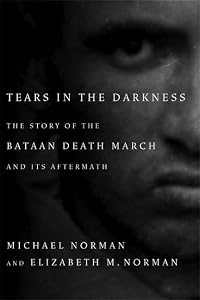
Tears in the Darkness: The Story of the Bataan Death March and Its Aftermath
by Michael Norman, Elizabeth M. Norman
On This Page
Description
Following the U.S. surrender to the Japanese on the peninsula of Bataan in 1942, 76,000 American and Filipino POWs began the infamous Death March. This gripping narrative, told in unsparing but sympathetic detail, focuses intermittently on American POW Ben Steele, whose sketches adorn the book, and the hell of Japanese prison and labor camps that introduced these captives to the starvation, dehydration and murderous Japanese brutality that would become routine for the next three years.Tags
Recommendations





Member Reviews
Hjónin Elizabeth og Michael Norman skrifa ákaflega hjartnæma en um leið grimmilega frásögn í riti sínu Tears in the Darkness; The Story of the Bataan Death March and Its Aftermath. Þau lýsa hér undanhaldi herja Bandaríkjamanna og Filipseyinga undan hersveitum Japan og hörmuglegri fangavist bandarísku hermannanna í kjölfarið.
Þau byggja frásögnina á sögu Bill Steele, bandarísks hermanns, allt frá upphafsárum hans í Bandaríkjunum til endurhæfingar og tilraunar til að öðlast eðlilegt líf eftir stríðið.
Sagan er byggð á fjölda viðtala við einstaklinga frá þeim þeim herjum sem áttust við í Kyrrahafsstríðinu og borgurum þjóðanna. Þau fella yfirleitt ekki dóma yfir framferði einstaklinga, show more jafnvel ekki japanskra illvirkja, heldur benda t.d. á hvernig japanski herinn barði nýliða sína miskunnarlaust til hlýðni þar til þeir annað hvort brotnuðu niður og frömdu sjálfsmorð eða tóku þátt í að berja næstu nýliða. Þetta var stríðsvél sem framleiddi miskunnarlausa hrotta. Það er þó athyglisvert að Norman-hjónin gagnrýna yfirhershöfðingja Bandaríkjamanna, Douglas McArthur, harkalega fyrir vanmat, undirbúningsleysi og fyrir að hafa flúið frá hermönnum sínum sem mættu örlögum sínum í Filippseyjum.
Þetta er vel skrifuð saga, hjartnæm og ég mæli eindregið með henni. show less
Þau byggja frásögnina á sögu Bill Steele, bandarísks hermanns, allt frá upphafsárum hans í Bandaríkjunum til endurhæfingar og tilraunar til að öðlast eðlilegt líf eftir stríðið.
Sagan er byggð á fjölda viðtala við einstaklinga frá þeim þeim herjum sem áttust við í Kyrrahafsstríðinu og borgurum þjóðanna. Þau fella yfirleitt ekki dóma yfir framferði einstaklinga, show more jafnvel ekki japanskra illvirkja, heldur benda t.d. á hvernig japanski herinn barði nýliða sína miskunnarlaust til hlýðni þar til þeir annað hvort brotnuðu niður og frömdu sjálfsmorð eða tóku þátt í að berja næstu nýliða. Þetta var stríðsvél sem framleiddi miskunnarlausa hrotta. Það er þó athyglisvert að Norman-hjónin gagnrýna yfirhershöfðingja Bandaríkjamanna, Douglas McArthur, harkalega fyrir vanmat, undirbúningsleysi og fyrir að hafa flúið frá hermönnum sínum sem mættu örlögum sínum í Filippseyjum.
Þetta er vel skrifuð saga, hjartnæm og ég mæli eindregið með henni. show less
Excellent history, but very depressing. Had to space it out with other activities/books.
Using primary sources, especially solider diaries, from both sides, the Normans do an excellent job of describing events from both sides of the victor-defeated divide. The Japanese are presented not as evil, but as products of their environment, culture, and military training. Surprised by their victory, the lack of Japanese logistical planning killed many survivors during the trek through the jungle. Unfortunately, the famed "Death March", was only the beginning of the horrors for the American and Filipino Bataan survivors. After arriving at the POW camps, malnutrition, disease, and racism continued to decimate the ranks. Overall, Tears in the show more Darkness is a must read for those interested in World War II. The text makes this overlooked corner of the war come brutally to life. Although the writing is very accessible, the events themselves make restrict the audience somewhat.
The events makes the hatred of all things Japanese, at least in the survivors, a bit more understandable. But MacArthur comes off as an arrogant, self-aggrandizing prick.
WW2 not only gave us US run concentration camps, but also US run kangaroo courts. And both against the Japanese. Both the Japanese and US seemed to be fighting a race war. show less
Using primary sources, especially solider diaries, from both sides, the Normans do an excellent job of describing events from both sides of the victor-defeated divide. The Japanese are presented not as evil, but as products of their environment, culture, and military training. Surprised by their victory, the lack of Japanese logistical planning killed many survivors during the trek through the jungle. Unfortunately, the famed "Death March", was only the beginning of the horrors for the American and Filipino Bataan survivors. After arriving at the POW camps, malnutrition, disease, and racism continued to decimate the ranks. Overall, Tears in the show more Darkness is a must read for those interested in World War II. The text makes this overlooked corner of the war come brutally to life. Although the writing is very accessible, the events themselves make restrict the audience somewhat.
The events makes the hatred of all things Japanese, at least in the survivors, a bit more understandable. But MacArthur comes off as an arrogant, self-aggrandizing prick.
WW2 not only gave us US run concentration camps, but also US run kangaroo courts. And both against the Japanese. Both the Japanese and US seemed to be fighting a race war. show less
Dad was living in Maywood, Illinois when he was drafted in 1943; Maywood was home to the 192nd General Headquarters Tank Battalion of the Illinois National Guard, which was federalized in 1940 and sent off to the Philippines just in time for things to get really unpleasant there. Maywood had (and still has) a Bataan Day in commemoration; I went a couple of times when my family still lived in the area. Dad didn’t know anybody in the 192nd personally, but knew some names and was “friends of friends” so there was something a little personal when he landed on Leyte in 1944.
I don’t know whether I want to give Dad Tears in the Darkness to read or not; the war’s over. The story centers around Ben Steele, a young Montana cowboy who, show more on his Mom’s suggestion, decided to join the Army Air Corps, and like the boys from Maywood got to the Philippines just in time to have an interesting experience.
This isn’t really a military history; coauthors Michael and Elizabeth Norman are not military historians. There are accounts of battles, but they’re generally described “as seen by” individual American (and a few Filipino and Japanese) soldiers and, of course, the actually fighting was pretty brief. Things get going when the fighting is over, and Steele and his buddies are marched up the Bataan Peninsula to prison camps. The authors are not Japanese apologists, but they make a few mitigating points; the Japanese were expecting about 25000 POWs and got about 75000, and although individual Japanese soldiers seem to have been just as humane as anybody else (or, at least the ones the authors found willing to talk were), Japanese officers – especially middle-ranking officers – were not and encouraged and sometimes actively ordered brutality. Steele made it to Camp O’Donnell and then volunteered to work on a road-building project, figuring anything would be better than a concentration camp. It wasn’t; there were no tools, no mosquito nets, and no protection from the weather. (One of the little instances of Japanese humanity does crop up; the Japanese were almost as bad off as the Americans – for example, then had nothing for dysentery themselves and were treating it with powdered charcoal, resulting in a lot of Japanese guards that were black from the waist down. Nevertheless, a few would come over to the Americans every day and, after checking to be sure no one was watching, dropped a small package wrapped in a banana leaf. It contained a little rice and two quinine tablets, and presumably kept some of the Americans alive).
By the time Steele got to his next stop (Bilibid Prison; the Japanese essentially gave up on the road building; Steele was one of 50 survivors from the original 325 men on the work detail) he was (a note from the medical record survives; the doctor who wrote the note didn’t) suffering from malaria, starvation, dysentery, jaundice, pneumonia, incipient gangrene from an infected puncture wound on his left instep, and beriberi. Steele received extreme unction twice (he wasn’t Catholic but wasn’t in any state to complain) but gradually came around. Like many other accounts of people in Auschwitz and Kolyma and other death camps, Steele found something to live for – he was always interested in art and began making drawings – of his ranching experience, of the prison, of his guards. An American engineer gave him a little instruction on perspective and Steele pulled through.
In time to be packed on a prison ship and sent to a Japan. “Packed” is literal; the men didn’t have enough space to lie down until some of them started dying (including the medical officer who had treated Steele and the priest who had given him extreme unction). And, of course, they were bombed and strafed by American aircraft. About 1/3 the men who initially boarded ship survived to work in a coal mine in Japan, where one day in August 1945 they heard a deep rumble and saw a curious mushroom shaped cloud building to the south. A few days later Japan surrendered.
Their troubles weren’t over, of course; some POWs were killed or injured by American supply drops and by gorging themselves on the food. Nurses in hospital ships taking them back to the States reported ex-POWs couldn’t get enough food; they would take it back from the mess halls and hide it in their clothes and bunks (people working with escapees from the XSSR reported a similar phenomenon – they would stockpile food in their apartments to the point that there was no place to walk around the cans and cartons). Steele spent some time in a Spokane hospital and headed for home – he was recognized by a home town friend on the train and treated to so many drinks that he didn’t recognize his family when he finally got off.
The penultimate chapter deals with General Homma. There’s still debate over whether Yamashita and Homma should have been executed as war criminals. The authors are very sympathetic to Homma, and I think I am too; he wasn’t present during the Death March (although a few survivors claimed to have seen him) and was relieved in disgrace immediately afterward (because the conquest of the Philippines had taken too long). There is a rather intriguing footnote about a certain Colonel Masanobu Tsuji, who reportedly did order a lot of the brutality on the Death March and after. A request by the Normans for information about Tsuji resulted in a response from the CIA stating that “…we are neither confirming or denying that such documents exist. It has been determined that such information – that is, whether or not any responsive documents exist – would be classified for reasons of national security”. Homma’s wife, Fujiko – everybody who saw her described her as “beautiful and elegant” – pleaded personally with MacArthur. MacArthur bent far enough to order Homma shot instead of hanged.
The final chapter covers Steele’s post war life – he went to art school, married, divorced, and married again, and became an art teacher. During a 1999 radio interview about the Death March, he suffered a ruptured aortal aneurysm – and once again managed to survive despite the odds.
Perhaps just a little melodramatic – but so what; it actually happened. Well written and very moving. Some of Steele’s art can be seen be seen on his web site. show less
I don’t know whether I want to give Dad Tears in the Darkness to read or not; the war’s over. The story centers around Ben Steele, a young Montana cowboy who, show more on his Mom’s suggestion, decided to join the Army Air Corps, and like the boys from Maywood got to the Philippines just in time to have an interesting experience.
This isn’t really a military history; coauthors Michael and Elizabeth Norman are not military historians. There are accounts of battles, but they’re generally described “as seen by” individual American (and a few Filipino and Japanese) soldiers and, of course, the actually fighting was pretty brief. Things get going when the fighting is over, and Steele and his buddies are marched up the Bataan Peninsula to prison camps. The authors are not Japanese apologists, but they make a few mitigating points; the Japanese were expecting about 25000 POWs and got about 75000, and although individual Japanese soldiers seem to have been just as humane as anybody else (or, at least the ones the authors found willing to talk were), Japanese officers – especially middle-ranking officers – were not and encouraged and sometimes actively ordered brutality. Steele made it to Camp O’Donnell and then volunteered to work on a road-building project, figuring anything would be better than a concentration camp. It wasn’t; there were no tools, no mosquito nets, and no protection from the weather. (One of the little instances of Japanese humanity does crop up; the Japanese were almost as bad off as the Americans – for example, then had nothing for dysentery themselves and were treating it with powdered charcoal, resulting in a lot of Japanese guards that were black from the waist down. Nevertheless, a few would come over to the Americans every day and, after checking to be sure no one was watching, dropped a small package wrapped in a banana leaf. It contained a little rice and two quinine tablets, and presumably kept some of the Americans alive).
By the time Steele got to his next stop (Bilibid Prison; the Japanese essentially gave up on the road building; Steele was one of 50 survivors from the original 325 men on the work detail) he was (a note from the medical record survives; the doctor who wrote the note didn’t) suffering from malaria, starvation, dysentery, jaundice, pneumonia, incipient gangrene from an infected puncture wound on his left instep, and beriberi. Steele received extreme unction twice (he wasn’t Catholic but wasn’t in any state to complain) but gradually came around. Like many other accounts of people in Auschwitz and Kolyma and other death camps, Steele found something to live for – he was always interested in art and began making drawings – of his ranching experience, of the prison, of his guards. An American engineer gave him a little instruction on perspective and Steele pulled through.
In time to be packed on a prison ship and sent to a Japan. “Packed” is literal; the men didn’t have enough space to lie down until some of them started dying (including the medical officer who had treated Steele and the priest who had given him extreme unction). And, of course, they were bombed and strafed by American aircraft. About 1/3 the men who initially boarded ship survived to work in a coal mine in Japan, where one day in August 1945 they heard a deep rumble and saw a curious mushroom shaped cloud building to the south. A few days later Japan surrendered.
Their troubles weren’t over, of course; some POWs were killed or injured by American supply drops and by gorging themselves on the food. Nurses in hospital ships taking them back to the States reported ex-POWs couldn’t get enough food; they would take it back from the mess halls and hide it in their clothes and bunks (people working with escapees from the XSSR reported a similar phenomenon – they would stockpile food in their apartments to the point that there was no place to walk around the cans and cartons). Steele spent some time in a Spokane hospital and headed for home – he was recognized by a home town friend on the train and treated to so many drinks that he didn’t recognize his family when he finally got off.
The penultimate chapter deals with General Homma. There’s still debate over whether Yamashita and Homma should have been executed as war criminals. The authors are very sympathetic to Homma, and I think I am too; he wasn’t present during the Death March (although a few survivors claimed to have seen him) and was relieved in disgrace immediately afterward (because the conquest of the Philippines had taken too long). There is a rather intriguing footnote about a certain Colonel Masanobu Tsuji, who reportedly did order a lot of the brutality on the Death March and after. A request by the Normans for information about Tsuji resulted in a response from the CIA stating that “…we are neither confirming or denying that such documents exist. It has been determined that such information – that is, whether or not any responsive documents exist – would be classified for reasons of national security”. Homma’s wife, Fujiko – everybody who saw her described her as “beautiful and elegant” – pleaded personally with MacArthur. MacArthur bent far enough to order Homma shot instead of hanged.
The final chapter covers Steele’s post war life – he went to art school, married, divorced, and married again, and became an art teacher. During a 1999 radio interview about the Death March, he suffered a ruptured aortal aneurysm – and once again managed to survive despite the odds.
Perhaps just a little melodramatic – but so what; it actually happened. Well written and very moving. Some of Steele’s art can be seen be seen on his web site. show less
A powerful tale of dehumanization and dignity. Not a military history but a very human story told primarily through the experience of a Native American unfortunate enough to be trapped in this hellhole. Not an easy read, but an important one as it gives us understanding of the process of individual and systemic dehumanization.
A gripping, well written book which graphically and horrifically portrays the the Bataan Death March and subsequent atrocities by Japanese captors in the Philippines during WW2. A particularly good component is the juxtaposition of one prisoner's life as a counterpoint to the general story. Not easy to read because of the content but well worth the effort.
Following Japan's devastating bombing of Pearl Harbor on December 7, 1941, the fight for Manila in the Pacific Southwest was one of the first battles that U.S. troops encountered when they finally entered World War II, which had already been raging across the Atlantic for over two years. "Tears in the Darkness" is a well-written, though horrifying, account of the 'Death March' and the shocking treatment of prisoners of war (POWs) by the Japanese army after the fall of the Bataan Peninsula in the South China Sea.
The book focuses on one of the few survivors, a cowboy named Ben Steele from Montana. It follows his harrowing journey through unimaginable hardships and his return home at the war's end. Some parts of this story are difficult to show more read, as the authors do not hold back their descriptions. I have read several historical accounts detailing the atrocities committed during war, and all are ghastly and unforgivable. Ben's story ranks among the worst.
I appreciate that the book offers background on Japanese culture, their reasons for fighting, and their mindset in battle, although this excuses nothing. I found it an educational look into one of history's darkest moments. show less
The book focuses on one of the few survivors, a cowboy named Ben Steele from Montana. It follows his harrowing journey through unimaginable hardships and his return home at the war's end. Some parts of this story are difficult to show more read, as the authors do not hold back their descriptions. I have read several historical accounts detailing the atrocities committed during war, and all are ghastly and unforgivable. Ben's story ranks among the worst.
I appreciate that the book offers background on Japanese culture, their reasons for fighting, and their mindset in battle, although this excuses nothing. I found it an educational look into one of history's darkest moments. show less
The grim tale of the Bataan Death March is recorded with historical accuracy and even-handedness. Though the cruelty of the Japanese soldiers to their American and Filipino prisoners of war was extreme, the cruelty of the Japanese commanders to the standard foot soldiers is recorded as well. One is left with the sense that no one in war is truly innocent. The institution of warfare makes monsters of us all.
Members
- Recently Added By
Lists

2008-2012 Notable Books for Adults
127 works; 10 members
Author Information

2 Works 520 Members

8 Works 1,191 Members
Dr. Elizabeth M. Norman is an associate professor of nursing and the director of the doctoral program at New York University's Division of Nursing in the School of Education. Her specialty is nursing history. The recipient of many honors and awards, she has written Women at War: The Story of Fifty Military Nurses Who Served in Vietnam and numerous show more articles. She is married and lives with her husband, Michael, and their two sons, Joshua and Benjamin, in New Jersey. show less
Awards and Honors
Awards
Distinctions
Common Knowledge
- People/Characters
- Ben Steele
- Important places
- Bataan, the Philippines; The Philippines
- Important events
- World War II (1939 | 1945); World War II, Pacific Theater (1941-12-07 | 1945-09-02); Bataan Death March (1942)
Classifications
Statistics
- Members
- 486
- Popularity
- 61,891
- Reviews
- 23
- Rating
- (4.31)
- Languages
- English
- Media
- Paper, Audiobook, Ebook
- ISBNs
- 9
- ASINs
- 10