On This Page
Description
Having completed the two cycles of legend to which she has devoted her career so far, Anne Rice gives us now her most ambitious and courageous book, a novel about the early years of Christ the Lord, based on the Gospels and on the most respected New Testament scholarship. The book's power derives from the passion its author brings to the writing and the way in which she summons up the voice, the presence, the words of Jesus who tells the story.Tags
Recommendations







Member Reviews
I wasn't going to read this. I hated that Rice stopped writing about vampires and witches. I wanted more of her supernatural storytelling. But this, this was well worth the read. I won't get into my religious beliefs, but rather focus on the story itself. Writing a novel that chronicles the early life of Jesus was ingenious and somewhat dangerous when considering the potential backlash. What I liked the most is the way in which makes Jesus a human story. The young boy's need for answers- his desire to understand who/what he is a struggle that we all face... I'm ready to read the next one.
Probably the driest of all good novels I have completed recently. I almost gave up on the book, but I'm so glad I didn't.
Although it wasn't as exciting as Anne Rice's Vampire Chronicles that I enjoyed in high school, it did have the hallmark detailed historical descriptions that I loved about Rice's writing, and this alone kept me from casting the book aside. In fairness to Rice, writing the story of Jesus as a child in the first person is exceedingly ambitious and constrains her ability to manufacture narrative excitement or reflect upon internal struggles is greatly hampered when the story's narrator is the sinless boy son of God worshiped by two billion people.
Sticking with it paid off as the book turned the story of the 12-year-old show more Jesus in the temple into an amazing climax which pulls together the narratives in Matthew and Luke's gospels in a way that ingenious and faithful to orthodox thought. If nothing else, the author's afterward contains her testimony--which alone is worth reading even if you don't read the book.
Epilogue: Reading Road to Cana fully redeems this book. The sequel reveals the scope and majesty of her endeavor. Road to Cana reveals that Out of Egypt was a necessary setup to a literary masterpiece. show less
Although it wasn't as exciting as Anne Rice's Vampire Chronicles that I enjoyed in high school, it did have the hallmark detailed historical descriptions that I loved about Rice's writing, and this alone kept me from casting the book aside. In fairness to Rice, writing the story of Jesus as a child in the first person is exceedingly ambitious and constrains her ability to manufacture narrative excitement or reflect upon internal struggles is greatly hampered when the story's narrator is the sinless boy son of God worshiped by two billion people.
Sticking with it paid off as the book turned the story of the 12-year-old show more Jesus in the temple into an amazing climax which pulls together the narratives in Matthew and Luke's gospels in a way that ingenious and faithful to orthodox thought. If nothing else, the author's afterward contains her testimony--which alone is worth reading even if you don't read the book.
Epilogue: Reading Road to Cana fully redeems this book. The sequel reveals the scope and majesty of her endeavor. Road to Cana reveals that Out of Egypt was a necessary setup to a literary masterpiece. show less
I read this as long time Anne Rice fan and gay agnostic dealing with the recent conversion of my parents to born-again christianity. It was a hard time for me. I read the bible, talked to many christians, and read this. I was hoping Anne Rice's perspective could help me reconcile my conflicted feelings about my parents conversion. It did.
I was afraid it would be preachy and flat, like my parents had become since finding the Baptist church. It was much more simply written than her other works, but instead it contained a warmth, peacefulness and sureness.. When I read the parts of the bible that tell directly of Jesus, this is the sort of man I see. The son of a man who loves ALL his children.
I was afraid it would be preachy and flat, like my parents had become since finding the Baptist church. It was much more simply written than her other works, but instead it contained a warmth, peacefulness and sureness.. When I read the parts of the bible that tell directly of Jesus, this is the sort of man I see. The son of a man who loves ALL his children.
This is not your typical, fluffy Christmas book, but it is gripping, sad, a bit violent, and brooding. But also real and convincing. Anne Rice, the former horror writer, now turned Christian author, gives praise to the Lord through this theoretical depiction of the childhood of Jesus Christ before age 12. The Apocrypha is a questionable source background material, but Rice takes a few of the legends and works them into a believable character. The story opens with the young Messiah striking down a bully and killing him, only to repent and bring him back to life at the site of the grieving family. The story gets darker from there. Joseph and Mary decide it's time to leave Egypt and return to the Holy Land, which is where the prophecies show more say their Son is supposed to live. When they arrive in Jerusalem, military unrest drives them out, and they seek a home where the family can live peacefully.
During the journey, Jesus continually asks questions about his past because He does not know who He is but has an inkling that His existence has caused suffering. His process is more than a boy becoming a man; it is a boy who would rather be an ordinary man only to learn of His role as God.
When one reads the Luke chapter 2 story, one can see the inconvenience and difficulty of being the Virgin Mary, the stepfather Joseph, or even one of the wise men. The necessity to travel to Bethlehem to complete the census could not have come at a worse time, i.e. when Mary is ready to give birth. Herod's jealous wrath triggers a pogrom that results in the death of children under age 2 in Bethlehem. But the narrative also brings the reader to a sense of victory and rejoicing. In spite of the hassles, we can, like the shepherds, get excited about the coming of the Messiah.
In Rice's book, the reader enters that same difficult process of grieving the losses but cheering the young Lord. As Jesus struggles to learn his story, you feel His pain and loneliness, as well as His decision to honor the Heavenly Father no matter what truth He uncovers.
In spite of the use of the Apocryphal stories, this one's still a worthy book. You get a sense that being God is not glamorous, nor is it even desirable. But we are thankful that the King of Kings made the sacrifice and became Emmanuel, God With Us. show less
During the journey, Jesus continually asks questions about his past because He does not know who He is but has an inkling that His existence has caused suffering. His process is more than a boy becoming a man; it is a boy who would rather be an ordinary man only to learn of His role as God.
When one reads the Luke chapter 2 story, one can see the inconvenience and difficulty of being the Virgin Mary, the stepfather Joseph, or even one of the wise men. The necessity to travel to Bethlehem to complete the census could not have come at a worse time, i.e. when Mary is ready to give birth. Herod's jealous wrath triggers a pogrom that results in the death of children under age 2 in Bethlehem. But the narrative also brings the reader to a sense of victory and rejoicing. In spite of the hassles, we can, like the shepherds, get excited about the coming of the Messiah.
In Rice's book, the reader enters that same difficult process of grieving the losses but cheering the young Lord. As Jesus struggles to learn his story, you feel His pain and loneliness, as well as His decision to honor the Heavenly Father no matter what truth He uncovers.
In spite of the use of the Apocryphal stories, this one's still a worthy book. You get a sense that being God is not glamorous, nor is it even desirable. But we are thankful that the King of Kings made the sacrifice and became Emmanuel, God With Us. show less
Though the subject of Jesus' life seems something that would never fit into the same sentence as Anne Rice's name, this book shows the revival of her voice after her work on the Vampire Chronicles declined after her husband's death. With her typical exhaustive research behind it, Christ The Lord portrays the story of young Jesus in a convincing and almost heartbreaking manner.
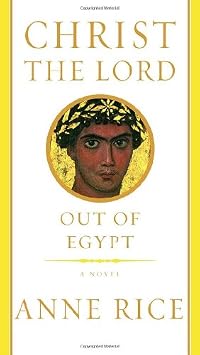
I took this from the box as much as for the cover as the author - the picture is one of those beautiful mummy portraits from Fayum Egypt (specifically a portrait of a young man from the early middle Antonine periord c 138 - 189.) I have a couple of picture books of these portraits and have seen several at art museums. They have inspired several of my fictional characters.
As to the story: I was hooked immediately by the prose - spare and beautiful. Rice does a masterful job of painting a portrait of an extraordinary young boy (Jesus is 7 - 8 years old during the entire book) living an entirely ordinary life. He knows he is different, but his father Joseph forbids him to ask questions. When his extended family leaves Egypt to return to show more Nazareth, Jesus starts piecing together the mystery of his birth and purpose. I particularly like how Rice portrayed the extended family and their day-to-day life and rituals. Her scholarship shows in the realistic vision she gives to her narrative. show less
As to the story: I was hooked immediately by the prose - spare and beautiful. Rice does a masterful job of painting a portrait of an extraordinary young boy (Jesus is 7 - 8 years old during the entire book) living an entirely ordinary life. He knows he is different, but his father Joseph forbids him to ask questions. When his extended family leaves Egypt to return to show more Nazareth, Jesus starts piecing together the mystery of his birth and purpose. I particularly like how Rice portrayed the extended family and their day-to-day life and rituals. Her scholarship shows in the realistic vision she gives to her narrative. show less
Review by Jeremy Taylor
Anne Rice caused a bit of a scandal when she released this book about Jesus. Since her long, acclaimed career prior to this book was dominated by occult thrillers and erotica (written under a pseudonym), no one knew who the audience for this effort would be. Would her vampire-loving readers come on board for a novel about Jesus Christ’s childhood? Would Christians who had no use for any of her previous books suddenly take interest? No one could tell. But Rice was determined to forge ahead, no matter what the risk. The result is a brilliantly conceived and nearly flawlessly executed work that explores the early life of Jesus in a unique way.
Christ the Lord is written from the perspective of the seven-year-old show more Jesus bar Joseph. Living in a Jewish community in Alexandria, Egypt, Jesus is mostly a very normal boy. He loves his young, beautiful mother and respects the man acting as his father, a man he has been taught to call Joseph rather than Daddy, though he doesn’t know why. He looks up to his older half-brother James and is thrilled at the chance to sit at the feet of Philo and learn from the Jewish philosopher. He speaks Greek and Aramaic and a little Hebrew.
The normalcy of Jesus’ life changes when he rebukes a bully during a scuffle and the boy falls dead. When the young Jesus restores his playmate to life, he is greatly feared by the community. And then Joseph receives a dream telling him to return with his family to Galilee.
From that point on the first-person narrative follows Jesus and his family from Egypt to Jerusalem and finally on to Nazareth, where they settle for good. As the story unfolds, young Jesus gradually learns bits and pieces of the incredible story of his birth and his place in the world. He learns about the angels that visited his mother and Joseph; he hears of shepherds and kings from the far East who came to bestow gifts on a tiny baby; he learns the horrible truth of what happened in Bethlehem when Herod’s soldiers came looking for the newborn “king of the Jews.”
Through it all, as Jesus goes through the rituals of Jewish family life in first-century Israel and struggles with his growing knowledge of his identity, Rice paints a tender picture of a boy who is very special and yet very real. He has no true understanding of his divine nature, yet he senses that he is different from other people. He has no real earthly father, but he feels a strong connection with his Heavenly Father. When he prays for childish things like rain to stop or snow to fall—or for his uncle Cleopus to be healed of an illness or a blind man in the Temple to receive sight—they happen. He doesn’t understand why, but he does recognize the importance of only praying for things that are God’s will.
Rice definitely went out on a limb with this approach to the story. Ascribing thoughts and motivations to the true Son of God is daring and perhaps even dangerous, and without question she has raised some eyebrows in the Christian world. Yet she proceeds with caution and reverence, sticking close to the biblical story of Jesus’ birth and extrabiblical sources (like the Infant Gospel of Thomas) that describe certain legendary events of his childhood (like the striking and raising of his playmate and turning clay pigeons into real birds). There is a risk in this, but by including these extrabiblical events in her story, Rice only adds to the picture she is already painting of the young Savior—that of a boy who doesn’t yet know he is the sinless Son of God but understands just enough to know he’s unique.
Some of the best moments in the book come when Jesus gains a new kernel of insight about himself. When the Pharisees at the synagogue, knowing the dubious circumstances of Jesus’ birth, question him intensely, Jesus gives them brilliant answers that surprise even him. When his uncle is surprised by the grown-up content of the questions Jesus asks him, he says mysteriously, “Someday you will have to give the answers to us.” Other moments include the first time Jesus calls God “Father,” his impressions of his strange cousin John (the Baptist), Jesus meeting the kindly priest Joseph Caiaphas (who will eventually be High Priest and send Jesus to Pilate for execution), and an emotional scene when James confesses to his younger brother that he has sinned by being envious in his heart because of Jesus’ amazing birth.
Since the Bible is basically silent about the period between Jesus’ circumcision and his momentous trip to the Temple at age twelve, Rice does take some liberties with the story. For example, she has Jesus witnessing the Temple massacre of 4 BC as described by Josephus when he was seven years old. There’s nothing in Scripture to suggest this might have happened (and the dates don’t quite match up), but again, the result is a depth of character for the young Messiah that reveals his love and compassion for humanity. Though Rice takes some risks, she never crosses the line between artistic license and inappropriate revisionism.
Some Christians may find the idea of putting thoughts into Jesus’ head offensive or just too weird to read as entertainment. Some may be put off by the descriptions of violence in the book. Others may find Rice’s list of previous books to be too repulsive to consider reading this one. But those who do read it will find a heavily researched and delightfully narrated story that just might make them think about their Savior in a new way.
In her lengthy author’s note, Rice expresses hope that readers who have never known Christ will find a desire to know more about him after reading this book. That sentiment suggests to me that her heart is in the right place. I share her hope that her work will introduce people to Christ. I applaud her stated commitment to write only books that honor God for the remainder of her career. And as far as Christ the Lord: Out of Egypt goes, I would strongly recommend it to anyone.
(http://www.cerebralexchange.com/books/reviews.asp?book=184&host=1) show less
Anne Rice caused a bit of a scandal when she released this book about Jesus. Since her long, acclaimed career prior to this book was dominated by occult thrillers and erotica (written under a pseudonym), no one knew who the audience for this effort would be. Would her vampire-loving readers come on board for a novel about Jesus Christ’s childhood? Would Christians who had no use for any of her previous books suddenly take interest? No one could tell. But Rice was determined to forge ahead, no matter what the risk. The result is a brilliantly conceived and nearly flawlessly executed work that explores the early life of Jesus in a unique way.
Christ the Lord is written from the perspective of the seven-year-old show more Jesus bar Joseph. Living in a Jewish community in Alexandria, Egypt, Jesus is mostly a very normal boy. He loves his young, beautiful mother and respects the man acting as his father, a man he has been taught to call Joseph rather than Daddy, though he doesn’t know why. He looks up to his older half-brother James and is thrilled at the chance to sit at the feet of Philo and learn from the Jewish philosopher. He speaks Greek and Aramaic and a little Hebrew.
The normalcy of Jesus’ life changes when he rebukes a bully during a scuffle and the boy falls dead. When the young Jesus restores his playmate to life, he is greatly feared by the community. And then Joseph receives a dream telling him to return with his family to Galilee.
From that point on the first-person narrative follows Jesus and his family from Egypt to Jerusalem and finally on to Nazareth, where they settle for good. As the story unfolds, young Jesus gradually learns bits and pieces of the incredible story of his birth and his place in the world. He learns about the angels that visited his mother and Joseph; he hears of shepherds and kings from the far East who came to bestow gifts on a tiny baby; he learns the horrible truth of what happened in Bethlehem when Herod’s soldiers came looking for the newborn “king of the Jews.”
Through it all, as Jesus goes through the rituals of Jewish family life in first-century Israel and struggles with his growing knowledge of his identity, Rice paints a tender picture of a boy who is very special and yet very real. He has no true understanding of his divine nature, yet he senses that he is different from other people. He has no real earthly father, but he feels a strong connection with his Heavenly Father. When he prays for childish things like rain to stop or snow to fall—or for his uncle Cleopus to be healed of an illness or a blind man in the Temple to receive sight—they happen. He doesn’t understand why, but he does recognize the importance of only praying for things that are God’s will.
Rice definitely went out on a limb with this approach to the story. Ascribing thoughts and motivations to the true Son of God is daring and perhaps even dangerous, and without question she has raised some eyebrows in the Christian world. Yet she proceeds with caution and reverence, sticking close to the biblical story of Jesus’ birth and extrabiblical sources (like the Infant Gospel of Thomas) that describe certain legendary events of his childhood (like the striking and raising of his playmate and turning clay pigeons into real birds). There is a risk in this, but by including these extrabiblical events in her story, Rice only adds to the picture she is already painting of the young Savior—that of a boy who doesn’t yet know he is the sinless Son of God but understands just enough to know he’s unique.
Some of the best moments in the book come when Jesus gains a new kernel of insight about himself. When the Pharisees at the synagogue, knowing the dubious circumstances of Jesus’ birth, question him intensely, Jesus gives them brilliant answers that surprise even him. When his uncle is surprised by the grown-up content of the questions Jesus asks him, he says mysteriously, “Someday you will have to give the answers to us.” Other moments include the first time Jesus calls God “Father,” his impressions of his strange cousin John (the Baptist), Jesus meeting the kindly priest Joseph Caiaphas (who will eventually be High Priest and send Jesus to Pilate for execution), and an emotional scene when James confesses to his younger brother that he has sinned by being envious in his heart because of Jesus’ amazing birth.
Since the Bible is basically silent about the period between Jesus’ circumcision and his momentous trip to the Temple at age twelve, Rice does take some liberties with the story. For example, she has Jesus witnessing the Temple massacre of 4 BC as described by Josephus when he was seven years old. There’s nothing in Scripture to suggest this might have happened (and the dates don’t quite match up), but again, the result is a depth of character for the young Messiah that reveals his love and compassion for humanity. Though Rice takes some risks, she never crosses the line between artistic license and inappropriate revisionism.
Some Christians may find the idea of putting thoughts into Jesus’ head offensive or just too weird to read as entertainment. Some may be put off by the descriptions of violence in the book. Others may find Rice’s list of previous books to be too repulsive to consider reading this one. But those who do read it will find a heavily researched and delightfully narrated story that just might make them think about their Savior in a new way.
In her lengthy author’s note, Rice expresses hope that readers who have never known Christ will find a desire to know more about him after reading this book. That sentiment suggests to me that her heart is in the right place. I share her hope that her work will introduce people to Christ. I applaud her stated commitment to write only books that honor God for the remainder of her career. And as far as Christ the Lord: Out of Egypt goes, I would strongly recommend it to anyone.
(http://www.cerebralexchange.com/books/reviews.asp?book=184&host=1) show less
Members
- Recently Added By
Published Reviews
ThingScore 30
Usually you couldn't pay me to read a religous based book but Anne Rice is not everyone's common author. She does her research, and sets the tone of the time in which her characters lived. It is more of a human perspective than a religous one. Jesus is a child and he knows he is different but not the backstory. His family is protective and we follow him as Herod the king who has sought him show more since birth for assignation has died and the fight for the succession to the throne of David. It is a multi level plot line; the life of jesus and his family members, the plaques, the warring of the Romans and the Jewish fight back in Alexandria. The fear of being Jesus and the miracles and the unexpected reaction by the community when Jesus raises a member of the clan who has died. His fears at the direction of his power and the temptation by the devil to use it for otherwize appropriate needs. Not a sucky book and everyone should know that Anne Rice takes her writing very seriously no matter the subject. it will not be what you expected at all! show less
added by 23563111RobertsonV
It doesn't really matter about accuracy - a novelist should be free to play with the facts to get nearer to the truth. What's wrong is the lack of skill in imagining and then depicting a time, a place and a person. In Christ the Lord, Anne Rice has conscientiously taken all the drama, elegance and urgency of the Gospels and the Apocrypha, and flattened them into a tedious and mediocre show more potboiler. Which is a pity, because it's still a hell of a good idea for a novel. show less
added by MikeBriggs — edited by 2wonderY
As for the plot, it's a year in the life of a rather plodding 7-year-old boy. As for suspense, he discovers that several mysterious events attended his birth, but we already know that, and so do all the other characters, who are made entirely of cardboard. Mary is innocent; Joseph steadfast; Mary's brother Cleopas laughs so continuously that he might as well be at a vaudeville show; and James, show more the savior's older brother, glowers throughout the book with big-time sibling rivalry. show less
added by MikeBriggs
Lists

You Couldn't Pay Me to Read That (Take 2)
203 works; 81 members
Author Information

132+ Works 189,697 Members
Anne Rice was born Howard Allen O'Brien on October 4, 1941 in New Orleans, Louisiana. She received a bachelor's degree in political science in 1964 and master's degree in English and creative writing in 1972 from San Francisco State University. She published her first short story in 1965 called October 4, 1948. Her first book, Interview with the show more Vampire, was published in 1976. It was made into a film starring Brad Pitt, Kirsten Dunst, and Tom Cruise in 1994. She wrote various series in the same genre including the rest of the Vampire Chronicles, the Mayfair Witches books, and The Wolf Gift Chronicles. Her novel, Feast of All Saints, became a Showtime mini-series in 2001. Her other works include Cry to Heaven, Servant of the Bones, and Violin. In 1998, Rice returned to the Catholic Church and for some time only wrote for Christ or about Christ. These works include Christ the Lord: Out of Egypt, Christ the Lord: The Road to Cana, and Called Out of Darkness. Anne Rice died on December 11, 2021 at the age of 80. (Bowker Author Biography) show less
Some Editions
Awards and Honors
Distinctions
Series

Work Relationships
Common Knowledge
- Canonical title
- Christ the Lord: Out of Egypt
- Original publication date
- 2005
- People/Characters
- Jesus Christ; Mary, mother of Jesus; Joseph; James; John
- Important places
- Jerusalem; Alexandria, Egypt; Nazareth, Judea; Bethlehem, Judea
- Important events
- Passover Seder
- Epigraph
- When Israel went out of Egypt, the house of Jacob from a people of strange language;
Judah was his sanctuary, and Israel his dominion.
The sea saw it, and fled: Jordan was driven back.
The mountains skipped like ram... (show all)s, and the little hills like lambs.
What ailed thee, O thous sea, that thou fleddest? thou Jordan, that thou wast driven back?
Ye mountains, that ye skipped like rams; and ye little hills, like lambs?
Tremble, thou earth, at the presence of the Lord, at the presence of the God of Jacob;
Which turned the rock into a standing water, the flint into a fountain of waters.
-Psalms 114. King James Version - Dedication
- For Christopher
- First words
- I was seven years old.
- Last words
- (Click to show. Warning: May contain spoilers.)"Father," I said. "I am your child."
Classifications
- Genres
- Christian Fiction, Fiction and Literature, General Fiction, Historical Fiction
- DDC/MDS
- 813.54 — Literature & rhetoric American literature in English American fiction in English 1900-1999 1945-1999
- LCC
- PS3568 .I265 .C48 — Language and Literature American literature American literature Individual authors 1961-
- BISAC
Statistics
- Members
- 3,307
- Popularity
- 5,117
- Reviews
- 64
- Rating
- (3.46)
- Languages
- 10 — Catalan, Danish, English, Norwegian, Polish, Portuguese, Romanian, Russian, Spanish, Swedish
- Media
- Paper, Audiobook, Ebook
- ISBNs
- 48
- ASINs
- 21