On This Page
Description
Smuk og kærlig beretning om en drengs barndom i en fattig og børnerig parisisk familie og hans lange og seje kamp for at blive en anerkendt kunstmaler.Tags
Recommendations























Member Recommendations


Member Reviews
Sure, there's incest and someone is beat bloody with a poker, but still surprisingly sentimental for Simenon.
Georges Simenon is better known for his mystery series of the French detective Maigret. This is a big departure in subject matter, but not completely.
The Little Saint tells the story of Louis Cuchas and his life growning up in the Parisienne slum neighbourhood of the 1890s. His mother pushes a vegetable cart, selling the vegetables she purchase in the Les Halles produce market. It is a tough life but the family some how survives without the presence of a father.
Louis is a strange little boy who is the 5th of 6 siblings. He is not agressive but seems to turn the other cheek when tormented by schoolmates, thereby earning the name of The Little Saint. Louis chooses to see beauty in life instead of the violence and cruelty. Not necessarily show more a goody two shoes but one who looks for and finds the kinder life.
Simenon tells the story more from the perspective of the boy and what he observes of life as it goes by. Starting at about age 5-6 on through to his life at 75. What Louis observes and reacts to, his mother's many lovers, his siblings' life choices, war, hard work; all that contribut to his life of becoming an artist. Life during the time of Lautrec, Picasso, Bracque and Matisse; energy, colour and the perceiving of shapes. All elements that do come into play in his later life. show less
The Little Saint tells the story of Louis Cuchas and his life growning up in the Parisienne slum neighbourhood of the 1890s. His mother pushes a vegetable cart, selling the vegetables she purchase in the Les Halles produce market. It is a tough life but the family some how survives without the presence of a father.
Louis is a strange little boy who is the 5th of 6 siblings. He is not agressive but seems to turn the other cheek when tormented by schoolmates, thereby earning the name of The Little Saint. Louis chooses to see beauty in life instead of the violence and cruelty. Not necessarily show more a goody two shoes but one who looks for and finds the kinder life.
Simenon tells the story more from the perspective of the boy and what he observes of life as it goes by. Starting at about age 5-6 on through to his life at 75. What Louis observes and reacts to, his mother's many lovers, his siblings' life choices, war, hard work; all that contribut to his life of becoming an artist. Life during the time of Lautrec, Picasso, Bracque and Matisse; energy, colour and the perceiving of shapes. All elements that do come into play in his later life. show less
1965. A beautiful and heartwarming recollection of Paris from the 1890s to WWII. Louis is a slum boy whose mother and grandmother work at pushcarts on the street. He lives in two rooms with five siblings with mostly different fathers. He is a very gentle and abstracted little boy and grows up to be an artist. Delightful. Reminds me of A Tree Grows in Brooklyn in a way.
i read this a long time ago. i know i enjoyed it a lot but all i can remember is that it is a sad and gripping story of a boy living in poverty.
Avec ce récit de l’enfance d’un futur peintre, Simenon s’attache surtout à décrire le Paris du début du 20e. Une mère, pauvre qui pousse sa charrette de fruits ou légumes pour nourrir seule ses six enfants. Un livre comme un tableau vivant, la vie de famille, les hommes qui ne restent rarement longtemps et le lit de la mère séparé d’un simple draps des paillasses des enfants. Et la maladie qui en emporte, puis la guerre.
Et là, au milieu, Louis, le petit saint qui deviendra célèbre.
Simenon peintre naturaliste ou ethnographe tente de se rapprocher au plus proche de l’humain, avec ses corvées, travail, saletés et ses maigres instants de bonheurs
Et là, au milieu, Louis, le petit saint qui deviendra célèbre.
Simenon peintre naturaliste ou ethnographe tente de se rapprocher au plus proche de l’humain, avec ses corvées, travail, saletés et ses maigres instants de bonheurs
Dec 21, 2025French
Louis Cuchas es el penúltimo de los seis hijos de Gabrielle, una mujer que trata de compaginar a sus sucesivos amantes con su puesto ambulante de fruta y verdura. Crecidos en el ambiente promiscuo y problemático del pisito en que viven hacinados, los seis hermanos intentan encontrar su lugar en el mundo. Louis, observador, hipersensible e inocente —tanto que en el colegio le llaman «el angelito»—, va dejando atrás la infancia mientras asiste maravillado a la bulliciosa vida que se desarrolla en el populoso mercado de abastos donde comienza a trabajar y en las calles aledañas; todo le atrae: sonidos, colores, imágenes, sensaciones y, en particular, las personas. Cierto día descubre su afición a la pintura, y partir de ese show more momento vivirá sólo para esa pasión. Tal vez entonces su vida se precipite, tal vez Louis se convierta en un pintor célebre y llegue a vender muy caras sus telas, pero siempre verá las cosas como ese niño introvertido al que llamaban «el angelito». show less
Dec 14, 2022Spanish
Celà commence comme du L.F. Céline, mais cette fresque sociale de la misére se termine par une immense béatitude.
Sep 15, 2009French
Members
- Recently Added By
Lists

Canon de la narrativa universal del s. XX (cicutadry)
499 works; 3 members
Author Information

1,322+ Works 62,937 Members
The prolific Belgian-born writer Georges Simenon produced hundreds of fictional works under his own name and 17 pseudonyms, in addition to more than 70 books about Inspector Maigret, long "the favorite sleuth of highbrow detective-story readers" (SR). More than 50 "Simenons" have been made into films. In addition to his mystery stories, he wrote show more what he called "hard" books, the serious psychological novels numbering well over 100. The autobiographical Pedigree, set in his native town of Liege, is perhaps his finest work. The publication of Simenon's intimate memoirs also attracted considerable attention. Simenon himself once said that he would never write a "great novel." Yet Gide called him "a great novelist, perhaps the greatest and truest novelist we have in French literature today," and Thornton Wilder (see Vol. 1) found that Simenon's narrative gift extends "to the tips of his fingers." The following are some of Simenon's novels, exclusive of the Maigret detective stories, that are in print. (Bowker Author Biography) Georges Simenon was born on February 13, 1903 in Liege, Belgium. He wrote more than 200 fiction works under 16 different pseudonyms. His first book, The Case of Peter the Lent led to 80 more of the like including the main character, Inspector Maigret. He published over 400 books that were translated into 50 different languages and sold by the millions. He also wrote psychological novels, including The Man Who Watched the Train Go By. He died on September 4, 1989 in Lausanne. (Bowker Author Biography) show less
Awards and Honors
Notable Lists
Series

Work Relationships
Common Knowledge
- Canonical title
- The Little Saint
- Original title
- Le Petit saint
- Alternate titles*
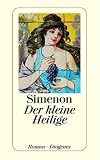
- Der kleine Heilige
- Original publication date
- 1964; 1979 (Deutsch) (Deutsch); 2013 (Italia) (Italia)
- People/Characters
- Louis Cuchas
- First words*
- Il avait entre quatre et cinq ans lorsque le monde commença à vivre autour de lui, lorsqu'il prit conscience d'une vraie scène se jouant entre des êtres humains qu'il était capable de distinguer les uns des autres, de si... (show all)tuer dans l'espace, dans un décor déterminé.
- Original language
- French
*Some information comes from Common Knowledge in other languages. Click "Edit" for more information.
Classifications
Statistics
- Members
- 171
- Popularity
- 190,365
- Reviews
- 12
- Rating
- (4.39)
- Languages
- 10 — Danish, Dutch, English, Finnish, French, German, Italian, Norwegian (Bokmål), Portuguese, Spanish
- Media
- Paper, Ebook
- ISBNs
- 19
- ASINs
- 11