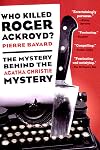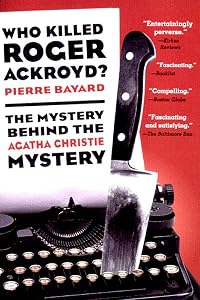
Who Killed Roger Ackroyd?
by Pierre Bayard
On This Page
Description
A thrilling piece of literary detective work, which reexamines Agatha Christie's classic novel The Murder of Roger Ackroyd.Tags
Recommendations

















Member Recommendations
Member Reviews
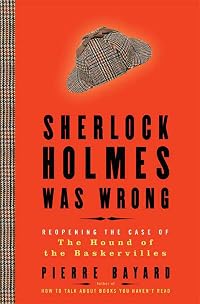
Okay, this is actually kinda great. Bayard's other book on this subject - Sherlock Holmes Was Wrong: Reopening the Case of The Hound of the Baskervilles - rubbed me the wrong way because I simply don't believe that characters have lives outside the page, or that any useful literary theory can come from that. Here, he's much more analytical. From Oedipus to Agatha Christie, Bayard is clearly using these texts as discussion points for his broader thoughts on textual authority, and his mastery of the subject shines through.
The first section is a detailed recap of the plot of Christie's famous The Murder of Roger Ackroyd. The second is an examination of Christie's oeuvre from the point of view of both rational investigation and literary show more criticism. The third section is a broader discussion of truth and authorial voice. The final section returns to Ackroyd to put forward arguments why Hercule Poirot may have got it wrong - and finally an allegation against a different character entirely.
This is not heady academic stuff. Bayard is a populist critic at best, although he is pretty darn good at translating dense subjects for a general audience. It's worth noting that the book contains spoilers for roughly every single Christie novel without warning, so you'd better be either indifferent or well-read in the subject.
This book will interest people with a broader enthusiasm for literary theory but especially crime fiction fans. While his solution for the Ackroyd murder was rather obvious (it was my assumption from page one), his broader points about how we interpret texts, and the purposes of crime fiction, are salient. Occasionally borderline absurd, but salient! show less
The first section is a detailed recap of the plot of Christie's famous The Murder of Roger Ackroyd. The second is an examination of Christie's oeuvre from the point of view of both rational investigation and literary show more criticism. The third section is a broader discussion of truth and authorial voice. The final section returns to Ackroyd to put forward arguments why Hercule Poirot may have got it wrong - and finally an allegation against a different character entirely.
This is not heady academic stuff. Bayard is a populist critic at best, although he is pretty darn good at translating dense subjects for a general audience. It's worth noting that the book contains spoilers for roughly every single Christie novel without warning, so you'd better be either indifferent or well-read in the subject.
This book will interest people with a broader enthusiasm for literary theory but especially crime fiction fans. While his solution for the Ackroyd murder was rather obvious (it was my assumption from page one), his broader points about how we interpret texts, and the purposes of crime fiction, are salient. Occasionally borderline absurd, but salient! show less
Three quarters of it was fascinating, and the other quarter was Freudian. Not being a fan of Freud, I could have lived without that part. I wonder if Agatha Christie put anywhere near the amount of thought into writing as Bayard did into analyzing. I know that I'll never read The Murder of Roger Ackroyd the same way again. Bayard had a lot of interesting ideas about how the mystery author and reader interact, and methods of misleading us while still providing all the relevant information. It would be interesting to see a similar exercise done with some of Sayers' books.
An intriguing point to ponder was that although any literary work appears to be a closed world, bound by the statements of the author, it really just consists of show more fragments of a world, "made up of parts of characters and dialogues, in which entire swaths of reality are missing." Therefore, "the text is not legible if the reader does not give it its ultimate shape--for example, by consciously or unconsciously imagining a multitude of details that are not directly provided." So we really do read between the lines, and every reading is different.
For the record, I made the same choice for an alternative murderer as Bayard did, but we took different routes to get there.
For anyone who intends to read this: There are HUGE spoilers for Endless Night, Curtain, and The Murder of Roger Ackroyd, as well as briefer ones for numerous other Christie books. show less
An intriguing point to ponder was that although any literary work appears to be a closed world, bound by the statements of the author, it really just consists of show more fragments of a world, "made up of parts of characters and dialogues, in which entire swaths of reality are missing." Therefore, "the text is not legible if the reader does not give it its ultimate shape--for example, by consciously or unconsciously imagining a multitude of details that are not directly provided." So we really do read between the lines, and every reading is different.
For the record, I made the same choice for an alternative murderer as Bayard did, but we took different routes to get there.
For anyone who intends to read this: There are HUGE spoilers for Endless Night, Curtain, and The Murder of Roger Ackroyd, as well as briefer ones for numerous other Christie books. show less
Poirot might have been wrong all along. In Who Killed Roger Ackroyd, Pierre Bayard blasts Poirot’s shocking solution to the Roger Ackroyd murder by pointing to all its glaring weaknesses. He gives us a tour through the techniques by which Agatha Christie and other writers hide the truth in plain sight in their novels, discusses delusions and classical detective stories as far back as Oedipus Rex, and, in the tradition of the genre, presents his surprising solution near the end.
Though Bayard’s solution doesn’t have the shock factor of the original novel, it’s more logical, elegant, and poetic than Poirot’s –an excellent read if you enjoyed the original. Just two warnings: Bayard gives away the ending to a huge number of show more Christie’s plots, and the discussions on psychoanalysis and text interpretation get a bit heady at times. Whether you like that depends on your taste. show less
Though Bayard’s solution doesn’t have the shock factor of the original novel, it’s more logical, elegant, and poetic than Poirot’s –an excellent read if you enjoyed the original. Just two warnings: Bayard gives away the ending to a huge number of show more Christie’s plots, and the discussions on psychoanalysis and text interpretation get a bit heady at times. Whether you like that depends on your taste. show less
If you ever meet anyone who whines that your reading of a novel "isn't what the author intended", point them in the direction of this scholarly yet amusing book - anyone with an open mind would have to admit that Bayard's reading of Christie's seminal mystery is utterly ingenious and in some respects more satisfying than the original. Was it what Christie "intended"? Of course not, but the reading is nonetheless perfectly valid!
(One word of warning - Bayard drops spoilers for other Christie mysteries along the way, notably her posthumous work CURTAIN. Approach WHO KILLED ROGER ACKROYD only if you've read most of the Poirot mysteries.)
(One word of warning - Bayard drops spoilers for other Christie mysteries along the way, notably her posthumous work CURTAIN. Approach WHO KILLED ROGER ACKROYD only if you've read most of the Poirot mysteries.)
In this slim volume Bayard disects Christie's book and conclusion to the murder. At times it is difficult to follow the psychological lingo, but he makes many good points and following his entire line of reasoning I was able to come to the identity of the "real" murderer before he revealed it. And I was RIGHT !
This book makes you look at mysteries in a different light.
This book makes you look at mysteries in a different light.
Though heavier in the theory department than the subsequent Sherlock Holmes Was Wrong, Who Killed Roger Ackroyd? still shares some of that other works same flaws in that Bayard occasionally pushes some of his theories and postulations to the near breaking point. Still, it's enjoyable in its own right, though definitely not recommended for Christie fans who have yet to make their way through the majority of her works (as spoilers aplenty abound).
Bayard takes the bold step of reinvestigating one of Christie's most famous novels and insisting that Poirot was deluded and got it wrong. Much of Poirot's evidence is, in fact, rather flimsy, and Bayard makes a convincing case that Shepherd lacked the temperament, sufficient time, and a strong enough motive. His alternate suspect meets possesses all three, and further meets the Van Dyne principle--it's one of the most unlikely possible suspects.
While the premise is interesting, the execution is boring. Much of the book is taken up with literary theory about the nature of narration, the definition of delusion, etc., containing sentences like "While these are meant to falsify the reader's perception of the literary reality (done most show more effectively by exhibition), the lie by omission conjures away certain elements of that reality by failing to communicate them to the reader." It's the kind of writing that drove me out of grad school in English, not that would interest the general reader. Still, if you're a big Christie fan, up for a bit of a challenge, and willing to do some skimming, Bayard's proposal is interesting. show less
While the premise is interesting, the execution is boring. Much of the book is taken up with literary theory about the nature of narration, the definition of delusion, etc., containing sentences like "While these are meant to falsify the reader's perception of the literary reality (done most show more effectively by exhibition), the lie by omission conjures away certain elements of that reality by failing to communicate them to the reader." It's the kind of writing that drove me out of grad school in English, not that would interest the general reader. Still, if you're a big Christie fan, up for a bit of a challenge, and willing to do some skimming, Bayard's proposal is interesting. show less
Members
- Recently Added By
Author Information

31+ Works 2,469 Members
Pierre Bayard is a psychoanalyst and professor of French literature in Paris
Some Editions
Work Relationships
Is a commentary on the text of
Common Knowledge
- Canonical title
- Who Killed Roger Ackroyd?
- Original title
- Qui a tué Roger Ackroyd?
- Original publication date
- 1998
- People/Characters
- Hercule Poirot; Roger Ackroyd; James Sheppard; Caroline Sheppard; Mrs. Cecil Ackroyd; Flora Ackroyd (show all 12); Ralph Paton; Hector Blunt; Geoffrey Raymond; Parker [Ackroyd butler]; Elizabeth Russell; Charles Kent
- Important places
- King's Abbott, England, UK; Fernly Park, King's Abbott, England, UK
- Dedication
- To Punkie who likes an orthodox detective story, murder, inquest, and suspicion falling on everyone in turn!
- First words
- Many of today's readers know who killed Roger Ackroyd. (Prologue)
Replaying the investigation into the death of Roger Ackroyd involves conveying the chief elements - Last words
- (Click to show. Warning: May contain spoilers.)This is a story told in great detail - unfolding throughout the book but invisible to the blinded reader - of a murder by interpretation.
Classifications
Statistics
- Members
- 244
- Popularity
- 133,504
- Reviews
- 12
- Rating
- (3.77)
- Languages
- English, French, Swedish, Turkish
- Media
- Paper, Ebook
- ISBNs
- 10
- ASINs
- 3