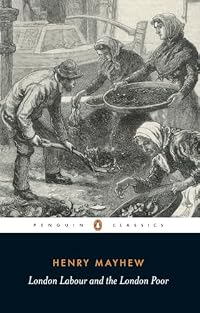
London Labour and the London Poor [abridged - Neuburg]
by Victor Neuburg (Editor), Henry Mayhew (Writer)
London Labour and the London Poor (Neuburg — )
On This Page
Description
London Labour and the London Poor originated in a series of newspaper articles written by the great journalist Henry Mayhew between 1849 and 1850. A dozen years later, it had grown into the fullest picture we have of labouring people in the world's greatest city in the nineteenth century- a four volume account of the hopes, customs, grievances and habits of the working-classes that allows them to tell their own stories. Combining practicality with compassion, Mayhew worked unencumbered by show more political theory and strove solely to report on the lives of the London poor, their occupations and trades. This selection shows how well he succeeded. From costermongers to ex-convicts, from chimney-sweeps to vagrants, the underprivileged of London are uniquely brought to life - their plight expressed through a startling blend of first person accounts, Mayhew's perceptions, and sharp statistics. show lessTags
Recommendations











Member Reviews
"London Labour and the London Poor" is an extraordinary piece of mid-19th-century journalism. Henry Mayhew, a writer and editor well-known in his time (he was an early editor of Punch), spent years roaming the poor neighborhoods of London, seeking out stories of the poor and downtrodden. He carefully describes the work and economics involved with each profession, and presents many faithfully recorded statements from the people he finds.
From mudlarks (scavengers during low tide on the Thames), to prostitutes (of several distinct classes, such as soldiers' women and moonlighting housewives), to street food-sellers (who knew that one could write so engagingly about the sale of baked potatoes?), Mayhew presents an astonishing portrait of show more the lives and struggles of poor people in the world's richest city at the height of its power. His writing is detailed but never dull, and he provides invaluable economic data without letting it overwhelm his storytelling. (In particular, his description early in the book of the bustle of activity in the Brill market is one of the loveliest stretches of historical descriptive writing I've ever seen.) Additionally, the statements from his informants are extraordinary and heartbreaking; each one could spawn a novel all by itself.
This particular edition is a collection of well-chosen excerpts from the original three-volume work, plus a few selections from the later fourth volume (edited by Mayhew but largely written by others). My only complaint about this version is that it has no index and only a very general table of contents, for which it loses half a star. But even with these oversights, it is a marvelous reading experience and a priceless source of information about Victorian London. Today, "London Labour and the London Poor" has become an essential resource for anyone who writes about Victorian culture, from Dickens scholars to steampunk and alternate-history authors, and I cannot recommend it highly enough. show less
From mudlarks (scavengers during low tide on the Thames), to prostitutes (of several distinct classes, such as soldiers' women and moonlighting housewives), to street food-sellers (who knew that one could write so engagingly about the sale of baked potatoes?), Mayhew presents an astonishing portrait of show more the lives and struggles of poor people in the world's richest city at the height of its power. His writing is detailed but never dull, and he provides invaluable economic data without letting it overwhelm his storytelling. (In particular, his description early in the book of the bustle of activity in the Brill market is one of the loveliest stretches of historical descriptive writing I've ever seen.) Additionally, the statements from his informants are extraordinary and heartbreaking; each one could spawn a novel all by itself.
This particular edition is a collection of well-chosen excerpts from the original three-volume work, plus a few selections from the later fourth volume (edited by Mayhew but largely written by others). My only complaint about this version is that it has no index and only a very general table of contents, for which it loses half a star. But even with these oversights, it is a marvelous reading experience and a priceless source of information about Victorian London. Today, "London Labour and the London Poor" has become an essential resource for anyone who writes about Victorian culture, from Dickens scholars to steampunk and alternate-history authors, and I cannot recommend it highly enough. show less
Fairly odd mix of opinion, statistics and personal stories. Still this is quite compelling reading. Mayhew is enthralled and horrified at the state in which e finds his countrymen. He documents this with every literary tool he has to hand. It's not always artfully done but it most certainly captivating. And honestly it is far too often that the storyteller is taken with their method instead of with their subject. This chunk of history is more skillfully wrought than most. It's impression is certainly more lasting.
The journalist Henry Mayhew started writing articles on London's poor in 1849, interviewing people so they could tell their own story. Over the years by adding vivid descriptions, statistics, essays and drawings it spiralled into a giant 4 volumes dealing with nearly every aspect of poverty. This verson abridges these books into a mere 500 pages and the result is utterly fascinating.
There are personal accounts from nearly every possible occupation: musicians, vagrants, street traders, thieves, chimney sweeps and on and on. Their tales are usually deeply tragic, heartbreaking stories rub up against self inflicted woes, evryone of them now stuck in the vicious cycle of poverty in Victorian England. Although not all are sad, some purely show more uncover fascinating information. So we get to hear stories such as: the many dirty tricks of cheap photographers, a lively description of a penny theatre or the impact of the Poor act. It's all here in overwhelming detail.
Of course there are some problems (whether with the abridgement or original text I could not say). Too much time is spent on accounts of street traders but fallen women are non existent (I presume being too depraved to even consider!). I also found it just too much to read straight through but it's perfect for dipping into.
Also this version also contains a brief intro of Henry Mayhew himself, placing the work in much needed context. Its very useful for to gage Mayhew views for as well as a study of the poor we also see the views of the middle classes though Mayhew's admonishments. show less
There are personal accounts from nearly every possible occupation: musicians, vagrants, street traders, thieves, chimney sweeps and on and on. Their tales are usually deeply tragic, heartbreaking stories rub up against self inflicted woes, evryone of them now stuck in the vicious cycle of poverty in Victorian England. Although not all are sad, some purely show more uncover fascinating information. So we get to hear stories such as: the many dirty tricks of cheap photographers, a lively description of a penny theatre or the impact of the Poor act. It's all here in overwhelming detail.
Of course there are some problems (whether with the abridgement or original text I could not say). Too much time is spent on accounts of street traders but fallen women are non existent (I presume being too depraved to even consider!). I also found it just too much to read straight through but it's perfect for dipping into.
Also this version also contains a brief intro of Henry Mayhew himself, placing the work in much needed context. Its very useful for to gage Mayhew views for as well as a study of the poor we also see the views of the middle classes though Mayhew's admonishments. show less
Capitalism in the 19th century in England creating an ever-enlarging mass of poor people.
paperback
Ratings
Members
- Recently Added By
Lists

Books that changed the world
67 works; 63 members
Author Information

Henry Mayhew had a varied career as a London writer of the mid-Victorian period. He was the son of a London solicitor, Joshua Mayhew, who reputedly was a rather tyrannous father. Apparently, Henry was a bitter disappointment to his father; the younger Mayhew had been educated at the Westminster School but, in objection to a flogging he had show more received, ran away from school and went to sea for a year. On his return, he was articled to his father but after three years, he abandoned the law to seek a career as a journalist and a dramatist. Mayhew achieved some early success as a dramatist, most notably with his 1834 farce, "The Wandering Minstrel." In the late 1830's, he was the joint editor of a successful satirical weekly, Figaro in London, and later helped to found Figaro's most significant and long-lived successor, Punch. Evidently, a fairly serious rift developed between Mayhew and his magazine colleagues, although the details of this falling-out remain a mystery---one of the many unanswered questions about Mayhew's life. Mayhew was never without financial worries, and, as a means of making quick money, he collaborated on a number of comic novels with his younger brother, Augustus (1826--75). Their most successful work is "The Greatest Plague of Life" (1847), which was issued in monthly numbers and proved very popular. They followed it with "Whom to Marry and How to Get Married" (1848); later Mayhew singly authored 1851, or, "The Adventures of Mr. and Mrs. Sandbags 1851," (1851). Mayhew's attempt, in 1851, to publish the 82 "letters" he had written for the Morning Chronicle, in which he investigates the plight of London's urban poor, was a financial failure. They were issued in 1861, however, in four volumes under the title London Labour and the London Poor. It is for this classic work that Mayhew is today best known. In it, he unhesitatingly depicts the opprobrium under which most of the London working classes led their lives. In many ways, London Labour and the London Poor epitomizes the Victorian tendency to be simultaneously repulsed and fascinated by the working classes, the "Great Unwashed" huddled together in the urban centers of England. Along with Edwin Chadwick and J.P. Kay-Shuttleworth, Mayhew stands as one of the earliest of urban sociologists. Although recent years have witnessed an increase in interest in Henry Mayhew, a "definitive" biography remains to be written. The introductions to his work, notably John Rosenberg's preface to the Dover facsimile edition of London Labour and the London Poor and the essays framing the edition of "The Unknown Mayhew," are good sources of information. (Bowker Author Biography) show less
Series

Belongs to Publisher Series
Work Relationships
Is an abridged version of
Common Knowledge
- Canonical title
- London Labour and the London Poor [abridged - Neuburg]
- Important places
- London, England, UK
- Original language
- English
- Disambiguation notice
- This is the abridged Penguin Classics edition of London Labour and the London Poor and is edited and introduced by Victor Neuburg. Please do not combine with other selections made and introduced by other editors. Both ... (show all)the contents and the critical introductions differ.
Classifications
- Genres
- Nonfiction, History, General Nonfiction
- DDC/MDS
- 305.56909421 — Society, Government, and Culture Social sciences, sociology & anthropology Social group - Age, Gender, Ethnicity People by social and economic levels Lower, alienated, excluded classes Poor people History, geographic treatment, biography Europe England & Wales London
- LCC
- HV4086 .L66 .M38 — Social sciences Social pathology. Social and public welfare. Criminology Social pathology. Social and public welfare. Protection, assistance and relief Poor in cities. Slums
- BISAC
Statistics
- Members
- 384
- Popularity
- 80,868
- Reviews
- 6
- Rating
- (4.18)
- Languages
- English
- Media
- Paper, Ebook
- ISBNs
- 3
- ASINs
- 3