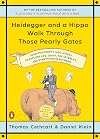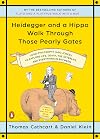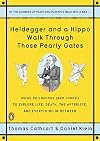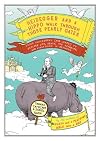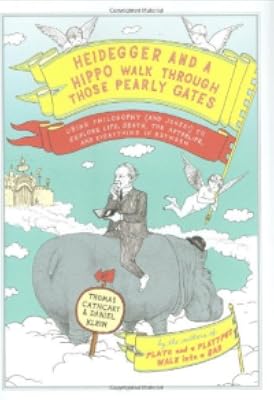
Heidegger and a Hippo Walk Through Those Pearly Gates: Using Philosophy (and Jokes!) to Explore Life, Death, the Afterlife, and Everything in Between
by Thomas Cathcart, Daniel Klein
On This Page
Description
Explores death and the afterlife from lighthearted philosophical, theological, and psychological perspectives that consider that death may not be such a pessimism-inducing state.Tags
Recommendations



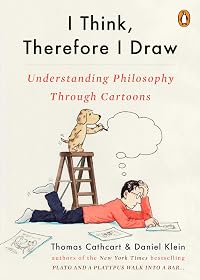

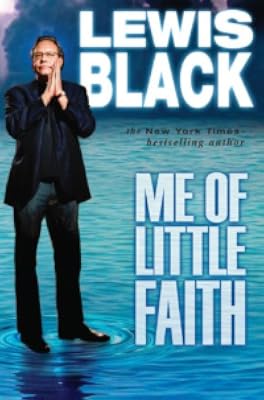
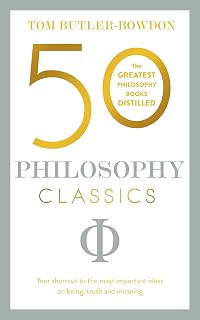
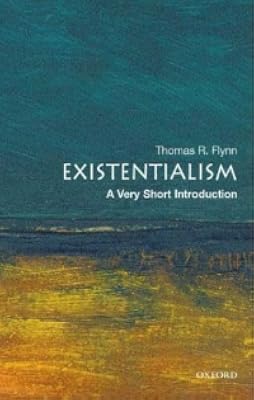
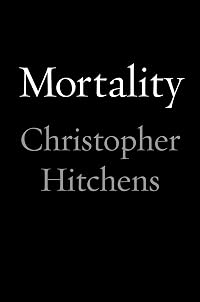



Member Recommendations
Member Reviews
I would seem that we can't talk about death without making jokes to cover our anxiety - and boy, do I agree! Whereas I was laughing throughout the whole book, I couldn't help but notice an uneasiness and sometimes a downright grumpiness as I read this book - a little bit of death can be sobering, but too much is definitely unpleasant. In this Cathcart and Klein strike a good balance between laughter and reflective moments. In a subject as contentious as this, especially when it comes to suicide or the after-life, they do a good job of presenting all schools of thought - although sometimes rather glibly. To me, they came across as hard-core atheists (maybe I'm just projecting) and I sometimes found their treatment of some religions a show more little bit irreverent.
Their use of Daryl as a foil was sometimes a bit annoying - the joking sometimes turning to mocking - but the book does a good job of covering all aspects of death and human reactions and thought to it throughout time. show less
Their use of Daryl as a foil was sometimes a bit annoying - the joking sometimes turning to mocking - but the book does a good job of covering all aspects of death and human reactions and thought to it throughout time. show less
I found this to be an absolutely delightful book. This is not heavy reading, but it does indeed take you through a light hearted journey in the issues and thoughts and practices surrounding death. Some of the jokes may seem to be in poor taste by some, but what the hell? Death, being such an eternal, definite phenomena, I am sure that Death can take a bit of a joke about - ? - himself? Itself? None of us really know what will become of us after death, and there is such a lot of heavy literature, and heavy ceremony surrounding death, that it is high time that some one came out with something as light as this book.
Well done guys. Keep 'em coming.
Well done guys. Keep 'em coming.
I've been giving out too many stars for books that bothered me and it's time I stopped doing that. After all, I'm not going to live forever and it's time I started expressing myself honestly. So here it is.
Most of the jokes I'd heard before. Maybe 2 or 3 were new and maybe one of those I laughed at. As for the philosophy. I'd hoped it would help me make sense of Heidegger who seems to have a lot of people convinced he's a major thinker. And I still don't know what's so great about him. Is it that he made people confront their death? Street criminals do that every day. And the Nazis did that, I guess, which may be why he became one.
Most of the jokes I'd heard before. Maybe 2 or 3 were new and maybe one of those I laughed at. As for the philosophy. I'd hoped it would help me make sense of Heidegger who seems to have a lot of people convinced he's a major thinker. And I still don't know what's so great about him. Is it that he made people confront their death? Street criminals do that every day. And the Nazis did that, I guess, which may be why he became one.
I read this because I have never been able to comprehend what makes philosophers tic. My brain simply doesn't work that way. I read them, and in my head I'm saying, "piffle." Anyway, this possibly wasn't such a great book to read when I'm suffering from a painful and unknown malady, because the theme of it is Death. Pretty depressing outlook most of these gentlemen have. The writers did a fairly good job differentiating between the different philosophers and their beliefs, and frankly, I thought they skated through a very touchy subject without somehow being too maudlin and depressing at the end. They handled religious views as I would expect philosophers to, not subscribing to them, but also not demolishing them and trying to show many show more of the misconceptions people have of what religions really have to say about the afterlife.
This was as pleasant a way as any to examine death and what it means, or what many throughout the ages have thought it meant. The authors can be quite corny at times and the jokes are groaners, but then I like my jokes that way. show less
This was as pleasant a way as any to examine death and what it means, or what many throughout the ages have thought it meant. The authors can be quite corny at times and the jokes are groaners, but then I like my jokes that way. show less
A deliciously light-hearted look at that very serious question of how knowing we will die someday informs, or should inform, the way we live, according to various famous philosophers and others. For true philosophy jocks, it might be a little too light, but it suited me just fine.
A fun book dealing with a subject most would prefer not to consider. The philosophers tagged are given nearly understandable sound bites. As such, it is also a good overview of them (even though they are all dead--so what did they know?).
GREAT morbid humor!!
And for my epitaph, as Rev. Jan Vuijst remarked on his deathbed: "It was a privilege to have lived."
GREAT morbid humor!!
And for my epitaph, as Rev. Jan Vuijst remarked on his deathbed: "It was a privilege to have lived."
Unlike their earlier book, [b:Plato and a Platypus Walk Into a Bar: Understanding Philosophy Through Jokes|180995|Plato and a Platypus Walk Into a Bar Understanding Philosophy Through Jokes|Thomas Cathcart|https://images.gr-assets.com/books/1222897338s/180995.jpg|2402271], which was brilliant and witty, this book is neither. They can be forgiven for the heavy subject matter, death, the soul, and afterlife, and for the depressed philosophers who dwelled on them, but not for bad jokes! There are plenty of opportunities for black humor, but I found little that was funny. The jokes seem terribly strained and not very clever whether taken in or out of context. Of course, they may say that I didn't like it because I am in denial, just like show more everybody else who has not chosen suicide, but I got more pleasure out of reading the existentialist philosophers themselves than listening to this book. I guess they've reached the limit of how far one can carry this style, but I'll give them an extra star for trying. show less
Members
- Recently Added By
Author Information

7 Works 4,712 Members
Thomas Cathcart is the author of coauthor of six books, including the New York Times best-seller Plato and a Platypus Walk into a Bar (2007). He has been a college instructor, a hospital administrator, a social worker with inner-city gangs, a hospice director for patients with HIV/AIDS, and a lay leader in many congregations. He lives in upstate show more New York. show less

21+ Works 5,397 Members
Common Knowledge
- Canonical title*
- Heidegger en het hangbuikzwijn bij de hemelpoort
- Original title
- Heidegger and a Hippo Walk through those Pearly Gates
- Dedication
- For our philosophical mentor, Woody Allen, whose astute phenomenological analysis rings true to this day: "It is impossible to experience one's own death objectively and still carry a tune."
*Some information comes from Common Knowledge in other languages. Click "Edit" for more information.
Classifications
Statistics
- Members
- 615
- Popularity
- 47,278
- Reviews
- 23
- Rating
- (3.59)
- Languages
- 8 — Dutch, English, French, Italian, Polish, Romanian, Spanish, Turkish
- Media
- Paper, Audiobook, Ebook
- ISBNs
- 21
- UPCs
- 1
- ASINs
- 11