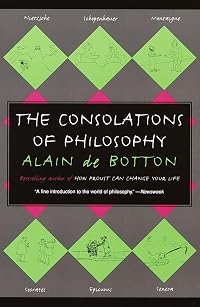
The Consolations of Philosophy
by Alain de Botton
On This Page
Description
Alain de Botton's The Consolations of Philosophy takes the discipline of logic and the mind back to its roots. Drawing inspiration from six of the finest minds in history, Socrates, Epicurus, Seneca, Montaigne, Schopenhauer and Nietzsche, he addresses lack of money, the pain of love, inadequacy, anxiety and conformity. De Botton's book led one critic to call philosophy 'the new rock and roll.'Tags
Recommendations
























Member Recommendations


Member Reviews
So many philosophy books get bogged down pretty quickly, and I lose interest. That wasn't the case with this one. Admittedly, it is on the lighter side, but De Botton's choice of philosophers and philosophies is interesting. I found his descriptions of Schopenhauer and Nietzsche to be much more understandable than other overviews. And, essentially, he includes stoicism, which is a philosophy we all need more of. He writes with humor and, like Montaigne, he doesn't spare himself as he weaves his story. So, this is very enjoyable and may provide a basis for digging further into these philosophers
Ok, I confess: after reading The Consolations of Philosophy, I'm a confirmed Alain de Botton fangirl. I'm not quite sure why, though. Perhaps it's his clear-as-a-bell writing style, which is scholarly without being condescending and avuncular without being arch. Perhaps it's the fact that he's not afraid to tackle big topics, like love, life, and how the philosophies of Plato and Nietzsche fit into it all.
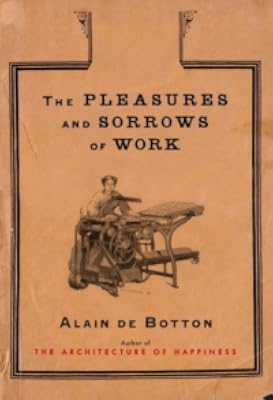
Who knows? All I know is that I loved this book, which is an excellent and accessible primer on major philosophers Epicurus, Seneca, and Montaigne, among others. And I'm pretty much running out to go buy de Botton's new one, The Pleasures and Sorrows of Work.
Who knows? All I know is that I loved this book, which is an excellent and accessible primer on major philosophers Epicurus, Seneca, and Montaigne, among others. And I'm pretty much running out to go buy de Botton's new one, The Pleasures and Sorrows of Work.
Recently I've been following De Botton on Facebook, and watching his lectures has reminded me how much I enjoy the way he presents his arguments (even when he sometimes makes me want to shake him). So when I was recently at Barnes & Noble, going crazy buying Christmas books for the kids, I wandered around a bit looking for a few of his books. This wasn't one of the two I was hoping for, but it looked promising as well, so I picked it up.
I really, really like De Botton's writing. Light, conspiratorial, always sympathetic. The text is peppered with photos, and as I've now seen several of his lectures online, I can hear his voice as I read, which makes reading this book very similar to watching one of his PowerPoint presentations.
Well, show more enough on De Botton's style. The substance of this book is an introduction to philosophy of sorts. But much more painless than Sophie's World, which I could force myself to finish. He begins with the assertion that philosophers, both ancient and modern, have much to offer us in our real, day-to-day lives. He then presents us with the life and work of six philosophers, each to console us for some particular ill in life -- for example, Epicurus to console us for not having enough money.
Each chapter was fascinating and insightful, rich with De Botton's sense of humor (which I enjoy, I'm sure not everyone does). I want to know more about each of the philosophers, but in the meantime I feel the morsel I've had of each is enough to direct my mind into some better thoughts, perhaps leading to a more satisfied life.
I adored it, and will be seeking more of De Botton's work in the future. show less
I really, really like De Botton's writing. Light, conspiratorial, always sympathetic. The text is peppered with photos, and as I've now seen several of his lectures online, I can hear his voice as I read, which makes reading this book very similar to watching one of his PowerPoint presentations.
Well, show more enough on De Botton's style. The substance of this book is an introduction to philosophy of sorts. But much more painless than Sophie's World, which I could force myself to finish. He begins with the assertion that philosophers, both ancient and modern, have much to offer us in our real, day-to-day lives. He then presents us with the life and work of six philosophers, each to console us for some particular ill in life -- for example, Epicurus to console us for not having enough money.
Each chapter was fascinating and insightful, rich with De Botton's sense of humor (which I enjoy, I'm sure not everyone does). I want to know more about each of the philosophers, but in the meantime I feel the morsel I've had of each is enough to direct my mind into some better thoughts, perhaps leading to a more satisfied life.
I adored it, and will be seeking more of De Botton's work in the future. show less
This is an accessible and well-written introduction to philosophy (not all of them are). Instead of going the textbook route, Alain de Botton mixes short biographies of major philosophers with well-organized explanations of their works to show how philosophy can be used to deal with common problems. Covering only six philosophers in under 300 pages means that there's only space for the essence of each approach, which keeps the reader from being swamped. For instance, there's a lot in Stoicism about physics, cosmology, virtue, and so on. But de Botton's focus is on what in Seneca's life and writings can help us learn to cope with frustration, and so those topics aren't mentioned. And the whole book is saved from turning into a historical show more work by de Botton's use of modern examples like falling in love with a fellow passenger on a train or a story of a sudden airplane crash. Most pages in this book have at least one photograph, directly tied to whatever is being discussed at that point. I thought this made the book even more interesting, although I'm wondering how some ereaders will handle it, and if the audiobook version has to make allowances for that.
Generally, I recommend this book both as an introduction to Western philosophy and as a practical demonstration of using philosophy to improve lives. show less
Generally, I recommend this book both as an introduction to Western philosophy and as a practical demonstration of using philosophy to improve lives. show less
I received this as a gift when leaving school from a teacher I'd really got along with. He knew I was intending to do philosophy at uni, hence the choice of book. Not only was it a nice gesture, the book turned out to be a hell of good read too.
What de Botton does with this book is take the thoughts of six different philosophers and show some of their writings can provide consolation for six different sorts of problems that most people deal with in their day-to-day lives- Socrates for unpopularity, Epicurus for not having enough money, Seneca for frustration (anger, sense of injustice etc), Montaigne for inadequacies, Schopenhauer for a broken heart, and Nietzsche for difficulties (tragedies etc). I read a few reviews of this book show more beforehand and found that, while popular with the general public, de Botton's book was criticised by philosophers for trivialising philosophy and giving the public the wrong impression as to what philosophy is. So I made sure not to let the book give me the impression when I went to uni that philosophy could solve all my personal problems. Having now done some proper philosophy, I can confirm that. This is more like self-help done by philosophers than philosophy. But it seems we should try to do more of that, because it turns out to be damn good self-help.
The Consolations of Philosophy is just a fantastic, fascinating and highly useful read. The histories of these six philosophers were very interesting to me, so those alone would have made the book valuable, but even better were the ideas and consolations de Botton extrapolated from the works of these thinkers. They were in some cases, quite exciting and liberating thoughts for me, with my various anxieties. I'd point out which ones I loved most, but quite simply I loved it all with the exception of the chapter on Schopenhauer, whose philosophy, or the portrayals of his philosophy that I have read, I have come across a couple of times now and both times found that I disagree with it strongly. But even then it was highly interesting.
So even if The Consolations of Philosophy is just self-help, I found it to be an incredibly fun, inspiring and absorbing read. I'm not sure if I'll read any of de Botton's other stuff, but I certainly don't regret reading this. show less
What de Botton does with this book is take the thoughts of six different philosophers and show some of their writings can provide consolation for six different sorts of problems that most people deal with in their day-to-day lives- Socrates for unpopularity, Epicurus for not having enough money, Seneca for frustration (anger, sense of injustice etc), Montaigne for inadequacies, Schopenhauer for a broken heart, and Nietzsche for difficulties (tragedies etc). I read a few reviews of this book show more beforehand and found that, while popular with the general public, de Botton's book was criticised by philosophers for trivialising philosophy and giving the public the wrong impression as to what philosophy is. So I made sure not to let the book give me the impression when I went to uni that philosophy could solve all my personal problems. Having now done some proper philosophy, I can confirm that. This is more like self-help done by philosophers than philosophy. But it seems we should try to do more of that, because it turns out to be damn good self-help.
The Consolations of Philosophy is just a fantastic, fascinating and highly useful read. The histories of these six philosophers were very interesting to me, so those alone would have made the book valuable, but even better were the ideas and consolations de Botton extrapolated from the works of these thinkers. They were in some cases, quite exciting and liberating thoughts for me, with my various anxieties. I'd point out which ones I loved most, but quite simply I loved it all with the exception of the chapter on Schopenhauer, whose philosophy, or the portrayals of his philosophy that I have read, I have come across a couple of times now and both times found that I disagree with it strongly. But even then it was highly interesting.
So even if The Consolations of Philosophy is just self-help, I found it to be an incredibly fun, inspiring and absorbing read. I'm not sure if I'll read any of de Botton's other stuff, but I certainly don't regret reading this. show less
I've read a great many books this year, but none have made me so extraordinarily happy as Alain De Botton's little guide to philosophy.
De Botton has assembled a group of six philosophers, linked through time by shared interests and fascinations and a certain philosophical lineage, and uses their work to help us in each of six consolations: for unpopularity; for not having enough money; for frustration; for inadequacy; for a broken heart; and for difficulties.
De Botton chooses his philosophers, and their quotables, very wisely, and everything is as clear to follow and as enjoyable as Montaigne himself would have wanted. As well as being very erudite, De Botton's prose is light and humourous, and leads the reader comfortably along; still, show more there is a lot of time to pause for thought, and I allowed myself twice as long to read this slim volume as I would have done any other book. show less
De Botton has assembled a group of six philosophers, linked through time by shared interests and fascinations and a certain philosophical lineage, and uses their work to help us in each of six consolations: for unpopularity; for not having enough money; for frustration; for inadequacy; for a broken heart; and for difficulties.
De Botton chooses his philosophers, and their quotables, very wisely, and everything is as clear to follow and as enjoyable as Montaigne himself would have wanted. As well as being very erudite, De Botton's prose is light and humourous, and leads the reader comfortably along; still, show more there is a lot of time to pause for thought, and I allowed myself twice as long to read this slim volume as I would have done any other book. show less
This book is highly readable, yet never simple-minded or patronizing to the reader. Alain de Botton succeeds in bringing to life the most important concepts of some of the most important Western philosophers, relating them in a very effective manner to the everyday trials and tribulations any human being might experience.
The reviewer who had "trouble" with this approach seems to have missed the point, and to have misunderstood the Socrates section in particular. (Alain de Botton is not suggesting we be consoled by the thought that future generations will think us right; he suggests that if we have reasoned out our position and find it correct by method of such reason, we should not be troubled if that position is unpopular. This is the show more example Socrates provided, and also what de Botton relates.)
This book will turn you on to Montaigne, to philosophy, and to the possibilities of learning in general. The humor that runs throughout the book makes reading it a pleasure, as well as a worthwhile endeavor. show less
The reviewer who had "trouble" with this approach seems to have missed the point, and to have misunderstood the Socrates section in particular. (Alain de Botton is not suggesting we be consoled by the thought that future generations will think us right; he suggests that if we have reasoned out our position and find it correct by method of such reason, we should not be troubled if that position is unpopular. This is the show more example Socrates provided, and also what de Botton relates.)
This book will turn you on to Montaigne, to philosophy, and to the possibilities of learning in general. The humor that runs throughout the book makes reading it a pleasure, as well as a worthwhile endeavor. show less
Members
- Recently Added By
Lists


Author Information

54+ Works 26,009 Members
Born in Zurich, Switzerland on December 20, 1969, Alain de Botton was educated at Cambridge University, England, and now divides his time between London and Washington, D.C. With the publication of his first novel, Essays in Love, de Botton quickly became one of the most talked about British novelists of the 1990s. Although the basic plot of show more Essays in Love (published in the U.S. as On Love) is a rather typical love story, de Botton presents it in a unique and humorous way. De Botton's other novels include The Romantic Movement: Sex, Shopping and the Novel, which is written in a similar style to Essays on Love, and Kiss and Tell, which follows a would-be biographer as he attempts to write the life story of the first person he encounters. The Course of Love is his latest novel and is on the bestsellers list. Alain de Botton is also the author of How Proust Can Change Your Life: Not a Novel. (Bowker Author Biography) show less
Some Editions
Series
Belongs to Publisher Series
Work Relationships
Is contained in
Has as a reference guide/companion
Common Knowledge
- Canonical title
- The Consolations of Philosophy
- Original title
- The Consolations of Philosophy
- Original publication date
- 2000
- Related movies
- Philosophy: A Guide to Happiness (2000 | IMDb)
- First words
- A few years ago, during a bitter New York winter, with an afternoon to spare before catching a flight to London, I found myself in a deserted gallery on the upper level of the Metropolitan Museum of Art.
- Last words
- (Click to show. Warning: May contain spoilers.)Not everything which hurts may be bad.
- Original language
- English
Classifications
Statistics
- Members
- 4,026
- Popularity
- 3,868
- Reviews
- 63
- Rating
- (3.82)
- Languages
- 20 — Arabic, Catalan, Chinese, Czech, Dutch, English, Estonian, Finnish, French, German, Greek, Hungarian, Italian, Norwegian (Bokmål), Polish, Romanian, Spanish, Swedish, Turkish, Portuguese (Brazil)
- Media
- Paper, Audiobook, Ebook
- ISBNs
- 83
- ASINs
- 14