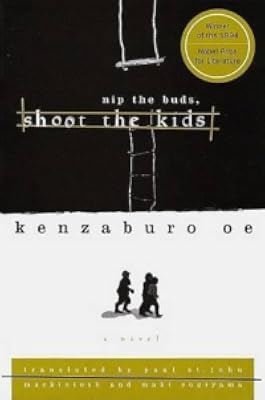
Nip the Buds, Shoot the Kids
by Kenzaburō Ōe
On This Page
Description
In Japan during World War II a group of boys who are evacuated to the country take over a village when the inhabitants flee a plague. The novel describes the way the boys administer the village--breaking into homes for food, burying the dead, caring for the sick--and what happens when the villagers return. By the author of The Silent Cry.Tags
Recommendations






Member Recommendations
JuliaMaria Kinder auf sich allein gestellt - was sagt es über die Gesellschaft aus?
20
Member Reviews
'The War sent its mass insanity flooding into the convolutions of people's feelings, into every last recess of their bodies', 7 Mar. 2013
By
sally tarbox
Verified Purchase(What is this?)
This review is from: Nip the Buds, Shoot the Kids (Hardcover)
A harsh yet utterly compelling read, narrated by a boy from a reformatory, evacuated with his mates into a village while World War 2 rages elsewhere. And while the war itself doesn't touch the characters, it infects the adult villagers around them, who treat the youths brutally:
' "Anyone caught stealing, starting fires or making a row will be beaten to death by the villagers. Even so we'll shelter and feed you. Always remember that in this village you're only useless vermin." '
Amid freezing show more conditions and with bad food, the kids are soon called up to bury a heap of decaying livestock, in a grisly scene. But it soon appears that the animals are dead from plague, and for five days the adults flee the village, leaving the youths to fend for themselves. Yet they are not alone: there's a young girl, a Korean, a friendly dog and a runaway army cadet...
Often horrifying, yet with moments of great beauty and innocence...as they wash to keep free of plague, they find a crab; the narrator has a close relationship with his kid brother, lending him his camel tin-opener and watching him play with his dog; and the kids make a skating rink when it snows. But such moments just emphasize the brutality that forms the major part of the work all the more. A memorable work. show less
By
sally tarbox
Verified Purchase(What is this?)
This review is from: Nip the Buds, Shoot the Kids (Hardcover)
A harsh yet utterly compelling read, narrated by a boy from a reformatory, evacuated with his mates into a village while World War 2 rages elsewhere. And while the war itself doesn't touch the characters, it infects the adult villagers around them, who treat the youths brutally:
' "Anyone caught stealing, starting fires or making a row will be beaten to death by the villagers. Even so we'll shelter and feed you. Always remember that in this village you're only useless vermin." '
Amid freezing show more conditions and with bad food, the kids are soon called up to bury a heap of decaying livestock, in a grisly scene. But it soon appears that the animals are dead from plague, and for five days the adults flee the village, leaving the youths to fend for themselves. Yet they are not alone: there's a young girl, a Korean, a friendly dog and a runaway army cadet...
Often horrifying, yet with moments of great beauty and innocence...as they wash to keep free of plague, they find a crab; the narrator has a close relationship with his kid brother, lending him his camel tin-opener and watching him play with his dog; and the kids make a skating rink when it snows. But such moments just emphasize the brutality that forms the major part of the work all the more. A memorable work. show less
A very powerful book, misery and dread seem to permeate throughout every word of every page. Not the easiest read given the subject matter, but well worth it for the sharpness of vision and brutal strength of its story.
Though on the surface it could be easy to write Oe's book off as a variation on Golding's Lord of the Flies, I think one would be completely dismissing this books historical and social context in doing so. For Golding, the adults of the world simply weren't present. As for Oe, the adults were there, detached and apart at first, but there, and eventually (spoiler) returning with a bloody and almost righteously unjustified anger and malice towards the reformatory boys.
Again, not the easiest read, and it certainly won't show more leave you with a smile or any sort of life affirmation. But this book should be read as both a statement on both the (at times) miserable potential of humanity and the incredible survival instinct that can in certain moments be all that keeps a person going. show less
Though on the surface it could be easy to write Oe's book off as a variation on Golding's Lord of the Flies, I think one would be completely dismissing this books historical and social context in doing so. For Golding, the adults of the world simply weren't present. As for Oe, the adults were there, detached and apart at first, but there, and eventually (spoiler) returning with a bloody and almost righteously unjustified anger and malice towards the reformatory boys.
Again, not the easiest read, and it certainly won't show more leave you with a smile or any sort of life affirmation. But this book should be read as both a statement on both the (at times) miserable potential of humanity and the incredible survival instinct that can in certain moments be all that keeps a person going. show less
Very poignant. Very raw. A booked that rocked Japan when published just 13 years after the Japanese surrender in 1945.
This is Japan’s Lord of the Flies with important exceptions: adults are always on the periphery and the children work together for survival.
During WW2, a group of boys is left to fend for themselves in a village deserted due to a viral outbreak. Despite most surviving against the odds, when the adults return, they force them into secrecy about how they have been treated. Only the narrator escapes to an unknown fate – clearly a metaphor for the author.
The storytelling is vivid and heartbreaking. Their plight is visceral and easy to get drawn into. Their betrayal and treatment at the hands of the adult villagers is show more harsh. The metaphors abound.
Oe was 23 when he wrote this. It’s a youth’s response to the intertia of mass denial as his nation lay crushed by the unbearable weight of the shame of surrender. This is captured well by John Dower in his excellent Embracing Defeat.
In a few hundred pages, Oe wrested his nation’s conscience into consciousness. He forced them to face questions about what being Japanese was all about. Had he been Russian, he would have faced the Gulag.
A powerful and important book in the literature of Japan, it needs to be understood in its context. With the passing of time and the necessary cultural chasm between English and Japanese, this is becoming harder and harder to do. My advice would be to read it as soon as possible. show less
This is Japan’s Lord of the Flies with important exceptions: adults are always on the periphery and the children work together for survival.
During WW2, a group of boys is left to fend for themselves in a village deserted due to a viral outbreak. Despite most surviving against the odds, when the adults return, they force them into secrecy about how they have been treated. Only the narrator escapes to an unknown fate – clearly a metaphor for the author.
The storytelling is vivid and heartbreaking. Their plight is visceral and easy to get drawn into. Their betrayal and treatment at the hands of the adult villagers is show more harsh. The metaphors abound.
Oe was 23 when he wrote this. It’s a youth’s response to the intertia of mass denial as his nation lay crushed by the unbearable weight of the shame of surrender. This is captured well by John Dower in his excellent Embracing Defeat.
In a few hundred pages, Oe wrested his nation’s conscience into consciousness. He forced them to face questions about what being Japanese was all about. Had he been Russian, he would have faced the Gulag.
A powerful and important book in the literature of Japan, it needs to be understood in its context. With the passing of time and the necessary cultural chasm between English and Japanese, this is becoming harder and harder to do. My advice would be to read it as soon as possible. show less
A beautifully written book about a horrible situation. A group of young male delinquents are relocated into he interior of Japan during WWII. The village to which they are sent has a plague scare and the boys are abandoned by the villagers, barricaded in to suffer whatever fate has in store for them. As their isolation lasts only a short time & the assumption is that the villagers will return, the boys in this novel do not attempt to create a functioning society or suffer its eventual breakdown as depicted in Lord of the Flies; these boys endure. They redefine their role, considering themselves as occupiers of the deserted village rather than accept the role of abandoned, unwanted vermin. Instead of demonstrating the inhumanity of and show more between individuals, the book demonstrates how the society fails the boys. show less
Esta novela ha sido mi introducción a la obra de Kenzaburo Oé.
Quince niños que, en período de guerra, deben abandonar el reformatorio al que habían sido confinados. Son trasladados al que será su nuevo "hogar": una aldea minúscula en medio de la montaña. Doblemente parias, deben luchar contra el rechazo absoluto del resto de la población.
Distópica hasta el cringe, uno se debate entre sumirse en una desesperanza infinita, y alegrarse de que nuestra infancia NO haya sido como la del narrador. O la de cualquiera de sus compañeros. Es muy cruda, aunque la penmanship es de otro mundo; haciendo imposible dejar el libro. O tal vez es cierto sentimiento de empatía que nos genera el desafortunado grupo, que nos obliga a velar por show more él y a aguardar por la luz al final del túnel. Una suerte de [b:El señor de las moscas|8665110|El señor de las moscas|William Golding|https://images.gr-assets.com/books/1280257076s/8665110.jpg|2766512] pero en el que la mayor parte de la crueldad la proporcionan los adultos. show less
Quince niños que, en período de guerra, deben abandonar el reformatorio al que habían sido confinados. Son trasladados al que será su nuevo "hogar": una aldea minúscula en medio de la montaña. Doblemente parias, deben luchar contra el rechazo absoluto del resto de la población.
Distópica hasta el cringe, uno se debate entre sumirse en una desesperanza infinita, y alegrarse de que nuestra infancia NO haya sido como la del narrador. O la de cualquiera de sus compañeros. Es muy cruda, aunque la penmanship es de otro mundo; haciendo imposible dejar el libro. O tal vez es cierto sentimiento de empatía que nos genera el desafortunado grupo, que nos obliga a velar por show more él y a aguardar por la luz al final del túnel. Una suerte de [b:El señor de las moscas|8665110|El señor de las moscas|William Golding|https://images.gr-assets.com/books/1280257076s/8665110.jpg|2766512] pero en el que la mayor parte de la crueldad la proporcionan los adultos. show less
This incredibly harsh novel about hate, violence and pestilence is definitely an emotional investment. The reader is torn with sympathy for these children desperate for guidance and love and with horror at their violence and wildness. Oe, with few words, is able to portray a world of betrayal, fear, anger and love. While I had tossed all eventuality of hope, the masterful ending actually leaves room for redemption. A tremendous book which will not leave the reader indifferent.
This is one of those must read classics, especially since the author was awarded the Nobel for Literature. While never naming the place or time, or most of the characters, it centers on a group of reform school boys marched into the mountains around the time of World War II. Classism and racism feature prominently. The narrator's struggle to survive starvation and hatred long enough to escape, even though escape doesn't offer salvation, builds a hopelessness that is difficult to read. Many focus on the near apocalyptic setting and the spare details to push the book into an almost magical realism category, especially as examined against the author's other work, but it is squarely a flat realist narrative. On balance, it's not the show more difficult substance of the book, but the lack of much else but increasing violence that foils the book. It's one thing to describe hopelessness, and an altogether different thing to withhold hope. Also, an odd side note - there's a fair amount of homosexuality in the text that reads like it was meant to shock rather than as a true part of a character's life. Oe dropped it in at odd times, in odd ways, always trying to express vulgarity, which is an odd note to strike with the topic. The true success of the book for me was the author's deft hand with the natural world around his characters - the descriptions of the forest evidenced a poet's mind. That alone brought the rating of the book up for me.
3 bones!!! show less
3 bones!!! show less
Members
- Recently Added By
Lists

1001 Books You Must Read Before You Die
1,448 works; 1,134 members

Japanese Literature
230 works; 40 members

1950s
340 works; 22 members

Childhood: Books for or about children in different cultures around the wor
345 works; 17 members

1,001 BYMRBYD Concensus
723 works; 27 members

Books Read in 2021
5,361 works; 114 members

Viral Outbreaks and Pandemics
82 works; 8 members
Author Information

140+ Works 8,407 Members
Kenzaburo Oe was born on January 31, 1935. He was born in a small village on the island of Shikoku, Japan. A winner of numerous Japanese literary prizes, Oe came to manhood during World War II and the occupation. At Tokyo University, Oe studied Jean-Paul Sartre and absorbed many popular leftist ideas. These influences appear in his early writings, show more which often deal with contemporary issues. With the birth of his deformed son, father and son became the new focus of his work. In his two books, A Personal Matter (1964) and A Healing Family (1996), Oe describes the pain involved with accepting his brain-damaged son and the small victories involved their lives as his son progressed. In 1994, Oe won the Nobel Prize for Literature. (Bowker Author Biography) show less
Some Editions
Awards and Honors
Series
Belongs to Publisher Series
Common Knowledge
- Canonical title
- Nip the Buds, Shoot the Kids
- Original title
- 芽むしり仔撃ち
- Alternate titles*
- Me mushiri kōuchi
- Original publication date
- 1958
- People/Characters*
- Li; Leo; Minami
- Important places
- Japan
- Important events
- World War II
- First words
- Two of our boys had escaped during the night, so at dawn we still hadn't left.
- Last words
- (Click to show. Warning: May contain spoilers.)I got up, clenching my teeth, and dashed into the deeper darkness between the trees and the darker undergrowth.
- Original language
- Japanese
*Some information comes from Common Knowledge in other languages. Click "Edit" for more information.
Classifications
- Genres
- Fiction and Literature, General Fiction
- DDC/MDS
- 895.635 — Literature & rhetoric Literatures of other languages Literatures of East and Southeast Asia Japanese Japanese fiction 1945–2000
- LCC
- PL858 .E14 .M413 — Language and Literature Languages and literatures of Eastern Asia, Africa, Oceania Languages of Eastern Asia, Africa, Oceania Japanese language and literature Japanese literature Individual authors and works
- BISAC
Statistics
- Members
- 1,067
- Popularity
- 24,052
- Reviews
- 32
- Rating
- (3.73)
- Languages
- 11 — Czech, Dutch, English, French, German, Greek, Japanese, Polish, Slovenian, Spanish, Thai
- Media
- Paper, Audiobook, Ebook
- ISBNs
- 20
- ASINs
- 8