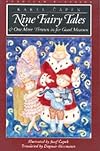
Nine Fairy Tales: and One More Thrown in for Good Measure (European Classics)
by Karel Čapek
On This Page
Description
A collection of 10 charming folktales from Czechoslovakia.Tags
Recommendations


















Member Reviews
A delightful collection of stories that brighten the mind and are sure to lighten any mood. In this book fantasy is spoken of in such a way that it is simply a reality. Elves, goblins and ghosts, as in all good fairy tales are real and the reader doesn't need to be convinced, they simply know that it makes perfect sense for creatures of fantasy to work in a post office after hours and be able to play cards with the envelopes.
Each story is beautifully written and is full of charm and combines modern with the past in such a way that the stories almost have a time of their own. I literally could not bring myself to put the book down and read each tale, one after the other. My only warning to readers would be not to misjudge this book as show more being a collection of unrelated stories that you can set aside at the end of an adventure, because like with chips, it's impossible to have just one. show less
Each story is beautifully written and is full of charm and combines modern with the past in such a way that the stories almost have a time of their own. I literally could not bring myself to put the book down and read each tale, one after the other. My only warning to readers would be not to misjudge this book as show more being a collection of unrelated stories that you can set aside at the end of an adventure, because like with chips, it's impossible to have just one. show less
Karel Capek wrote novels, short stories, essays, and plays in a number of different genres. This is his book of fairy tales, and it has the same casual, rambling, humanistic feeling as many of his other stories and novels. The main problem I had with this one was that some of the stories were too sweet – too-happy endings, Jesus-y figures. I guess that’s to be expected with fairy tales. The rambling tangents and daily Czech life with ordinary people running into the supernatural were entertaining though.
The first story “The Great Cat’s Tale” is a long one and has a very long tangent where the princess believes her cat is stolen and there’s a big chase but it turns out that the cat was somewhere else. The first part of the show more story is an amusing bit with an old woman outwitting the king, and the depiction of the cat-dog friendship is fun as well. However, this one definitely has its too-sappy moments.
In “The Dog’s Tale” Peanut the dog sees some fairy dogs, but the descriptions of his early life are the best part. Capek wrote another book about cats and dogs – his affectionate familiarity is in this story and the first one.
“The Bird’s Tale” reminded me a bit of his play “The Insect Play”, about anthropomorphic insects, although here they are anthropomorphic birds.
The two robbers’ stories are amusingly twisty – the first has the narrator’s great-grandfather finding himself in a sticky situation with a gang of robbers, the second is an ironic tale of the head thief’s son, who was brought up to be a courteous gentleman and who finds it difficult taking over the family business.
“The Tramp’s Tale” is a quixotic story about a man who is wrongly accused and a shaggy dog explanation.
Stories about the police, the mailman and doctors have nymphs, water sprites, dragons and others running into everyday problems and running up against bureaucracy. show less
The first story “The Great Cat’s Tale” is a long one and has a very long tangent where the princess believes her cat is stolen and there’s a big chase but it turns out that the cat was somewhere else. The first part of the show more story is an amusing bit with an old woman outwitting the king, and the depiction of the cat-dog friendship is fun as well. However, this one definitely has its too-sappy moments.
In “The Dog’s Tale” Peanut the dog sees some fairy dogs, but the descriptions of his early life are the best part. Capek wrote another book about cats and dogs – his affectionate familiarity is in this story and the first one.
“The Bird’s Tale” reminded me a bit of his play “The Insect Play”, about anthropomorphic insects, although here they are anthropomorphic birds.
The two robbers’ stories are amusingly twisty – the first has the narrator’s great-grandfather finding himself in a sticky situation with a gang of robbers, the second is an ironic tale of the head thief’s son, who was brought up to be a courteous gentleman and who finds it difficult taking over the family business.
“The Tramp’s Tale” is a quixotic story about a man who is wrongly accused and a shaggy dog explanation.
Stories about the police, the mailman and doctors have nymphs, water sprites, dragons and others running into everyday problems and running up against bureaucracy. show less
Book Description: Evanston: Northwestern University Press, 1990. As New. in As New dj. Illustrated by Josef Capek. First Edition. 8vo - 8" Tall. 252 pages. Blue cloth. A fine, clean, sturdy copy
Ratings
Members
- Recently Added By
Lists

Hayao Miyazaki's 50 Recommended Children's Books
48 works; 6 members
Talk Discussions
Past Discussions
Nine Fairy Tales and One More Thrown in for Good Measure, Karel Čapek in World Reading Circle (July 2013)
Author Information

254+ Works 7,156 Members
Karel Capek is best known abroad for his plays, but at home he is also revered as an accomplished novelist, short-story writer, essayist, and writer of political articles. His bitingly satirical novel The War with the Newts (1936) reveals his understanding of the possible consequences of scientific advance. The novel Krakatit (1924), about an show more explosive that could destroy the world, foreshadows the feared potential of a nuclear disaster. In his numerous short stories he depicts the problems of modern life and common people in a humorous and whimsically philosophical fashion. The plays of Karel Capek presage the Theater of the Absurd. R.U.R. (Rossum's Universal Robots) (1921) was a satire on the machine age. He created the word robot from the Czech noun robota, meaning "work" for the human-made automatons who in that play took over the world, leaving only one human being alive. The Insect Comedy (1921), whose characters are insects, is an ironic fantasy on human weakness. The Makropoulos Secret (1923), later used as the basis for Leos Janacek's opera, was an experimental piece that questioned whether immortality is really desirable. All the plays have been produced successfully in New York. Most deal satirically with the modern machine age or with war. Underlying all his work, though, is a faith in humanity, truth, justice, and democracy, which has made him one of the most beloved of all Czech writers. (Bowker Author Biography) show less
Some Editions
Series
Belongs to Publisher Series
Common Knowledge
- Original title
- Devatero pohádek a ještě jedna
- First words
- In the land of Pranksters there reigned a king about whom it could be said that he ruled happily.
- Last words
- (Click to show. Warning: May contain spoilers.)Perhaps your children will live to see it.
Classifications
- Genres
- Fiction and Literature, General Fiction
- DDC/MDS
- 891.8635 — Literature & rhetoric Literatures of other languages East Indo-European and Celtic literatures West and South Slavic languages (Bulgarian, Slovene, Polish, Czech, Slovak, Serbo-Croatian, and Macedonian) Czech Czech fiction 1900–1989
- LCC
- PZ70 .C9 .C26 — Language and Literature Fiction and juvenile belles lettres Fiction and juvenile belles lettres Juvenile belles lettres
- BISAC
Statistics
- Members
- 157
- Popularity
- 208,714
- Reviews
- 3
- Rating
- (3.62)
- Languages
- 7 — Chinese, Czech, English, Estonian, Croatian, Slovenian, Spanish
- Media
- Paper
- ISBNs
- 16
- ASINs
- 3