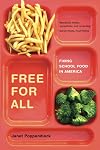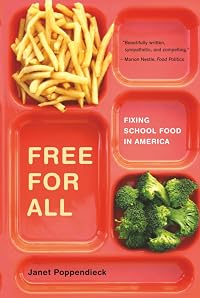
Free for All: Fixing School Food in America
by Janet Poppendieck
On This Page
Description
How did our children end up eating nachos, pizza, and Tater Tots for lunch? Taking us on an eye-opening journey into the nation's school kitchens, this superbly researched book is the first to provide a comprehensive assessment of school food in the United States. Janet Poppendieck explores the deep politics of food provision from multiple perspectives--history, policy, nutrition, environmental sustainability, taste, and more. How did we get into the absurd situation in which nutritionally show more regulated meals compete with fast food items and snack foods loaded with sugar, salt, and fat? What is the nutritional profile of the federal meals? How well are they reaching students who need them? Opening a window onto our culture as a whole, Poppendieck reveals the forces--the financial troubles of schools, the commercialization of childhood, the reliance on market models--that are determining how lunch is served. She concludes with a sweeping vision for change: fresh, healthy food for all children as a regular part of their school day. show lessTags
Recommendations
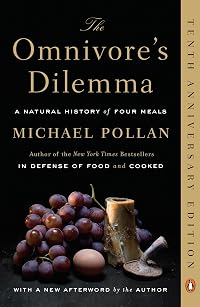
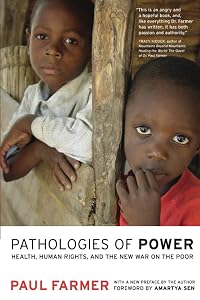
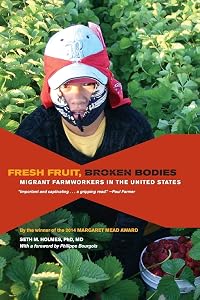
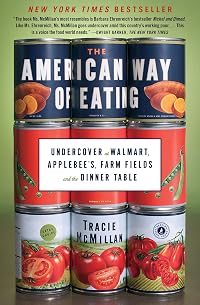





Member Recommendations
Member Reviews
I knew a lot about our food system, and a fair bit about our agricultural system. What I didn't know a lot about was how those two joined together into our school food program. Jamie Oliver was right: our school lunch program is broken - possibly irreparably so. However, he is also naive about just why it is broken and why it is not an easy fix.
Poppendieck explains how today's school lunches are the culmination of over a century of policy and legislation that were put into place for a variety of different reasons. There are competing goals in place: supporting the US agricultural system, providing a market for surplus food, ensuring adequate nutrition in school children, fighting hunger, etc.
It was especially eye-opening to learn just show more why children are served monochromatic fast-food, and why that would be difficult to change. The answer isn't simply "just give them better food." It's tied into a large suite of requirements schools are required to meet regarding nutritionally content, servings, what counts as reimbursable, who qualifies for free or reduced lunch - all with the eye of the bottom line. Tie that in with stigma (children can be relentlessly cruel) and administrative red tape, and the end result is a program that is deeply flawed.
Fascinating and disheartening at the same time. The title "Free for All" points to what Poppendieck concludes is the solution to ensuring that hungry children can eat without jumping through hurdles - both socially and logistically. I'm less convinced that is a workable solution for a number of reasons - first being the appropriations necessary to fund this and the reluctance (failure?) of Congress in this financial climate to spend any money not towards defense.
It also doesn't solve the problem of the quality of the food being served in schools. Poppendieck acknowledges this and points to several programs around the country that are working on sourcing locally, cooking from scratch, etc. But there is heavy reluctance in the vast majority of schools to adopt such measures, and in many schools an impossibility due to infrastructure.
Still, a very compelling and much needed book. It certainly got me thinking. show less
Poppendieck explains how today's school lunches are the culmination of over a century of policy and legislation that were put into place for a variety of different reasons. There are competing goals in place: supporting the US agricultural system, providing a market for surplus food, ensuring adequate nutrition in school children, fighting hunger, etc.
It was especially eye-opening to learn just show more why children are served monochromatic fast-food, and why that would be difficult to change. The answer isn't simply "just give them better food." It's tied into a large suite of requirements schools are required to meet regarding nutritionally content, servings, what counts as reimbursable, who qualifies for free or reduced lunch - all with the eye of the bottom line. Tie that in with stigma (children can be relentlessly cruel) and administrative red tape, and the end result is a program that is deeply flawed.
Fascinating and disheartening at the same time. The title "Free for All" points to what Poppendieck concludes is the solution to ensuring that hungry children can eat without jumping through hurdles - both socially and logistically. I'm less convinced that is a workable solution for a number of reasons - first being the appropriations necessary to fund this and the reluctance (failure?) of Congress in this financial climate to spend any money not towards defense.
It also doesn't solve the problem of the quality of the food being served in schools. Poppendieck acknowledges this and points to several programs around the country that are working on sourcing locally, cooking from scratch, etc. But there is heavy reluctance in the vast majority of schools to adopt such measures, and in many schools an impossibility due to infrastructure.
Still, a very compelling and much needed book. It certainly got me thinking. show less
An excellent book if you are interested in school food. However, it is not a casual read. The writer is a professor of sociology at Hunter College whose academic focus is on hunger. The book is very comprehensive and covers the history, politics, and technical nature of the school food system (procurement, nutrition requirements, economics, etc.). It's accessible to the general reader or casual concerned parent but perhaps it is a bit overkill and it's really those who are school food reform advocates or in some other fashion part of the sustainable food movement who will have the patience and stamina to get through the book.
Ratings
Members
- Recently Added By
Published Reviews
ThingScore 100
In its patient, no-nonsense approach to the problem of feeding our kids, Free for All will, I hope, be a goad and a clarion call for an energetic horde of nutritional revolutionaries. Hats off to Poppendieck. Three cheers for free lunch.
added by Shortride
Lists

University Presses
155 works; 1 member
Author Information

3+ Works 172 Members
Janet Poppendieck is Professor of Sociology at Hunter College, City University of New York. She is the author of Sweet Charity? Emergency Food and the End of Entitlement and Breadlines Knee Deep in Wheat: Food Assistance in the Great Depression.
Series
Belongs to Publisher Series
Common Knowledge
- Canonical title
- Free for All: Fixing School Food in America
- Original publication date
- 2010
- Dedication
- For my daughter, Amanda
- First words
- School meals don't have a very good reputation.
- Last words
- (Click to show. Warning: May contain spoilers.)I can think of no better place to begin that process than with the food that we serve our children at school.
- Blurbers
- Nestle, Marion; Ayres, Bill; Lytton, Timothy D.; Sidel, Ruth
Classifications
- Genres
- Nonfiction, General Nonfiction, Food & Cooking
- DDC/MDS
- 371.7 — Society, government, & culture Education Schools and their activities; special education School hygiene
- LCC
- LB3479 .U6 .P55 — Education Theory and practice of education Theory and practice of education School hygiene. School health services
- BISAC
Statistics
- Members
- 69
- Popularity
- 455,375
- Reviews
- 2
- Rating
- (3.70)
- Languages
- English
- Media
- Paper, Ebook
- ISBNs
- 4
- ASINs
- 1