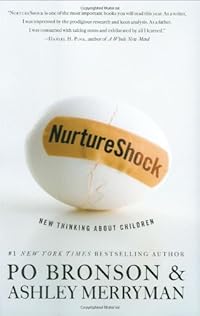
NurtureShock: New Thinking About Children
by Po Bronson, Ashley Merryman
On This Page
Description
Psychology. Nonfiction. In a world of modern, involved, caring parents, why are so many kids aggressive and cruel? Where is intelligence hidden in the brain, and why does that matter? Why do cross-racial friendships decrease in schools that are more integrated? If 98% of kids think lying is morally wrong, then why do 98% of kids lie? What's the single most important thing that helps infants learn language? NurtureShock is a groundbreaking collaboration between award-winning science show more journalists Po Bronson and Ashley Merryman. They argue that when it comes to children, we've mistaken good intentions for good ideas. With impeccable storytelling and razor-sharp analysis, they demonstrate that many of modern society's strategies for nurturing children are in fact backfiring--because key twists in the science have been overlooked. Nothing like a parenting manual, the authors' work is an insightful exploration of themes and issues that transcend children's (and adults') lives. show lessTags
Recommendations
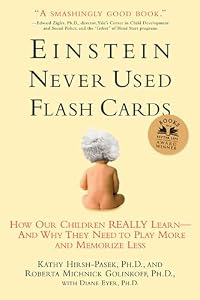
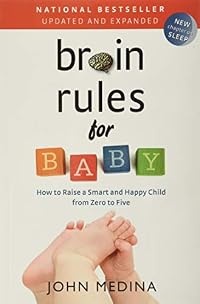
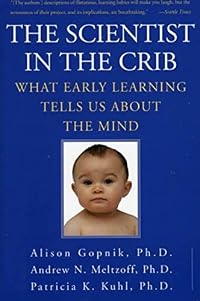
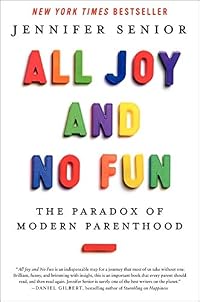






Member Recommendations
Member Reviews
Nutureshock is a fascinating synthesis of the best available research by a pair of journalists on paradoxes in childrearing. Despite raising children for, well, as long as there have been people, there is a lot of diversity of opinion about how best to do it. Even with decades of research, we still don't really know how to best raise children.
The good news is that children are resilient. Short of outright abuse, it's hard to really mess a child up. The bad news is that children are resilient. There's very little evidence of any intervention or change in condition that leads to better outcomes for kids.
I will focus on some paradoxes. In the past 16 years since this book was first published, it's become broadly accepted that praising show more children for intelligence leads to fragile perfectionists, and that it is much better to praise children for grit.
Social aptitude is also a mixed bag. Increased social aptitude is associated with lying in very small children, around five or six. In elementary school, children with high social aptitude score very high in both empathetic and relational aggression, using a mixture of kindness and cruelty to shape the norms and social hierarchy of their classrooms. This extends into the teenage years. While most parents believe that their teens would talk to them about anything, teens routinely lie about topics from the serious, like drug and alcohol use and older boyfriends, to the medium, like is homework done, to the irrelevant, like what you did after school, when the options are hang out at the mall or the park.
What does strike as true through the paradox is that teens arguing is a sign of respect, not disrespect. What is important is not to be permissive or strict, but to have a finite number of well-enforced rules, and an open and contextual process for debating them so that teens feel like participants in their own growth and developing autonomy.
Another area where the book hits at conventional thinking is in gifted classrooms. Educational tracking is a third rail in American politics, where providing the best resources for talented kids runs into serious concerns about equity and racial discrimination. Either way, most districts start gifted programs far too early, with initial sorting at or before kingergarten. IQ scores vary wildly in young children over time, and don't really settle down until third grade.
Surveys of new curriculums and teaching methods to develop both cognitive and emotional skills is a litany of null results, except for the Tools of the Mind curriculum, which apparently boasted astonishing results. I use past tense, because a 2021 survey shows no result, again.
Finally, there are some real head scratchers. The authors have no opinion on corporal punishment, and note a racial divide, that White kids find spanking traumatic and Black kids don't. This hints at some of the worst "Black people don't experience pain the same way" racist psuedoscience, though the explanation, that African-American culture more broadly accepts getting whooped a few times as something that just happens, and that the moral exclusion from the family signified by spanking is what is traumatic, is at least cultural and not biological. I do wonder if the authors would be okay with me taking a swing at their kids.
As an older book, NutureShock has little to say about whatever the fuck has happened to kids since 2010. Jonathan Haidt blames cellphones, I think a little called the Global Financial Crisis might be to blame, but whatever the cause, mental health is DOWN and Skibidi Toilet is UP.
Plot from The Atlantic, End the Phone Based Childhood Now
And again, returning to the use of evidence, while the authors provide citations and ably discuss the research, epistemic closure on interactive kinds is impossible. Or without the STS jargon, as much as we try to determine the truth about people, they change as we examine them. For any topic as politically fraught as education, there will be ample room to disagree. show less
The good news is that children are resilient. Short of outright abuse, it's hard to really mess a child up. The bad news is that children are resilient. There's very little evidence of any intervention or change in condition that leads to better outcomes for kids.
I will focus on some paradoxes. In the past 16 years since this book was first published, it's become broadly accepted that praising show more children for intelligence leads to fragile perfectionists, and that it is much better to praise children for grit.
Social aptitude is also a mixed bag. Increased social aptitude is associated with lying in very small children, around five or six. In elementary school, children with high social aptitude score very high in both empathetic and relational aggression, using a mixture of kindness and cruelty to shape the norms and social hierarchy of their classrooms. This extends into the teenage years. While most parents believe that their teens would talk to them about anything, teens routinely lie about topics from the serious, like drug and alcohol use and older boyfriends, to the medium, like is homework done, to the irrelevant, like what you did after school, when the options are hang out at the mall or the park.
What does strike as true through the paradox is that teens arguing is a sign of respect, not disrespect. What is important is not to be permissive or strict, but to have a finite number of well-enforced rules, and an open and contextual process for debating them so that teens feel like participants in their own growth and developing autonomy.
Another area where the book hits at conventional thinking is in gifted classrooms. Educational tracking is a third rail in American politics, where providing the best resources for talented kids runs into serious concerns about equity and racial discrimination. Either way, most districts start gifted programs far too early, with initial sorting at or before kingergarten. IQ scores vary wildly in young children over time, and don't really settle down until third grade.
Surveys of new curriculums and teaching methods to develop both cognitive and emotional skills is a litany of null results, except for the Tools of the Mind curriculum, which apparently boasted astonishing results. I use past tense, because a 2021 survey shows no result, again.
Finally, there are some real head scratchers. The authors have no opinion on corporal punishment, and note a racial divide, that White kids find spanking traumatic and Black kids don't. This hints at some of the worst "Black people don't experience pain the same way" racist psuedoscience, though the explanation, that African-American culture more broadly accepts getting whooped a few times as something that just happens, and that the moral exclusion from the family signified by spanking is what is traumatic, is at least cultural and not biological. I do wonder if the authors would be okay with me taking a swing at their kids.
As an older book, NutureShock has little to say about whatever the fuck has happened to kids since 2010. Jonathan Haidt blames cellphones, I think a little called the Global Financial Crisis might be to blame, but whatever the cause, mental health is DOWN and Skibidi Toilet is UP.
Plot from The Atlantic, End the Phone Based Childhood Now
And again, returning to the use of evidence, while the authors provide citations and ably discuss the research, epistemic closure on interactive kinds is impossible. Or without the STS jargon, as much as we try to determine the truth about people, they change as we examine them. For any topic as politically fraught as education, there will be ample room to disagree. show less
The authors took several "popular wisdom" issues and looked at the research about them. The result is fascinating revelations that will change the way you parent. They take on the American parent's obsession with praising children for everything, and find that it demotivates them. Only praising for effort bears good results. They look at what creates mean kids, and find that more often, the mean kids are also the nice kids. Also, educational children's TV makes kids much meaner than violent TV makes kids violent. Nearly every chapter I wanted to read aloud to others! Definitely a book I would like on my shelf to refer to and have some data to challenge assumptions with.
Interesting, but a book in the format of "here's a counter-intuitive and/or counter-mainstream result" per chapter that Freakonomics made so popular, and which is therefore incredibly high level and leaves me wondering if, and then how much, of this I should take on board. And then of course, "How?"
As an example: sure, I buy the idea that self-esteem was terminally over-hyped for decades, and it makes sense to me that giving kids constructive feedback, targetted praise, and generally focussing on effort rather than "oh, you're so smart" is the better way. But what do you tell a kid who is trying very hard and just doesn't appear to get better? How much time/money/effort/emotion/etc. should you invest in something the kid just sucks at? show more When/how do you make the call that they lack the knack? On the other hand, how much should you force a kid to keep trying when they might want to quit? For how long? In what ways?
A lot of interesting factoids, but little here that, outside of the most straightforward circumstances, is particularly *useful.* show less
As an example: sure, I buy the idea that self-esteem was terminally over-hyped for decades, and it makes sense to me that giving kids constructive feedback, targetted praise, and generally focussing on effort rather than "oh, you're so smart" is the better way. But what do you tell a kid who is trying very hard and just doesn't appear to get better? How much time/money/effort/emotion/etc. should you invest in something the kid just sucks at? show more When/how do you make the call that they lack the knack? On the other hand, how much should you force a kid to keep trying when they might want to quit? For how long? In what ways?
A lot of interesting factoids, but little here that, outside of the most straightforward circumstances, is particularly *useful.* show less
Got this after reading the cover story in Newsweek, which is a condensed and misleadingly headlined version of the race chapter, basically “what white liberal guilt gets wrong and how it teaches white children to be aversive racists when parents think it’s teaching colorblindness.” Very interesting; the lessons are going to be very hard to implement. Other chapters cover topics like the often counterproductive effects of praise, the truth about lying, sibling relationships, and other topics where current research sometimes matches conventional wisdom and sometimes veers far away from it. I liked it a lot.
While I have several problems with this book, there is some very interesting ideas around teenagers, lying and language acquisition that ultimately make me recommend it for parents. I don't appreciate the authors blind acceptance of the wisdom of testing gifted children out of the traditional school systems, ignoring the still present racial bias issues around standardized testing or cheerleading excitement over tools of the mind.
I really loved this book. I won it as a giveaway. I tend to avoid non-fiction because its so hard to get through, but this should be required reading for all parents, teachers and anyone interested in child psychology. Each chapter covers a different study of children which often caused unexpected results. In many instances, parents, teachers, government or scientists are putting a lot of well-meaning time, money, effort, and emotional deposits into ideas or programs which studies show do not produce the expected results. The authors tell you in detail why this happened, and what studies were done to discover why. The detail on the studies is almost tedious, yet neccessary. They tell you how each study was done, for how long, if there show more was a similar study done elsewhere, follow up studies, how many children were involved, how cooperative the parents and teachers were, where the study took place, socioeconomic backgrounds, race, etc etc etc.
The chapters almost always start with an intersting anecdote that seems unrelated to the topic, but explains things perfectly as you read through the chapter. Some of the topics covered are, lying, praise, self-esteem, teen rebellion, sibling relationships, how kids view race and much more.
The authors found that there are two biases that had to be overcome before these studies could be done properly, understood clearly and implemented in the lives of children:
1. Things work in children the same way they work in adults (The Fallacy of Similar Effect)
(It shouldn't be hard to see this is false, and yet the studies get overlooked in favor of what is best for adults - such as when school starts, zero-tolerance policies, discipline and praise, diversity training and the list goes on.)
2. Positive traits in children oppose or ward off negative behavior (The Fallacy of the Good/Bad Dichotomy)
A few examples would be assuming children with good self-esteem are less agressive than kids with bad self-esteem - its the opposite, assuming that children who clearly understand what lies are and why they are bad lie less. (They lie more convincingly and more often.) Cause and effect are tricky things.
It is a really long read (as is this review - I apologize) but is jam packed with so many goodies that I'll be referring back to it for a long time. I'm afraid to lend it out. I wish I had a few more copies! show less
The chapters almost always start with an intersting anecdote that seems unrelated to the topic, but explains things perfectly as you read through the chapter. Some of the topics covered are, lying, praise, self-esteem, teen rebellion, sibling relationships, how kids view race and much more.
The authors found that there are two biases that had to be overcome before these studies could be done properly, understood clearly and implemented in the lives of children:
1. Things work in children the same way they work in adults (The Fallacy of Similar Effect)
(It shouldn't be hard to see this is false, and yet the studies get overlooked in favor of what is best for adults - such as when school starts, zero-tolerance policies, discipline and praise, diversity training and the list goes on.)
2. Positive traits in children oppose or ward off negative behavior (The Fallacy of the Good/Bad Dichotomy)
A few examples would be assuming children with good self-esteem are less agressive than kids with bad self-esteem - its the opposite, assuming that children who clearly understand what lies are and why they are bad lie less. (They lie more convincingly and more often.) Cause and effect are tricky things.
It is a really long read (as is this review - I apologize) but is jam packed with so many goodies that I'll be referring back to it for a long time. I'm afraid to lend it out. I wish I had a few more copies! show less
It has been written by two journalists and not scientists so, yes, it tends to be as sensationalist as can be (well, just read the title!). But, after years of 'professionals' bashing us on how to raise children, to the point where parenting is now like a minefields people don't dare to trade upon for fear of failing their kids or worst, such an explosive little book is refreshing. 'Explosive', not because it's shocking or ground-breaking but, because it's a call from that good old pal: common sense.
Thus, if praising kids is crucial, one has to be careful with the frequency and the kind of praise being made (effort vs. supposed innate qualities like intelligence); IQ tests are absurd when it comes to very young children; discipline is show more not a totalitarian word or, again, there's no need going berserk when children are lying or siblings are arguing. More, the chapter about language and language acquisition is very interesting.
Good and punchy. show less
Thus, if praising kids is crucial, one has to be careful with the frequency and the kind of praise being made (effort vs. supposed innate qualities like intelligence); IQ tests are absurd when it comes to very young children; discipline is show more not a totalitarian word or, again, there's no need going berserk when children are lying or siblings are arguing. More, the chapter about language and language acquisition is very interesting.
Good and punchy. show less
Members
- Recently Added By
Published Reviews
ThingScore 25
But to judge from these pages, the authors are a bit too enthralled with their academic sources. Their penchant for describing psychological studies and research projects as if they were chemistry experiments, with phrases like “the test of scientific analysis” and “the science of peer relations,” conjure up the image of Thomas Dolby repeatedly exhorting “Science!” ......Bronson show more has adroitly polished a fairly unoriginal subject into high-gloss pop psychology. show less
added by vancouverdeb
Lists

Non-Fiction Worth Reading
1,015 works; 261 members

Books read in 2014
11 works; 1 member

Sonlight Books
1,487 works; 25 members

Books To Get From The Library
115 works; 5 members
Author Information

18+ Works 5,372 Members
Po Bronson is an American journalist and author who lives in San Francisco, California. (Bowker Author Biography)
2+ Works 1,902 Members
Awards and Honors
Awards
Distinctions
Common Knowledge
- Canonical title
- NurtureShock: New Thinking About Children
- Alternate titles
- Nurtureshock: Why Everything We Thought About Children is Wrong
- Original publication date
- 2009-09
- First words
- My wife has great taste in art, with one exception.
- Last words
- (Click to show. Warning: May contain spoilers.)It's when children are at their most mysterious that we, their caretakers, can learn something new.
Classifications
- Genres
- General Nonfiction, Nonfiction
- DDC/MDS
- 305.231 — Society, Government, and Culture Social sciences, sociology & anthropology Social group - Age, Gender, Ethnicity Age groups Young people up to 20
- LCC
- HQ772 .B8455 — Social sciences The family. Marriage, Women and Sexuality The Family. Marriage. Women The family. Marriage. Home Children. Child development
- BISAC
Statistics
- Members
- 1,703
- Popularity
- 12,985
- Reviews
- 97
- Rating
- (4.02)
- Languages
- 6 — Chinese, Dutch, English, French, German, Korean
- Media
- Paper, Audiobook, Ebook
- ISBNs
- 19
- UPCs
- 1
- ASINs
- 7
