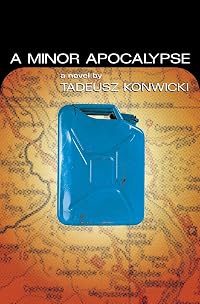
A Minor Apocalypse
by Tadeusz Konwicki
On This Page
Description
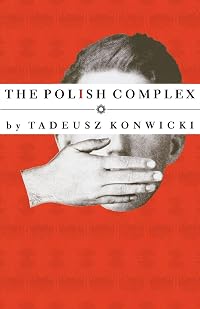
As in his novel The Polish Complex, Konwicki's A Minor Apocalypse stars a narrator and character named Konwicki, who has been asked to set himself on fire that evening in front of the Communist Party headquarters in Warsaw in an act of protest. He accepts the commission, but without any clear idea of whether he will actually go through with the self-immolation. He spends the rest of the day wandering the streets of Warsaw, being tortured by the secret police and falling in love. Both himself show more and Everyman, the character-author experiences the effects of ideologies and bureaucracies gone insane with, as always in history, the individual struggling for survival rather than offering himself up on the pyre of the greater good. Brilliantly translated by Richard Lourie, A Minor Apocalypse is one of the most important novels to emerge from Poland in the last twenty five years. show lessTags
Recommendations















Member Reviews
This is a novel about the "end of the world" for an aging Polish writer named Konwicki who has built a reputation as a representative of the people in their battle against the oppressive Communist government and its Soviet allies. As we meet him he thinks about his night . It was one that when he went to sleep he began to "understand the meaning of existence, time, and the life beyond this one. I understand that mystery for a fraction of a second, through an instant of distant memories, a brief moment of consolation or fearful foreboding , and then plunge instantly into the depths of my bad dreams. . . I would give everything I possess -- to see that mystery in all its simplicity, to see it once and then to forget it forever." (p show more 6)
Konwicki is in reality doomed to forfeit his life for the cause, the uprising of activists, writers like himself, and other compatriots who oppose the State in Poland at the end of the 1970s. He is approached early on this day by his friends Rhysio and Hubert with the decision , made by others in his absence, that he must that evening immolate himself in front of the Congress building of the government.
This is not an act that he can agree to but neither is it one that he rejects. He spends the rest of his day, one that may be his last, thinking about the meaning of this act. At some point he acquires a can filled with specially prepared gasoline that he carries with him like a cross. As he walks through Warsaw he is challenged several times during the day by various levels of State police to prove his identity by providing his papers and answering annoying questions. The quotidian details of his day provide a picture of the rigid society in which he lives. He also meets another friend, Tadzio Skorko, and the love of his life Nadezhda.
At one point his last two friends walk past him without saying hello and he thinks, "I really do have one foot in the grave." (p 107)
The satire is present and heavy at times. The police are portrayed as buffoons yet the one time he is interrogated the scene is filled with brutal reality, both physical and mental. The State apparatus is clearly aware that something unusual is planned for this day.
The mixture of the quotidian details of the day and Konwicki's fleeting memories of his past relationships and writing provide a fascinating background for the impending horror of his death. There are allusions to Dante and Savonarola but the most pertinent and poignant is the following literary reference:
""You were created by this regime. You were excreted by the system, you're part of this tyranny's flesh and blood. You're like a character from Dostoevsky's The Possessed*, not from a Zeromski story or one by Strug.""(p 138)
As the day proceeds Konwicki's meditations on his existence and imminent death become more serious and, for the reader, more thought-provoking.
"A reckoning with my conscience. My act of contrition. Regret for my sins. My life story in the colors of mediocrity. At first I hated that mediocrity, disdained it, but in the end I made my home in it. Greatness in mediocrity. Mediocrity as the highest form of aristocracy. Mediocrity as asceticism, as proud isolation amid vulgarity, the gray habit of a proud monk. Mediocrity as the final stage of exaltation."(p 143)
I could conclude with that statement, for it is one that includes his life - greatness - the culture in which he lives - vulgarity - and his own isolation and coming exaltation. But the novel is not without lyrical passages, in spite of the gray vulgarity of living in that society. Not surprisingly it is Nadezhda who inspires the best of his lyricism:
"Saying nothing, without a single word, we rose from the cement step which was already absorbing the late-afternoon chill and we entered the silent nave of the editorial offices' ruins. . . The remains of the walls, partitions, and ceilings were lying in the middle of the building, piles of picturesque rubble which seemed arranged by some romantic architect. Astonishingly luxuriant vegetation had entwined itself around those hunks of cement and brick, those dunes of withered lime. The sun's oblique light made the large, blackish burdocks glow; it gilded the handsome ferns and lit the deadly nightshade bushes on fire. Even fall asters had stolen into that enchanted garden, which had overgrown the junk pile of what once had been editorial offices.
The stairs invited our eyes to the sky, which had grown distinctly opalescent now." (p 170)
This is a beautiful novel about the ultimate moment in one man's life. The narrator says it best:
"My testament. My lavish legacy to those I loved."
*Also translated as The Demons. show less
Konwicki is in reality doomed to forfeit his life for the cause, the uprising of activists, writers like himself, and other compatriots who oppose the State in Poland at the end of the 1970s. He is approached early on this day by his friends Rhysio and Hubert with the decision , made by others in his absence, that he must that evening immolate himself in front of the Congress building of the government.
This is not an act that he can agree to but neither is it one that he rejects. He spends the rest of his day, one that may be his last, thinking about the meaning of this act. At some point he acquires a can filled with specially prepared gasoline that he carries with him like a cross. As he walks through Warsaw he is challenged several times during the day by various levels of State police to prove his identity by providing his papers and answering annoying questions. The quotidian details of his day provide a picture of the rigid society in which he lives. He also meets another friend, Tadzio Skorko, and the love of his life Nadezhda.
At one point his last two friends walk past him without saying hello and he thinks, "I really do have one foot in the grave." (p 107)
The satire is present and heavy at times. The police are portrayed as buffoons yet the one time he is interrogated the scene is filled with brutal reality, both physical and mental. The State apparatus is clearly aware that something unusual is planned for this day.
The mixture of the quotidian details of the day and Konwicki's fleeting memories of his past relationships and writing provide a fascinating background for the impending horror of his death. There are allusions to Dante and Savonarola but the most pertinent and poignant is the following literary reference:
""You were created by this regime. You were excreted by the system, you're part of this tyranny's flesh and blood. You're like a character from Dostoevsky's The Possessed*, not from a Zeromski story or one by Strug.""(p 138)
As the day proceeds Konwicki's meditations on his existence and imminent death become more serious and, for the reader, more thought-provoking.
"A reckoning with my conscience. My act of contrition. Regret for my sins. My life story in the colors of mediocrity. At first I hated that mediocrity, disdained it, but in the end I made my home in it. Greatness in mediocrity. Mediocrity as the highest form of aristocracy. Mediocrity as asceticism, as proud isolation amid vulgarity, the gray habit of a proud monk. Mediocrity as the final stage of exaltation."(p 143)
I could conclude with that statement, for it is one that includes his life - greatness - the culture in which he lives - vulgarity - and his own isolation and coming exaltation. But the novel is not without lyrical passages, in spite of the gray vulgarity of living in that society. Not surprisingly it is Nadezhda who inspires the best of his lyricism:
"Saying nothing, without a single word, we rose from the cement step which was already absorbing the late-afternoon chill and we entered the silent nave of the editorial offices' ruins. . . The remains of the walls, partitions, and ceilings were lying in the middle of the building, piles of picturesque rubble which seemed arranged by some romantic architect. Astonishingly luxuriant vegetation had entwined itself around those hunks of cement and brick, those dunes of withered lime. The sun's oblique light made the large, blackish burdocks glow; it gilded the handsome ferns and lit the deadly nightshade bushes on fire. Even fall asters had stolen into that enchanted garden, which had overgrown the junk pile of what once had been editorial offices.
The stairs invited our eyes to the sky, which had grown distinctly opalescent now." (p 170)
This is a beautiful novel about the ultimate moment in one man's life. The narrator says it best:
"My testament. My lavish legacy to those I loved."
*Also translated as The Demons. show less
While this wasn't a natural selection for the holidays, I did elect to read this at Christmas; a time during my 20s when neither rigor or resignation were at hand: guess which one I chose? This novel had been discovered and purchased at Twice-Told and I read it in two days seated at Table Eight, pausing between espresso and pints of pilsner to ask Roger about Poland in the 1980s. What resulted was a gnawing sense of historical displacement and a need to publicly explore my worthlessness. I told my friends Steve and Craig that I was considering self-immolation at the Dickens on Main street Exhinition. Reasomns were listed and pints emptied. Finally i walked home. Thinking about that novel and its drifitng sense of time with TV announcers show more and clocks at constant opposition. It is amazing that I survived my 20s; thoughts to the Warsaw Pact remain another kettle entirely. show less
I can think of very few books since Kafka's best that capture the sense of sadness and futility of life as well as Konwicki does here.
It was alright. Had its moments where Konwicki's excellent word wizardry had me locked, and its moments where I may have skimmed a chapter here and there.
Used Book Entertainment
The previous owner of my copy has underlined certain words and put a X mark against those sentences, in red ink.
Here is the list of words from hell: X
jerk
goddamnit
twerp
Everything's fucked as fucked can be.
cunts
Old fart
fucking asshole
take a crap
Shit
son-of-a-bitch
lousy faggot
Sissies
fucking
kicked the shit out of
dink
faggot
comes off
I don't give a shit.
cabbagehead
kick his ass
boob
fucked
shit-ass
drag-ass
asshole
freak
Who the hell knows.
scum
erection
old bag
The hell with him.
turns me on
faggoty
budding tits
dick
slob
These words are bad.
Ratings
Members
- Recently Added By
Lists

Novels set over the course of a single day (or less)
72 works; 8 members
Author Information

37 Works 827 Members
Tadeusz Konwicki was born on June 22, 1926 in Nowa Wilejka, Wilenskie, Poland. He was raised by extended family because his father died when he was three years old and his mother was persistently ailing. With the outbreak of World War II, he was forced to leave high school when the Nazis forbade Poles to attend school. He finished his class work show more clandestinely. He was conscripted into a Nazi labor force and worked clearing a forest before escaping and joining the resistance movement. After the war, he studied in Krakow and then in Warsaw but never graduated from college. He became a reporter and critic, writing mainly about film, and began to write short stories and novels. His novels included The Hole in the Sky, The Dreambook of Our Time, The Polish Complex, and A Minor Apocalypse, which is required reading for all Polish high school students. He was also a filmmaker. His film Last Day of Summer won the Grand Prix at the International Festival of Documentary and Short Feature Films in Venice. He died on January 7, 2015 at the age of 88. (Bowker Author Biography) show less
Some Editions
Awards and Honors
Awards
Notable Lists
Series
Belongs to Publisher Series
Common Knowledge
- Canonical title
- A Minor Apocalypse
- Original title
- Mała apokalipsa
- Original publication date
- 1979
- People/Characters
- Narrator; Hubert; Rysio; Kolka Nachalow; Halina; Nadezhda (show all 7); Tadzio Skorko
- Important places
- Warsaw, Poland
- Important events
- Apocalypse
- Related movies
- La petite apocalypse (1993 | IMDb)
- First words
- Here comes the end of the world.
- Quotations
- I was thinking about the fragile chain of chemical reactions which causes my eyelid to rise, my stomach to rumble, the skin on my forehead to wrinkle, or makes the ordinary bladder creak with muffled pain. It causes that rus... (show all)h of words and images we call thoughts inside or outside of my head, it causes a cloud of waves - longing, a spasm of hatred - to appear; it causes a missile of fear of the eternal unknown to be shot out into space or fires a cartridge of pleasure of knowing a morsel of truth.
The cigarette before breakfast tastes the best. It shortens your life. For many years know, I have been shortening my life. Everybody shortens their existence on the sly. There must be something to all that. Some command... (show all) from above, or perhaps a law of nature in this overpopulated world.
When I pray, skittish, blasphemous thoughts buzz about my head. I shoo them away, though they are only the measure of my modest knowledge seen against the enormous, old-fashioned structure of religious axioms encrusted in th... (show all)at dreary and melancholy edifice erected by people in epochs which were bright and dark, good and cruel.
A cigarette on an empty stomach is bad for you, but a hundred grams of potato vodka is death itself. Or maybe it's better.
No one knows the date, because for years they've been moving it, sometimes ahead, sometimes back. At one moment they're chasing the West, then they pass it, then they're chasing it again, and then they're behind again. Ever... (show all)y branch of industry, every institution, every state farm had its own calendar and had to struggle with it. Five moths ahead, then twelve back. 1974 turns into 1972, then 1977 becomes 1979. Everything got all screwed up. We're still going around the sun, but it's a horrible mess.
It wasn't only on work but on life's joys that I wore myself out. I wore myself out looking at the thrilling beauty of the sunrise and with love for the women I so desperately desired. I wore myself out taking transient suc... (show all)cesses from the hands of fate and praying to God in gratitude. I even wore myself out in my dreams when I tore myself away from the earth and sailed off to the far islands of the paradise promised to us. But everyone else was wearing themselves out along with me, with the exception of those who don't ever wear themselves out. But in all that suffering, the most painful suffering of all was the consciousness that it was all banal, had all been discovered a long time ago, and was known to all the generations past, all just a repeated series, stamped out by our genes.
The sudden, all-embracing certainty is that we, people, that biological river of flowing from nowhere into the next, we who have created God. Not in seven days, but through ages of glaciers and tropics, through ages of conti... (show all)nents being born and seas drying up, through centuries when the cerebral hemispheres developed and the gills died out, through evil centuries and good, through eras that have been fathomed and eras still sunk in mystery, throughout our human eternity we have created in toil, pain, and agony our God, the God of mercy and goodness, so that He would protect us against the evil of the universe, the cosmos, or even from that heavenly sky which strikes us with lightning bolts. So that He would protect us from ourselves.
God exists. A God formed of our electromagnetic waves or some other sort of waves, waves vibrating with our suffering, our despair, our anger. - Last words
- (Click to show. Warning: May contain spoilers.)People, give me strength. People...
- Original language*
- Pools
*Some information comes from Common Knowledge in other languages. Click "Edit" for more information.
Classifications
- Genres
- Fiction and Literature, General Fiction
- DDC/MDS
- 891.8 — Literature & rhetoric Literatures of other languages East Indo-European and Celtic literatures West and South Slavic languages (Bulgarian, Slovene, Polish, Czech, Slovak, Serbo-Croatian, and Macedonian)
- LCC
- PG7158 .K6513 .M313 — Language and Literature Slavic languages and literatures. Baltic languages. Albanian language Slavic. Baltic. Albanian Slavic Polish
- BISAC
Statistics
- Members
- 242
- Popularity
- 133,894
- Reviews
- 5
- Rating
- (3.53)
- Languages
- 11 — Danish, Dutch, English, Finnish, French, Lithuanian, Norwegian, Polish, Romanian, Spanish, Swedish
- Media
- Paper
- ISBNs
- 22
- ASINs
- 1