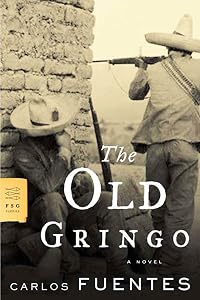
The Old Gringo
by Carlos Fuentes
On This Page
Description
Set during the Mexican Revolution, a frustrated spinster, a retired journalist, and a fiery young general are inexplicably drawn together as they face love, death and war.Tags
Recommendations










Member Reviews
First line:
~ Now she sits alone and remembers ~
This was an odd book.
I found the writing lyrical, poetic and, as a result of that, really enjoyed it. It read like a fairy tale a lot of the time. However it was an odd book.
I appreciated the depiction of the culture of the Mexican revolution and the cultural differences of the two Americans in the story. I was thoroughly caught up in the story of Ambrose Bierce and the fact that he was a real person who, virtually disappeared into Mexico and was never heard from again.
I did find some it confusing and so that is why I am not giving it a higher rating. Enjoyed it though!
~ Now she sits alone and remembers ~
This was an odd book.
I found the writing lyrical, poetic and, as a result of that, really enjoyed it. It read like a fairy tale a lot of the time. However it was an odd book.
I appreciated the depiction of the culture of the Mexican revolution and the cultural differences of the two Americans in the story. I was thoroughly caught up in the story of Ambrose Bierce and the fact that he was a real person who, virtually disappeared into Mexico and was never heard from again.
I did find some it confusing and so that is why I am not giving it a higher rating. Enjoyed it though!
The novel is framed as the reminiscence of a woman. An old journalist heads to Mexico during the time of the Mexican Revolution seeking, not a story, but his death. He joins with a band of Pancho Villa’s guerilla fighters, led by General Tomas Arroyo, and witnesses events as they destroy all but the mirrored ballroom of a once great hacienda. And there he encounters a white woman, Harriet Winslow. Harriet had been hired as a governess for the owner’s children, but they had all fled by the time she arrived from the US, and now she is stranded and yet determined to stay and defend the property as best she can.
There has been much praise for this work; it was the first translated work by a Mexican author to become a bestseller in the show more United States. But I had great difficulty engaging with the characters and the plot, such as it was.
Fuentes interrupts the action with long stream-of-conciousness soliloquies by each of his characters. Some of these consist of one long sentence that takes more than a page of text to get through. Now, I’ve read other works with a similar technique – Jose Saramago’s works come to mind – and I’ve enjoyed them. But in this book, I felt that these interludes did nothing so much as interrupt the meager story and make me like the book even less.
Then there are the sex scenes. I’ll say this for Fuentes, he doesn’t pull any punches. But he also has NO IDEA how women think or what motivates them to act the way they do. These are nothing but a macho man’s fantasy. Enough said.
The Old Gringo in the story is based on Ambrose Bierce, an historical figure who disappeared shortly after he travelled to Mexico during that country’s revolution. But the name is mentioned only once towards the very end of the book. show less
There has been much praise for this work; it was the first translated work by a Mexican author to become a bestseller in the show more United States. But I had great difficulty engaging with the characters and the plot, such as it was.
Fuentes interrupts the action with long stream-of-conciousness soliloquies by each of his characters. Some of these consist of one long sentence that takes more than a page of text to get through. Now, I’ve read other works with a similar technique – Jose Saramago’s works come to mind – and I’ve enjoyed them. But in this book, I felt that these interludes did nothing so much as interrupt the meager story and make me like the book even less.
Then there are the sex scenes. I’ll say this for Fuentes, he doesn’t pull any punches. But he also has NO IDEA how women think or what motivates them to act the way they do. These are nothing but a macho man’s fantasy. Enough said.
The Old Gringo in the story is based on Ambrose Bierce, an historical figure who disappeared shortly after he travelled to Mexico during that country’s revolution. But the name is mentioned only once towards the very end of the book. show less
There's a reason why Fuentes is one of my favorite novelists, and it's probably because he can pick up where history has left off, intertwining stories from our collective unconscious with imaginary personal testimonials. This is his vision of what happened to Ambrose Bierce, a journalist from the late 19th-/early 20th-century, after his disappearance into Mexico during the revolution. It uses a visceral language as a springboard for what is essentially a nostalgic journey, seamlessly bringing together the reality of what has been and the fantasy of what could be.
Everything about this story was deceiving. Despite the fact it was written in 1985 it has an old world language and culture to it. The time frame is supposed to take place in 1914 but to read it, it wasn't full of new language trying to sound ancient. Despite the fact it is only 199 pages long it was packed with histories of places and people, cultures and religions. The language was both accessible and challenging. It reminded me of fun house mirrors. Not everything was as it seemed.
Ambrose Bierce is an American writer and soldier traveling to Mexico to die. He is known throughout the story as simply the Old Gringo. Once in Mexico he meets several characters with equally troubling, mysterious stories. Tomas Arroyo is a Villa general show more who gives the Old Gringo competition when vying for the attention of Harriet Winslow, another American who came to Mexico to teach English. All the characters have a past they can't forget and a future they can't escape. The Old Gringo tells the story of these personalities with the same passion used to describe the Mexican landscape. In the end, the Old Gringo does die, but it is worth the read because there is definitely more to the story than that. show less
Ambrose Bierce is an American writer and soldier traveling to Mexico to die. He is known throughout the story as simply the Old Gringo. Once in Mexico he meets several characters with equally troubling, mysterious stories. Tomas Arroyo is a Villa general show more who gives the Old Gringo competition when vying for the attention of Harriet Winslow, another American who came to Mexico to teach English. All the characters have a past they can't forget and a future they can't escape. The Old Gringo tells the story of these personalities with the same passion used to describe the Mexican landscape. In the end, the Old Gringo does die, but it is worth the read because there is definitely more to the story than that. show less
Wow! I loved this book. Fuentes' writing is amazing: dreamy, brutally honest, sensual. I expected the story to be more about the Revolution and Ambrose Bierce than it was. Instead I found a romance, an exploration of loss and pain, reconciliation with the past, and a tale of loneliness and humanity. I got a general sense that at least metaphorically it was also about relations between Mexico and the United States, but I don't think it really sank in for me. 4.5 stars.
I am looking forward to more of Fuentes' works. He is one of my new favorite writers.
I am looking forward to more of Fuentes' works. He is one of my new favorite writers.
The old gringo is a former journalist who lost everything due in part to his job. In his own words, he is "A contemptable, muckraking reporter at the service of a baron of the press as corrupt as any I denounced in his name, I attacked the honor and dishonor of all men, without distinction. In my time, I was feared and hated." As a reporter, he also saw many events which disturbed him greatly. As an old man, he comes to Mexico with a mission, to die, to make amends and to fight with Pancho Villa. Only some of his goals are achieved.
Would I recommend................Although I found some of the story muddled with memories most of the novel is written with stark clarity. It's the muddle that prohibited me from giving this novel a 5/5 but show more it came very, very close. I look forward to reading more of Fuentes in the future. show less
Would I recommend................Although I found some of the story muddled with memories most of the novel is written with stark clarity. It's the muddle that prohibited me from giving this novel a 5/5 but show more it came very, very close. I look forward to reading more of Fuentes in the future. show less
The Old Gringo is a biographical novel about the alleged disappearance of Ambrose Bierce in Mexico during the revolution. Bierce travels to Mexico because he wants to be killed--and to be a good-looking corpse. Despite these simple desires, Bierce ends up in a dangerous triangle with a General of the Revolution and an American woman. This is a very difficult book to review because it is so deeply symbolic. I think the main idea is that life is like a dream--a dream in which people are prisoners of their pasts. Because of the dream-like quality of the prose, the book is heavy reading; it's not for everybody. However, those who appreciate symbolic and tragic literature will certainly enjoy The Old Gringo.
Members
- Recently Added By
Lists

Read These Too
458 works; 9 members
Talk Discussions
Past Discussions
Fun with Fuentes: Group Read of The Old Gringo in 75 Books Challenge for 2012 (July 2012)
Author Information

198+ Works 15,023 Members
Carlos Fuentes was born in Panama on November 11, 1928. He studied law at the National University of Mexico and did graduate work at the Institute des Hautes Etudes in Switzerland. He entered Mexico's diplomatic service and wrote in his spare time. His first novel, Where the Air Is Clear, was published in 1958. His other works include The Death of show more Artemio Cruz, Destiny and Desire, and Vlad. The Old Gringo was later adapted as a film starring Gregory Peck and Jane Fonda in 1989. He won numerous awards including the Fuentes the Romulo Gallegos Prize in Venezuela for Terra Nostra, the National Order of Merit in France, the Cervantes Prize in 1987, and Spain's Prince of Asturias Award for literature in 1994. He also wrote essays, short stories, screenplays, and political nonfiction. In addition to writing, he taught at numerous universities, including Columbia, Harvard, Princeton, and Brown. He served as the ambassador of Mexico to France. He died on May 15, 2012 at the age of 83. (Bowker Author Biography) show less
Some Editions
Awards and Honors
Awards
Series
Belongs to Publisher Series
Work Relationships
Is contained in
Has the adaptation
Has as a student's study guide
Common Knowledge
- Canonical title
- The Old Gringo
- Original title
- Gringo viejo
- Original publication date
- 1985 (1e édition originale espagnole) (1e édition originale espagnole); 1986-05-02 (1e traduction et édition française, Du monde entier, Gallimard) (1e traduction et édition française, Du monde entier, Gallimard); 1990-01-23 (Réédition française, Folio, Gallimard) (Réédition française, Folio, Gallimard)
- People/Characters
- Ambrose Bierce; Harriet Winslow; General Tomas Arroyo; Pancho Villa
- Important places
- Mexico
- Related movies
- Old Gringo (1989 | IMDb)
- Epigraph
- But who knows the fate of his bones
or how often he is to be buried?
--Sir Thomas Browne
What they call dying
is merely the last pain.
--Ambrose Bierce - Dedication
- To William Styron whose father included me in his dreams of the American Civil War.
- First words
- Now she sits alone and remembers.
- Last words
- (Click to show. Warning: May contain spoilers.)Now she sits alone and remembers.
- Original language*
- Espagnol (Mexique) (Mexique)
*Some information comes from Common Knowledge in other languages. Click "Edit" for more information.
Classifications
- Genres
- General Fiction, Fiction and Literature, Historical Fiction
- DDC/MDS
- 863 — Literature & rhetoric Spanish Literature Spanish fiction
- LCC
- PQ7297 .F793 .G713 — Language and Literature French, Italian, Spanish and Portuguese literatures Spanish literature Provincial, local, colonial, etc. Spanish America
- BISAC
Statistics
- Members
- 1,243
- Popularity
- 19,817
- Reviews
- 28
- Rating
- (3.48)
- Languages
- 18 — Czech, Danish, Dutch, English, Finnish, French, German, Italian, Japanese, Norwegian (Bokmål), Polish, Portuguese, Romanian, Russian, Serbian, Spanish, Swedish, Turkish
- Media
- Paper, Audiobook, Ebook
- ISBNs
- 62
- ASINs
- 19