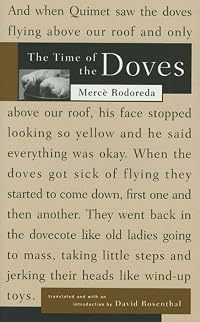
In Diamond Square
by Mercè Rodoreda
On This Page
Description
Barcelona, early 1930s: Natalia, a pretty shop-girl from the working-class quarter of Gracia, is hesitant when a stranger asks her to dance at the fiesta in Diamond Square. But Joe is charming and forceful, and she takes his hand. They marry and soon have two children; for Natalia it is an awakening, both good and bad. When Joe decides to breed pigeons, the birds delight his son and daughter - and infuriate his wife. Then the Spanish Civil War erupts, and lays waste to the city and to their show more simple existence. Natalia remains in Barcelona, struggling to feed her family, while Joe goes to fight the fascists, and one by one his beloved birds fly away. A highly acclaimed classic that has been translated into more than twenty languages, In Diamond Square is the moving, vivid and powerful story of a woman caught up in a convulsive period of history. show lessTags
Recommendations




















Member Recommendations
charl08 Powerful evocation of Barcelona's history through fiction.
Member Reviews
At the beginning of La plaza del diamante Natalia is convinced by her friend to go to a holiday celebration at the plaza, where she meets a man named Quimet who comes on to her pretty strongly. He tells her that he's going to call her "Colometa" (Catalan for "Little Dove") and he asserts that she'll be his wife. This proves to be the case, as he brusquely takes over her life and molds her in the image he desires. Pretty soon they're married and he's raising pigeons on the rooftop and they have a couple of children. She's never very happy with their life (it doesn't really seem like her life) and he's kind of a jerk. It's funny when he gets a really long tapeworm and passes it and comments that now he's given birth, just like her. His show more work as a furniture maker/repairer isn't going so well, so eventually she has to take a job in the house of a wealthy Barcelona family that lives off the rents from its real estate holdings. It's a strange house, and she never quite feels at ease there. Then the war comes, Quimet joins the Republican forces, and Natalia is left in the city with the children. After the war comes scarcity and hunger, and Natalia is deeply depressed. Eventually things turn around. New people enter her life and she starts to figure out her place in the world of postwar Barcelona.
I really enjoyed this book. Natalia/Colometa is a compelling character and I thought the author did a great job of putting me in her shoes as she progresses through life. I was satisfied by the way she finds herself/comes to some sort of understanding about who she is over the course of the novel. There's an epigraph at the beginning of the novel that states "My dear, these things are life", and much of Natalia's story is told in the context of the objects that surround her and encroach upon her life. Even the novel's opening, where her friend convinces her to go to the plaza, incorporates things, in this case the domestic items that are going to be raffled during the festivities. There's an extended chapter that describes the house where Natalia goes to work and how disorienting its structures are; nothing seems to fit together into a coherent whole, and she eventually admits that she was never able to make sense of that house. The whole book, in a way, is a bit like that: she struggles to fit things together and make sense of a world made up of countless disparate parts, whether they be people or any of the household items that are referenced throughout the book. The beginning, where she loses her identity in a way by meeting Quimet and becoming his woman with the name he chose for her, puts her at zero in a way. She has to figure out who she is in relation to her husband, his family, and her new role as wife and mother. She then spends the book on a sort of individual quest to find herself, eventually ceasing to be Colometa and becoming Natalia again, and coming to understand how she can transcend that other identity, which was imposed on her and which she struggled to mold herself to fit.
I read this book in the middle of a series of Spanish books from the 20th century that were, in a sense, very "Literary": they alluded to other books, incorporated portions of poems and popular songs, and even had real-life figures such as Rubén Darío or Miguel de Unamuno appear in their pages. La plaza del diamante is pretty much free of all intertextual references, unless you want to count the epigraph and the repeated mentions of a painting that hangs on the wall of Colometa's neighbor's home. I liked this nakedness, the way that the text stood alone without making explicit connections to other literary works. The Spanish tradition, with Don Quixote exerting its heavy influence, seems to be full of books that are about other books, and the whole art within art angle is something I really enjoy about peninsular literature. Maybe all countries share this tendency to some extent, but it's my hunch that Spain goes above and beyond in this regard. Also, it may be that I'm just invariably drawn to books that are a part of a certain academic tradition where intertextuality is much-appreciated and-applauded. Here, however, is a book that does not participate in that linking of texts to other texts. It's a sophisticated book, and I really felt like I was experiencing life through Natalia's eyes; maybe the point is that those eyes are much more trained on the objects that surround her in the world than on the letters printed on the pages of books. show less
I really enjoyed this book. Natalia/Colometa is a compelling character and I thought the author did a great job of putting me in her shoes as she progresses through life. I was satisfied by the way she finds herself/comes to some sort of understanding about who she is over the course of the novel. There's an epigraph at the beginning of the novel that states "My dear, these things are life", and much of Natalia's story is told in the context of the objects that surround her and encroach upon her life. Even the novel's opening, where her friend convinces her to go to the plaza, incorporates things, in this case the domestic items that are going to be raffled during the festivities. There's an extended chapter that describes the house where Natalia goes to work and how disorienting its structures are; nothing seems to fit together into a coherent whole, and she eventually admits that she was never able to make sense of that house. The whole book, in a way, is a bit like that: she struggles to fit things together and make sense of a world made up of countless disparate parts, whether they be people or any of the household items that are referenced throughout the book. The beginning, where she loses her identity in a way by meeting Quimet and becoming his woman with the name he chose for her, puts her at zero in a way. She has to figure out who she is in relation to her husband, his family, and her new role as wife and mother. She then spends the book on a sort of individual quest to find herself, eventually ceasing to be Colometa and becoming Natalia again, and coming to understand how she can transcend that other identity, which was imposed on her and which she struggled to mold herself to fit.
I read this book in the middle of a series of Spanish books from the 20th century that were, in a sense, very "Literary": they alluded to other books, incorporated portions of poems and popular songs, and even had real-life figures such as Rubén Darío or Miguel de Unamuno appear in their pages. La plaza del diamante is pretty much free of all intertextual references, unless you want to count the epigraph and the repeated mentions of a painting that hangs on the wall of Colometa's neighbor's home. I liked this nakedness, the way that the text stood alone without making explicit connections to other literary works. The Spanish tradition, with Don Quixote exerting its heavy influence, seems to be full of books that are about other books, and the whole art within art angle is something I really enjoy about peninsular literature. Maybe all countries share this tendency to some extent, but it's my hunch that Spain goes above and beyond in this regard. Also, it may be that I'm just invariably drawn to books that are a part of a certain academic tradition where intertextuality is much-appreciated and-applauded. Here, however, is a book that does not participate in that linking of texts to other texts. It's a sophisticated book, and I really felt like I was experiencing life through Natalia's eyes; maybe the point is that those eyes are much more trained on the objects that surround her in the world than on the letters printed on the pages of books. show less
Thanks to GR friend Dolors for recommending this author.
"Life is not meant to be easy, but it is our resilience that makes it worth living."
Catalan writer Merce Rodoreda's novel of the Spanish Civil War focuses on its effects on the people at the margins, the workers living from paycheck to paycheck. Natalia, whose mother died early in her childhood, worked as a bakery clerk in Barcelona. She met Quimet, a furniture maker who swept her into marriage, motherhood, and a life of waiting on him hand and foot. When his furniture-making shop began to fail, Natalia took a job cleaning for a wealthy family, leaving their young son and daughter alone in their apartment for long periods.
Then the Civil War began. Quimet and his friends joined the show more resistance, and Natalia lost her cleaning job. At first, Quimet returned with food for his family or sent food to them via his friends. However, he soon disappeared, and Natalia was left to try to find a way for her family to survive. Rodoreda's low-key stream-of-consciousness narrative effectively chronicles Natalia's battle against despair. The Time of the Doves is a powerful and moving novel that demonstrates the psychological trauma of war on civilians.
Highly recommend. show less
"Life is not meant to be easy, but it is our resilience that makes it worth living."
Catalan writer Merce Rodoreda's novel of the Spanish Civil War focuses on its effects on the people at the margins, the workers living from paycheck to paycheck. Natalia, whose mother died early in her childhood, worked as a bakery clerk in Barcelona. She met Quimet, a furniture maker who swept her into marriage, motherhood, and a life of waiting on him hand and foot. When his furniture-making shop began to fail, Natalia took a job cleaning for a wealthy family, leaving their young son and daughter alone in their apartment for long periods.
Then the Civil War began. Quimet and his friends joined the show more resistance, and Natalia lost her cleaning job. At first, Quimet returned with food for his family or sent food to them via his friends. However, he soon disappeared, and Natalia was left to try to find a way for her family to survive. Rodoreda's low-key stream-of-consciousness narrative effectively chronicles Natalia's battle against despair. The Time of the Doves is a powerful and moving novel that demonstrates the psychological trauma of war on civilians.
Highly recommend. show less
Acho que o que mais salta aos olhos na escrita de Rodoreda especificamente neste livro é como a narrativa começa leve e divertida com o uso da linguagem e simbolismo refletindo isso, para se tornar soturna e pesada na mesma proporção. A questão dos pombos é o que mais brilha no simbolismo poético, desde o apelido da narradora conseguido num momento mais feliz de sua vida até a guerra caótica que trava com os pombos num microespaço da Guerra Civil Espanhola. Um belo livro realmente.
This novel is widely considered to be one of the greatest works of Catalan literature, and an evocative portrait of life in Barcelona during and after the Spanish Civil War. It is set almost entirely in the city's Gràcia neighborhood and is narrated by Natalia, a simple and attractive young woman who works in a small shop there. She lives from day to day, with little concern of her future or the larger world outside of Gràcia, as she is largely unaware of the political turmoil and imminent danger facing the citizens of Barcelona and Catalonia as those loyal to the government and nationalists led by Francisco Franco begin to take sides against each other.
Natalia meets Quimet, a spirited young carpenter, on La Plaça del Diamant, who show more doggedly pursues and ultimately weds her. The marriage is a not completely blissful one for Natalia, as Quimet is a paternalistic, dismissive and unaffectionate husband, although he is apparently loyal to her and loves the two children she gives them. Quimet insists that raising doves will be their ticket out of poverty, and he builds a dovecote on the top of their apartment to the chagrin of Natalia, as the doves' home comes as the expense of her private work space. She tolerates this intrusion with resentment, which is followed by a surprising act of silent protest.
Quimet joins the Nationalists as war breaks out, and Natalia is left to fend for herself and her children. As the stress of poverty and the uncertainty of Quimet's fate haunts her, she realizes that no one will come to her aid in the besieged city where everyone is struggling to find enough food to eat. At her most desperate moment she is rescued by a kindly older man who takes her and her children under his wing. She is driven nearly to madness, but the experience emboldens and matures her, yet it is one that scars and continues to disturb her for the remainder of the story.
The Time of the Doves is largely narrated by Natalia, in a breathless manner of a woman who is overwhelmed by life, yet manages to overcome obstacles and survive tragedy. Hers is a sad and tragic story, but through it Rodoreda permits the reader a look at the lives of ordinary citizens helplessly caught up in political events, war and its aftermath. I found the first half of the book mildly interesting at best, but the second half was a much more compelling read, as Natalia's personal misfortunes threaten her sanity and the lives of her children. I was sorry to see this novel come to an end, and I will likely get to it again soon, as I suspect that it will be considerably more rewarding on a second reading. show less
Natalia meets Quimet, a spirited young carpenter, on La Plaça del Diamant, who show more doggedly pursues and ultimately weds her. The marriage is a not completely blissful one for Natalia, as Quimet is a paternalistic, dismissive and unaffectionate husband, although he is apparently loyal to her and loves the two children she gives them. Quimet insists that raising doves will be their ticket out of poverty, and he builds a dovecote on the top of their apartment to the chagrin of Natalia, as the doves' home comes as the expense of her private work space. She tolerates this intrusion with resentment, which is followed by a surprising act of silent protest.
Quimet joins the Nationalists as war breaks out, and Natalia is left to fend for herself and her children. As the stress of poverty and the uncertainty of Quimet's fate haunts her, she realizes that no one will come to her aid in the besieged city where everyone is struggling to find enough food to eat. At her most desperate moment she is rescued by a kindly older man who takes her and her children under his wing. She is driven nearly to madness, but the experience emboldens and matures her, yet it is one that scars and continues to disturb her for the remainder of the story.
The Time of the Doves is largely narrated by Natalia, in a breathless manner of a woman who is overwhelmed by life, yet manages to overcome obstacles and survive tragedy. Hers is a sad and tragic story, but through it Rodoreda permits the reader a look at the lives of ordinary citizens helplessly caught up in political events, war and its aftermath. I found the first half of the book mildly interesting at best, but the second half was a much more compelling read, as Natalia's personal misfortunes threaten her sanity and the lives of her children. I was sorry to see this novel come to an end, and I will likely get to it again soon, as I suspect that it will be considerably more rewarding on a second reading. show less
The Time of the Doves tells about the Spanish Civil War from a working class female point of view using stream of consciousness prose and grippingly vivid storytelling that assaults the senses. It takes place in Barcelona and was written in Catalan. This is maybe the best novel ever, even in translation, like Woolf meets Stein crossed with Graham Greene. Rodoreda seems to carve words as if they are made of physical material to construct a place and time that make you feel you can see, hear and taste the world her characters live. The sadness of history is captured here; you will cry real tears. I've never read anything quite like it. Utterly beautiful and profoundly moving. Life and Death and Love and War.
This is an incredibly depressing book. It's just relentless misery, all the time. From the very beginning, our narrator's life is miserable, and as time progresses things get worse and worse, until towards the end she finally gets a slight reprieve.
So I didn't find this book very satisfying. I read it over three reading sessions, and it seemed that the novel changed a lot between each of those sessions (even though the points where I stopped were not-particularly-remarkable chapter breaks).
For the first third, the thing that stood out to me was the abusive marriage that Natalia, or Pidgey, was stuck in.Her husband Joe was written so deliberately to be a controlling and emotionally abusive man that I thought it was going to become a show more plot point at some point, but... no. Perhaps my expectations were raised because it was right there in the introduction that she was going to marry a second time, which I thought meant she was going to find some agency and leave the worthless turd she was married to. Unfortunately not. His behaviour is never really acknowledged as controlling or anything either, which of course reflects the fact that Natalia doesn't have a lot of agency, and just accepts nearly everything that happens to her. She never questions her husband's behaviour, which doesn't mean that the author doesn't, because after all, she laid it out so plainly. But even so, it made it hard for me to get invested in the story – like, it was hard to barrack for Natalia when she wasn't even barracking for herself.
And then there is the second part – my reading session that took me up to 58% – which was just characterised by an overload of pigeons. Apparently (according to the introduction, again) this was actually Mercè Rodoreda's original vision for the novel; she wanted to write about someone completely surrounded by pigeons, and she made up the rest of the novel to work around this vision. I think this novel is an excellent example of how this is a terrible way to design a novel. Also,her violence towards the pigeons – like shaking the eggs to kill the pigeons before they hatched – kind of really disturbed me.
Finally, there is the war, and the consequences of that. Her thoroughly unlikeable husband goes off to fight against the fascists, which you could consider an attempt to show us that "even bad people can do good things", except that the novel thoroughly equates the fascists and the workers' revolution anyway. Bourgeois characters are given space to make their idiotic arguments (like "without the rich, the poor could not survive" – because history has shown how trickle-down economics works so well) and I can't recall any arguments ever being made in favour of the revolution. It's true that Natalia never really supports the fascists, because she's so busy trying to avoid starvation, but there are other characters supporting the fascists on the basis that it'll end the war and end starvation... so. That link is still made, just weakly.
I guess what bothered me about this is that the novel depoliticised a deeply, and integrally political conflict. This is something that depictions of the Spanish Civil War do a lot, and I think it's appalling, because if these are the only depictions accessible to you (which they basically are) then you're going to come away not even knowing what the war was.
I don't think this is a bad novel, but it definitely wasn't my type of novel, being depoliticised with a very weak protagonist. These may be valid choices, but they don't sit well with me.
Edit: Just one final comment – I wasn't really a fan of the translation; it seemed like the translator got over-excited and translated lots of things he shouldn't have, like people's names. Maybe Pidgey instead of Colometa was acceptable (if "Colometa" has the same vibe as "Pidgey" in Catalan, which I'd assume it does), but I don't think there are many Joes, Matthews or Ernies running around Barcelona and that really took me out of the story. Also, some street or another got translated to High Street, but Passeig de Gràcia stayed as it was? Why?! It's not the kind of story that would work if you tried to transplant it somewhere other than Barcelona, so I don't get why you would translate all the names and most of the geographical landmarks. Like I said, it took me out of the story and made me feel like it was set in some weird fake and/or alternate-universe version of Barcelona, which can't have been the intention. show less
So I didn't find this book very satisfying. I read it over three reading sessions, and it seemed that the novel changed a lot between each of those sessions (even though the points where I stopped were not-particularly-remarkable chapter breaks).
For the first third, the thing that stood out to me was the abusive marriage that Natalia, or Pidgey, was stuck in.
And then there is the second part – my reading session that took me up to 58% – which was just characterised by an overload of pigeons. Apparently (according to the introduction, again) this was actually Mercè Rodoreda's original vision for the novel; she wanted to write about someone completely surrounded by pigeons, and she made up the rest of the novel to work around this vision. I think this novel is an excellent example of how this is a terrible way to design a novel. Also,
Finally, there is the war, and the consequences of that. Her thoroughly unlikeable husband goes off to fight against the fascists, which you could consider an attempt to show us that "even bad people can do good things", except that the novel thoroughly equates the fascists and the workers' revolution anyway. Bourgeois characters are given space to make their idiotic arguments (like "without the rich, the poor could not survive" – because history has shown how trickle-down economics works so well) and I can't recall any arguments ever being made in favour of the revolution. It's true that Natalia never really supports the fascists, because she's so busy trying to avoid starvation, but there are other characters supporting the fascists on the basis that it'll end the war and end starvation... so. That link is still made, just weakly.
I guess what bothered me about this is that the novel depoliticised a deeply, and integrally political conflict. This is something that depictions of the Spanish Civil War do a lot, and I think it's appalling, because if these are the only depictions accessible to you (which they basically are) then you're going to come away not even knowing what the war was.
I don't think this is a bad novel, but it definitely wasn't my type of novel, being depoliticised with a very weak protagonist. These may be valid choices, but they don't sit well with me.
Edit: Just one final comment – I wasn't really a fan of the translation; it seemed like the translator got over-excited and translated lots of things he shouldn't have, like people's names. Maybe Pidgey instead of Colometa was acceptable (if "Colometa" has the same vibe as "Pidgey" in Catalan, which I'd assume it does), but I don't think there are many Joes, Matthews or Ernies running around Barcelona and that really took me out of the story. Also, some street or another got translated to High Street, but Passeig de Gràcia stayed as it was? Why?! It's not the kind of story that would work if you tried to transplant it somewhere other than Barcelona, so I don't get why you would translate all the names and most of the geographical landmarks. Like I said, it took me out of the story and made me feel like it was set in some weird fake and/or alternate-universe version of Barcelona, which can't have been the intention. show less
I read this book for the Spotlight Series (which puts the spotlight on small press publishers by having bloggers read and review a book by a small press that they have chosen to feature for that month. The current spotlight is on Graywolf Press). I will post this review on my blog on July 31, 2010:
This book is about the experience of something big in the body of something small, small as a woman named Natalia. Because all big experiences, even marriage, even children, even war, even despair--because all of these show more big things are also little things, or it comes one little thing at a time--doves and eggs and the name Colometta or the smell of hydrochloric acid.
And though something big can be forgotten, can be silenced, can be inside deep like termites going from inside out instead of outside in, something small like blue lights or a cork or a picture of some lobsters, they stay with you in tiny shards just quiet-like. This book is about how to forget them.
All these small things are like a cork to stop up the big things but the big things get through anyway. The things not said, because it's too painful, or simply because our narrator is not very eloquent. She's in-eloquent not because she's stupid but because she's not totally aware of her feelings, at least through most of the novel. But that doesn't mean she's not able to move you, the reader, all the more for it.
So that's what this book felt like--just tiny experiences that slowly build up, with a whirlwind of characters and things and thoughts all written in a style that seems slightly dizzying because the sentences are long but not complicated, they are long in the way a Frank O'Hara poem is long, where you run out of breath by the end of the sentence with that inexplicable breathless urgency.
I thoroughly enjoyed this book and was glad that Spotlight on Small Presses gave me the extra nudge in the rear-end to finally read this wonderful Graywolf Press book (since it was already on my "to read" list). show less
"And as he was talking he'd run his fingernail along the crack in the table and dig out breadcrumbs that had gotten stuck there, and it seemed strange to me that he'd do something I did sometimes but that he'd never seen me do."
This book is about the experience of something big in the body of something small, small as a woman named Natalia. Because all big experiences, even marriage, even children, even war, even despair--because all of these show more big things are also little things, or it comes one little thing at a time--doves and eggs and the name Colometta or the smell of hydrochloric acid.
And though something big can be forgotten, can be silenced, can be inside deep like termites going from inside out instead of outside in, something small like blue lights or a cork or a picture of some lobsters, they stay with you in tiny shards just quiet-like. This book is about how to forget them.
"I'd learned to read and write and my mother'd gotten me used to wearing white clothes. I'd learned to read and write and I sold pastries and candy and chocolates and bonbons filled with liqueurs. And I could walk through the streets like a human being surrounded by other human beings. I'd learned to read and write and waited on people and helped them…"
All these small things are like a cork to stop up the big things but the big things get through anyway. The things not said, because it's too painful, or simply because our narrator is not very eloquent. She's in-eloquent not because she's stupid but because she's not totally aware of her feelings, at least through most of the novel. But that doesn't mean she's not able to move you, the reader, all the more for it.
So that's what this book felt like--just tiny experiences that slowly build up, with a whirlwind of characters and things and thoughts all written in a style that seems slightly dizzying because the sentences are long but not complicated, they are long in the way a Frank O'Hara poem is long, where you run out of breath by the end of the sentence with that inexplicable breathless urgency.
I thoroughly enjoyed this book and was glad that Spotlight on Small Presses gave me the extra nudge in the rear-end to finally read this wonderful Graywolf Press book (since it was already on my "to read" list). show less
Members
- Recently Added By
Published Reviews
added by xrm-rvo
Lists

Harold Bloom - The Western Canon: D. The Chaotic Age
833 works; 24 members

500 Great Books by Women
507 works; 60 members

Llibres que he llegit el 2017
49 works; 1 member

Llibres que he llegit el 2013
47 works; 1 member

Books translated from Romance Languages into English
102 works; 7 members

Books about the Spanish Civil War
57 works; 3 members

Female Author
1,234 works; 67 members

le donne raccontano
116 works; 1 member

Books Read in 2019
4,052 works; 110 members

Books written in uncommon languages
97 works; 8 members

Books Read in 2018
4,360 works; 110 members

Canon de la narrativa universal del s. XX (cicutadry)
499 works; 3 members
Author Information

Some Editions
Awards and Honors
Series
Belongs to Publisher Series
Work Relationships
Common Knowledge
- Canonical title
- In Diamond Square
- Original title
- La plaça del Diamant
- Alternate titles
- The Pigeon Girl; The Time of the Doves
- Original publication date
- 1962
- People/Characters*
- Julieta; Pere; Natàlia (Colometa); Quimet; Antoni; Rita (show all 11); Toni; Senyora Enriqueta; Cintet; Mateu; Vicenç
- Important places
- Barcelona, Catalonia, Spain; Catalonia, Spain
- Important events
- Spanish Civil War (1936 | 1939)
- Related movies*
- La plaça del Diamant (1982 | IMDb)
- Epigraph
- My dear, these things are life.
--GEORGE MEREDITH - Dedication
- To J.P.
- First words
- Julie came to the cake-shop just to tell me they would be raffling coffeepots before they got to the lucky posy; she's seen them and they were lovely, an orange split in two, showing its pips, painted on a white background.
In Diamond Square begins: 'Julie came to the cake-shop just to tell me they would be raffling coffeepots before they got to the lucky posy; she's seen them and they were lovely, an orange split in two, showing its pips... (show all), painted on a white background.' (Prologue) - Last words
- (Click to show. Warning: May contain spoilers.)Happy ...
(Click to show. Warning: May contain spoilers.)I must go and see what the wind and the flowers are doing. (Prologue) - Blurbers
- Toibin, Colm; Oyeyemi, Helen; Athill, Diana
- Original language
- Catalan
*Some information comes from Common Knowledge in other languages. Click "Edit" for more information.
Classifications
Statistics
- Members
- 1,288
- Popularity
- 18,932
- Reviews
- 46
- Rating
- (4.04)
- Languages
- 33 — Basque, Bulgarian, Catalan, Czech, Danish, Dutch, English, Estonian, Finnish, French, German, Galician, Greek, Hebrew, Hindi, Hungarian, Icelandic, Italian, Japanese, Lithuanian, Norwegian (Bokmål), Norwegian, Polish, Romanian, Russian, Serbian, Slovenian, Spanish, Swedish, Turkish, Portuguese (Portugal), Portuguese (Brazil), Chinese, simplified
- Media
- Paper, Audiobook, Ebook
- ISBNs
- 93
- ASINs
- 14