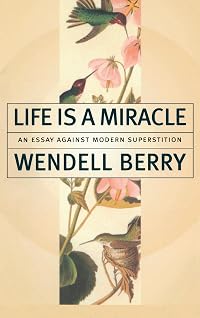
Life Is a Miracle: An Essay Against Modern Superstition
by Wendell Berry
On This Page
Description
"In Life is a Miracle, Wendell Berry urges us to begin a "conversation out of school." Believing we are on a course of arrogant and dangerous behavior in science and other intellectual disciplines, this proclamation against modern superstition recommends a shift in priorities and goals. Berry observes, "it is clearly bad for the sciences and the arts to be divided into 'two cultures.' It is bad for scientists to be working without a sense of obligation to cultural tradition. It is bad for show more artists and scholars in the humanities to be working without a sense of obligation to the world beyond the artifacts of culture." They must be the subjects of one complex conversation."--Jacket. show lessTags
Recommendations




Member Reviews
In this book Berry takes on the scientific establishment in its reductionist view of life. For Berry, life as a miracle means that there are some thing that cannot be put under a microscope and studied--nor should they be. Anyone reading The Selfish Gene owes it to themselves to be at least familiar with the arguments Berry makes here. Par fo the course, Berry tweaks the establishment in its funny bone, but also some other, more vulnerable places.
this song, essentially: https://www.youtube.com/watch?v=iGpoEPcmOK4
i appreciate the sentiment and i agree with regards towards corporate influence on the direction of scientific study (a point i wish was a bit more rigorously examined) and the whole could/should aspect. admittedly, he's not a scientist, though...and sometimes seems as if he's passionately swinging at air. he's upset that SCIENCE generalizes/abstracts things away and should instead consider the individual, yet he generalizes all scientific thought on the basis of one book and attacks that conception of SCIENCE (his annoyance at a strawman conceived in said book is not without irony?). he mentions discussions with a scientist friend of his and how they share similar views show more on the course of SCIENCE in current academia, and in fact this friend has also published a book in a similar vein to this one which I feel might prove more fruitful in its criticisms on the basis of its writer's greater expertise.
then again, the problem of SCIENCE itself is a bit of a red herring in this book as he's mostly pining for old days of hearth and homestead. he's more disturbed by things in general moving forward, quickly without caution, then SCIENCE in general and chastises certain forms of art for following that trend of experimentation derived from SCIENCE. and he advises a more active role of spirituality (in his case, mostly CHRISTIAN belief) in people's lives. the universe is a stage production and he doesn't wanna look behind the curtains, instead enjoy the show.
i liked the references to literature, especially King Lear, used throughout. Evocative, for sure.
well, it sounds like i am trying to dismantle his stance, but i do essentially agree with his important view on academic careerism and science of the sake of profit and the environment getting screwed over, but it seems he was mostly rallying against the harmful effects of CAPITALISM over SCIENCE. show less
i appreciate the sentiment and i agree with regards towards corporate influence on the direction of scientific study (a point i wish was a bit more rigorously examined) and the whole could/should aspect. admittedly, he's not a scientist, though...and sometimes seems as if he's passionately swinging at air. he's upset that SCIENCE generalizes/abstracts things away and should instead consider the individual, yet he generalizes all scientific thought on the basis of one book and attacks that conception of SCIENCE (his annoyance at a strawman conceived in said book is not without irony?). he mentions discussions with a scientist friend of his and how they share similar views show more on the course of SCIENCE in current academia, and in fact this friend has also published a book in a similar vein to this one which I feel might prove more fruitful in its criticisms on the basis of its writer's greater expertise.
then again, the problem of SCIENCE itself is a bit of a red herring in this book as he's mostly pining for old days of hearth and homestead. he's more disturbed by things in general moving forward, quickly without caution, then SCIENCE in general and chastises certain forms of art for following that trend of experimentation derived from SCIENCE. and he advises a more active role of spirituality (in his case, mostly CHRISTIAN belief) in people's lives. the universe is a stage production and he doesn't wanna look behind the curtains, instead enjoy the show.
i liked the references to literature, especially King Lear, used throughout. Evocative, for sure.
well, it sounds like i am trying to dismantle his stance, but i do essentially agree with his important view on academic careerism and science of the sake of profit and the environment getting screwed over, but it seems he was mostly rallying against the harmful effects of CAPITALISM over SCIENCE. show less
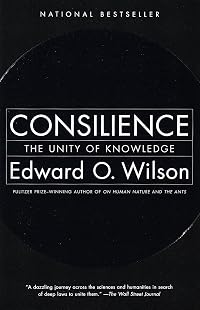
One of America's most respected and celebrated writers provides a thought-provoking analysis of, and a concise rebuttal of, E. O. Wilson's Consilience. "[A] scathing assessmentBerry shows that Wilson's much-celebrated, controversial pleas in Consilience to unify all branches of knowledge is nothing more than a fatuous subordination of religion, art, and everything else that is good to scienceBerry is one of the most perceptive critics of American society writing today. "-Lauren F. Winner, Washington Post Book World"I am tempted to say he understands [Consilience] better than Wilson himselfA new emancipation proclamation in which he speaks again and again about how to defy the tyranny of scientific materialism. "-Colin C. Campbell, show more Christian Science Monitor"Berry takes a wrecking ball to E. O. Wilson's Consilience, reducing its smug assumptions regarding the fusion of science, art, and religion to so much rubble. "-Kirkus ReviewsIn Life Is a Miracle, the devotion of science to the quantitative and reductionist world is measured against the mysterious, qualitative suggestions of religion and art. Berry sees life as the collision of these separate forces, but without all three in the mix we are left at sea in the world. show less
Wilson, Edward Osborne, 1929- Consilience/Philosophy and science/Philosophy
Ratings
Members
- Recently Added By
Author Information

160+ Works 24,888 Members
Wendell Berry The prolific poet, novelist, and essayist Wendell Berry is a fifth-generation native of north central Kentucky. Berry taught at Stanford University; traveled to Italy and France on a Guggenheim Fellowship; and taught at New York University and the University of Kentucky, Lexington, before moving to Henry County. Berry owns and show more operates Lanes Landing Farm, a small, hilly piece of property on the Kentucky River. He embraced full-time farming as a career, using horses and organic methods to tend the land. Harmony with nature in general, and the farming tradition in particular, is a central theme of Berry's diverse work. As a poet, Berry gained popularity within the literary community. Collected Poems, 1957-1982, was particularly well-received. Novels and short stories set in Port William, a fictional town paralleling his real-life home town of Port Royal further established his literary reputation. The Memory of Old Jack, Berry's third novel, received Chicago's Friends of American Writers Award for 1975. Berry reached his broadest audience and attained his greatest popular acclaim through his essays. The Unsettling of America: Culture and Agriculture is a springboard for contemporary environmental concerns. In his life as well as his art, Berry has advocated a responsible, contextual relationship with individuals in a local, agrarian economy. (Bowker Author Biography) show less
Common Knowledge
- Original publication date
- 2000
- Epigraph
- Thy life's a miracle. Speak yet again. King Lear, IV, vi, 55
- Dedication
- In memory:
Lionel Basney (1946 - 1999)
"We are not getting something for nothing. We are getting nothing for everything." - First words
- The expressed dissatisfaction of some scientists with the dangerous oversimplifications of commercialized science has encouraged me to hope that this dissatisfaction will run its full course.
- Last words
- (Click to show. Warning: May contain spoilers.)When the procession ends, so does the knowledge.
- Blurbers
- Abbey, Edward; Smith, Page; Little, Charles, E.; Perrin, Noel
Classifications
Statistics
- Members
- 633
- Popularity
- 46,188
- Reviews
- 4
- Rating
- (4.06)
- Languages
- English
- Media
- Paper, Ebook
- ISBNs
- 3