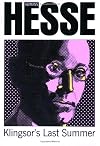
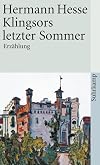
Klingsor's Last Summer
by Hermann Hesse
On This Page
Description
A child's heart.--Klein und Wagner.--Klingsor's last summer.Tags
Recommendations





















Member Recommendations
Member Reviews
“Klingsor’s Last Summer” is a novel about the final, painfully vivid season in the life of an Expressionist painter. It is constructed like a series of canvases: the separate parts are perceived as self-contained pictures, in which Hesse lays down “brushstrokes” — detail by detail, color by color. Because of this, reading resembles looking at a painting up close: at first the fragments seem disconnected, but gradually they assemble into one coherent canvas — a summer pushed to its limit.
In this rhythm, one sometimes gets the feeling that “nothing happens”: only vague images remain. But beneath this outward stillness an inner plot is constantly at work—Klingsor’s burning and his fear of the end. He understands that show more it is impossible to go on endlessly “burning the candle at both ends”: “no one can keep burning day and night all the time… it is coming to an end.” This is not merely a complaint of fatigue, but the key to his way of seeing: the world is beautiful precisely because it is diminishing, and therefore it must be seized now.
From this comes the novel’s important theme of replacing life with art. In the dialogues with Luigi, a cynical thought is voiced: painting is only a consoling substitute for a “missed life.” But Klingsor argues against this as an artist: the value lies not in what you do (love, write, drink), but in the degree of obsession, in the very act of “burning.” It is no accident that he formulates an almost manifesto-like statement: “To embrace a woman and to write poems are the same thing.”
The figure of Li Bai here becomes a symbol of that desired freedom. Klingsor chooses him as a “brother” in song and wine and literally tries the name on: Li Bai is “his favorite,” and when drunk he “called himself Li Bai.” But it is precisely through this mask that the text exposes the contradiction: Klingsor’s freedom is not calm, but painful. The Armenian astrologer tells him bluntly: “You have the right to call yourself Li Bai. But you… are a frightened man.” That is, Li Bai is not merely the “romance of drinking,” but a mirror: Klingsor wants to be free, but he is driven not by will, but by fear.
And the price of this life “at the limit” shows itself even in friendship: Klingsor understands too late that through uninhibited candor and weakness he himself destroys closeness with the only friend who understood him: “How short life was, how irrevocable everything was!.. Thus Klingsor reproached himself, too late.” In the end, for me the novel is not about events, but about a gaze: the gaze of a person who tries to turn fear of the end into freedom—through wine, art, and song — but each time runs up against the fact that you cannot escape yourself. show less
In this rhythm, one sometimes gets the feeling that “nothing happens”: only vague images remain. But beneath this outward stillness an inner plot is constantly at work—Klingsor’s burning and his fear of the end. He understands that show more it is impossible to go on endlessly “burning the candle at both ends”: “no one can keep burning day and night all the time… it is coming to an end.” This is not merely a complaint of fatigue, but the key to his way of seeing: the world is beautiful precisely because it is diminishing, and therefore it must be seized now.
From this comes the novel’s important theme of replacing life with art. In the dialogues with Luigi, a cynical thought is voiced: painting is only a consoling substitute for a “missed life.” But Klingsor argues against this as an artist: the value lies not in what you do (love, write, drink), but in the degree of obsession, in the very act of “burning.” It is no accident that he formulates an almost manifesto-like statement: “To embrace a woman and to write poems are the same thing.”
The figure of Li Bai here becomes a symbol of that desired freedom. Klingsor chooses him as a “brother” in song and wine and literally tries the name on: Li Bai is “his favorite,” and when drunk he “called himself Li Bai.” But it is precisely through this mask that the text exposes the contradiction: Klingsor’s freedom is not calm, but painful. The Armenian astrologer tells him bluntly: “You have the right to call yourself Li Bai. But you… are a frightened man.” That is, Li Bai is not merely the “romance of drinking,” but a mirror: Klingsor wants to be free, but he is driven not by will, but by fear.
And the price of this life “at the limit” shows itself even in friendship: Klingsor understands too late that through uninhibited candor and weakness he himself destroys closeness with the only friend who understood him: “How short life was, how irrevocable everything was!.. Thus Klingsor reproached himself, too late.” In the end, for me the novel is not about events, but about a gaze: the gaze of a person who tries to turn fear of the end into freedom—through wine, art, and song — but each time runs up against the fact that you cannot escape yourself. show less
Was it Leonardo who said that a painting is a poem you see and a poem a painting that you hear? What should I make then of a novella that tells of a painter’s last explosion of frenzied activity? Am I seeing it or hearing it?
Choose between life or art? Why not both while hurtling toward death?Hesse depicts Klingsor’s intoxication with the world his eyes take in, a rush that exceeds the drunkenness of his wine-soaked, song-filled nights. The names of the colors of his palette resound throughout like a mantra. The effect is poetic, which is uncanny since Hesse’s poems don’t impress me.
I was happy to let this book weave its spell on me, reading slowly to savor the writing. A perfect companion on a summery day in May.
Choose between life or art? Why not both while hurtling toward death?Hesse depicts Klingsor’s intoxication with the world his eyes take in, a rush that exceeds the drunkenness of his wine-soaked, song-filled nights. The names of the colors of his palette resound throughout like a mantra. The effect is poetic, which is uncanny since Hesse’s poems don’t impress me.
I was happy to let this book weave its spell on me, reading slowly to savor the writing. A perfect companion on a summery day in May.
I hadn't been aware of this early (1920) Hesse work before I found a slender used paperback copy in a used bookstore. It contains three short fictions, of which the third is the eponymous "Klingsor's Last Summer." I think it was the author's first published fiction after Demian, and it shows his attention to psychoanalytic concerns and the cultural aftermath of the First World War. More than once while reading it I was reminded of Huysmans' Au Rebours on account of the decadent, introspective subject matter, reinforced by the symbolic yellow of the Pan Books Picador cover art by Peter LeVasseur, which attempts to faithfully represent a scene from the last pages of the "Klingsor" story.
The first story of the set is "A Child's Heart," show more and it explores the hapless culpability of childhood hardening into ill-will and resentment. It is something of an outlier among the three under this cover because of the reminiscing first-person narrative voice. The whole story transpires over just a couple of days, and Hesse's thoroughly unsentimental representation of the boy's mentality is vivid and convincing.
The other two stories concern central characters who were about Hesse's age when he wrote the book, and in various features reflect his biography at the time. Unlike "A Child's Heart," though, they are written in third-person voices. The subject of "Klein and Wagner" is a Friedrich Klein, although he is living under a different, assumed name that isn't specified. The "Wagner" of the title is ambivalently the famous composer Richard and a contemporary schoolteacher named Wagner who was reported to have murdered his family and suicided. The tale culminates in a passage that cannot have been autobiographical, except possibly as catharsis for a contemplated course of events.
Wikipedia at the moment (January 2026) falsely calls "Klingsor's Last Summer" a Bildungsroman, even though it concerns an accomplished forty-two-year-old art painter. In this story, I found some attributes that were prominent for me in Hesse's final novel The Glass Bead Game: a documentary attitude for the not-quite-identified narrator, inclusion of poems and heterogeneous texts, textual representations of other artistic media, and a sense of the precession of eras. Where the conclusion of "Klein and Wagner" involves a sort of extreme rapture, that mode is more distributed through "Klingsor." It finishes on a suspended chord: the tonic has been defined, but the score stops before that resolution is reached.
Each of the three novellas in this short volume were substantial and illuminating. I suppose that for someone studying Hesse as an author it helps to have them grouped together. He did seem to be using all of them to explore a set of shared themes, but they are only mutually illuminating on that sort of abstracted basis, and each would stand on its own very well. show less
The first story of the set is "A Child's Heart," show more and it explores the hapless culpability of childhood hardening into ill-will and resentment. It is something of an outlier among the three under this cover because of the reminiscing first-person narrative voice. The whole story transpires over just a couple of days, and Hesse's thoroughly unsentimental representation of the boy's mentality is vivid and convincing.
The other two stories concern central characters who were about Hesse's age when he wrote the book, and in various features reflect his biography at the time. Unlike "A Child's Heart," though, they are written in third-person voices. The subject of "Klein and Wagner" is a Friedrich Klein, although he is living under a different, assumed name that isn't specified. The "Wagner" of the title is ambivalently the famous composer Richard and a contemporary schoolteacher named Wagner who was reported to have murdered his family and suicided. The tale culminates in a passage that cannot have been autobiographical, except possibly as catharsis for a contemplated course of events.
Wikipedia at the moment (January 2026) falsely calls "Klingsor's Last Summer" a Bildungsroman, even though it concerns an accomplished forty-two-year-old art painter. In this story, I found some attributes that were prominent for me in Hesse's final novel The Glass Bead Game: a documentary attitude for the not-quite-identified narrator, inclusion of poems and heterogeneous texts, textual representations of other artistic media, and a sense of the precession of eras. Where the conclusion of "Klein and Wagner" involves a sort of extreme rapture, that mode is more distributed through "Klingsor." It finishes on a suspended chord: the tonic has been defined, but the score stops before that resolution is reached.
Each of the three novellas in this short volume were substantial and illuminating. I suppose that for someone studying Hesse as an author it helps to have them grouped together. He did seem to be using all of them to explore a set of shared themes, but they are only mutually illuminating on that sort of abstracted basis, and each would stand on its own very well. show less
I love Hesse, one of my favorite authors ever. Not only is the spirtualism/sensualism dichotomy (which forms the major theme of all of his works) one of the more interesting philosophical questions of mankind, but I can't think of any author who has continually revealed his own personal neuroses and self-doubts through their characters. This quality has always provoked a certain empathy, admiration, and even self-recognition when I read his books. As someone concerned with those important questions of life, I can identify with his characters, and, because his characters are so autobiographical, I feel like I can consequently identify with Hesse himself.
One of the more fascinating thought exercises related to Hesse is studying his works show more as attempts to reconcile these two aspects of life: the ethereal, divine and ecstatic with the corporeal, material and sensual. As brilliant as he was, he never figured out how to do it completely, which is what makes all of his novels ultimately unsatisfying. The interesting part, however, is that each successive novel comes closer to the answer, so that [b:Demian|24861|Demian|Hermann Hesse|http://photo.goodreads.com/books/1327975164s/24861.jpg|5334697] feels by far the least developed, and while Hesse realizes "Nirvana" in [b:Siddhartha|52036|Siddhartha|Hermann Hesse|http://photo.goodreads.com/books/1320519981s/52036.jpg|4840290], it never feels authentically earned. [b:Steppenwolf|16631|Steppenwolf|Hermann Hesse|http://photo.goodreads.com/books/1347752205s/16631.jpg|57612] feels altogether more on the right track before devolving into a psychedelic madhouse (perhaps precisely because he didn't know where next to take it?), and then [b:Narcissus and Goldmund|5954|Narcissus and Goldmund|Hermann Hesse|http://photo.goodreads.com/books/1165553931s/5954.jpg|955995] and [b:The Journey to the East|13519|The Journey to the East|Hermann Hesse|http://photo.goodreads.com/books/1316728881s/13519.jpg|1528180] get even closer to the ultimate reconciliation while still falling short. [b:The Glass Bead Game|16634|The Glass Bead Game|Hermann Hesse|http://photo.goodreads.com/books/1312020091s/16634.jpg|2959456] is by far the most developed of his novels and gets tantalizingly close to a "solution" for this problem, but it still leaves the reader vaguely grasping at the "how" of Hesse's prescription.
As obsessed as Hesse was with this issue, he was never able to solve it, and it leaves us with the suspicion that it is an insoluble problem, perhaps THE insoluble issue of humanity. His books are so enjoyable, though, precisely because nobody has ever taken up the question with such earnest seriousness. All of his books leave us unsatisfied, but upon further thought one concludes that they are unsatisfactory only because they so unerringly reflect the great human predicament: the paradox of the divine animal. **Full Disclosure: I can no longer remember concretely, but I suspect that I owe a lot of credit for this analysis to Colin Wilson, from his fantastic [b:The Outsider|67880|The Outsider|Colin Wilson|http://photo.goodreads.com/books/1348172189s/67880.jpg|3310176].**
All of that said, it is clear from this collection of three short stories/novellas that Hesse wrote them before he seriously started thinking of solutions to his Great Problem. They are by far the most depressing of anything I've read by him, and the writing is for the most part less interesting as well. The main stylistic problem is that the vast majority of all of these stories takes place in the head of the narrator, so page after page we are just reading their inner monologue. It is a well-written and poetic monologue, but it feels very constrained and fairly boring. This stylistic problem is most glaring in the second story, "Klein and Wagner," a tale of a respectable bourgeois banker who suddenly decides to embezzle thousands of dollars, abandon his family and flee to Italy under a pseudonym. After the first few pages of this 80-page novella, there's really only one way it can end, and it does so, very depressingly.
The high points occur in the 1st story, "A Child's Heart," and the eponymous "Klingsor," where Hesse gives one of the most vivid (and I suspect authentic, given Hesse's own mental health struggles) portrayals of manic depression that I've ever read. In the 1st story, Hesse provides a thoughtful and in-depth psychoanalysis of a boy's ambivalent relationship with his father, although the fact that it is supposed to be coming from the mind of a child makes it somewhat stilted. An example:
One of the more fascinating thought exercises related to Hesse is studying his works show more as attempts to reconcile these two aspects of life: the ethereal, divine and ecstatic with the corporeal, material and sensual. As brilliant as he was, he never figured out how to do it completely, which is what makes all of his novels ultimately unsatisfying. The interesting part, however, is that each successive novel comes closer to the answer, so that [b:Demian|24861|Demian|Hermann Hesse|http://photo.goodreads.com/books/1327975164s/24861.jpg|5334697] feels by far the least developed, and while Hesse realizes "Nirvana" in [b:Siddhartha|52036|Siddhartha|Hermann Hesse|http://photo.goodreads.com/books/1320519981s/52036.jpg|4840290], it never feels authentically earned. [b:Steppenwolf|16631|Steppenwolf|Hermann Hesse|http://photo.goodreads.com/books/1347752205s/16631.jpg|57612] feels altogether more on the right track before devolving into a psychedelic madhouse (perhaps precisely because he didn't know where next to take it?), and then [b:Narcissus and Goldmund|5954|Narcissus and Goldmund|Hermann Hesse|http://photo.goodreads.com/books/1165553931s/5954.jpg|955995] and [b:The Journey to the East|13519|The Journey to the East|Hermann Hesse|http://photo.goodreads.com/books/1316728881s/13519.jpg|1528180] get even closer to the ultimate reconciliation while still falling short. [b:The Glass Bead Game|16634|The Glass Bead Game|Hermann Hesse|http://photo.goodreads.com/books/1312020091s/16634.jpg|2959456] is by far the most developed of his novels and gets tantalizingly close to a "solution" for this problem, but it still leaves the reader vaguely grasping at the "how" of Hesse's prescription.
As obsessed as Hesse was with this issue, he was never able to solve it, and it leaves us with the suspicion that it is an insoluble problem, perhaps THE insoluble issue of humanity. His books are so enjoyable, though, precisely because nobody has ever taken up the question with such earnest seriousness. All of his books leave us unsatisfied, but upon further thought one concludes that they are unsatisfactory only because they so unerringly reflect the great human predicament: the paradox of the divine animal. **Full Disclosure: I can no longer remember concretely, but I suspect that I owe a lot of credit for this analysis to Colin Wilson, from his fantastic [b:The Outsider|67880|The Outsider|Colin Wilson|http://photo.goodreads.com/books/1348172189s/67880.jpg|3310176].**
All of that said, it is clear from this collection of three short stories/novellas that Hesse wrote them before he seriously started thinking of solutions to his Great Problem. They are by far the most depressing of anything I've read by him, and the writing is for the most part less interesting as well. The main stylistic problem is that the vast majority of all of these stories takes place in the head of the narrator, so page after page we are just reading their inner monologue. It is a well-written and poetic monologue, but it feels very constrained and fairly boring. This stylistic problem is most glaring in the second story, "Klein and Wagner," a tale of a respectable bourgeois banker who suddenly decides to embezzle thousands of dollars, abandon his family and flee to Italy under a pseudonym. After the first few pages of this 80-page novella, there's really only one way it can end, and it does so, very depressingly.
The high points occur in the 1st story, "A Child's Heart," and the eponymous "Klingsor," where Hesse gives one of the most vivid (and I suspect authentic, given Hesse's own mental health struggles) portrayals of manic depression that I've ever read. In the 1st story, Hesse provides a thoughtful and in-depth psychoanalysis of a boy's ambivalent relationship with his father, although the fact that it is supposed to be coming from the mind of a child makes it somewhat stilted. An example:
. . . I felt . . . how utterly two well-intentioned human beings can torment each other, and how in such a case all talk, all attempts at wisdom, all reason merely adds another dose of poison, creates new tortures, new wounds, new errors. How was that possible? But it was possible, it was happening. It was absurd, it was crazy, it was ridiculous and desperate -- but it was so. 35In sum, there are many beautiful passages and I quite like Hesse's prose, but I can only recommend this book to avowed Hesse fans. For the uninitiated, Steppenwolf, Siddhartha, or Demian are better bets, and if you like any of those, then Narcissus. show less
1242. Klingsor's Last Summer, by Hermann Hesse (13 Sept 1973) This is in three parts. A Child's Heart, written in 1919, is a tale of a boy who steals some figs from his father and the terrors he goes thru in regard to his guilt. Klein and Wagner, also written in 1919, studies an embezzler who escapes to Italy and what befalls him there. Klingsor's Last Summer (also of 1919) tells of a painter's last summer of life. I really did not get much from these tales, but the language at times is beautous, e.g.,: "It was that glorious hour, with the daylight still glowing everywhere but the moon already gleaming and the first bats dipping in the green, shimmering air. One edge of the woods stood dissolving in the last light, bright chestnut show more trunks against black shadows . . . Here and there an acacia twig had already yellowed. The western sky hung golden and green above the velvet blue mountains..." show less
Klingsor, pintor, passa el darrer estiu de la seva vida als alps italians. L'estada és una reflexió de la vida i de la societat. Llibre més filosòfic que narratiu, la seva lectura no és fàcil. Molt poètic.
A trio of short stories (actually, novellas) from Herman Hesse, of which the final title story is the most memorable, in which an expressionist painter has a final sensual fling.
Members
- Recently Added By
Author Information

1,012+ Works 93,862 Members
Hermann Hesse (July 2, 1877 -- August 9, 1962) was a German poet, novelist, essayist and painter. His best-known works included Steppenwolf, Siddhartha, and The Glass Bead Game, each of which explores an individual's search for authenticity, self-knowledge and spirituality. In 1946, he received the Nobel Prize in Literature. Hess publicly show more announced his views on the savagery of World War I, and was considered a traitor. He moved to Switzerland where he eventually became a naturalized citizen. He warned of the advent of World War II, predicting that cultureless efficiency would destroy the modern world. His theme was usually the conflict between the elements of a person's dual nature and the problem of spiritual loneliness. His first novel, Peter Camenzind, was published in 1904. His masterpiece, Death and the Lover (1930), contrasts a scholarly abbot and his beloved pupil, who leaves the monastery for the adventurous world. Steppenwolf (1927), a European bestseller, was published when defeated Germany had begun to plan for another war. It is the story of Haller, who recognizes in himself the blend of the human and wolfish traits of the completely sterile scholarly project. During the 1960s Hesse became a favorite writer of the counter culture, especially in the United States, though his critical reputation has never equaled his popularity. Hermann Hesse died in 1962. (Bowker Author Biography) show less
Some Editions
Series
Belongs to Publisher Series
Work Relationships
Is contained in
Has as a student's study guide
Common Knowledge
- Canonical title
- Klingsor's Last Summer
- Original title
- Klingsors letzter Sommer
- Alternate titles*
- Последнее лето Клингзора
- Original publication date
- 1920
- People/Characters
- Klein; Wagner; Klingsor; Gina; Louis
- Important places
- Italy
- First words
- Sometimes we act, go in and out, do this and that, and everything is easy, casual, and unforced; seemingly it could all be done differently.
- Quotations
- The hot days, long as they were, flared up and away like burning streamers.
why did time exist? why always this idiotic succession of one thing after another, and not a roaring, surfeiting simultaniety?
... that all our art is merely a substitute, a painful substitute bought ten times too dearly for missed life, missed animality, missed love.
But Louis didnot like to see these weaknesses. They paired him, they demanded sympathy. Klingsor made it a practice to reveal his heart to his friend, and realized too latethat in doing so he was losing him.
The war has glossed everything in the past, turning it all into a paradise, even the most idi otic things, the things we could well do without. - Last words
- (Click to show. Warning: May contain spoilers.)Then he washed, shaved, put on clean clothes, rode into town, and bought fruit and cigarettes to give to Gina.
- Original language
- German
*Some information comes from Common Knowledge in other languages. Click "Edit" for more information.
Classifications
Statistics
- Members
- 899
- Popularity
- 29,941
- Reviews
- 17
- Rating
- (3.51)
- Languages
- 17 — Catalan, Chinese, Czech, Dutch, English, Estonian, Finnish, French, German, Hungarian, Italian, Norwegian (Bokmål), Portuguese, Russian, Spanish, Swedish, Turkish
- Media
- Paper, Ebook
- ISBNs
- 62
- ASINs
- 27