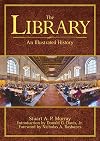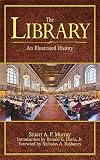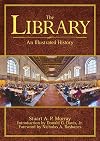
The Library: An Illustrated History
by Stuart A. P. Murray
On This Page
Description
The history of libraries from ancient to modern times is presented through a review of the types of documents stored, the structures themselves, the way they have been managed, and the important part they have played in every culture around the world.Tags
Recommendations















Member Reviews
This is a rich work exploring the history of libraries from ancient Assyria to the present day. This is an admirable and fascinating concept, and the book is richly illustrated, meriting its title, and is overall a pleasure to read. That said, the execution of the concept didn't entirely work for me. As well as being a history of libraries, their physical and literary development and the essential role of cataloguing, it also attempted to cover the history of writing and written media, with forays into publishing and bookbinding. All related of course, but it just often felt a bit too skating and a little over ambitious.
Most of the book moves chronologically through the history of libraries, with a spread of coverage across the world. show more There is an understandable US bias, given the work's origin, though as a Brit, I would have liked to see more coverage of British libraries outside London, Oxford and Cambridge. There are common themes of course and the saddest one is the destruction of numerous libraries across the world in warfare and invasion, but also through natural fires and sheer accident and attrition. The final section of the book consisted of potted accounts of prominent libraries across the world, arranged in no particular order as far as I could tell, and quite often with unnecessary duplication, such as quotes from library's mission statements which, as is often the nature of such statements, are very similar and usually not very revealing about what that particular library does. But overall this is a worthwhile read, and I am sure I will be coming back to it for reference and dipping into in future. show less
Most of the book moves chronologically through the history of libraries, with a spread of coverage across the world. show more There is an understandable US bias, given the work's origin, though as a Brit, I would have liked to see more coverage of British libraries outside London, Oxford and Cambridge. There are common themes of course and the saddest one is the destruction of numerous libraries across the world in warfare and invasion, but also through natural fires and sheer accident and attrition. The final section of the book consisted of potted accounts of prominent libraries across the world, arranged in no particular order as far as I could tell, and quite often with unnecessary duplication, such as quotes from library's mission statements which, as is often the nature of such statements, are very similar and usually not very revealing about what that particular library does. But overall this is a worthwhile read, and I am sure I will be coming back to it for reference and dipping into in future. show less
A history of books and libraries from ancient to modern times, with a particular focus on the United States. Indeed, the author's specialization is in American History, and I think it shows here, as the chapters on US libraries feel a bit more detailed to me, as well as taking up a disproportionate amount of the book. Overall, it's really not particularly in-depth. The writing isn't exactly lively, either, and it's a bit disjointed, as each chapter is divided into small sections that don't necessarily connect to each other. The illustrations are plentiful and interesting, though, and despite the special US focus, it does cover a lot of history, however broadly. Which might make it a pleasant browse for book-lovers, except that it turns show more out that much of the history of libraries is a history of libraries being burned (accidentally or deliberately) and/or looted, so it's a bit more depressing than you'd think. Despite that, it does come across, often, as a bit of a low-key celebration of freedom of speech and the preservation of knowledge. show less
Stuart A.P. Murray's The Library: An Illustrated History (Skyhorse Publishing, 2009) is an extremely broad historical survey of libraries (and certain other aspects of the book world), with pictures. The first several chapters, focusing on the ancient world through the early modern period, are the strongest; after that, particularly in the chapters on American libraries during the colonial period through the twentieth century, Murray's narrative becomes both repetitive and disjointed, lending an air of choppiness to the text that mars the work rather severely.
There are a number of small factual and typographical errors in the text which should have been edited out, and which draw the reader's attention (at least this reader's attention) show more away from the story. The third librarian of Congress was George Watterston, not Watterson, for example (why this jumped out at me I have no idea).
Murray's book ends with a random survey of some fifty individual libraries and institutions around the world, some of which have already been discussed at length in the text. This section doesn't seem to be governed by any organizational scheme at all, and jumping all over the world for brief snippet profiles may not have been the most effective way to present this information. There is no concluding section to round out the work, which ends abruptly after the institutional profiles.
I should say a word about the images, which are mostly well-chosen (although not always of the highest reproduction quality) and complement the text nicely. There are unfortunately no reference notes, and the "For Further Reading" section is poorly-formatted and surprisingly succinct.
In the introduction, eminent library history scholar Donald G. Davis, Jr. sums up the challenges of a book like this: "The difficult choices to be made in preparation of a short work that reaches for such breadth and scope should not be underestimated. Telling the intriguing story of the production, transmission, preservation, organization, and utilization of cumulated human knowledge - and telling it in a style that appeals to the widest spectrum of readers - is both a challenging and a most worthy task. No one - from library historians and cultural scholars to the general public and young readers - will agree on what should be included in or omitted from the text and illustrations. Least of all will librarians themselves be of one mind - of that we can be sure! But the effort to tell this story, however sketchy and idiosyncratic, is well worth it."
Just so. A flawed book, but a noble attempt nonetheless.
http://philobiblos.blogspot.com/2009/10/book-review-library-illustrated-history.... show less
There are a number of small factual and typographical errors in the text which should have been edited out, and which draw the reader's attention (at least this reader's attention) show more away from the story. The third librarian of Congress was George Watterston, not Watterson, for example (why this jumped out at me I have no idea).
Murray's book ends with a random survey of some fifty individual libraries and institutions around the world, some of which have already been discussed at length in the text. This section doesn't seem to be governed by any organizational scheme at all, and jumping all over the world for brief snippet profiles may not have been the most effective way to present this information. There is no concluding section to round out the work, which ends abruptly after the institutional profiles.
I should say a word about the images, which are mostly well-chosen (although not always of the highest reproduction quality) and complement the text nicely. There are unfortunately no reference notes, and the "For Further Reading" section is poorly-formatted and surprisingly succinct.
In the introduction, eminent library history scholar Donald G. Davis, Jr. sums up the challenges of a book like this: "The difficult choices to be made in preparation of a short work that reaches for such breadth and scope should not be underestimated. Telling the intriguing story of the production, transmission, preservation, organization, and utilization of cumulated human knowledge - and telling it in a style that appeals to the widest spectrum of readers - is both a challenging and a most worthy task. No one - from library historians and cultural scholars to the general public and young readers - will agree on what should be included in or omitted from the text and illustrations. Least of all will librarians themselves be of one mind - of that we can be sure! But the effort to tell this story, however sketchy and idiosyncratic, is well worth it."
Just so. A flawed book, but a noble attempt nonetheless.
http://philobiblos.blogspot.com/2009/10/book-review-library-illustrated-history.... show less
I was a bit disappointed by this book. Though in hindsight, I guess the author delivers on his title. It is a history of Libraries and he does a reasonable job of looking at libraries from Assurbanipal in Assyria onwards. .... In the seventh century BCE, Assyrian king Assurbanipal established one of the greatest ancient libraries at Nineveh, on the Tigris River. Assurbanipal’s royal library of more than 30,000 clay tablets, written in several languages, often were organized according to shape: four-sided tablets were for financial transactions, while round tablets recorded agricultural information. (In this era, some written documents were also on wood and others on wax tablets.) The Nineveh library was Assurbanipal’s passion, and show more he sent out scribes to the distant corners of his kingdom to visit other libraries and record their contents. These were among the first library catalogs. The king also organized the copying of original literary works, for he sought to study the “artistic script of the Sumerians” and the “obscure script of the Akkadians.”
With the rise of the Egyptian state papyrus became the major medium for scrolls. Papyrus grew almost exclusively in Egypt; this meant that Egyptians controlled its distribution, which influenced the development of books and writing in the civilized world.
The English term “library” derives from liber, Latin for “book.” The Greek term for a papyrus roll is biblion, and a container for storing rolls is called a bibliotheke. In some languages, the word for library is a variant of bibliotheke, a place where books are kept. Legend has it that when the preeminence of Egypt’s Alexandria library was challenged by a new library at Pergamum in Asia Minor, the Egyptians refused to export papyrus to their competitors. As a result, Pergamum developed a writing material of its own, made from the skin of calves, sheep, and goats, called parchment (it is pergamenum in Latin and pergament in Germanic languages, harking back to its origins in Pergamum).
The world of Islam acquired the art of papermaking in the eighth century, taught by Chinese prisoners who had been taken during eastward expeditions. Eventually, the Muslims brought papermaking to the Indian subcontinent and to Europe. Muslim Spain had at least seventy libraries, with the greatest at Cordoba, a city second in size only to Constantinople. In 1258, Mongol hordes destroyed Baghdad and its thirty-six public libraries, the pillagers tearing books apart so the leather covers could be used for sandals. .....I guess what is important to you!!...By the tenth century, many Islamic cities had major libraries, and one of the largest, with an estimated 400,000 to 600,000 books, was at Cordoba. The craft of papermaking reached (Muslim) Spain in the twelfth century, and at subsequent hundred-year intervals arrived in Italy, Germany, and England. Yet, for centuries after paper became widely available in Europe, vellum and parchment were preferred for documents that had to be long-lasting. up to 40 percent of the cost of a book made in Constantinople had been in the parchment alone. The increased use of paper drastically reduced publishing costs.
In some ways the history of libraries is a difficult subject to cover because libraries have tended to have long lives but have suffered from wars and fires especially....and sometimes from neglect. In fact, one of the depressing things I noticed in the book was the constant refrain of massive losses caused by fires. And this points to a fundamental problem with Libraries....collections concentrated in the one spot....they are in danger of fire always. The other common factor appeared to be that political and religious strife culminating in wars allowed the conquerors to make off with booty in the form of libraries ...though all too frequently libraries were simply torched. Other common factor appeared to be religious fundamentalism in its various forms which encouraged massive "book-burnings" and the consequent loss of knowledge.
I was interested in the observation about the Spanish destroying the Aztec codices: "Ironically, what the Spanish were eradicating was, in fact, a biased Aztec version of history. The Aztecs, themselves, had tried to wipe out Mayan culture and traditions previous to the Spaniards’ arrival".
It's hard to grasp today just how precious books were prior to the arrival of moveable type printing presses. Just copying the bible took 15 months of toil.
European books, publishing, and libraries underwent a radical change after 1450, when German goldsmith Johann Gutenberg turned his metalworking talents to the manufacture of “movable type.” At his workshop in the Rhineland city of Mainz, Gutenberg.......By 1500, approximately 260 printing establishments were in operation. Within a few decades after Gutenberg’s achievement, the enormous output of the printing press stimulated increased reading, as well as original new scholarship and writing on every sort of subject". One significant effect of typesetting and large-scale printing was that authorship of specific works could be more surely ascertained. Previously, texts were often copied and recopied and incorporated, without attribution, into other works. One estimate calculates that 40,000 book editions had been published by the start of the sixteenth century. Figuring an average print run of 500 copies of each edition, as many as 20 million books could have been printed. Although half the titles were Bibles or Christian texts, many were literary works by the likes of Italian poet, Dante Alighieri, and England’s Chaucer. Other titles offered valuable scientific and historical information, until then impossible to find without hunting endlessly through libraries and archives.
At the same time, the Church used the duplication power of the press to print thousands of so-called letters of indulgence, purchased by the devout in hopes of spending less time in purgatory after their earthly lives. Opposition to indulgences and to the absolute authority of the pope spurred on the Protestant Reformation, led by German monk and theologian, Martin Luther (1483–1546). .....Though Luther published a pamphlet in 1524 that called upon all German cities to establish schools to teach children—schools that needed libraries free of the Church’s rigid dogma. Luther called for libraries with books on religious commentary, law, and medicine, and for histories that “help in observing the marvelous works of God.” (So surprisingly liberal in this respect).
There are some interesting digressions about islamic libraries: a major Mongol leader, or khan, named Berke (d. 1266) converted to Islam, yet he could do nothing to stop a rival (Christian-led) Mongol horde from sacking Baghdad, Islam’s greatest city. The invaders slaughtered hundreds of thousands and ravaged the metropolis, throwing so many books into the Tigris that for a year the river ran black with ink. The destruction of a revered city and its sacred Islamic books, including many a Qur’an, so infuriated Berke that he struck an alliance with the Muslim Mamluks defending the Levant, Palestine, and Egypt. Berke’s aid helped defeat the Mongol horde, saving Jerusalem and Cairo and Islam’s holy cities on the Arabian Peninsula, all of them with irreplaceable libraries.
And interestingly, in Africa, in Timbuktu.....the city’s leading families possessed more than 100,000 manuscripts, then considered one of Timbuktu’s greatest treasures. Written mostly in Arabic, and many of them pre-Islamic, these works were the source of a young scholar’s education, particularly in religion, commerce, astronomy, botany, and music. (As I recall....such manuscripts were only recently squirrelled away to prevent their destruction at the hands of muslim extremists).
The sack of Baghdad in 1258 sent surviving Islamic scholars, doctors, writers, architects, teachers, and musicians to Delhi, which became the great center of Islamic culture.
One of the greatest Mughal emperors, Akbar (1542–1605), formed a department exclusively for cataloging and arranging the Imperial Library’s 24,000 volumes. He did much of the work himself, classifying the books under three main groupings: first, poetry, medicine, astrology, and music; second, philology, philosophy, Sufism, astronomy, and geometry; and third, commentaries on the Qur’an, general theology, and law. This system was comparable to the classification of most Muslim libraries of the era.
Something that I was unaware of was that (despite having lived 3 years in Malaysia) a distinctive form of manuscript illumination developed among the Malays, an art influenced by Chinese Islamic manuscript illumination and Arabic script. The Malays also followed traditional Muslim methods of book design and layout—symmetrically decorated double pages and beautifully illuminated colophons (brief, informative texts about the book or author). The texts usually were in Malay or Arabic, but sometimes used other regional languages such as Acehnese or Javanese.
Even in the late part of the 16th century, books were precious. Francis Trigge established a famous public library in Lincolnshire in 1598......"The chains were riveted to the front cover of Trigge’s books, which numbered more than three hundred and fifty titles. Protestant and Catholic works were well represented in the library, considered a unique period collection that manifests the conflicting religious ideas of the Reformation".
But society also started to change (in Britain anyway): coffeehouses became popular in the mid-seventeenth century. The house was usually open to everyone, generally without deference to rank, as attested to by one set of “Rules and Orders of the Coffee-House”....... Periodicals (printed weekly newspapers, sometimes from foreign lands) were the most popular reading matter. New books, many of them brief monographs on a specific subject, were also discussed around the tables. It seems that the ordinary man could get a pretty good education via the coffee houses.
In the Americas, the first North American paper mill was established in Mexico City in 1575. It was not until 1690 that the first British-American paper mill began operations near Philadelphia and there was no American-produced type until 1769.
Stuart goes into a great deal of detail about the growth of public libraries and the important role of benefactors like Andrew Carnegie. By 1875, 188 public libraries had been established in the United States, thanks to the library movement. More than 600 were operating in 1886.
He has a large section of the book devoted to various libraries of the world ...especially the large national library collections such as the British Library and the Library of Congress in the USA. But I was a little disappointed in his choices because he seems to have focused on the size of the library rather than, say, the beauty of its construction. He doesn't cover the beautiful Ervin Szabo library in Budapest, or the wonderful Library of the Monastery of San Lorenzo del Escorial in Spain, for example.
Overall, I think he does a workman like job with a huge subject ......maybe just a bit disappointed with the choice of libraries to cover in detail and the omission of many of the really beautiful libraries of the world. I give it three stars. show less
With the rise of the Egyptian state papyrus became the major medium for scrolls. Papyrus grew almost exclusively in Egypt; this meant that Egyptians controlled its distribution, which influenced the development of books and writing in the civilized world.
The English term “library” derives from liber, Latin for “book.” The Greek term for a papyrus roll is biblion, and a container for storing rolls is called a bibliotheke. In some languages, the word for library is a variant of bibliotheke, a place where books are kept. Legend has it that when the preeminence of Egypt’s Alexandria library was challenged by a new library at Pergamum in Asia Minor, the Egyptians refused to export papyrus to their competitors. As a result, Pergamum developed a writing material of its own, made from the skin of calves, sheep, and goats, called parchment (it is pergamenum in Latin and pergament in Germanic languages, harking back to its origins in Pergamum).
The world of Islam acquired the art of papermaking in the eighth century, taught by Chinese prisoners who had been taken during eastward expeditions. Eventually, the Muslims brought papermaking to the Indian subcontinent and to Europe. Muslim Spain had at least seventy libraries, with the greatest at Cordoba, a city second in size only to Constantinople. In 1258, Mongol hordes destroyed Baghdad and its thirty-six public libraries, the pillagers tearing books apart so the leather covers could be used for sandals. .....I guess what is important to you!!...By the tenth century, many Islamic cities had major libraries, and one of the largest, with an estimated 400,000 to 600,000 books, was at Cordoba. The craft of papermaking reached (Muslim) Spain in the twelfth century, and at subsequent hundred-year intervals arrived in Italy, Germany, and England. Yet, for centuries after paper became widely available in Europe, vellum and parchment were preferred for documents that had to be long-lasting. up to 40 percent of the cost of a book made in Constantinople had been in the parchment alone. The increased use of paper drastically reduced publishing costs.
In some ways the history of libraries is a difficult subject to cover because libraries have tended to have long lives but have suffered from wars and fires especially....and sometimes from neglect. In fact, one of the depressing things I noticed in the book was the constant refrain of massive losses caused by fires. And this points to a fundamental problem with Libraries....collections concentrated in the one spot....they are in danger of fire always. The other common factor appeared to be that political and religious strife culminating in wars allowed the conquerors to make off with booty in the form of libraries ...though all too frequently libraries were simply torched. Other common factor appeared to be religious fundamentalism in its various forms which encouraged massive "book-burnings" and the consequent loss of knowledge.
I was interested in the observation about the Spanish destroying the Aztec codices: "Ironically, what the Spanish were eradicating was, in fact, a biased Aztec version of history. The Aztecs, themselves, had tried to wipe out Mayan culture and traditions previous to the Spaniards’ arrival".
It's hard to grasp today just how precious books were prior to the arrival of moveable type printing presses. Just copying the bible took 15 months of toil.
European books, publishing, and libraries underwent a radical change after 1450, when German goldsmith Johann Gutenberg turned his metalworking talents to the manufacture of “movable type.” At his workshop in the Rhineland city of Mainz, Gutenberg.......By 1500, approximately 260 printing establishments were in operation. Within a few decades after Gutenberg’s achievement, the enormous output of the printing press stimulated increased reading, as well as original new scholarship and writing on every sort of subject". One significant effect of typesetting and large-scale printing was that authorship of specific works could be more surely ascertained. Previously, texts were often copied and recopied and incorporated, without attribution, into other works. One estimate calculates that 40,000 book editions had been published by the start of the sixteenth century. Figuring an average print run of 500 copies of each edition, as many as 20 million books could have been printed. Although half the titles were Bibles or Christian texts, many were literary works by the likes of Italian poet, Dante Alighieri, and England’s Chaucer. Other titles offered valuable scientific and historical information, until then impossible to find without hunting endlessly through libraries and archives.
At the same time, the Church used the duplication power of the press to print thousands of so-called letters of indulgence, purchased by the devout in hopes of spending less time in purgatory after their earthly lives. Opposition to indulgences and to the absolute authority of the pope spurred on the Protestant Reformation, led by German monk and theologian, Martin Luther (1483–1546). .....Though Luther published a pamphlet in 1524 that called upon all German cities to establish schools to teach children—schools that needed libraries free of the Church’s rigid dogma. Luther called for libraries with books on religious commentary, law, and medicine, and for histories that “help in observing the marvelous works of God.” (So surprisingly liberal in this respect).
There are some interesting digressions about islamic libraries: a major Mongol leader, or khan, named Berke (d. 1266) converted to Islam, yet he could do nothing to stop a rival (Christian-led) Mongol horde from sacking Baghdad, Islam’s greatest city. The invaders slaughtered hundreds of thousands and ravaged the metropolis, throwing so many books into the Tigris that for a year the river ran black with ink. The destruction of a revered city and its sacred Islamic books, including many a Qur’an, so infuriated Berke that he struck an alliance with the Muslim Mamluks defending the Levant, Palestine, and Egypt. Berke’s aid helped defeat the Mongol horde, saving Jerusalem and Cairo and Islam’s holy cities on the Arabian Peninsula, all of them with irreplaceable libraries.
And interestingly, in Africa, in Timbuktu.....the city’s leading families possessed more than 100,000 manuscripts, then considered one of Timbuktu’s greatest treasures. Written mostly in Arabic, and many of them pre-Islamic, these works were the source of a young scholar’s education, particularly in religion, commerce, astronomy, botany, and music. (As I recall....such manuscripts were only recently squirrelled away to prevent their destruction at the hands of muslim extremists).
The sack of Baghdad in 1258 sent surviving Islamic scholars, doctors, writers, architects, teachers, and musicians to Delhi, which became the great center of Islamic culture.
One of the greatest Mughal emperors, Akbar (1542–1605), formed a department exclusively for cataloging and arranging the Imperial Library’s 24,000 volumes. He did much of the work himself, classifying the books under three main groupings: first, poetry, medicine, astrology, and music; second, philology, philosophy, Sufism, astronomy, and geometry; and third, commentaries on the Qur’an, general theology, and law. This system was comparable to the classification of most Muslim libraries of the era.
Something that I was unaware of was that (despite having lived 3 years in Malaysia) a distinctive form of manuscript illumination developed among the Malays, an art influenced by Chinese Islamic manuscript illumination and Arabic script. The Malays also followed traditional Muslim methods of book design and layout—symmetrically decorated double pages and beautifully illuminated colophons (brief, informative texts about the book or author). The texts usually were in Malay or Arabic, but sometimes used other regional languages such as Acehnese or Javanese.
Even in the late part of the 16th century, books were precious. Francis Trigge established a famous public library in Lincolnshire in 1598......"The chains were riveted to the front cover of Trigge’s books, which numbered more than three hundred and fifty titles. Protestant and Catholic works were well represented in the library, considered a unique period collection that manifests the conflicting religious ideas of the Reformation".
But society also started to change (in Britain anyway): coffeehouses became popular in the mid-seventeenth century. The house was usually open to everyone, generally without deference to rank, as attested to by one set of “Rules and Orders of the Coffee-House”....... Periodicals (printed weekly newspapers, sometimes from foreign lands) were the most popular reading matter. New books, many of them brief monographs on a specific subject, were also discussed around the tables. It seems that the ordinary man could get a pretty good education via the coffee houses.
In the Americas, the first North American paper mill was established in Mexico City in 1575. It was not until 1690 that the first British-American paper mill began operations near Philadelphia and there was no American-produced type until 1769.
Stuart goes into a great deal of detail about the growth of public libraries and the important role of benefactors like Andrew Carnegie. By 1875, 188 public libraries had been established in the United States, thanks to the library movement. More than 600 were operating in 1886.
He has a large section of the book devoted to various libraries of the world ...especially the large national library collections such as the British Library and the Library of Congress in the USA. But I was a little disappointed in his choices because he seems to have focused on the size of the library rather than, say, the beauty of its construction. He doesn't cover the beautiful Ervin Szabo library in Budapest, or the wonderful Library of the Monastery of San Lorenzo del Escorial in Spain, for example.
Overall, I think he does a workman like job with a huge subject ......maybe just a bit disappointed with the choice of libraries to cover in detail and the omission of many of the really beautiful libraries of the world. I give it three stars. show less
It took me twice through the photo credits of this volume before I realized what it is: it is the tangible form of information about libraries that is available on the internet. I do not mean to suggest that it is in any way trite or meaningless, rather that it is an example of a 21st century way of writing a book. In other words: this is library after the Internet. At least, according to one person.
The passages quoted and the illustrations chosen are very well suited to their purposes. This is a book that I may not read word for word again, not because of a lack of facts, rather because, not unlike much popular specialist writing – it’s not as in-depth as I would like. The number of websites Murray lists in his Further Reading show more suggestions do very little more than convince me that in print in a narrow column is a terrible place for a URL – they are cluttered and not at all easy to parse on three or four lines.
The last almost 70 pages of the book are dedicated to a geographically random list of Libraries of the World. It is a wonderful list that could be the basis for an extremely expensive and fulfilling year traveling the globe. There is just enough information to inspire more investigation without being tiresome.
I recommend this for the Sunday afternoon library history reader. It reads fairly quickly, cites wonderful works and is very accessible. show less
The passages quoted and the illustrations chosen are very well suited to their purposes. This is a book that I may not read word for word again, not because of a lack of facts, rather because, not unlike much popular specialist writing – it’s not as in-depth as I would like. The number of websites Murray lists in his Further Reading show more suggestions do very little more than convince me that in print in a narrow column is a terrible place for a URL – they are cluttered and not at all easy to parse on three or four lines.
The last almost 70 pages of the book are dedicated to a geographically random list of Libraries of the World. It is a wonderful list that could be the basis for an extremely expensive and fulfilling year traveling the globe. There is just enough information to inspire more investigation without being tiresome.
I recommend this for the Sunday afternoon library history reader. It reads fairly quickly, cites wonderful works and is very accessible. show less
This book was pretty interesting. Murray provides a snapshot of each historical period and place, discussing the beginning of the written word, books, and the first libraries, finally ending with the libraries in the United States and the beginnings of the digital age of libraries. Murray also provides a list of some of the best and most important libraries in the world, which is pretty cool.
I picked up this book because I've always been interested in libraries and books, and I am thinking of getting my Masters degree in Library Studies in a few years. While the information was interesting and I learned a lot, some of the chapters were kind of boring, and I didn't always follow the organization Murray chose.
This is a good book for show more anyone interested in the history of libraries, or any bibliophile who wants to know a bit more about the institutions they love. show less
I picked up this book because I've always been interested in libraries and books, and I am thinking of getting my Masters degree in Library Studies in a few years. While the information was interesting and I learned a lot, some of the chapters were kind of boring, and I didn't always follow the organization Murray chose.
This is a good book for show more anyone interested in the history of libraries, or any bibliophile who wants to know a bit more about the institutions they love. show less
I really only read this because one of my favorite professors wrote the intro. It was too broad an overview for my tastes and questionably organized with little markers throughout the chapters indicating a change in idea rather than transition sentences. It also had no conclusion, ending with descriptions of a handful of noteworthy libraries. It was a quick read though and enjoyable enough.
Members
- Recently Added By
Lists

Authors from Scotland
9 works; 1 member
Author Information

26 Works 2,390 Members
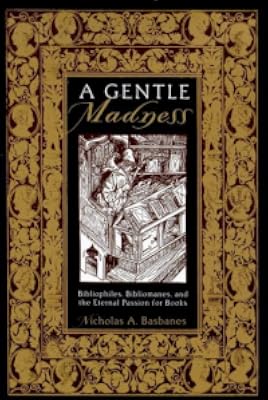
Stuart A. P. Murray has been an author and editor for almost thirty years, specializing in American history. He is the author of thirty-four books, including the award-winning America's Song: The Story of "Yankee Doodle" and books on the American Revolution, the Civil War, and the Vietnam War. He lives in Petersburgh, New York. Nicholas A. show more Basbanes is the author of the bestselling book on book collecting, A Gentle Madness: Bibliophiles, Bibliomanes, and the Eternal Passion for Books. Donald G. Davis, Jr., editor of Libraries Culture, is the author of several books and serves as emeritus professor at the University of Texas School of Information. Previously, Dr. Davis worked in the University of California, Berkeley, Library. H. Austin Booth is the dean of the Division of Libraries at New York University. She was formerly the vice provost for University Libraries at the University at Buffalo. Active and respected in national circles of research university librarians, she serves on the Executive Committee of the Board of Directors of the Association of Research Libraries and is chair of its Coordinating Committee. show less
Common Knowledge
- Canonical title
- The Library: An Illustrated History
- Original publication date
- 2009
- Epigraph
- "For the Dedication of the New City Library, Boston"
Behind the ever open gate
No pikes shall fence a crumbling throne,
No lackeys cringe, no courtiers wait, -
This palace is the people's own!
1888 - Dedication
- To Els
- First words
- On a December night in 1853, gangs of diggers labored with pick and shovel by the light of oil lamps to fill baskets and handcarts with sandy rubble.
- Original language
- English US
Classifications
Statistics
- Members
- 633
- Popularity
- 46,052
- Reviews
- 13
- Rating
- (3.80)
- Languages
- Catalan, English, Spanish
- Media
- Paper, Ebook
- ISBNs
- 6
- ASINs
- 4