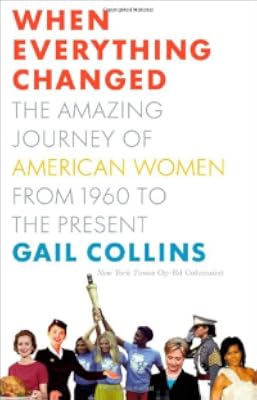
When Everything Changed: The Amazing Journey of American Women from 1960 to the Present
by Gail Collins
On This Page
Description
Gail Collins, New York Times columnist and bestselling author, recounts the astounding revolution in women's lives over the past 50 years, with her usual sly wit and unfussy style. When Everything Changed begins in 1960, when most American women had to get their husbands' permission to apply for a credit card. It ends in 2008 with Hillary Clinton's historic presidential campaign. This was a time of cataclysmic change, when, after four hundred years, expectations about the lives of American show more women were smashed in just a generation. A comprehensive mix of oral history and Gail Collins's keen research--covering politics, fashion, popular culture, economics, sex, families, and work--When Everything Changed is the definitive book on five crucial decades of progress. The enormous strides made since 1960 include the advent of the birth control pill, the end of "Help Wanted--Male" and "Help Wanted--Female" ads, and the lifting of quotas for women in admission to medical and law schools. Gail Collins describes what has happened in every realm of women's lives, partly through the testimonies of both those who made history and those who simply made their way. Picking up where her highly lauded book America's Women left off, When Everything Changed is a dynamic story, told with the down-to-earth, amusing, and agenda-free tone for which this beloved New York Times columnist is known. Older readers, men and women alike, will be startled as they are reminded of what their lives once were--"Father Knows Best" and "My Little Margie" on TV; daily weigh-ins for stewardesses; few female professors; no women in the Boston marathon, in combat zones, or in the police department. Younger readers will see their history in a rich new way. It has been an era packed with drama and dreams--some dashed and others realized beyond anyone's imagining. show lessTags
Recommendations





Member Recommendations
Member Reviews
"You've come a long way baby" doesn't even begin to cover the changes in women's lives and society's attitudes since 1960. Born in 1953 and married in 1974, I had forgotten how difficult it was for me to obtain a credit card in my own name in my 20's...and I could only qualify if I had my husband co-sign. At least now I realize that I was in good company!!
I was particulary struck by the discrimination shown by the leaders of the civil rights movement for the women who were on the front lines. One would have thought they would have been more sympathetic to all oppression...how silly of me.
Gail Collins did a wonderfull job on this social history. It is easy to read, entertaining and educational all at the same time.
I was particulary struck by the discrimination shown by the leaders of the civil rights movement for the women who were on the front lines. One would have thought they would have been more sympathetic to all oppression...how silly of me.
Gail Collins did a wonderfull job on this social history. It is easy to read, entertaining and educational all at the same time.
So much of this has happened in my lifetime. I can remember going to buy my first (used) car on my own in 1985, and the salesman asking me if my daddy was going to co-sign the loan for me. There I stood, college degree in one hand and downpayment I had earned in the other, and was being asked if my daddy was going to stand for me. Things have come very far, very fast. However, it's sad and scary the movie '9-5' could be remade today with updated fashions and little if no other changes to the script and still be right on the mark regarding women in the workplace. An upside is what Title IX has done for women in high schools and colleges regarding athletics. Collins provides terrific detail, great personal stories from women who fought show more the good fight, and provides thought-provoking parallels to the Civil Rigths movement; insight on the rise of the New Right; and how Sarah Palin is basically a Phyllis Schafly retread. show less
Gail Collins is one of the most consistently thoughtful and entertaining op-ed columnists at the New York Times, and she brings those qualities, along with an impressive amount of research, to the story of the women's movement from 1960 until the end of the first decade of the twenty-first century. I was born in 1964, a few months after the passage of the Civil Rights Act, which included an amendment prohibiting discrimination on the basis of a person's sex. Although I had lived through much of the history covered in Collins' book, I found that I really knew very little of it. I knew about Betty Friedan and Gloria Steinem, of course, but I new nothing about many of the "ordinary" women whose persistence and courage helped to bring about show more such remarkable change in American society over the past half century—women like Lorena Weeks, the plaintiff in a landmark lawsuit against her employer, Southern Bell, that struck a major blow against sex discrimination in the workplace. Nor did I know about the bill, cosponsored by Walter Mondale in the early 1970s, that would have provided universal free or subsidized childcare for American workers. The bill passed both the House and Senate with bipartisan support, only to be vetoed by President Nixon at the urging of conservative staffers led by Pat Buchanan, who feared the bill would lead to "the Sovietization of American children." Collins is a lively writer, and her combination of archival research and oral history presents a colorful picture of the period. When Everything Changed is a fast, captivating, and often inspiring read.
Note: One of the lesser-known heroines of Collins' book is the late Republican state Assemblywoman from New York, Constance Cook, who introduced the first state law legalizing abortion, in 1970. The law became the model for the decision in Roe v. Wade. Constance Cook represented Ithaca, New York, and was a familiar name when I was growing up in her district in the 1970s. show less
Note: One of the lesser-known heroines of Collins' book is the late Republican state Assemblywoman from New York, Constance Cook, who introduced the first state law legalizing abortion, in 1970. The law became the model for the decision in Roe v. Wade. Constance Cook represented Ithaca, New York, and was a familiar name when I was growing up in her district in the 1970s. show less
[When Everything Changed] by [[Gail Collins]] is a history of the women’s movement and of women’s place in the US. It’s well-written and full of interesting details. Collins covers issues of class, race and sexual orientation as they relate to women’s roles, so the book is quite comprehensive. It’s broad, rather than deep, but well worth reading.
I was impressed at how far we have come since the early 60’s when women were marginalized and accepted the marginalization. The story that resonated with me was an anecdote about JFK. Katharine Graham told how the president wanted to know why Adlai Stevenson, balding and chubby, was regarded as so attractive by his many female friends. Told that it was because Stevenson actually show more listened with interest to what women had to say, the president responded “Well, I don’t say you’re wrong, but I’m not sure I can go to those lengths. “ show less
I was impressed at how far we have come since the early 60’s when women were marginalized and accepted the marginalization. The story that resonated with me was an anecdote about JFK. Katharine Graham told how the president wanted to know why Adlai Stevenson, balding and chubby, was regarded as so attractive by his many female friends. Told that it was because Stevenson actually show more listened with interest to what women had to say, the president responded “Well, I don’t say you’re wrong, but I’m not sure I can go to those lengths. “ show less
American society has changed at an amazing pace in the last fifty years, especially for women. In 1960, when Gail Collins begins the narrative of When Everything Changed, most white, middle-class women were married, stay-at-home mothers well before their thirtieth birthdays; they may have worked before they married, but their choices of acceptable careers were limited - sometimes by convention, sometimes by actual barriers to entry, including the law. It was more expected for poor women to work, even if they had children, but they were still primarily responsible for family and housekeeping as well. While the suffragists had succeeded in winning women the right to vote in 1920, progress for women in society essentially stalled after show more that. When it was proposed that non-discrimination on the basis of gender, as well as race, be added to the Civil Rights Act, it was essentially a joke aimed at derailing the law's passage in the first place.
The Civil Rights Act passed anyway, and together with Title IX, the legal framework was put in place for women's rights and opportunities to expand dramatically. And with that framework, women's consciousness began to expand too, and they began to question and reshape the social framework as well...ultimately, by the early 21st century, bending some of it back toward where it started.
It's rather difficult to review this book fully, because it includes so much material. However, it's a relatively fast and very engaging read (if I'd had more time to spend with it, I'd have finished it sooner). There are some topics and people on which I'd have liked to spend more time, but I don't think Collins missed or shortchanged anything that really matters. The book was enlightening about so many things: the women in the civil-rights movement (whom the men wanted to keep in the background); the early triumph and ultimate defeat of the Equal Rights Amendment, and its role in the rise of modern-day conservative politics (by the way, did you know that around the same time Congress originally passed the ERA, they also approved national child-care legislation? I didn't know it; if that had sustained some momentum, the lives of working moms could be so different); the perception of women as portrayed in popular culture, from That Girl to Mary Tyler Moore to Clair Huxtable, and reflected back as role models. Collins' approach embodies the "personal is political" tenet of modern feminism; much of the story here is oral history, told through women's experiences. While she spends time on plenty of prominent women - Gloria Steinem, Sandra Day O'Connor, Hillary Clinton - the stories of little-known women who also spent time in the trenches and lived out the changes are equally important here.
Collins is a reporter and columnist for The New York Times, and brings her journalist's approach to the writing here - it's very straightforward and direct, with plenty of references and endnotes. I read this on my Kindle, where the endnotes are actually links - it's a much more efficient approach, and I definitely liked it better than flipping back to the end all the time. show less
The Civil Rights Act passed anyway, and together with Title IX, the legal framework was put in place for women's rights and opportunities to expand dramatically. And with that framework, women's consciousness began to expand too, and they began to question and reshape the social framework as well...ultimately, by the early 21st century, bending some of it back toward where it started.
It's rather difficult to review this book fully, because it includes so much material. However, it's a relatively fast and very engaging read (if I'd had more time to spend with it, I'd have finished it sooner). There are some topics and people on which I'd have liked to spend more time, but I don't think Collins missed or shortchanged anything that really matters. The book was enlightening about so many things: the women in the civil-rights movement (whom the men wanted to keep in the background); the early triumph and ultimate defeat of the Equal Rights Amendment, and its role in the rise of modern-day conservative politics (by the way, did you know that around the same time Congress originally passed the ERA, they also approved national child-care legislation? I didn't know it; if that had sustained some momentum, the lives of working moms could be so different); the perception of women as portrayed in popular culture, from That Girl to Mary Tyler Moore to Clair Huxtable, and reflected back as role models. Collins' approach embodies the "personal is political" tenet of modern feminism; much of the story here is oral history, told through women's experiences. While she spends time on plenty of prominent women - Gloria Steinem, Sandra Day O'Connor, Hillary Clinton - the stories of little-known women who also spent time in the trenches and lived out the changes are equally important here.
Collins is a reporter and columnist for The New York Times, and brings her journalist's approach to the writing here - it's very straightforward and direct, with plenty of references and endnotes. I read this on my Kindle, where the endnotes are actually links - it's a much more efficient approach, and I definitely liked it better than flipping back to the end all the time. show less
I enjoy Gail Collins' writing and particularly enjoyed this book for its comprehensive review of the women's movement from 1960 on. I was born in the late 40's and came of age in the 60's. As a man I could see many societal changes. It is as if my brother, who was born in the early 40's and came of age in the 50's, and I saw the world from completely different viewpoints.
But the changes for men were nothing like the changes for women and it is good to be reminded of that and of how far there is still to go on the path to equality.
But the changes for men were nothing like the changes for women and it is good to be reminded of that and of how far there is still to go on the path to equality.
Engrossing herstory of American women from 1960 on. Ms. Collins gives us excellent perspectives to look back on the truly amazing journey we've taken in these past decades. As a woman growing up in the seventies, I was acutely aware of the double standards, and I just loved reading this well-thought out account of the journey women have taken to get the freedoms we did not enjoy in 1960.
I just love Ms Collins' humor and voice.
I just love Ms Collins' humor and voice.
Members
- Recently Added By
Published Reviews
ThingScore 100
Among the impressive features of Ms. Collins’s book is her genial, fair-minded sympathy, her refusal to smirk at the excesses of the most radical ’70s feminists or at the stances of women, among them Phyllis Schlafly, who counseled their sisters to stay home where they belonged. This evenhandedness seems all the more admirable later in the book, when she considers the significance of show more Hillary Rodham Clinton’s and Sarah Palin’s roles in the 2008 presidential election. show less
added by Shortride
Did feminism fail?
Gail Collins’s smart, thorough, often droll and extremely readable account of women’s recent history in America not only answers this question brilliantly, but also poses new ones about the past and the present, as she explicates moments that were widely recorded and illuminates scenes that were barely remarked upon at the time.
Gail Collins’s smart, thorough, often droll and extremely readable account of women’s recent history in America not only answers this question brilliantly, but also poses new ones about the past and the present, as she explicates moments that were widely recorded and illuminates scenes that were barely remarked upon at the time.
added by Shortride
Although women have come a long way, baby, Collins acknowledges that — in 21st century America — they haven't figured out how to raise children and hold down a job at the same time, or to keep marriages from cascading into divorce. Nonetheless, her splendid book reminds us that their moms created a world their grandmas "did not even have the opportunity to imagine."
added by Shortride
Lists

Feminism
167 works; 4 members

Read These Too
458 works; 9 members

thinking of reading in 2016
99 works; 1 member

Club Read's Recommended Nonfiction Written by Women
618 works; 30 members

The Complete Rory Gilmore Reading List
506 works; 5 members
Author Information

14+ Works 2,881 Members
Gail Collins was born in Cincinnati, Ohio, in 1945. She received a B.A. in journalism from Marquette University and an M.A. in government from the University of Massachusetts, Amherst. She writes an op-ed column for The New York Times every Thursday and Saturday. She was also the first woman to hold the position of Editorial Page Editor at the show more Times, which she held from 2001 to 2007. She has also written several books including America's Women: Four Hundred Years of Dolls, Drudges, Helpmates, and Heroines and When Everything Changed: The Amazing Journey of American Women from 1960 to the Present. (Bowker Author Biography) show less
Awards and Honors
Awards
Common Knowledge
- Canonical title
- When Everything Changed: The Amazing Journey of American Women from 1960 to the Present
- Original publication date
- 2009-10-14
- First words
- On a steamy morning in the summer of 1960, Lois Rabinowitz, a 28-year-old secretary for an oil-company executive, unwittingly became the feature story of the day in New York City when she went down to traffic court to pay her... (show all) boss's speeding ticket.
- Last words
- (Click to show. Warning: May contain spoilers.)"Because look at this THING."
Classifications
- Genres
- Sexuality and Gender Studies, General Nonfiction, History, Nonfiction
- DDC/MDS
- 305.4097309045 — Society, government, & culture Social sciences, sociology & anthropology Social group - Age, Gender, Ethnicity Women Standard subdivisions History, geographic treatment, biography North America United States
- LCC
- HQ1421 .C64 — Social sciences The family. Marriage, Women and Sexuality The Family. Marriage. Women Women. Feminism
- BISAC
Statistics
- Members
- 1,004
- Popularity
- 26,052
- Reviews
- 26
- Rating
- (4.09)
- Languages
- English
- Media
- Paper, Audiobook, Ebook
- ISBNs
- 10
- ASINs
- 8