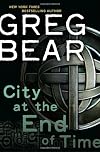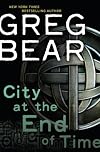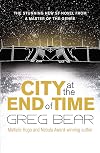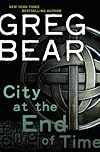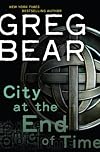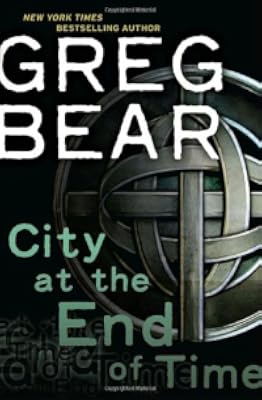
City at the End of Time
by Greg Bear
On This Page
Description
Bear's work contains sweeping futuristic vistas populated by creatures spawned from a decaying universe. The young heroes, each assigned to protect a fragment of the universe's history, must survive long enough to pass that knowledge onto the new universe that is being born.Tags
Recommendations
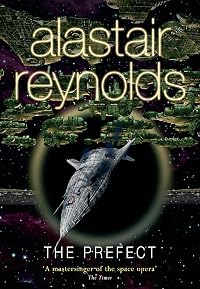
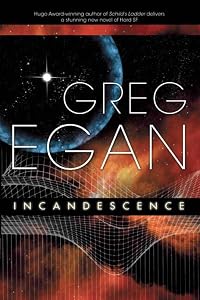
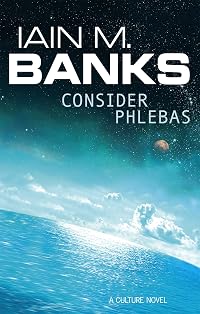
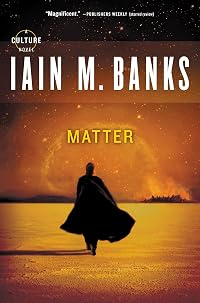


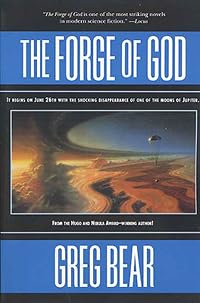

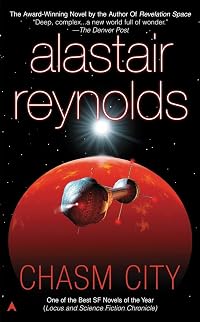
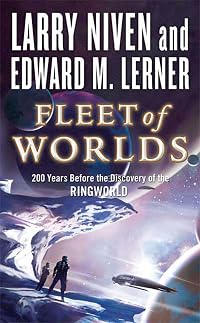
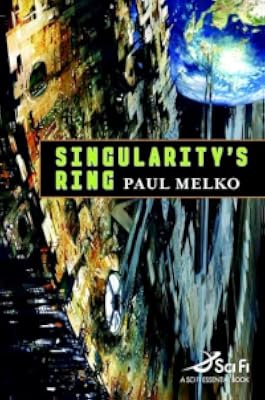







Member Recommendations
emf1123 Greg Bear's "City at the End of Time" is a homage to the classic "The Night Land" (Wm H. Hodgson), and --having read both--Greg Bear's version tells a better story in a similar landscape, and is much more readable. If you struggled with, or gave up on, The Night Land; try City at the End of Time first, then go back to The Night Land if you enjoyed Bear's version.
20
AlanPoulter Both books share an excess of plot and too much enthusiasm for the 'book', while one looks backwards into alternate history, the other into the far future.
Member Reviews
What a strange stew of familiar parts, and it really pretty much works. It starts out with a far (FAR) future bunch of post-humans living in an impossible kind of place, a little like [b: Eon|2986865|Eon Dragoneye Reborn (Eon, #1)|Alison Goodman|http://images.gr-assets.com/books/1299076175s/2986865.jpg|3017319]. Then there's a present-time thriller part, where people with odd talents are being chased by scary scariness with hints of cosmic historical depths, and this part reads like a mash-up of [a: Tim Powers|8835|Tim Powers|http://images.gr-assets.com/authors/1373471978p2/8835.jpg] and [a: Clive Barker|10366|Clive Barker|http://images.gr-assets.com/authors/1430330407p2/10366.jpg] (and I wouldn't be surprised to find some [a: Charles show more Williams|36289|Charles Williams|http://images.gr-assets.com/authors/1217390107p2/36289.jpg] on Bear's shelf too). These keep alternating and blurring together, leading up to a world-changing Big Thing, except there's more story after that and then a whole series of Big Things, kind of like Bear's fantasy [b: Songs of Earth and Power|172740|Songs of Earth and Power|Greg Bear|http://images.gr-assets.com/books/1312049376s/172740.jpg|1209966]. And there's a mythical back-story that has kind of a [b: Robert Silverberg|449309|The Best of Robert Silverberg|Robert Silverberg|http://images.gr-assets.com/books/1286840727s/449309.jpg|1104334] feel, with an oddly moving kinky chicken-eating joke. And there are some pretty disturbing bits of Bear trying to imagine a fate worse than death, as he sometimes does. And there are cats-- a real what-the-hell cat moment to rival [b: The Dream-Quest of Unknown Kadath|722667|The Dream-Quest of Unknown Kadath|H.P. Lovecraft|http://images.gr-assets.com/books/1293312354s/722667.jpg|926162]. There's a plot, but it's the kind where the rules aren't really available to you, so you have to just go with the flow. By the end I wasn't sure what it added up to, except that I had been with a damn good writer with a good heart, dreaming a big dream. show less
An ambitious effort from Bear, who's not noted for phoning it in to begin with. Though he has credited Clarke's The City and the Stars as an inspiration, this is much more an attempt to do a modern version of Hodgson's The Night Land, . Very late in the book a passing reference is made to that book, primarily I think to avert readers asking Bear if he was aware of it. Some key common elements: (1) the very very distant future -- labeled "Fourteen zeros" -- where the universe itself is wearing out and succumbing to Chaos personified (2) a telepathic connection between the inhabitants of that future and people from the present day -- labeled "Ten zeros" (3) a bit of romantic interest across those two ages (4) an extended quest, armed only show more with swords, from the last refuge of human kind across a nightmarish landscape to the other refuge that may or may not still exist. Some key differences: (1) a much larger cast of characters on both ends (2) more women in major roles (3) a stew of big ideas, including multiple universes, noötic matter (from de Chardin), much evolved (and de-evolved) humans a la Stapledon, and others (4) decent writing, not that painful pseudo-Biblical stuff.
That said, the book was almost as much of a slog for me as The Night Land. Quests are interesting when the journey is as much about the inner growth of the character as traveling across mysterious lands. But in this book, the characters are interesting only in the first half, when they are in some control of their fate. After that, they are pretty much along for the ride and the scenery palls after a while.
Recommended if you've read the Night Land and want to get something for your dues, or are a fan of Bear and want to read something a bit different from him. show less
That said, the book was almost as much of a slog for me as The Night Land. Quests are interesting when the journey is as much about the inner growth of the character as traveling across mysterious lands. But in this book, the characters are interesting only in the first half, when they are in some control of their fate. After that, they are pretty much along for the ride and the scenery palls after a while.
Recommended if you've read the Night Land and want to get something for your dues, or are a fan of Bear and want to read something a bit different from him. show less
Reminiscent of W.H. Hodgson’s "The Night Land", but more confusing. A poetic, episodic rhapsody on the end of the universe. Well written and very exciting…but I didn't like it. I struggled to get through the first 90 pages before it started to make sense—and then it still didn’t interest me such that I read 4 other books before I could bring myself to finish this one. The different characters in the future and in the past, visit each other in their dreams and are eventually pulled together for a trek into the encroaching chaos in the hope of somehow reestablishing “reality” in the face of horrific insanity/disorder: literally incomprehensible chaos. I give Greg Bear credit for constructing a “structured” universe, where show more even the bad guys are good; while maintaining a semblance of metaphysical certitude; while bouncing from one viewpoint to the next; while creating and disrupting one god after another. I don't want to discourage anyone from reading this book--Greg Bear is definitely one of my favorite authors--but I want to give heart to anyone else, like me, that found a potentially wonderful story disheartening, only off-putting, slightly comprehensible and just not interesting. show less
review of
Greg Bear's City of the End of Time
by tENTATIVELY, a cONVENIENCE - December 1, 2012
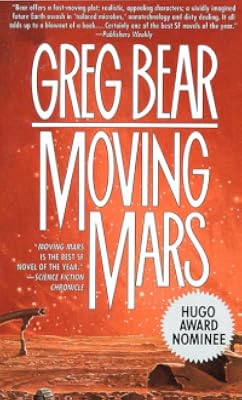
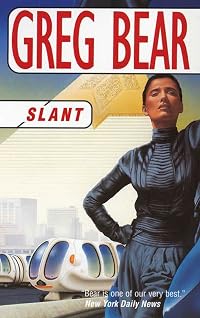
This is the 14th Greg Bear bk I've read so far & he's STILL not one of my favorite SF authors but I STILL keep coming back to him so I obviously like him somehow. My favorites of his so far are probably the early Blood Music, Moving Mars, Slant, &, maybe, this one. This is the most recent one I've read & it came after Quantico. I gave Quantico a somewhat thorough but not very enthusiastic review b/c it glamorized the FBI somewhat - for me, when I think "FBI", I think "COINTELPRO" & the suppression of black radicals & J. Edgar Hoover n'at - not a pretty picture.
SO, I was relieved for this bk to be so damned different from anything I've read by show more Bear so far. I was enthusiastic enuf about it at 1st to think that maybe I'd finally give this one another 5 star rating but by the time I was finished w/ it I wasn't quite as enthusiastic. As one of the capsule review blurbs on the back reads, it "has the flavor of weird fantasy" & that was what struck me about it 1st. I always associate Bear w/ 'hard- science' SF & while this may have a scientific basis it's full of names like "Ishanazade" & "Sangmer" that're presumably meant to be ancient.
No matter, the thing about this one is that, hard science or not, Bear still preserves his visionary grandiosity. It's not about moving an entire planet or a paradigm shift as a result of genetic experimentation gone awry, it's about the end of time literally. What if human society is still trying to hold onto its existence at a time in the remote future when the whole universe is collapsing? Not an easy thing to imagine & Bear explores it in imaginative & compelling detail.
In a recent interview w/ me conducted by Alan Davies & published online by Otoliths ( http://the-otolith.blogspot.com.au/2012/10/alan-davies-tentatively-interview.htm... ) I was asked about an ending to wch I replied (in part):
"But let's imagine further: you ask about "an-ending" - not THE ending, not one-of-many-possible-endings, just an-ending. If we were to discuss "an-ending" that's THE ending, "would it look like" anything? Would I be "doing" anything? It wd be "an-end[ing]" to looking & doing, to me, to you, to this sentence, to this language, to this planet, to this solar system, to the possibility of this solar system, to the galaxy, to the universe, to the multiverse, to ways of measuring itself, to itself - to spin off of what my girlfriend Amy Catanzano often discusses: it'd be not just an end to human scale but to ALL SCALE. PERIOD."
Bear actually takes something this unimaginable & does a pretty good job of both imagining it & turning it into a novel full of engrossing characters. Not an easy job. Bear is, indeed, a writer.
On p 67 there're science bks mentioned by various authors - some familiar, some possibly from fictitious alternate universes - maybe they're all from THIS world - it's worth checking into:
"Daniel had studied popular science books by Gamow, Weinberg, and Hawking, and finally came across P.C.W. Davies, who had taught him about special relativity, singularities, and universal constants.
"A man named Hugh Everett had created the Many Worlds interpretation of quantum mechanics, and two Davids - Bohm and Deutsch, very different in their thinking - had taught him about the possibility of multiverses. Daniel had then conceived of branching realities, four-dimensional cosmoses arranged side by side, in a way, across a fifth dimension...a thick rope of world-strands.
"John Cramer, a professor at the University of washington, had speculated about retrocausality - particles reaching back to reconcile their present with the past".
&, inevitably, I was amused when a spot of (I'm sure unintentional) neoism popped up: "T-square would soon set his hat on fire". There was even a bit of me circa 1989 in there (again, I'm sure unintentional): "the suit split equally black and white top to bottom". The section names alternate between "Ten Zeros" & "Fourteen Zeros" wch might have something to do w/ dating time.
I recently had a "Babelization Party" for my 59th birthday where the idea was for everyone to try to speak a language that others present at the party didn't speak. B/c of this I've had an interest in the myth of Babel in general - & Babel made an appearance here:
""Had all the parts of the Babel been brought together, they would have triggered the end of the Kalpa - an everything else. Their completion and unity would have beguiled the last great forces of our cosmos into starting over; Brahma, the moving stillness within, who will awaken; Mnemosyne, the reconciler, who walked among us for a time, but must return to her true nature; and Shiva, who will dance in joyous destruction. Do you understand what a Babel is, Keeper?"
"The Asyanax touched his cloak, and Ghentun saw homunculi - servants of the Babel - climbing spiral staircases from blacony to balcony, arrayed along a wall that stretched up, down, to left and right - seemingly forever. The balconies provided access to bookshelves bearing prodigious numbers of ancient bound volumes. Farther along, other staircases rose to impossible heights and descended to limitless depths." - pp 196-197
The latter seems reminiscent of an M.C. Escher print, the overall is the stuff myths are made from. & it's no surprise that Borges makes an appearance: ""One set had apparently been printed in Shanghai in the 1920s, to the specifications of an Argentinian named Borges. There are no records of Señor Borges [he's my next-door neighbor] except his nameplate in the index volume, and his signature on page 412 of volume one. And so our ladies had made one of the most magnificent finds of this century - a volume of the lost Encyclopedia Pseudogeographica. Only one other volume is known, incunabular, recovered in Toledo in 1432 and currently held in the British Library under lock and key - with excellent reason, I might add."" (p 227) The presence of Borges might not be a surprise but it's much appreciated by this reviewer, nonetheless, as is the whole thrust of the bk being to have bks in general be 'heros' of sorts. Bear loves bks & so do I.
""It doesn't like being looked at," Jebrassy said.
""A fundamental truth. The Chaos is not fond of observers."" - p 275
The Heisenberg Uncertainty Principle? Looking at something changes it. As such, one can't be just an observer. My spin on this is probably not what Bear intended but I still find it interesting to think about: to be aware is a way of accomplishing change. These days, I feel like people are so preoccupied w/ following the unwritten laws of their subculture that they barely notice anything outside of it.
More about the Babel appears later:
"All the shelves were packed tight with books, too many to count, not uniformly bound, but a crescendo of colors leaping from the shelves, as if demanding to be inspected." & ""This must be a Babel," Jebrassy murmured to himself. "All of it packed inside a minicosm, a Shen invention, no bigger than a pebble" & "The library that contained all possible stories. And all nonsense> A Babel, a name old as life itself, out of the Brightness, where all possible languages gathered. A place of confusion, seeking, and very, very rarely, illumination."
""As a master once lost in the mist of the Brightness once said, 'The map is not the territory.'"" That's another tidbit for people w/ memories &/or people w/ enuf curiosity to try to trace the quote, it's from Alfred Korzybski.
"The nonsense will become as valuable as the stories. For a multiverse builds itself mostly out of unreadable nonsense, and none can ever know for sure which text is truly useless." show less
Greg Bear's City of the End of Time
by tENTATIVELY, a cONVENIENCE - December 1, 2012
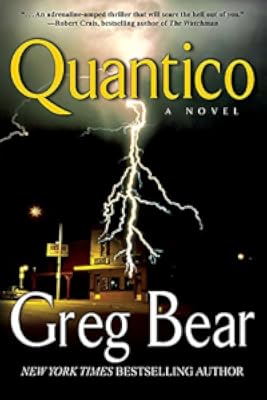
This is the 14th Greg Bear bk I've read so far & he's STILL not one of my favorite SF authors but I STILL keep coming back to him so I obviously like him somehow. My favorites of his so far are probably the early Blood Music, Moving Mars, Slant, &, maybe, this one. This is the most recent one I've read & it came after Quantico. I gave Quantico a somewhat thorough but not very enthusiastic review b/c it glamorized the FBI somewhat - for me, when I think "FBI", I think "COINTELPRO" & the suppression of black radicals & J. Edgar Hoover n'at - not a pretty picture.
SO, I was relieved for this bk to be so damned different from anything I've read by show more Bear so far. I was enthusiastic enuf about it at 1st to think that maybe I'd finally give this one another 5 star rating but by the time I was finished w/ it I wasn't quite as enthusiastic. As one of the capsule review blurbs on the back reads, it "has the flavor of weird fantasy" & that was what struck me about it 1st. I always associate Bear w/ 'hard- science' SF & while this may have a scientific basis it's full of names like "Ishanazade" & "Sangmer" that're presumably meant to be ancient.
No matter, the thing about this one is that, hard science or not, Bear still preserves his visionary grandiosity. It's not about moving an entire planet or a paradigm shift as a result of genetic experimentation gone awry, it's about the end of time literally. What if human society is still trying to hold onto its existence at a time in the remote future when the whole universe is collapsing? Not an easy thing to imagine & Bear explores it in imaginative & compelling detail.
In a recent interview w/ me conducted by Alan Davies & published online by Otoliths ( http://the-otolith.blogspot.com.au/2012/10/alan-davies-tentatively-interview.htm... ) I was asked about an ending to wch I replied (in part):
"But let's imagine further: you ask about "an-ending" - not THE ending, not one-of-many-possible-endings, just an-ending. If we were to discuss "an-ending" that's THE ending, "would it look like" anything? Would I be "doing" anything? It wd be "an-end[ing]" to looking & doing, to me, to you, to this sentence, to this language, to this planet, to this solar system, to the possibility of this solar system, to the galaxy, to the universe, to the multiverse, to ways of measuring itself, to itself - to spin off of what my girlfriend Amy Catanzano often discusses: it'd be not just an end to human scale but to ALL SCALE. PERIOD."
Bear actually takes something this unimaginable & does a pretty good job of both imagining it & turning it into a novel full of engrossing characters. Not an easy job. Bear is, indeed, a writer.
On p 67 there're science bks mentioned by various authors - some familiar, some possibly from fictitious alternate universes - maybe they're all from THIS world - it's worth checking into:
"Daniel had studied popular science books by Gamow, Weinberg, and Hawking, and finally came across P.C.W. Davies, who had taught him about special relativity, singularities, and universal constants.
"A man named Hugh Everett had created the Many Worlds interpretation of quantum mechanics, and two Davids - Bohm and Deutsch, very different in their thinking - had taught him about the possibility of multiverses. Daniel had then conceived of branching realities, four-dimensional cosmoses arranged side by side, in a way, across a fifth dimension...a thick rope of world-strands.
"John Cramer, a professor at the University of washington, had speculated about retrocausality - particles reaching back to reconcile their present with the past".
&, inevitably, I was amused when a spot of (I'm sure unintentional) neoism popped up: "T-square would soon set his hat on fire". There was even a bit of me circa 1989 in there (again, I'm sure unintentional): "the suit split equally black and white top to bottom". The section names alternate between "Ten Zeros" & "Fourteen Zeros" wch might have something to do w/ dating time.
I recently had a "Babelization Party" for my 59th birthday where the idea was for everyone to try to speak a language that others present at the party didn't speak. B/c of this I've had an interest in the myth of Babel in general - & Babel made an appearance here:
""Had all the parts of the Babel been brought together, they would have triggered the end of the Kalpa - an everything else. Their completion and unity would have beguiled the last great forces of our cosmos into starting over; Brahma, the moving stillness within, who will awaken; Mnemosyne, the reconciler, who walked among us for a time, but must return to her true nature; and Shiva, who will dance in joyous destruction. Do you understand what a Babel is, Keeper?"
"The Asyanax touched his cloak, and Ghentun saw homunculi - servants of the Babel - climbing spiral staircases from blacony to balcony, arrayed along a wall that stretched up, down, to left and right - seemingly forever. The balconies provided access to bookshelves bearing prodigious numbers of ancient bound volumes. Farther along, other staircases rose to impossible heights and descended to limitless depths." - pp 196-197
The latter seems reminiscent of an M.C. Escher print, the overall is the stuff myths are made from. & it's no surprise that Borges makes an appearance: ""One set had apparently been printed in Shanghai in the 1920s, to the specifications of an Argentinian named Borges. There are no records of Señor Borges [he's my next-door neighbor] except his nameplate in the index volume, and his signature on page 412 of volume one. And so our ladies had made one of the most magnificent finds of this century - a volume of the lost Encyclopedia Pseudogeographica. Only one other volume is known, incunabular, recovered in Toledo in 1432 and currently held in the British Library under lock and key - with excellent reason, I might add."" (p 227) The presence of Borges might not be a surprise but it's much appreciated by this reviewer, nonetheless, as is the whole thrust of the bk being to have bks in general be 'heros' of sorts. Bear loves bks & so do I.
""It doesn't like being looked at," Jebrassy said.
""A fundamental truth. The Chaos is not fond of observers."" - p 275
The Heisenberg Uncertainty Principle? Looking at something changes it. As such, one can't be just an observer. My spin on this is probably not what Bear intended but I still find it interesting to think about: to be aware is a way of accomplishing change. These days, I feel like people are so preoccupied w/ following the unwritten laws of their subculture that they barely notice anything outside of it.
More about the Babel appears later:
"All the shelves were packed tight with books, too many to count, not uniformly bound, but a crescendo of colors leaping from the shelves, as if demanding to be inspected." & ""This must be a Babel," Jebrassy murmured to himself. "All of it packed inside a minicosm, a Shen invention, no bigger than a pebble" & "The library that contained all possible stories. And all nonsense> A Babel, a name old as life itself, out of the Brightness, where all possible languages gathered. A place of confusion, seeking, and very, very rarely, illumination."
""As a master once lost in the mist of the Brightness once said, 'The map is not the territory.'"" That's another tidbit for people w/ memories &/or people w/ enuf curiosity to try to trace the quote, it's from Alfred Korzybski.
"The nonsense will become as valuable as the stories. For a multiverse builds itself mostly out of unreadable nonsense, and none can ever know for sure which text is truly useless." show less
Tedious. Difficult. Disappointing.
This book is a perfect example of a failure of editing. Well over a full third of this material could have been removed and nothing about the story would have been affected. The one character written to have any semblance of a character arc is a minor character at best. The reader instead gets to follow some incredibly bland and passive characters just waiting for the end to arrive. When that end does come around, it is painfully obvious that it has been phoned in; most of the supporting cast has simply been forgotten in Bear's rush to have the protagonists do -- nothing. Congrats on a paycheck, I guess.
The story encompasses two time periods of Earth - one set in the present and one set is the extreme show more distant future. The humans of the future do not resemble us in either form or culture as trillions of years of evolution would leave a mark. Unfortunately, this future is extremely boring. For the first 250 pages, I would strongly suggest skimming or skipping entirely any chapters dealing with this time. They provide nothing aside from tiresome angst from characters that aren't essential to the plot. The characters inhabiting the present are much more interesting. Well, not the protagonists but rather the minor characters that serve to push the incredibly passive boors towards the finish line.
At about the halfway point of the book, the future storyline picks up and gets quite interesting. If the reader has skimmed a scant few of the earlier future chapters, it should not be difficult to understand what is going on. Even if confusion sets in, worry not, for the excitement is pretty irrelevant in the end anyway. These characters simply disappear and nothing is mentioned of their relationships again. A wonderful buildup of tension and wonder is squandered at this point as Bear again focuses on those painfully unimpressive protagonists waiting and wandering and waiting some more. A few entertaining scenes are sprinkled around the last quarter of the book but they're certainly not enough to make up for the lack of, well, everything else in this exceptionally shoddy work.
Yes, I suppose I am a bit bitter about having stuck through to the end. There was a very nifty premise that appeared to have some potential here but a poor execution and utterly boring story put that to bed. There's a reason this hardcover was found in the $1.99 bin. There's a reason my copy will be back in there in the very near future as well. show less
This book is a perfect example of a failure of editing. Well over a full third of this material could have been removed and nothing about the story would have been affected. The one character written to have any semblance of a character arc is a minor character at best. The reader instead gets to follow some incredibly bland and passive characters just waiting for the end to arrive. When that end does come around, it is painfully obvious that it has been phoned in; most of the supporting cast has simply been forgotten in Bear's rush to have the protagonists do -- nothing. Congrats on a paycheck, I guess.
The story encompasses two time periods of Earth - one set in the present and one set is the extreme show more distant future. The humans of the future do not resemble us in either form or culture as trillions of years of evolution would leave a mark. Unfortunately, this future is extremely boring. For the first 250 pages, I would strongly suggest skimming or skipping entirely any chapters dealing with this time. They provide nothing aside from tiresome angst from characters that aren't essential to the plot. The characters inhabiting the present are much more interesting. Well, not the protagonists but rather the minor characters that serve to push the incredibly passive boors towards the finish line.
At about the halfway point of the book, the future storyline picks up and gets quite interesting. If the reader has skimmed a scant few of the earlier future chapters, it should not be difficult to understand what is going on. Even if confusion sets in, worry not, for the excitement is pretty irrelevant in the end anyway. These characters simply disappear and nothing is mentioned of their relationships again. A wonderful buildup of tension and wonder is squandered at this point as Bear again focuses on those painfully unimpressive protagonists waiting and wandering and waiting some more. A few entertaining scenes are sprinkled around the last quarter of the book but they're certainly not enough to make up for the lack of, well, everything else in this exceptionally shoddy work.
Yes, I suppose I am a bit bitter about having stuck through to the end. There was a very nifty premise that appeared to have some potential here but a poor execution and utterly boring story put that to bed. There's a reason this hardcover was found in the $1.99 bin. There's a reason my copy will be back in there in the very near future as well. show less
If you like far futures and are dissatisfied with looking only a few billion years forward, City at the End of Time may satisfy your craving for temporal immensity. The domain of the Kalpa exists 100,000,000,000,000 years from now, give or take a trillion or two. It is "at the end of time" in a literal sense: Time and space are being steadily obliterated by the forces of blind chaos. The Kalpa may be all that is left of cosmic order, though there are hopes that a second city, cut off from communication long ago, yet endures. Teams of explorers regularly set out for it, traveling into the realm of chaos. None has ever been heard from again.
Complementing the adventures of a pair of these explorers is a story set in our own time, involving show more three youngsters with odd talents for avoiding trouble and a peculiar lack of roots, who are wooed and pursued by combatants in an ancient struggle that is not unrelated to the travails of mankind's vastly distant descendants. The plot threads merge in the final third of the novel, as the destruction of time spreads backward from the end of the universe to its beginning.
The underlying scientific rationale appears to be an Ultra-Strong Anthropic Principle: The existence of the universe is dependent upon the existence of observers. In the book's concrete terms, the written word makes the world coherent, and its corruption (you thought typographical errors were mere mistakes?) brings on chaos. It's wonderful to have a new excuse for buying books!
City at the End of Time has other virtues, too. Its future is right up to date and suitably bizarre. Virtual reality mingles with "primordial matter" (the stuff you and I are composed of), and there is a sense of the vastness of history, along with the inevitable ignorance that distance brings. When the Kalpa set out to recreate the "primordial" human race, their research leads them quite a bit astray.
For those who like such bonbons, the author works in literary and pop-cultural allusions, most of which I probably missed. It was only by the happenstance of having recently seen Les enfants du Paradis that I noticed the homage to that famous French film in an early chapter.
On the less admirable side, the mysterious devices that enable the 21st Century characters to jump between timelines have an arbitrary feel. The plot needs them, but it isn't clear why the universe does.
This novel is a large, ambitious undertaking, maybe too much so. The scale is so far beyond human comprehension that its effect diminishes, just as staring into the Sun is blinding rather than dazzling. Nonetheless, the structure is impressive, and the tale moves convincingly from modest beginnings through and beyond the last syllable of recorded time. show less
Complementing the adventures of a pair of these explorers is a story set in our own time, involving show more three youngsters with odd talents for avoiding trouble and a peculiar lack of roots, who are wooed and pursued by combatants in an ancient struggle that is not unrelated to the travails of mankind's vastly distant descendants. The plot threads merge in the final third of the novel, as the destruction of time spreads backward from the end of the universe to its beginning.
The underlying scientific rationale appears to be an Ultra-Strong Anthropic Principle: The existence of the universe is dependent upon the existence of observers. In the book's concrete terms, the written word makes the world coherent, and its corruption (you thought typographical errors were mere mistakes?) brings on chaos. It's wonderful to have a new excuse for buying books!
City at the End of Time has other virtues, too. Its future is right up to date and suitably bizarre. Virtual reality mingles with "primordial matter" (the stuff you and I are composed of), and there is a sense of the vastness of history, along with the inevitable ignorance that distance brings. When the Kalpa set out to recreate the "primordial" human race, their research leads them quite a bit astray.
For those who like such bonbons, the author works in literary and pop-cultural allusions, most of which I probably missed. It was only by the happenstance of having recently seen Les enfants du Paradis that I noticed the homage to that famous French film in an early chapter.
On the less admirable side, the mysterious devices that enable the 21st Century characters to jump between timelines have an arbitrary feel. The plot needs them, but it isn't clear why the universe does.
This novel is a large, ambitious undertaking, maybe too much so. The scale is so far beyond human comprehension that its effect diminishes, just as staring into the Sun is blinding rather than dazzling. Nonetheless, the structure is impressive, and the tale moves convincingly from modest beginnings through and beyond the last syllable of recorded time. show less
Deeply weird, compelling, and mysterious, by turns chilling and sublime, every page packed with amazing imagery, this book was an absolute joy to read and thrilled right to the very end. The plot wends a corkscrew path between quantum mechanics and the metaphysical, unfolding before the characters' eyes -- some of the present day, some of a distant and alien future, some who seem to exist outside of time entirely. This is a story that almost demands repeat readings, promising a new experience through different eyes.
Members
- Recently Added By
Published Reviews
ThingScore 75
It is a gauge of Bear's mastery that the book never feels like a cheat and that he manages to craft a reading experience that blends the rigors of scientific method with the more homespun pleasures of good gossip.
added by Shortride
Lists

ALA The Reading List
490 works; 28 members
Author Information

141+ Works 47,243 Members
Greg Bear was born in San Diego, California, on August 20, 1951. He received a Bachelor of Arts degree from San Diego State University in 1973. At age 14, he began submitting pieces to magazines and at 15 he sold his first story to Robert Lowndes' Famous Science Fiction. It would be five years before he sold another piece, but by 23 he was selling show more stories regularly. He has written more than 30 science fiction and fantasy books and has won numerous awards for his work. In 1984, Hardfought and Blood Music won the Nebula Awards for best novella and novelette; Blood Music went on to win the Hugo Award. The novel version of that story, also called Blood Music, won the Prix Apollo in France. In 1987, Tangents won the Hugo and Nebula awards for best short story. He also won a Nebula in 1994 for Moving Mars and in 2001 for Darwin's Radio. Both Dinosaur Summer and Darwin's Radio have been awarded the Endeavour for best novel published by a Northwest science fiction author. He is also an illustrator and his work has appeared in Galaxy, Fantasy and Science Fiction, and Vertex, and in both hardcover and paperback books. He was a founding member of ASFA, the Association of Science Fiction Artists. His works include City at the End of Time, Hull Zero Three, The Mongoliad, Mariposa, Halo: Cryptum, Halo: Primordium and Halo: Silentium. (Bowker Author Biography) show less
Some Editions
Awards and Honors
Awards
Distinctions
Notable Lists
Work Relationships
Has as a commentary on the text
Common Knowledge
- Original publication date
- 2008-07
- People/Characters
- Ginny; Jack; Daniel; Jebrassy; Tiadba; Max Glaucous (show all 9); Librarian; Sangmer; Ishanaxade
- Important places
- Seattle, Washington, USA
- Important events
- End of Time
- Dedication
- For Richard Curtis
Celebrating thiry years - First words
- Coming to the Broken Tower was dangerous.
- Last words
- (Click to show. Warning: May contain spoilers.)Others say -
In the beginning is the Word. - Blurbers
- Vinge, Vernor; Crais, Robert; King, Stephen
- Original language
- English
Classifications
Statistics
- Members
- 788
- Popularity
- 35,445
- Reviews
- 35
- Rating
- (3.03)
- Languages
- English, French, German, Spanish
- Media
- Paper, Audiobook, Ebook
- ISBNs
- 17
- ASINs
- 9