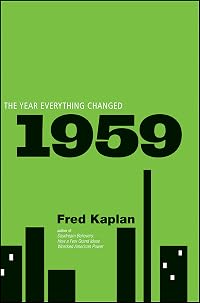
1959: The Year Everything Changed
by Fred M. Kaplan
On This Page
Description
Acclaimed national security columnist and noted cultural critic Fred Kaplan looks past the 1960s to the year that really changed AmericaWhile conventional accounts focus on the sixties as the era of pivotal change that swept the nation, Fred Kaplan argues that it was 1959 that ushered in the wave of tremendous cultural, political, and scientific shifts that would play out in the decades that followed. Pop culture exploded in upheaval with the rise of artists like Jasper Johns, Norman show more Mailer, Allen Ginsberg, and Miles Davis. Court rulings unshackled previously banned books. Political power broadened with the onset of Civil Rights laws and protests. The sexual and feminist revolutions took their first steps with the birth control pill. America entered the war in Vietnam, and a new style in superpower diplomacy took hold. The invention of the microchip and the Space Race put a new twist on the frontier myth.
-
- Vividly chronicles 1959 as a vital, overlooked year that set the world as we know it in motion, spearheading immense political, scientific, and cultural change
- Strong critical acclaim: "Energetic and engaging" (Washington Post); "Immensely enjoyable . . . a first-rate book" (New Yorker); "Lively and filled with often funny anecdotes" (Publishers Weekly)
- Draws fascinating parallels between the country in 1959 and today
Drawing fascinating parallels between the country in 1959 and today, Kaplan offers a smart, cogent, and deeply researched take on a vital, overlooked period in American history.
The EPUB format of this title may not be compatible for use on all handheld devices.
. show less
Tags
Recommendations




















Member Reviews
1959 by Fred Kaplan is a sociopolitical history book about various events of that year that “broke the barriers” and opened up new frontiers in music, media, politics, and even sex. It was an eye-opener to me because I had never heard of any of this stuff, which occurred a few years before I was born.
The birth control pill, for example, came to be because of the efforts of two women, both independently wealthy, who saw their work only come to fruition in their old age. Margaret Sanger and Kathleen McCormick were both women’s rights activists; Sanger, the founder of Planned Parenthood, was the genesis of the idea, McCormick the financial backer and supporter. I didn’t think I would enjoy this chapter as much as the others, but I show more did, because it ran so counter to the narrative I thought I knew – of Big Pharma inventing a drug because there was a demand for it, not two women supporting research into artificial female hormones on their own dime, doing the legwork until the industry giants took an interest in it. (At first, the Pill was marketed as a relief for menstrual miseries.) This chapter was the only one to focus on the achievements of women while all the rest, usual for 1950s America, were about the accomplishments of men.
This isn’t to say, though, that women were entirely absent. The accomplishments of Peggy Guggenheim and Hilla Rebay in getting the Guggenheim Museum built are touched on as well, and in fact they did more to get it built than the man it was named after.
The bulk of the book was, in fact, about the intersection of the music and art worlds, not surprising as the writer is also a jazz blogger. It’s too easy to relate the free-form innovations in jazz music to the wild spatters of Jackson Pollock’s drip canvases; yet the boundary-breaking scales of structures of 1950s jazz also had equivalents in literature (Norman Mailer, the Beat poets) and cinema (John Cassavetes.) Kaplan speckles the chapters with anecdotes of artists, writers, and musicians moving between these worlds, hanging out in coffeehouses together, attending the same parties. The book was perhaps too heavy on jazz music (the author’s specialty) but I didn’t mind, it was interesting to me.
The book is also helped by the structure of its chapters, in which each pivotal event is presented chronologically, in the order it appeared in the year, though within each chapter time hopscotched back and forth from the event’s lead-up to its later impact. Each chapter built on the next, so, by the end when President John F. Kennedy makes his declaration to put a man on the moon by the end of the 1960s, the reader feels that all this has been a narrative buildup to making the impossible, possible, and taking the idea of a new frontier as far as it can go.
I wonder, though, if that narrative is dated already. The book was published in 2009, still a heady, optimistic time, when boundary-smashing was seen as right and good, and still to be expected. From today’s viewpoint of 2023 I wonder if it set off an era that has gone too far, devolving into chaos, violence, and authoritarianism. Perhaps in a few years historians will look at the 1960s in a different light. show less
The birth control pill, for example, came to be because of the efforts of two women, both independently wealthy, who saw their work only come to fruition in their old age. Margaret Sanger and Kathleen McCormick were both women’s rights activists; Sanger, the founder of Planned Parenthood, was the genesis of the idea, McCormick the financial backer and supporter. I didn’t think I would enjoy this chapter as much as the others, but I show more did, because it ran so counter to the narrative I thought I knew – of Big Pharma inventing a drug because there was a demand for it, not two women supporting research into artificial female hormones on their own dime, doing the legwork until the industry giants took an interest in it. (At first, the Pill was marketed as a relief for menstrual miseries.) This chapter was the only one to focus on the achievements of women while all the rest, usual for 1950s America, were about the accomplishments of men.
This isn’t to say, though, that women were entirely absent. The accomplishments of Peggy Guggenheim and Hilla Rebay in getting the Guggenheim Museum built are touched on as well, and in fact they did more to get it built than the man it was named after.
The bulk of the book was, in fact, about the intersection of the music and art worlds, not surprising as the writer is also a jazz blogger. It’s too easy to relate the free-form innovations in jazz music to the wild spatters of Jackson Pollock’s drip canvases; yet the boundary-breaking scales of structures of 1950s jazz also had equivalents in literature (Norman Mailer, the Beat poets) and cinema (John Cassavetes.) Kaplan speckles the chapters with anecdotes of artists, writers, and musicians moving between these worlds, hanging out in coffeehouses together, attending the same parties. The book was perhaps too heavy on jazz music (the author’s specialty) but I didn’t mind, it was interesting to me.
The book is also helped by the structure of its chapters, in which each pivotal event is presented chronologically, in the order it appeared in the year, though within each chapter time hopscotched back and forth from the event’s lead-up to its later impact. Each chapter built on the next, so, by the end when President John F. Kennedy makes his declaration to put a man on the moon by the end of the 1960s, the reader feels that all this has been a narrative buildup to making the impossible, possible, and taking the idea of a new frontier as far as it can go.
I wonder, though, if that narrative is dated already. The book was published in 2009, still a heady, optimistic time, when boundary-smashing was seen as right and good, and still to be expected. From today’s viewpoint of 2023 I wonder if it set off an era that has gone too far, devolving into chaos, violence, and authoritarianism. Perhaps in a few years historians will look at the 1960s in a different light. show less
This is a great book, and the works of Kaplan are now on my must-read list.
From my reading, it seems the 19th Century centered around roughly Darwin's 1859 The Origin of Species, saw a sociological upheaval around the confrontation of society with evolution and The Industrial Revolution and more. The results ranged from Social Darwinism to Gothic literature having been born with Frankenstein saw its most creative period, ranging from Poe to the Brontë sisters (Wuthering Heights, 1847) and Bram Stoker's Dracula(1897).
Looking a century later, Kaplan pinpoints a year of birth control, free jazz, Cassavetes, the Beats, Normal Mailer, abstract expressionists, and more as the seminal year that is the roots of Civil Rights, the tumultuous show more '60s, and more.
This is an enlightening microhistory on Western civilization. Makes me think; What is brewing now to emerge in 2059? show less
From my reading, it seems the 19th Century centered around roughly Darwin's 1859 The Origin of Species, saw a sociological upheaval around the confrontation of society with evolution and The Industrial Revolution and more. The results ranged from Social Darwinism to Gothic literature having been born with Frankenstein saw its most creative period, ranging from Poe to the Brontë sisters (Wuthering Heights, 1847) and Bram Stoker's Dracula(1897).
Looking a century later, Kaplan pinpoints a year of birth control, free jazz, Cassavetes, the Beats, Normal Mailer, abstract expressionists, and more as the seminal year that is the roots of Civil Rights, the tumultuous show more '60s, and more.
This is an enlightening microhistory on Western civilization. Makes me think; What is brewing now to emerge in 2059? show less
No, everything did not change in 1959 but this hugely enjoyable book captures stirrings in the worlds of music, literature, politics and the arts.
As one bard mentioned in the acknowledgments later wrote, "She's got the right dynamic for the new frontier." :)
As one bard mentioned in the acknowledgments later wrote, "She's got the right dynamic for the new frontier." :)
This is a very competent, lively book. And the way it fits into my life means I give it a 4 rather than perhaps a 3. I was in the 6th-7th grade in 1959. I remember some of the events of the book. Most I don't. But my life was shaped by these events. The beginnings of so much that we think of in the 60s and 70s. I recommend this book. (Listened on Audible.)
Interesting Information, but I think I'd use it for a reference book rather than a book to curl up and read. It brought back a lot of memories though. Well written and appears to be well researched as well.
Everything a popular cultural history should be.
Ratings
Members
- Recently Added By
Published Reviews
ThingScore 50
What becomes increasingly clear with every chapter, however, is that nearly any one of that decade’s other years could serve equally well, if not better, as a turning point. History rarely adheres to the Gregorian calendar, and the need to squish everything into the self-imposed 365-day timeline causes Mr. Kaplan at times to treat his argument like a gerrymandered district, stretching it show more beyond its natural shape. show less
added by Shortride
Lists

What A Year: Books titled with a particular year
147 works; 2 members
Author Information

10+ Works 1,357 Members
Some Editions
Awards and Honors
Awards
Common Knowledge
- Original language
- English
Classifications
Statistics
- Members
- 263
- Popularity
- 122,879
- Reviews
- 6
- Rating
- (3.74)
- Languages
- English
- Media
- Paper, Audiobook, Ebook
- ISBNs
- 5
- ASINs
- 3