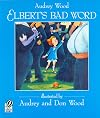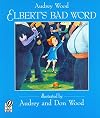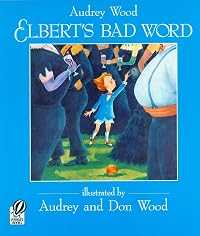
Elbert's Bad Word
by Audrey Wood
On This Page
Description
After shocking the elegant garden party by using a bad word, Elbert learns some acceptable substitutes from a helpful wizard.Tags
Recommendations
Member Reviews
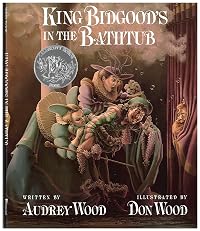
In this engaging picture-book exploration of "bad words," Audrey and Don Wood - the team who created such classics of the genre as The Napping House, King Bidgood's in the Bathtub and Heckedy Peg - follow young Elbert as he picks up a very ugly word, while at a party for grown-ups, and causes quite a stir, when he uses it himself. His mother's outrage - she washes his mouth out with soap - is followed by a more practical solution, provided by the family gardener (and secret magician): the creation of other, more-satisfying words to express pain or frustration.
I enjoyed Elbert's Bad Word, liked the physical manifestation of the bad word, and approved of the solution depicted. I liked the fact that the story demonstrates that children show more often pick up bad language from their elders, and that it takes into account the natural desire of any person, child or adult, to express strong negative emotions. That said, I didn't like the scene in which Elbert's mother forces him to wash out his mouth with soap, or that the thoughtful discussion of the issue occurs, not with her, but with a servant. Although that may be a dynamic found in some homes, I think that most young readers would have more affinity with a tale in which the young "offender" must contend with his parents - discussing the issue with them.
Still, Elbert's Bad Word is definitely one of the few picture-books I've seen that addresses this topic through story, rather than the overt didacticism to be found in guides on correct behavior. Despite its flaws, it works fairly well, I think, and I would recommend it to parents who are looking to start a conversation with children on the topic. show less
I enjoyed Elbert's Bad Word, liked the physical manifestation of the bad word, and approved of the solution depicted. I liked the fact that the story demonstrates that children show more often pick up bad language from their elders, and that it takes into account the natural desire of any person, child or adult, to express strong negative emotions. That said, I didn't like the scene in which Elbert's mother forces him to wash out his mouth with soap, or that the thoughtful discussion of the issue occurs, not with her, but with a servant. Although that may be a dynamic found in some homes, I think that most young readers would have more affinity with a tale in which the young "offender" must contend with his parents - discussing the issue with them.
Still, Elbert's Bad Word is definitely one of the few picture-books I've seen that addresses this topic through story, rather than the overt didacticism to be found in guides on correct behavior. Despite its flaws, it works fairly well, I think, and I would recommend it to parents who are looking to start a conversation with children on the topic. show less
Elbert's Bad Word is a modern fantasy tale that features a lively, furry foul word that surfaces in the middle of a fancy dinner party. Elbert is disciplined, but seeks the help of the family gardener/wizard who bakes him up a cake of powerful, sparkly words to use instead.
This book has special meaning and memories for me as it was gifted to me by a colleague who inadvertantly used a "bad word" on the day she met me. I also love the personification of the word as it mischeviously weaves its way through the story.
It's the perfect story to share when inappropriate language surfaces in the classroom. Perhaps cupcakes topped with sparkly, powerful words the class has generated would be just the thing to cure those bad word blues! I may also show more share this story as a great example of Modern Fantasy woven into a common scene. It would be an interesting model for writing our own stories. show less
This book has special meaning and memories for me as it was gifted to me by a colleague who inadvertantly used a "bad word" on the day she met me. I also love the personification of the word as it mischeviously weaves its way through the story.
It's the perfect story to share when inappropriate language surfaces in the classroom. Perhaps cupcakes topped with sparkly, powerful words the class has generated would be just the thing to cure those bad word blues! I may also show more share this story as a great example of Modern Fantasy woven into a common scene. It would be an interesting model for writing our own stories. show less
Elbert is the only child at an elegant garden party. While wandering through the crowd of adults, Elbert hears an unfamiliar word. The word has manifested itself into an ugly, furry little cloud. Elbert catches it and puts it in his back pocket and went on his way. When Elbert joins the crowd to listen to Aunt Isabella sing, the word flies into his mouth. Just then, chaos ensues resulting in a mallet being tossed in the air and landing on Elbert's foot. Elbert goes to scream but instead the bad word jumps out, shocking everyone. Elbert knows he has to get rid of the bad word so he visits the gardener, who happens to be a wizard. The wizard gardener bakes Elbert a cake filled with good words that he can use instead of the ugly bad word. show more As he eats the cake, the bad word shrivels up to only the size of a flea. Chaos breaks out at the party once more and again, a mallet lands on Elbert's foot. This time, a whole slew of good words come out of his mouth instead of the bad one. Elbert is finally free of his bad word as he watches it crawl down a hole in the ground and disappear.
This book can serve as a lesson for children and adults alike. Children will learn that there are many other words to use to express how you're feeling, and bad words don't need to be used. Having the illustrations of the bad word taking the form of a mean ugly creature will help them understand that some words just shouldn't be used. For adults, it's a reminder to watch the language you use because you never know who may be listening. Children are like sponges and they pick up on everything adults do. show less
This book can serve as a lesson for children and adults alike. Children will learn that there are many other words to use to express how you're feeling, and bad words don't need to be used. Having the illustrations of the bad word taking the form of a mean ugly creature will help them understand that some words just shouldn't be used. For adults, it's a reminder to watch the language you use because you never know who may be listening. Children are like sponges and they pick up on everything adults do. show less
One little slip of the tongue, an utterance of one bad word...and Elbert has upset the entire lawn party...
This is an enchanting "EB" with bright colorful pictures, wonderful stuffy adult characters, and a nice message.
This is an enchanting "EB" with bright colorful pictures, wonderful stuffy adult characters, and a nice message.
Summary: This was a story about a young boy named Elbert. He had learned a new word, but it was a bad one. When he was at a party a croquet mallet fell on his toe. He then yelled out a bad word. He went to a wizard who was a farmer. The wizard then cured him from his bad word. Elbert went back to the party and didn't say that word again. Everyone was so happy.
Personal Reaction: This book was good. I thought it was cute how the little boy was trying so hard to get rid of his bad word. The pictures were in great detail. I thought this book was good because children can see that bad words are not good and it can also be a good teaching book.
Classroom Extension Ideas:
1)The class could act out a scene from one of the pages
2)The class could show more make wizard hats and magic wands
3)Have the class do research on farmers. show less
Personal Reaction: This book was good. I thought it was cute how the little boy was trying so hard to get rid of his bad word. The pictures were in great detail. I thought this book was good because children can see that bad words are not good and it can also be a good teaching book.
Classroom Extension Ideas:
1)The class could act out a scene from one of the pages
2)The class could show more make wizard hats and magic wands
3)Have the class do research on farmers. show less
This is a story of a boy at an adult party who overhears a "bad" word and uses it to the party guests surprise and disbelief. The word is never told, but it is given life-like characteristics and follows the boy around. His mother punishes the child by having him wash his mouth with soap. The boy learns his lesson, and the next opportunity he has to use the word, he chooses other made-up words instead. This book is great for storytime with children who may encounter bad words like Elbert, and a good selection to help enforce a rule about the language children use.
Summary:
While at a fancy dinner party, Elbert stumbles upon a bad word. He sticks it in his back pocket and forgets about it. Later, the bad word sneaks into him. After the bad word slips out, Elbert has to figure out how to completely rid himself of the bad word.
Personal Reaction:
This is a really great book! It's such a cute, original way to explain bad words to children. I love how it shows a bad word as an actual being. I think that this book has a very interesting story line considering that it's a children's book. I feel that this book also has a great moral to it.
Classroom Extension Ideas:
1. The art work in this book was created with pencil, water color paints, and colored pencils. Using these tools students could illustrate their show more favorite scene from the story.
2. Using the same art style from idea 1, students could also create a picture showing me how they would get rid of their own bad words. show less
While at a fancy dinner party, Elbert stumbles upon a bad word. He sticks it in his back pocket and forgets about it. Later, the bad word sneaks into him. After the bad word slips out, Elbert has to figure out how to completely rid himself of the bad word.
Personal Reaction:
This is a really great book! It's such a cute, original way to explain bad words to children. I love how it shows a bad word as an actual being. I think that this book has a very interesting story line considering that it's a children's book. I feel that this book also has a great moral to it.
Classroom Extension Ideas:
1. The art work in this book was created with pencil, water color paints, and colored pencils. Using these tools students could illustrate their show more favorite scene from the story.
2. Using the same art style from idea 1, students could also create a picture showing me how they would get rid of their own bad words. show less
Members
- Recently Added By
Lists

Youth: Emotions & Feelings
126 works; 1 member
Author Information

68 Works 42,755 Members
Audrey Wood was born on August 12, 1948. She is a children's book author and illustrator. Her books include Blue Sky, Silly Sally, Weird Parents, The Red Racer, and Tugford Wanted To Be Bad. She also collaborates with her husband Don Wood on picture books. These include Moonflute, The Napping House, Tickle-Octopus, Bright and Early Thursday show more Evening, and The Full Moon at the Napping House. (Bowker Author Biography) show less
All Editions
Awards and Honors
Common Knowledge
- Related movies
- Shelley Duvall's Bedtime Stories: Elbert's Bad Word/Weird Parents (1992 | IMDb)
Classifications
Statistics
- Members
- 500
- Popularity
- 60,526
- Reviews
- 28
- Rating
- (4.23)
- Languages
- English, French, Portuguese, Swedish
- Media
- Paper
- ISBNs
- 10
- ASINs
- 3