
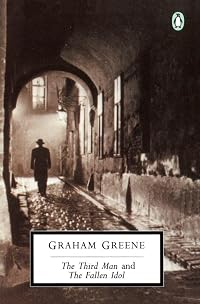
The Third Man and The Fallen Idol
by Graham Greene 
On This Page
Description
The third man : Rollo Martins, a second-rate novelist, arrives penniless to visit his friend and hero, Harry Lime. But Harry has died in suspicious circumstances, and the police are closing in on his associates. The fallen idol : A small boy is caught up in the games adults play. Left in the care of the butler and his wife while his parents go on holiday, Philip realizes too late the danger of lies and deceit. But the truth is even deadlier.Tags
Recommendations
















Member Recommendations

Member Reviews
It is no surprise that The Third Man as a novel remains inchoate. It is a signpost, a germinating seed carelessly pitched in frustrated haste. Where does it lead, what will grow? The film’s images travel in any reader’s bloodstream. Cotten, Howard and Welles occupy the dialogue. Greene’s descriptions are wan and undeveloped. What then can possibly pierce a contemporary reader? The crux of The Third Man is the death of loyalty. Reason and Ideology may trade blows in a makeshift ring, governed in an incomprehensible language, what matters is friendship, right? Even loyalties forged over a lifetime become suspect in the murky reality of postwar Vienna.
The Third Man novella occupies a peculiar position in Graham Greene's oeuvre, which makes it a difficult book to appraise. It was written by Greene as preparation for the 1949 film The Third Man and never intended to be published, yet this was done when the film became such a resounding success. This success was deserved, for the film is a triumph: atmospheric, accomplished and surprisingly modern. It is rightly considered one of the greatest films ever made, and consequently any attempt to compare the preparatory novella to its more evolved counterpart would be as unfair as it would to compare early homo erectus to modern homo sapiens. As Greene himself says in his illuminating preface, there is no debate; the film is the better story show more because it is in this case the finished state of the story." (pg. 10).
But the novella is no mere storyboard; it does stand up as a decent thriller in its own right for those who haven't seen the film. Some plot points are a bit more fleshed out, and Greene's authorial voice is as precise as ever. But for fans of the film it lacks newness: despite some cosmetic changes, it follows the same course as the film, and contains the same dialogue (with the notable exception of the famous "cuckoo clock" line, which was written by Orson Welles, who played Harry Lime). What the novella cannot capture is the fine acting and peerless cinematography of the film – the epitome of atmospheric film noir. (I'm not entirely sold on the merits of the famous zither score.) Also in the novella's debit column is that it gives us a happy ending; the film's achingly brilliant and bittersweet long shot was far superior. That ending made you realise you'd been watching something special even as the first of the credits popped up on screen. For all its unassuming merit, the novella can never match that.
It's also worth briefly discussing the other story included in this edition, the much shorter 'The Fallen Idol', also known as 'The Basement Room'. This is an interesting story of a young boy who witnesses a crime, and delves into themes surrounding the moral confusion and the loss of innocence of this poor lad. It is more stylistic than The Third Man, as unlike its companion it was intended for literary publication, and this literary shift can be rather jarring after the more functional novella. But it was fascinating in its own way, and serves as a reminder of Graham Greene's literary talents, even if the preceding story was more accomplished on the screen than on the page." show less
But the novella is no mere storyboard; it does stand up as a decent thriller in its own right for those who haven't seen the film. Some plot points are a bit more fleshed out, and Greene's authorial voice is as precise as ever. But for fans of the film it lacks newness: despite some cosmetic changes, it follows the same course as the film, and contains the same dialogue (with the notable exception of the famous "cuckoo clock" line, which was written by Orson Welles, who played Harry Lime). What the novella cannot capture is the fine acting and peerless cinematography of the film – the epitome of atmospheric film noir. (I'm not entirely sold on the merits of the famous zither score.) Also in the novella's debit column is that it gives us a happy ending; the film's achingly brilliant and bittersweet long shot was far superior. That ending made you realise you'd been watching something special even as the first of the credits popped up on screen. For all its unassuming merit, the novella can never match that.
It's also worth briefly discussing the other story included in this edition, the much shorter 'The Fallen Idol', also known as 'The Basement Room'. This is an interesting story of a young boy who witnesses a crime, and delves into themes surrounding the moral confusion and the loss of innocence of this poor lad. It is more stylistic than The Third Man, as unlike its companion it was intended for literary publication, and this literary shift can be rather jarring after the more functional novella. But it was fascinating in its own way, and serves as a reminder of Graham Greene's literary talents, even if the preceding story was more accomplished on the screen than on the page." show less
In his introduction to this combined volume, Graham Greene admits that written version of the "The Third Man" is probably an afterthought to its film version. He's right -- it's a decidedly minor work on the page -- but both the author's modesty and his honesty is refreshing. While the plot of this novella will likely be familiar to many readers, there are still a few things to enjoy. Greene's narrator, an old embassy hand, takes considerable pleasure in describing the byzantine bureaucratic machinations that defined life in postwar Vienna. There is also the question of evil that lies at the center of the book, touched on, famously, during the conversation that Harry Lime and his former friend have while sitting atop a dilapidated feris show more wheel. Greene doesn't really provide an answer to Lime's ruthless view of human nature here, but its a very memorable scene, and, since Vienna's residents were likely just coming to terms with totalitarianism´s atrocities in the years that immediately followed World War II , the ambiguities it raises seem particularly appropriate to the book's setting.
"The Fallen Idol" isn't much more than a short story, but seems the stronger work here. Its a gothic, psychologically haunted picture of a badly out-of-balance domestic arrangement. Some readers will probably charge that it courts misogyny and is, in places, a bit too forthright about its themes, and those criticisms are, I think, valid. But "The Fallen Idol" is still effective as a depiction of childhood trauma and a particular sort emotional dependence and vulnerability that's exclusive to the earlier stages of our lives. In fact, I was surprised that a writer who is best known for his "cinematic" style and emphasis on plot handled could handle psychological complexities of childhood so well. Also, the marked contrast between central protagonist's keen observations about of the difficult situation in which he finds himself and his inability to take much agency in his own role in the drama that goes on around him is painful to witness. These two stories, brief though they are, don't suggest that Mr. Greene was much of an optimist when it came to human nature. show less
"The Fallen Idol" isn't much more than a short story, but seems the stronger work here. Its a gothic, psychologically haunted picture of a badly out-of-balance domestic arrangement. Some readers will probably charge that it courts misogyny and is, in places, a bit too forthright about its themes, and those criticisms are, I think, valid. But "The Fallen Idol" is still effective as a depiction of childhood trauma and a particular sort emotional dependence and vulnerability that's exclusive to the earlier stages of our lives. In fact, I was surprised that a writer who is best known for his "cinematic" style and emphasis on plot handled could handle psychological complexities of childhood so well. Also, the marked contrast between central protagonist's keen observations about of the difficult situation in which he finds himself and his inability to take much agency in his own role in the drama that goes on around him is painful to witness. These two stories, brief though they are, don't suggest that Mr. Greene was much of an optimist when it came to human nature. show less
I can see now that Grahan Green was right in his original decision not to put 'The Third Man' forward for publication as a novella.
My expectations going in were fairly low. I saw it as a preliminary sketch, made in isolation, in preparation for the collaborative creative effort of making what was to become a good movie. In effect, it’s a first-pass storyboard I didn't expect it to be so lifeless that I abandoned it at 35% because I was bored.
The structure of the storytelling is clumsy and ineffective. Having events curated by a policeman who is reflecting on his memories and who slides back and forth on the timeline doesn't work well. It keeps you out of the heads of the main players and keeps the action as passive recollections and show more the emotions as chewed-over summaries. I think it was meant to add mystery and foreshadowing but, for me, it just made the story ponderous.
The plot is wafer-thin. It's fairly obvious from the beginning who the third man is and what Role Martins' blind spot is. This might have been OK if I was invested in Rolo's search for the truth but he's a hard man to like. His only distinguishing features seem to be weakness and bad temper. His relationship with Lime seems to be one of suppressed homosexual attraction arising from an early, apparently abusive, relationship when he and Lime were at school together. He refers frequently to 'mixing his drinks' which seems to be a coded reference to his bisexuality. Lime, as seen from the policeman's eyes and Martins' shared memories, is a narcissist and a racketeer. Martins' is his long-time stooge. The story gives me no reason to care about Harry Lime. Martins' could have been drawn as the route-for-him-because-he's-loyal-and-grieving-for-a-friend under-dog but instead, he comes across as weak, broken men, thrashing around trying to sustain the fantasy of a relationship that he won't allow himself to see clearly.
Still, I didn't set the novella aside because I didn't like the characters or the plot. I put it aside because the prose limps along and I became bored. The whole thing is only 157 pages long. I should have read it in a day. Instead, I kept putting it down and then found myself reluctant to pick it up again.
My advice: skip this and watch the movie. If the movie really hooks you and you want to see what made it work, dip into this novella and see how far they came from this beginning.
Here's the trailer for the movie. It's worth watching for the camera work and the music, even before you add Orson Welles.
https://www.youtube.com/watch?v=r9yyDEDGlr0&list=PLogzKwi9H4RRI7jhBmNFwVtHZO... show less
Contained in this volume are two stories which while very different in subject, character and setting, both bear the Greene stain, that quest to understand why man sins; why, ultimately, he is weak. Greene once said something to the effect that he was always surprised to find himself loved knowing he was the sort of person only his mother and God is likely to love. As a Jansenist, even that fierce love of God was not a certainty as only a few are elected. Rollo Martins, the hapless (or is that more effect than real) is reminded of this in the too pristine office of the too pristine Dr. Winkler. Winkler, a collector of relics and crucifixes ( is there a Greene story without a significant crucifix?) has among his collection a Jansenist show more cross with the Saviour's arms reaching upward rather than widely, all embracing. Later Martin is reminded that to much of humanity those one do not know are mere moving dots which can be stopped without remorse. Any such remorse is sentimentality. Where does this leave the individual, God is not all embracing and one's fellows are indifferent to one's fate. Often this is the thread that Greene's novel run along. Where is the point in virtue or as is lampooned in an arrest scene the American chivalry. Weak though they may be Greene's heroes often choose to look at humans as worth caring about. So is the case with the hero of The Third Man, but not The Fallen Idol. Greene's famously jaundiced eye takes it all in, then drops the whole corrupt wallow in your lap without answers. But then Chekov says it is the artist's job to ask questions, not answer them.
That is quite a long set up for the review of an novella which Greene would have put in the category of an "entertainment." Even among his entertainments, he considered it a weak effort. It was never meant to be a book at all. Carol Kane asked for a script, Greene never could script except from a story, thus he wrote the novella as a launch pad for the movie script. He acknowledges it as weak. Weak by his standards,at least. Still, it is an excellent suspense story set in the moody, fractured postwar Vienna where commodities such as tires, medicines and joy are scarce. On the other hand corruption is rampant. Called there to work with his schoolfriend, Harry Lime, Rollo Martins arrives in the surreal mess of the once fairy take city to find his friend dead and suspected by the English police force of being involved in a racket, "the dirtiest racket" in a city teeming with such. Determined to defend his schoolmate's honor, Martins begins an investigation of his own. There is a side complication in that Martins, after being mistaken as a major literary novelist who shares the same last name as the pen name Martins uses for his Western novelettes, goes along with the mistake when he finds there is free food, lodging at the Hotel Sacher and cash to be gained. There is added fun in that the novelist he is mistaken for is obviously a fictionalized E. M. Forster. I can just imagine the smug look on Greene's face as he wrote that bit.
Tautly, deftly crafted, The Third Man is great moody fun. "The Fallen Idol" is not. Not fun, not fun that is. The story is told in retrospect by an elderly man who acknowledges his own nihilistic dilettantism . He describes an event in which as a naive child he unwittingly participates in the secrets of his hero, the family butler. Forever marked by the event he cowers into the life of ineffectual dabbler. Of the two stories, this is the story Greene thought the better. Artistically speaking it is. The corruption of a child by unthinking adults is one of the more haunting motifs in literature. Greene serves it up beautifully here. show less
That is quite a long set up for the review of an novella which Greene would have put in the category of an "entertainment." Even among his entertainments, he considered it a weak effort. It was never meant to be a book at all. Carol Kane asked for a script, Greene never could script except from a story, thus he wrote the novella as a launch pad for the movie script. He acknowledges it as weak. Weak by his standards,at least. Still, it is an excellent suspense story set in the moody, fractured postwar Vienna where commodities such as tires, medicines and joy are scarce. On the other hand corruption is rampant. Called there to work with his schoolfriend, Harry Lime, Rollo Martins arrives in the surreal mess of the once fairy take city to find his friend dead and suspected by the English police force of being involved in a racket, "the dirtiest racket" in a city teeming with such. Determined to defend his schoolmate's honor, Martins begins an investigation of his own. There is a side complication in that Martins, after being mistaken as a major literary novelist who shares the same last name as the pen name Martins uses for his Western novelettes, goes along with the mistake when he finds there is free food, lodging at the Hotel Sacher and cash to be gained. There is added fun in that the novelist he is mistaken for is obviously a fictionalized E. M. Forster. I can just imagine the smug look on Greene's face as he wrote that bit.
Tautly, deftly crafted, The Third Man is great moody fun. "The Fallen Idol" is not. Not fun, not fun that is. The story is told in retrospect by an elderly man who acknowledges his own nihilistic dilettantism . He describes an event in which as a naive child he unwittingly participates in the secrets of his hero, the family butler. Forever marked by the event he cowers into the life of ineffectual dabbler. Of the two stories, this is the story Greene thought the better. Artistically speaking it is. The corruption of a child by unthinking adults is one of the more haunting motifs in literature. Greene serves it up beautifully here. show less
More like a novella than a full blown novel, this story is hard as nails as Greene paints an evocative picture of war-ravished Vienna in the grey wintertime.
I found the fact that Greene had adopted an unusual point of view for this novel difficult. The narrator is a police inspector who isn't the main character in the book. This was confusing at times and it made me wonder why he did it. I've read a lot of Greene and I can't think of another work where he does this.
But the book resounds with imagery of the bleak choices we face in life, the different pathways that we take and the way we justify them to those around us and our own souls. In this at least, it's classic Greene.
I found the fact that Greene had adopted an unusual point of view for this novel difficult. The narrator is a police inspector who isn't the main character in the book. This was confusing at times and it made me wonder why he did it. I've read a lot of Greene and I can't think of another work where he does this.
But the book resounds with imagery of the bleak choices we face in life, the different pathways that we take and the way we justify them to those around us and our own souls. In this at least, it's classic Greene.
Contained in this volume are two stories which while very different in subject, character and setting, both bear the Greene stain, that quest to understand why man sins; why, ultimately, he is weak. Greene once said something to the effect that he was always surprised to find himself loved knowing he was the sort of person only his mother and God is likely to love. As a Jansenist, even that fierce love of God was not a certainty as only a few are elected. Rollo Martins, the hapless (or is that more effect than real) is reminded of this in the too pristine office of the too pristine Dr. Winkler. Winkler, a collector of relics and crucifixes ( is there a Greene story without a significant crucifix?) has among his collection a Jansenist show more cross with the Saviour's arms reaching upward rather than widely, all embracing. Later Martin is reminded that to much of humanity those one do not know are mere moving dots which can be stopped without remorse. Any such remorse is sentimentality. Where does this leave the individual, God is not all embracing and one's fellows are indifferent to one's fate. Often this is the thread that Greene's novel run along. Where is the point in virtue or as is lampooned in an arrest scene the American chivalry. Weak though they may be Greene's heroes often choose to look at humans as worth caring about. So is the case with the hero of The Third Man, but not The Fallen Idol. Greene's famously jaundiced eye takes it all in, then drops the whole corrupt wallow in your lap without answers. But then Chekov says it is the artist's job to ask questions, not answer them.
That is quite a long set up for the review of an novella which Greene would have put in the category of an "entertainment." Even among his entertainments, he considered it a weak effort. It was never meant to be a book at all. Carol Kane asked for a script, Greene never could script except from a story, thus he wrote the novella as a launch pad for the movie script. He acknowledges it as weak. Weak by his standards,at least. Still, it is an excellent suspense story set in the moody, fractured postwar Vienna where commodities such as tires, medicines and joy are scarce. On the other hand corruption is rampant. Called there to work with his schoolfriend, Harry Lime, Rollo Martins arrives in the surreal mess of the once fairy take city to find his friend dead and suspected by the English police force of being involved in a racket, "the dirtiest racket" in a city teeming with such. Determined to defend his schoolmate's honor, Martins begins an investigation of his own. There is a side complication in that Martins, after being mistaken as a major literary novelist who shares the same last name as the pen name Martins uses for his Western novelettes, goes along with the mistake when he finds there is free food, lodging at the Hotel Sacher and cash to be gained. There is added fun in that the novelist he is mistaken for is obviously a fictionalized E. M. Forster. I can just imagine the smug look on Greene's face as he wrote that bit.
Tautly, deftly crafted, The Third Man is great moody fun. "The Fallen Idol" is not. Not fun, not fun that is. The story is told in retrospect by an elderly man who acknowledges his own nihilistic dilettantism . He describes an event in which as a naive child he unwittingly participates in the secrets of his hero, the family butler. Forever marked by the event he cowers into the life of ineffectual dabbler. Of the two stories, this is the story Greene thought the better. Artistically speaking it is. The corruption of a child by unthinking adults is one of the more haunting motifs in literature. Greene serves it up beautifully here. show less
That is quite a long set up for the review of an novella which Greene would have put in the category of an "entertainment." Even among his entertainments, he considered it a weak effort. It was never meant to be a book at all. Carol Kane asked for a script, Greene never could script except from a story, thus he wrote the novella as a launch pad for the movie script. He acknowledges it as weak. Weak by his standards,at least. Still, it is an excellent suspense story set in the moody, fractured postwar Vienna where commodities such as tires, medicines and joy are scarce. On the other hand corruption is rampant. Called there to work with his schoolfriend, Harry Lime, Rollo Martins arrives in the surreal mess of the once fairy take city to find his friend dead and suspected by the English police force of being involved in a racket, "the dirtiest racket" in a city teeming with such. Determined to defend his schoolmate's honor, Martins begins an investigation of his own. There is a side complication in that Martins, after being mistaken as a major literary novelist who shares the same last name as the pen name Martins uses for his Western novelettes, goes along with the mistake when he finds there is free food, lodging at the Hotel Sacher and cash to be gained. There is added fun in that the novelist he is mistaken for is obviously a fictionalized E. M. Forster. I can just imagine the smug look on Greene's face as he wrote that bit.
Tautly, deftly crafted, The Third Man is great moody fun. "The Fallen Idol" is not. Not fun, not fun that is. The story is told in retrospect by an elderly man who acknowledges his own nihilistic dilettantism . He describes an event in which as a naive child he unwittingly participates in the secrets of his hero, the family butler. Forever marked by the event he cowers into the life of ineffectual dabbler. Of the two stories, this is the story Greene thought the better. Artistically speaking it is. The corruption of a child by unthinking adults is one of the more haunting motifs in literature. Greene serves it up beautifully here. show less
Members
- Recently Added By
Lists

20th Century Literature
1,161 works; 55 members

Books Read in 2018
4,360 works; 110 members
Author Information

356+ Works 87,436 Members
Born in 1904, Graham Greene was the son of a headmaster and the fourth of six children. Preferring to stay home and read rather than endure the teasing at school that was a by-product of his father's occupation, Greene attempted suicide several times and eventually dropped out of school at the age of 15. His parents sent him to an analyst in show more London who recommended he try writing as therapy. He completed his first novel by the time he graduated from college in 1925. Greene wrote both entertainments and serious novels. Catholicism was a recurring theme in his work, notable examples being The Power and the Glory (1940) and The End of the Affair (1951). Popular suspense novels include: The Heart of the Matter, Our Man in Havana and The Quiet American. Greene was also a world traveler and he used his experiences as the basis for many books. One popular example, Journey Without Maps (1936), was based on a trip through the jungles of Liberia. Greene also wrote and adapted screenplays, including that of the 1949 film, The Third Man, which starred Orson Welles. He died in Vevey, Switzerland in 1991. (Bowker Author Biography) show less
Graham Greene has a Legacy Library. Legacy libraries are the personal libraries of famous readers, entered by LibraryThing members from the Legacy Libraries group.
Series
Belongs to Publisher Series
Work Relationships
Contains
Common Knowledge
- Canonical title
- The Third Man and The Fallen Idol
- Original publication date
- 1949 (The Third Man) (The Third Man); 1948 (The Fallen Idol) (The Fallen Idol)
- People/Characters
- Harry Lime; Rollo Martins; Colonel Calloway
- Important places
- Vienna, Austria
- Related movies
- The Third Man (1949 | IMDb); The Fallen Idol (1948 | IMDb)
- First words
- One never knows when the blow may fall.
- Original language
- English
- Disambiguation notice
- The original title of "The Fallen Idol" was "The Basement Room"
Classifications
Statistics
- Members
- 1,275
- Popularity
- 19,118
- Reviews
- 34
- Rating
- (3.69)
- Languages
- 9 — Danish, Dutch, English, French, German, Italian, Norwegian (Bokmål), Polish, Spanish
- Media
- Paper, Audiobook, Ebook
- ISBNs
- 20
- ASINs
- 30