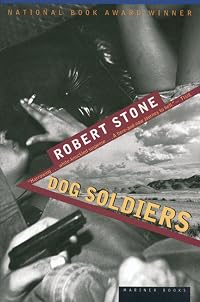
Dog Soldiers
by Robert Stone
On This Page
Description
In Saigon during the waning days of the Vietnam War, a small-time journalist named John Converse thinks he'll find action--and profit--by getting involved in a big-time drug deal. But back in the States, things go horribly wrong for him. Dog Soldiers perfectly captures the underground mood of America in the 1970s, when amateur drug dealers and hippies encountered profiteering cops and professional killers--and the price of survival was dangerously high.Tags
Recommendations











Member Recommendations

Member Reviews
John Converse is a quasi-journalist in Vietnam as the war is winding down. His main talent appears to lie in concocting sensational headlines for his communist father-in-law’s underground newspaper. Converse considers himself “a feckless and disorderly person,” “at the mercy of events.” At least he does after he smuggles three kilos of heroin into California, using a sometimes friend named Hicks as the mule, and it all goes terribly wrong.
Hicks disappears with Converse’s wife, Marge, and the heroin. Their young daughter is traumatized and ends up with Marge’s parents. Marge takes a liking to the heroin while she’s on the run with Hicks. Converse is waylaid by a corrupt agent who was meant to get the dope.
Stone portrays show more the ephemeral nature of life during the Vietnam War era, where corruption is rampant and even hippies can’t be trusted. As Antheil, the agent, says: "If you think someone's doing you wrong, it's not for you to judge. Kill them first and then God can do the judging." As the violence mounts, Converse becomes “ashamed of the casual arrogance with which he had presumed to scurry about creation.”
Stone’s writing is beautifully descriptive, but always with the result of enhancing the story rather than bogging it down. show less
Hicks disappears with Converse’s wife, Marge, and the heroin. Their young daughter is traumatized and ends up with Marge’s parents. Marge takes a liking to the heroin while she’s on the run with Hicks. Converse is waylaid by a corrupt agent who was meant to get the dope.
Stone portrays show more the ephemeral nature of life during the Vietnam War era, where corruption is rampant and even hippies can’t be trusted. As Antheil, the agent, says: "If you think someone's doing you wrong, it's not for you to judge. Kill them first and then God can do the judging." As the violence mounts, Converse becomes “ashamed of the casual arrogance with which he had presumed to scurry about creation.”
Stone’s writing is beautifully descriptive, but always with the result of enhancing the story rather than bogging it down. show less
Beautiful book even despite the relentless depravity depicted in the desperate lives of drug smugglers set against a bleak, gritty backdrop during the waning years of the Vietnam War. So many hard drugs got smuggled out of the Sixties. Too bad peace and love couldn't have been smuggled out of the decade too.
Published in 1974, and winner of the National Book Award, Dog Soldiers served as a nice dark bookend to the fractured dreams of Woodstock's generation. It's a black denouement to dashed hippie ideals, a twisted paean to the power of heroin and hash, covert-ops and coverups. But Dog Soldiers is not dated. Nearly forty years out, its sordid story still resonates. For as long as lies, lust, disillusionment, addiction, exploitation, show more small-time dope dealer's schemes, greed, murder, betrayal, embezzlement, military corruption and law enforcement hubris, remain en vogue in the shadier realms of our already wrecked humanity, so will Dog Soldiers remain universally relevant. The novel's social realism rings as sadly true today as it did in the smashed Seventies, mirroring a now cracked nation's spiritual demise, its indefatigable decline of optimism and immanence, when its alleged dream metastasized into something less lovely than freedom or flowers. show less
Published in 1974, and winner of the National Book Award, Dog Soldiers served as a nice dark bookend to the fractured dreams of Woodstock's generation. It's a black denouement to dashed hippie ideals, a twisted paean to the power of heroin and hash, covert-ops and coverups. But Dog Soldiers is not dated. Nearly forty years out, its sordid story still resonates. For as long as lies, lust, disillusionment, addiction, exploitation, show more small-time dope dealer's schemes, greed, murder, betrayal, embezzlement, military corruption and law enforcement hubris, remain en vogue in the shadier realms of our already wrecked humanity, so will Dog Soldiers remain universally relevant. The novel's social realism rings as sadly true today as it did in the smashed Seventies, mirroring a now cracked nation's spiritual demise, its indefatigable decline of optimism and immanence, when its alleged dream metastasized into something less lovely than freedom or flowers. show less
When somebody says that a book is "a product of its time," it's not usually meant as a compliment. The great achievement of Robert Stone's novel, on the other hand, is to capture the sense of cultural malaise that followed the end of sixties idealism. Another reviewer here has pointed out some philosophical overtones in this work, but I tend to think that he reads too deeply – this book's characters, most of whom are self-serving hustlers or wannabe hustlers, have perverted sixties-era ideas and language for their own selfish ends. These characters have chosen to sustain themselves on pretty but hollow rhetoric and a pharmacy full of controlled substances, and the overall effect is unsettling in the extreme. Stone's writing is also show more perfectly suited to his material, capturing both his subjects desperation and a bit of their desperate humor. As the book draws to a close and things start to go off the rails, the entire thing starts to feel like a particularly heavy, particularly bad trip. "Dog Soldiers" is built like a noir – I wasn't surprised to learn that it'd been adapted for the screen – but a seductive junkie haze hangs over the entire thing, too, giving the book a softer, more beautiful edge. Don't try any of this at home. Highly recommended. show less
Rereading this and A Hall of Mirrors, I was knocked over by both of them again in different ways... but while I still can't rate this one as any less than great, it now seems like a lesser kind of thing, a little more schematic. Where A Hall of Mirrors felt like it took place in a living world (though an often yucky one), Dog Soldiers feels more like a hollowed-out dream-world where the characters are totally alone with the results of their free will-- which is probably exactly the effect Stone was going for, but it's less interesting to me. Still, it's stunningly written, with his usual great ear for dialogue, and as a straight-up crime story it sure does convey the pure miserable terror of having to be around people who hurt and kill show more people. Also, if you stick it out to the end, there is one character who's not crazy, cowardly, or destructive, and that person does okay.
The movie adaptation, Who'll Stop the Rain, had a decent cast but left out pretty much everything interesting. This is 10,000 times better. Just don't read it without some ice cream and kittens nearby as an antidote. show less
The movie adaptation, Who'll Stop the Rain, had a decent cast but left out pretty much everything interesting. This is 10,000 times better. Just don't read it without some ice cream and kittens nearby as an antidote. show less
Was Robert Stone stoned when he wrote this novel? "Dog Soldiers" is a story about drug dealers and drug addiction. It was written in 1973 and won the National Book Award. The plot involves a naive journalist named Converse who is covering the Viet Nam war. Apparently, all forms of drugs were easy to obtain in Viet Nam during the war, and Converse enjoys partaking - and is getting negatively influenced by a beautiful, sexy woman (also an America correspondent). She convinces him to help transport heroin to the USA - where she assures him her own personal connections will assist in distribution. Just one big suitcase full of pure un-cut heroin. He could make a lot of money! While he is high on something he agrees. He has his own show more connections. It will be simple - right?
Converse has no trouble getting the stuff transported, and delivered to his wife in California. So far the plot is a bit boring moving at a slow pace. None of the characters are likable, in fact most of them are downright repulsive.
The problem is everyone involved in the story is on some kind of drug: hash, marijuana, heroin, crack, cocaine, smack, opium, scag…. you name it - they were doing it.
Then the nightmare begins. Time Magazine was not exaggerating when they recommended this novel as “harrowing…white-knuckled suspense… a here and how journey to hell”. However, the way the story is told is confusing, disoriented, and chaotic. Robert Stone provides very little character development relying on dialogue composed of “tough guy street slang” that seems exaggerated and drug induced conversations that are theatrical and absurd.… as thought the reader would be thinking, “groovy!” or “right on!” - when in reality most of the dialogue was nonsensical gibberish.
The plot was indeed intense, and harrowing: corrupt NARC agents, professional hit-men, violent rival drug dealers - Converse’s wife strung out on drugs with no one to trust and no where to run, but so many details were left out that the conclusion was anti-climactic.
Rated 3 Stars February 2026
After writing my review, just out of curiosity, I did a little research on Robert Stone. I discovered he hung out with Ken Kesey and the renowned hippy group the “Merry Pranksters” in the 1960s. The Merry Pranksters were into communal living and hallucinogenic drugs. I was being cynical when I questioned if Robert Stone was stoned while writing this book… but perhaps he really was. show less
Converse has no trouble getting the stuff transported, and delivered to his wife in California. So far the plot is a bit boring moving at a slow pace. None of the characters are likable, in fact most of them are downright repulsive.
The problem is everyone involved in the story is on some kind of drug: hash, marijuana, heroin, crack, cocaine, smack, opium, scag…. you name it - they were doing it.
Then the nightmare begins. Time Magazine was not exaggerating when they recommended this novel as “harrowing…white-knuckled suspense… a here and how journey to hell”. However, the way the story is told is confusing, disoriented, and chaotic. Robert Stone provides very little character development relying on dialogue composed of “tough guy street slang” that seems exaggerated and drug induced conversations that are theatrical and absurd.… as thought the reader would be thinking, “groovy!” or “right on!” - when in reality most of the dialogue was nonsensical gibberish.
The plot was indeed intense, and harrowing: corrupt NARC agents, professional hit-men, violent rival drug dealers - Converse’s wife strung out on drugs with no one to trust and no where to run, but so many details were left out that the conclusion was anti-climactic.
Rated 3 Stars February 2026
After writing my review, just out of curiosity, I did a little research on Robert Stone. I discovered he hung out with Ken Kesey and the renowned hippy group the “Merry Pranksters” in the 1960s. The Merry Pranksters were into communal living and hallucinogenic drugs. I was being cynical when I questioned if Robert Stone was stoned while writing this book… but perhaps he really was. show less
This one grew on me as it went along, I can give it 3.5 stars. In “Dog Soldiers”, published 1974, Robert Stone shows the 60s dream turned into a nightmare: the hippie weed smoker is now into heavier drugs; the violence from the war in Vietnam has leaked back home and society is, well - morally corrupt. The characters are unlikable but they keep fighting; what they want is unclear, even to themselves. Having irrational actors allows Stone to put together an action movie plot not without interesting philosophical asides; he is skilled, perhaps a little too much so, at detailing the tortured thoughts of his troubled creations. The novel not a bad thriller, a sort of cowboy chase across the wilderness not without a decent shootout. That show more the Mexican border is not far off near the end is inevitable, Mexico exists as an escape route for the American outlaw. He hardly ever makes it across though, maybe because he knows that once out of the States he ceases to matter.
The book's opening scene throws you off guard: Converse, a thirty-five year old American journalist in Vietnam, tries to pick up a older woman on a park bench. He might have had a chance if she wasn't a missionary, but he tries anyway. Converse is going to run heroin back to the States. He'll use his merchant marine buddy Ray Hicks. The 'scag' is to be delivered to Marge, Converse's drug-addled wife. She’s into Dilaudid bought from the Samoan usher at the adult movie theatre where she works selling tickets. Once the heroin arrives she quickly gets hooked on that.
Thugs tipped off by Converse's Vietnam supplier jump Hicks when he delivers the drugs to Marge. Hicks fights them off and takes Marge and the scag to a former hippie colony in the forest. The thugs, the violent and unbalanced Smitty and Daskin, with Converse as hostage set out in hot pursuit. They are working for a crooked cop of some kind and they’ll have their work cut out with Hicks, who was allegedly based on the famous beatnik Neal Cassady. I can’t imagine Cassady having the parts of a M16 in a safe place all greased up and ready to be assembled, Hicks even has a M70 grenade launcher attachment.
Some of the background about the hippie colony at the site of an old Spanish mission in the hills of Southern California doesn’t really come off. The spiritual leader, a German named Dieter, has put more security into his chill-pad than Castle Grayskull. Converse's past as a journalist with a flare for catchy headlines is mapped well enough, but I would have liked to get a clearer picture of Hicks.
Dog soldiers reminded me of Conrad’s "Victory" and Cormac McCarthy’s "No Country for Old Men". "Victory" has the same chase narrative and Stone was a fan of Conrad. "Dog Soldiers" has the evil of "No Country For Old Men" but more humour and less self-conscious preciseness. The female characters are all junkies in this book, but the men are messed up too, so it doesn’t feel too sexist. Here is an idea of Stone’s prose:
“He sat desiring the girl - a speed-hardened straw-colored junkie stewardess, a spoiled Augustana Lutheran, compounded of airport Muzak and beauty parlor school. Her eyes were fouled with smog and propane spray.”
I haven’t seen the movie with Nick Nolte, but I can imagine this novel would make a good film. A few years later Nolte starred in a movie of Steinbeck’s "Cannery Road", a much more positive take on the human condition - but not a book to make a movie out of. show less
The book's opening scene throws you off guard: Converse, a thirty-five year old American journalist in Vietnam, tries to pick up a older woman on a park bench. He might have had a chance if she wasn't a missionary, but he tries anyway. Converse is going to run heroin back to the States. He'll use his merchant marine buddy Ray Hicks. The 'scag' is to be delivered to Marge, Converse's drug-addled wife. She’s into Dilaudid bought from the Samoan usher at the adult movie theatre where she works selling tickets. Once the heroin arrives she quickly gets hooked on that.
Thugs tipped off by Converse's Vietnam supplier jump Hicks when he delivers the drugs to Marge. Hicks fights them off and takes Marge and the scag to a former hippie colony in the forest. The thugs, the violent and unbalanced Smitty and Daskin, with Converse as hostage set out in hot pursuit. They are working for a crooked cop of some kind and they’ll have their work cut out with Hicks, who was allegedly based on the famous beatnik Neal Cassady. I can’t imagine Cassady having the parts of a M16 in a safe place all greased up and ready to be assembled, Hicks even has a M70 grenade launcher attachment.
Some of the background about the hippie colony at the site of an old Spanish mission in the hills of Southern California doesn’t really come off. The spiritual leader, a German named Dieter, has put more security into his chill-pad than Castle Grayskull. Converse's past as a journalist with a flare for catchy headlines is mapped well enough, but I would have liked to get a clearer picture of Hicks.
Dog soldiers reminded me of Conrad’s "Victory" and Cormac McCarthy’s "No Country for Old Men". "Victory" has the same chase narrative and Stone was a fan of Conrad. "Dog Soldiers" has the evil of "No Country For Old Men" but more humour and less self-conscious preciseness. The female characters are all junkies in this book, but the men are messed up too, so it doesn’t feel too sexist. Here is an idea of Stone’s prose:
“He sat desiring the girl - a speed-hardened straw-colored junkie stewardess, a spoiled Augustana Lutheran, compounded of airport Muzak and beauty parlor school. Her eyes were fouled with smog and propane spray.”
I haven’t seen the movie with Nick Nolte, but I can imagine this novel would make a good film. A few years later Nolte starred in a movie of Steinbeck’s "Cannery Road", a much more positive take on the human condition - but not a book to make a movie out of. show less
I began this book thinking it would be about the Vietnam War told from the perspective of an in-country reporter named John Converse. I came to find that, while a few early scenes were set in Vietnam and Converse did occasionally reflect on his time spent there, the focus of the book is a drug deal that goes wrong--horribly, horribly wrong. However, I still loved the book. It has a bit of a Pulp Fiction or Guy Ritchie film feel to it. None of the characters are likable people and they have the moral sensibilities of a gnat, but they're entertaining and a reflection of the shifting values embodied by the time period (when asked why he tried to move heroin from Vietnam to the U.S., Converse replies, "You hear stories over there. They say show more everybody does it. Being there f***s up your perspective.") Like most Vietnam novels, the novel is liberally sprinkled with black humor (for those who can find and appreciate it). I would read the novel all over again just for Converse's remembrance of being fragmentation-bombed in Cambodia--a particularly harrowing and well-written scene of self-realization. show less
Members
- Recently Added By
Published Reviews
ThingScore 100
A great American masterpiece.
added by Shortride
Lists

Novels from The Guardian's Great American Novelist Tournament
148 works; 24 members

Favourite Books
1,820 works; 316 members
Time Magazine's "All-Time 100"
113 works; 15 members

National Book Award - Fiction
78 works; 10 members

Time's All-Time 100 Novels
100 works; 27 members
Read These Too
458 works; 9 members
Harold Bloom - The Western Canon: D. The Chaotic Age
833 works; 24 members
Author Information

26+ Works 5,151 Members
Robert Stone was born in Brooklyn, New York on August 21, 1937. His parents never married and his father was not part of his life. His mother had schizophrenia and was frequently hospitalized. From the ages of 6 to 10, he lived in an orphanage run by the Marist brothers. In 1954, he dropped out of high school and joined the Navy, where he earned show more his high school equivalency diploma. In the 1960's, he briefly attended New York University, worked as a copy boy for the New York Daily News, and attended the Wallace Stegner writing workshop at Standford University. His first novel, A Hall of Mirrors, won a William Faulkner Foundation award for best first novel of 1967 and was adapted into a movie entitled WUSA starring Paul Newman. His other books include Children of Light, Outerbridge Reach, Damascus Gate, Bear and His Daughter, Fun with Problems, Bay of Souls, and Death of the Black-Haired Girl. He also wrote a memoir entitled Prime Green: Remembering the Sixties. He won numerous awards including the National Book Award in 1975 for Dog Soldier, which was adapted into a movie entitled Who'll Stop the Rain starring Nick Nolte and Tuesday Weld, and a PEN/Faulkner Award for A Flag for Sunrise. He died of chronic obstructive pulmonary disease on January 10, 2015 at the age of 77. (Bowker Author Biography) show less
Awards and Honors
Awards
Distinctions
Series
Belongs to Publisher Series
Work Relationships
Common Knowledge
- Canonical title
- Dog Soldiers
- Original title
- Dog Soldiers
- Alternate titles*
- Les guerriers de l'enfer
- Original publication date
- 1974 (1e édition originale américaine sous le titre "Dog soldiers", Houghton Mifflin) (1e édition originale américaine sous le titre "Dog soldiers", Houghton Mifflin); 1978 (1e édition et traduction française sous le titre "Les Guerriers de l'enfer" par Michel Pétris et Marie Kalt, Le Sagitaire) (1e édition et traduction française sous le titre "Les Guerriers de l'enfer" par Michel Pétris et Marie Kalt, Le Sagitaire); 1980 (Réédition française, Bibliothèque Marabout) (Réédition française, Bibliothèque Marabout); 1994 (Réédition française, Série noire, Gallimard) (Réédition française, Série noire, Gallimard); 2016-06-02 (Nouvelle édition et traduction française par Philippe Garnier sous le titre "La ligne de fuite", Editions de l'Olivier) (Nouvelle édition et traduction française par Philippe Garnier sous le titre "La ligne de fuite", Editions de l'Olivier); 2018-02-08 (Réédition française, Signatures Poins) (Réédition française, Signatures Poins)
- People/Characters*
- John Converse
- Important places*
- Saigon, Vietnam
- Important events*
- Vietnamoorlog
- Related movies
- Who'll Stop the Rain (1978 | IMDb)
- Epigraph*
- (Nouvelle édition de 2016, traduite par Philippe Garnier)
« J’ai vu le démon de la violence, le démon de la cupidité et le démon du désir qui dévore ; mais, par tous les cieux ! c’étaient des démon... (show all)s puissants, lubriques, avec des yeux rouges, qui dévoyaient et poussaient les hommes – les gars, c’est moi qui vous le dis. Mais là, debout sur ce flanc de colline, j’eus le pressentiment que sous le soleil aveuglant de cette terre j’allais rencontrer un démon flasque au regard faible et trompeur, celui d’une folie avide et impitoyable. »
Joseph Conrad, Au cœur des ténèbres - Dedication*
- (Nouvelle édition de 2016, traduite par Philippe Garnier)
Au comité de la responsabilité - First words*
- (Nouvelle édition de 2016, traduite par Philippe Garnier)
Il n’y avait qu’un banc à l’ombre et Converse le choisit, bien qu’il fût déjà occupé. Il inspecta la surface de pierre au cas où il y aura... (show all)it eu des substances déplaisantes, n’en trouva pas, et s’assit. [...] - Original language*
- Anglais (Etats-Unis) (Etats-Unis)
*Some information comes from Common Knowledge in other languages. Click "Edit" for more information.
Classifications
Statistics
- Members
- 1,102
- Popularity
- 23,188
- Reviews
- 24
- Rating
- (3.70)
- Languages
- 7 — Dutch, English, Finnish, French, German, Russian, Spanish
- Media
- Paper, Audiobook, Ebook
- ISBNs
- 37
- UPCs
- 1
- ASINs
- 8