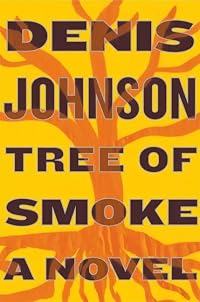
Tree of Smoke: A Novel
by Denis Johnson
On This Page
Description
Once upon a time there was a war . . . and a young American who thought of himself as the Quiet American and the Ugly American, and who wished to be neither, who wanted instead to be the Wise American, or the Good American, but who eventually came to witness himself as the Real American and finally as simply the Fucking American. That's me.This is the story of Skip Sands—spy-in-training, engaged in Psychological Operations against the Vietcong—and the disasters that befall him thanks show more to his famous uncle, a war hero known in intelligence circles simply as the Colonel. This is also the story of the Houston brothers, Bill and James, young men who drift out of the Arizona desert into a war in which the line between disinformation and delusion has blurred away. In its vision of human folly, and its gritty, sympathetic portraits of men and women desperate for an end to their loneliness, whether in sex or death or by the grace of God, this is a story like nothing in our literature.
Tree of Smoke is Denis Johnson's first full-length novel in nine years, and his most gripping, beautiful, and powerful work to date.
. show less
Tags
Recommendations









Member Recommendations
Member Reviews
The cancer of war.
Spreading like a plague from its epicentre, gorging on flesh, derailing minds, torturing emotions - only the strongest survive and then just barely.
An all pervading turmoil unbound by time or distance.
Entirely artificial, entirely human.
Tree of Smoke follows several characters in the Vietnam war, expertly leading the reader through its horrors from both sides of the engagement. Family, love, hopelessness, revenge, survival, purpose are all major themes, as they struggle with what truths they find in the choices they make. Anyone who has read 2666 by Robert Bolaño, should recall the chapter about the deaths. The saturated, desensitising prose so relentless to become paradoxically impressive. Tree of Smoke achieves show more something similar. What Denis Johnson has done here is capture war in all its atrocity.
I have now read five novels by Johnson and this is (so far) the jewel in the crown, despite its low 3.5 rating on goodreads, unsurprising, for two reasons:
1. War is a heavy subject matter which I doubt is every reader's idea of a 'good read' (I empathise of course and need time between books of this nature but war is so entwined in the human condition (sadly) that the subject leads to some of the very best writing - Birdsong, For Whom the Bell Tolls, Slaughterhouse 5, Wind-Up Bird Chronicle, War and Peace and of course, Catch-22)
2. I read parts of Tree of Smoke and listened to parts on audiobook, which was read amazingly by the actor Will Patton (of which I include a link to an excerpt below). Patton's handling of voice differentiation for the dialogues between characters was sublime and really improved the clarity and dynamics of their interactions, which my own reading in my head couldn't replicate (instead leading to confusion and rereadings). Johnson is such a skilful writer of dialogue - he knows exactly what other people would say that the characters sound like real people. Complimented by Patton's reading, the effect is very powerful. I wonder if people who solely read the book appreciated this element in the same way?
This book is a work of art, cementing Johnson in modern literature as one of its greatest writers (in my humble opinion). Although he is now lost to us, I'm thankful there are so many more of his offerings I have left to read. Jesus' son is apparently his arguable best - it will have to be one hell of a book to surmount what Tree of Smoke achieves. It is another symbol, in addition to the other important books previously mentioned, of why people should read, not war.
Will Patton reading Tree of Smoke:
https://www.youtube.com/watch?v=kdDOGebqZr8 show less
Spreading like a plague from its epicentre, gorging on flesh, derailing minds, torturing emotions - only the strongest survive and then just barely.
An all pervading turmoil unbound by time or distance.
Entirely artificial, entirely human.
Tree of Smoke follows several characters in the Vietnam war, expertly leading the reader through its horrors from both sides of the engagement. Family, love, hopelessness, revenge, survival, purpose are all major themes, as they struggle with what truths they find in the choices they make. Anyone who has read 2666 by Robert Bolaño, should recall the chapter about the deaths. The saturated, desensitising prose so relentless to become paradoxically impressive. Tree of Smoke achieves show more something similar. What Denis Johnson has done here is capture war in all its atrocity.
I have now read five novels by Johnson and this is (so far) the jewel in the crown, despite its low 3.5 rating on goodreads, unsurprising, for two reasons:
1. War is a heavy subject matter which I doubt is every reader's idea of a 'good read' (I empathise of course and need time between books of this nature but war is so entwined in the human condition (sadly) that the subject leads to some of the very best writing - Birdsong, For Whom the Bell Tolls, Slaughterhouse 5, Wind-Up Bird Chronicle, War and Peace and of course, Catch-22)
2. I read parts of Tree of Smoke and listened to parts on audiobook, which was read amazingly by the actor Will Patton (of which I include a link to an excerpt below). Patton's handling of voice differentiation for the dialogues between characters was sublime and really improved the clarity and dynamics of their interactions, which my own reading in my head couldn't replicate (instead leading to confusion and rereadings). Johnson is such a skilful writer of dialogue - he knows exactly what other people would say that the characters sound like real people. Complimented by Patton's reading, the effect is very powerful. I wonder if people who solely read the book appreciated this element in the same way?
This book is a work of art, cementing Johnson in modern literature as one of its greatest writers (in my humble opinion). Although he is now lost to us, I'm thankful there are so many more of his offerings I have left to read. Jesus' son is apparently his arguable best - it will have to be one hell of a book to surmount what Tree of Smoke achieves. It is another symbol, in addition to the other important books previously mentioned, of why people should read, not war.
Will Patton reading Tree of Smoke:
https://www.youtube.com/watch?v=kdDOGebqZr8 show less
Johnson is a phenomenal writer, fresh and illuminating, but the book is often frustrating. There are gripping, emotionally gruelling set-pieces all the way through but in between the pace slows down to a crawl. It can be hard to tell what’s happening in some scenes and what their relevance is to the broader narrative.
The strongest section of the book plunges us into the thick of the Tet Offensive. It’s a 65-page microcosm of all that’s great about the book: pin-sharp description, dazzling language and an almost poetic distillation of the horrors of war.
But this is too big a book to just be about how horrible war is. We know that, after all. Johnson is after something deeper. Loyalty is a prominent theme here, as is the notion of show more truth. Everyone is lying all the time, Trung, the North Vietnamese agent, tells himself.
Fatherhood is significant too but it’s hard to say why. The book is filled with dead, dying or absent fathers. Is Johnson saying that, robbed of their fathers, children fall into violence, corruption and disorder? Is Kennedy, whose death kicks off the story and arguably condemns America to war, the absent father of the nation?
Full review: http://www.26books.com/?p=244 show less
The strongest section of the book plunges us into the thick of the Tet Offensive. It’s a 65-page microcosm of all that’s great about the book: pin-sharp description, dazzling language and an almost poetic distillation of the horrors of war.
But this is too big a book to just be about how horrible war is. We know that, after all. Johnson is after something deeper. Loyalty is a prominent theme here, as is the notion of show more truth. Everyone is lying all the time, Trung, the North Vietnamese agent, tells himself.
Fatherhood is significant too but it’s hard to say why. The book is filled with dead, dying or absent fathers. Is Johnson saying that, robbed of their fathers, children fall into violence, corruption and disorder? Is Kennedy, whose death kicks off the story and arguably condemns America to war, the absent father of the nation?
Full review: http://www.26books.com/?p=244 show less
As the book opens, it is 1963, the day after JFK has been assassinated. Tree of Smoke follows the Vietnam war years through 1970, and then there's an add-on that happens in 1983, long after the war is over. The major character focus is William "Skip" Sands, a CIA PsyOps agent recruited by his uncle Colonel Frances Xavier Sands. At the outset, Skip views himself as a patriot, working on behalf of his country, but as the war winds on, he becomes ultimately disillusioned, eventually admitting that he "alternatively thought of himself as the Quiet American and the Ugly American, and who wished to be neither, who wanted instead to be the Wise American or the Good American, but who eventually came to witness himself as the Real American and show more finally as simply the F*ing American" (603). Skip joined his uncle’s coterie of groupies who follow the Colonel blindly. On index cards, he documents and catalogs information given to him by his uncle, but while he was in Vietnam, desperately wanting to put his training to work, he was kept out of the way at a dead physician's villa, where he "felt himself captured in a rainbow bubble of irrelevance." Skip realizes that he'd "come to war to see abstractions become realities. Instead he'd seen the reverse. Everything was abstract now." Hence the title: "Tree of Smoke" --the sense of obtuseness surrounding the Vietnam War for the characters in this novel, who all seem to work within different and changing frameworks of reality and deception. As the war continues, Skip unravels, finally giving up "working for the giant-size criminals," and going to work for "the medium size. Lousy hours and no fringe benefits, but the ethics are clearer." And it's not just Skip who breaks...the subplots are based on other characters who have to deal with how the war has affected their psyches and continues to do so after the war is over.
An amazing book...it's going to be tough for me to top this one this year in my reading travels. I very highly recommend it. After reading this, I got the sensation that Johnson's portrayal of his characters caught up in the Vietnam War had them all stuck in some sort of cosmic PsyOps operation - in which, as one character notes, "we're on the cutting edge of reality itself. Right where it turns into a dream "(255).
Simply outstanding. I can't praise it enough! show less
An amazing book...it's going to be tough for me to top this one this year in my reading travels. I very highly recommend it. After reading this, I got the sensation that Johnson's portrayal of his characters caught up in the Vietnam War had them all stuck in some sort of cosmic PsyOps operation - in which, as one character notes, "we're on the cutting edge of reality itself. Right where it turns into a dream "(255).
Simply outstanding. I can't praise it enough! show less
Tree of Smoke is long, sprawling, and not exactly an example of a story with a tidy conclusion. It's focus is on a mostly doomed set of characters, who are all involved with the Vietnam War, mainly in the periods before and after the Tet Offensive. It includes the iconoclastic CIA veteran, Colonel Francis Sands, his nephew and fellow CIA operative, Skip Sands, the two Houston brothers from Phoenix, a Canadian 7th Day Adventist nurse who has lost her husband, the Colonel's Vietnamese driver and his nephew, the Colonel's helicopter pilot, a potential Viet Cong double agent, and a whole host of other characters trying to navigate their way through the war (and perhaps through Johnson's labyrinthine story.) But--it is Dennis Johnson--so, show more even if sometimes things as a whole don't work out, such as a few plot threads that I would say aren't quite wrapped up to my satisfaction, the writing is extraordinary, and there are scenes here that will stick with you for a long while, such as James Houston's first encounter with real warfare after thinking he was in a safe position guarding the Colonel's landing zone, or an assassin's preparation to kill the Viet Cong double agent, or a bar scene with an Australian dwarf.... It goes on and on. So many of the great scenes are not necessary to the story--but they are necessary to the book!
The atmosphere, first in the Philippines, then in Vietnam, is damp, hot, and oppressive. The hotels, streets, taxis, pedicabs, restaurants, and other locations are portrayed in vivid colors. There is no paint-by-numbers in Johnson's book. Nothing is generic. Everything, down to the beer and cigarettes is as real as fiction can make it. I listened to most of this as an audiobook, read incredibly well by Will Patton, but my loan ran out and couldn't be renewed, so I read the last 60 pages or so. I haven't quite read all of Johnson's work yet, but it is all extremely worthwhile, and this is no exception. Just be prepared to take your time. There's a lot here to mull over as you listen or read. This is not any sort of realistic fictional depiction of THE Vietnam War, but it is a few people's Vietnam War, and perhaps that is easier to understand, in the end. The book only has one real hero--and she is about as unheroic as they come. But she perseveres. show less
The atmosphere, first in the Philippines, then in Vietnam, is damp, hot, and oppressive. The hotels, streets, taxis, pedicabs, restaurants, and other locations are portrayed in vivid colors. There is no paint-by-numbers in Johnson's book. Nothing is generic. Everything, down to the beer and cigarettes is as real as fiction can make it. I listened to most of this as an audiobook, read incredibly well by Will Patton, but my loan ran out and couldn't be renewed, so I read the last 60 pages or so. I haven't quite read all of Johnson's work yet, but it is all extremely worthwhile, and this is no exception. Just be prepared to take your time. There's a lot here to mull over as you listen or read. This is not any sort of realistic fictional depiction of THE Vietnam War, but it is a few people's Vietnam War, and perhaps that is easier to understand, in the end. The book only has one real hero--and she is about as unheroic as they come. But she perseveres. show less
Speaking of John F. Kennedy’ assassination, the Colonel in Denis Johnson’s [Tree of Smoke] says, “The dividing line between light and dark goes through the center of every heart, every soul. There isn’t one of us who isn’t guilty of his death.” For Johnson, the Colonel resides in the same boiling cauldron as Shakespeare’s witches from Macbeth, prophesying the end of tragic circumstances at the beginning of the tale and then woven in throughout the tale to recall what evil lies ahead and to make sense of the evil that has been done along the way. The Colonel learns of Kennedy’s death while in the Philippines, just after loaning his rifle to a young sailor, who uses it to senselessly shoot a monkey out of a tree. That the show more Colonel is responsible for the weapon that killed the monkey, the parallel to Kennedy’s death, and all of the death that would follow in Vietnam, is clear. The death of the innocent animal, on the heels of Kennedy’s assassination, also lays out the pattern for [Tree of Smoke]: a person acts out of his dark heart, frustrated and confused and alight with anger, and then tries to make sense of it, find salvation, find the light, while banded about on every side by the muddle of life and human endeavor.
After laying the blame for Kennedy’s assassination at humanity’s feet, the Colonel, again doing the work of Shakespeare’s weird sisters, goes on to describe the state of the world at the time, “We’re in a world wide war, have been for close to twenty years. … It’s a covert World War Three. It’s Armageddon by proxy. It’s a contest between good and evil, and its true ground is the heart of every human.” So, it’s not just Kennedy’s murder, it’s really the state of affairs in general, around the globe, good battling with evil for supremacy in the heart of men. Blame for evil, or praise for good, is usually meted out by the populace to those in power, and usually in helpless passivity, viewing the things that happen in the world outside of any control at the personal level. But Johnson focus is keenly aimed at the common man, as all of his characters, even the Colonel, hale from the everyday of life. Their salvation is dependent on personal choices, unequivocally outside the realm of any higher responsibility. And it is redemption in small bits, not in glorious acts but painfully eked out in the microcosms of the day-to-day.
The Colonel, and his nephew, Skip Sands, are at play in the fields of intelligence, the CIA, and Johnson treads the opaque world of Graham Greene. At one point, Skip even muses on whether he is a “quiet American” or “an ugly American,” playing on the title of Greene’s own examination of geo-politics in Indochina, [The Quiet American]. Johnson owes a great deal to Greene for helping to establish the murky, heaving tone of the Colonel and Skip’s portion of the story. For another story line, Johnson uses a missionary with a crisis of faith, again harkening to novels by Peter Matthieson, [At Play in the Fields of the Lord] or Paul Theroux, [The Mosquito Coast]. And Johnson’s view of the raw, wild American soldier in the jungles of Vietnam calls to mind Mailer’s [The Naked and the Dead] or Oliver Stone’s film “Platoon.” Toward the end of the book, a character embarks on a trek into the heart of the jungle to find the Colonel, who may or may not be dead, reminiscent of Conrad’s [Heart of Darkness] or the film version of the story, “Apocalypse Now.” There is a lot of either homage or redux in Johnson’s book, but he saves himself from mimicry with a unique, eloquent voice, cascading away from the ground covered in these other works in provocative stances on the human condition, as communicated by complex and conflicted people who represent the very essence of everyday.
There is a mildly nihilistic feeling about the resolution for all of the characters, as though whatever redemption they manage will not carry them far. Or maybe Johnson was trying to temper any saving grace with the hopeless repetitiveness of human behavior. Near the end of the book, a friend of the Colonel’s quotes Marcus Aurelius in speaking about him, “You may break your heart, but men will go on as before.” That’s the same heart that the Colonel declared was divided between good and evil. So, Johnson provides some hope in the story but leavens it with a healthy pinch of inevitability.
One passage in the book was particularly relevant with the current debate over the use of torture. After the death of one of their sergeants, a platoon apprehends a Viet Cong guerilla. They string him up to a tree, so that he is hanging from his wrists, bound behind him, and then they take turns at beating and mutilating him. The depraved punishment they inflict on their enemy is astonishing, but it is instructive of the weakness that humans have for vengeance, a tendency described more recently by former Vice President Cheney’s defense of the torture green-lighted after the 9/11 attacks. Johnson could not have scripted Cheney any better had he been one of the characters in the book; a dark figure obscured in shadow, manipulating the strings hanging from his hands.
Johnson won the National Book Award and was a Pulitzer finalist for this book, the largest in both depth and scope to that date in his career. But the award is probably more of a reflection of the surprise at Johnson’s ability to drag himself into such new territory. Having never read any of Johnson’s other work, I can’t be sure that’s the case, but the book is not perfect by any means. The passages describing the soldiers and their actions in the war seem a little tired and more than a little cliché, especially in their conversations. And Johnson dawdles setting up some of the plot lines. When he is focused, he’s brilliant, but he loses that focus too often, probably because this epic was a watershed in his writing, and he was finding his way. Again, what saves the book is that Johnson can shift into another gear from one page to the next with his prose and with his vision, descending into strata that quicken even the coldest heart.
Bottom Line: Epic book from a writer better known for his short fiction, and there is some loss of focus for the shift in forum, but a deeply provocative book examining the dividing line between good and evil as it rests in each human heart.
4 bones!!!!! show less
After laying the blame for Kennedy’s assassination at humanity’s feet, the Colonel, again doing the work of Shakespeare’s weird sisters, goes on to describe the state of the world at the time, “We’re in a world wide war, have been for close to twenty years. … It’s a covert World War Three. It’s Armageddon by proxy. It’s a contest between good and evil, and its true ground is the heart of every human.” So, it’s not just Kennedy’s murder, it’s really the state of affairs in general, around the globe, good battling with evil for supremacy in the heart of men. Blame for evil, or praise for good, is usually meted out by the populace to those in power, and usually in helpless passivity, viewing the things that happen in the world outside of any control at the personal level. But Johnson focus is keenly aimed at the common man, as all of his characters, even the Colonel, hale from the everyday of life. Their salvation is dependent on personal choices, unequivocally outside the realm of any higher responsibility. And it is redemption in small bits, not in glorious acts but painfully eked out in the microcosms of the day-to-day.
The Colonel, and his nephew, Skip Sands, are at play in the fields of intelligence, the CIA, and Johnson treads the opaque world of Graham Greene. At one point, Skip even muses on whether he is a “quiet American” or “an ugly American,” playing on the title of Greene’s own examination of geo-politics in Indochina, [The Quiet American]. Johnson owes a great deal to Greene for helping to establish the murky, heaving tone of the Colonel and Skip’s portion of the story. For another story line, Johnson uses a missionary with a crisis of faith, again harkening to novels by Peter Matthieson, [At Play in the Fields of the Lord] or Paul Theroux, [The Mosquito Coast]. And Johnson’s view of the raw, wild American soldier in the jungles of Vietnam calls to mind Mailer’s [The Naked and the Dead] or Oliver Stone’s film “Platoon.” Toward the end of the book, a character embarks on a trek into the heart of the jungle to find the Colonel, who may or may not be dead, reminiscent of Conrad’s [Heart of Darkness] or the film version of the story, “Apocalypse Now.” There is a lot of either homage or redux in Johnson’s book, but he saves himself from mimicry with a unique, eloquent voice, cascading away from the ground covered in these other works in provocative stances on the human condition, as communicated by complex and conflicted people who represent the very essence of everyday.
There is a mildly nihilistic feeling about the resolution for all of the characters, as though whatever redemption they manage will not carry them far. Or maybe Johnson was trying to temper any saving grace with the hopeless repetitiveness of human behavior. Near the end of the book, a friend of the Colonel’s quotes Marcus Aurelius in speaking about him, “You may break your heart, but men will go on as before.” That’s the same heart that the Colonel declared was divided between good and evil. So, Johnson provides some hope in the story but leavens it with a healthy pinch of inevitability.
One passage in the book was particularly relevant with the current debate over the use of torture. After the death of one of their sergeants, a platoon apprehends a Viet Cong guerilla. They string him up to a tree, so that he is hanging from his wrists, bound behind him, and then they take turns at beating and mutilating him. The depraved punishment they inflict on their enemy is astonishing, but it is instructive of the weakness that humans have for vengeance, a tendency described more recently by former Vice President Cheney’s defense of the torture green-lighted after the 9/11 attacks. Johnson could not have scripted Cheney any better had he been one of the characters in the book; a dark figure obscured in shadow, manipulating the strings hanging from his hands.
Johnson won the National Book Award and was a Pulitzer finalist for this book, the largest in both depth and scope to that date in his career. But the award is probably more of a reflection of the surprise at Johnson’s ability to drag himself into such new territory. Having never read any of Johnson’s other work, I can’t be sure that’s the case, but the book is not perfect by any means. The passages describing the soldiers and their actions in the war seem a little tired and more than a little cliché, especially in their conversations. And Johnson dawdles setting up some of the plot lines. When he is focused, he’s brilliant, but he loses that focus too often, probably because this epic was a watershed in his writing, and he was finding his way. Again, what saves the book is that Johnson can shift into another gear from one page to the next with his prose and with his vision, descending into strata that quicken even the coldest heart.
Bottom Line: Epic book from a writer better known for his short fiction, and there is some loss of focus for the shift in forum, but a deeply provocative book examining the dividing line between good and evil as it rests in each human heart.
4 bones!!!!! show less
TREE OF SMOKE, by Denis Johnson.
Wow! Double wow even. Whatever I say about Johnson's book couldn't begin to describe what a magnificent accomplishment it is. It's one of those books that, had Johnson written no other books, would still cement his reputation in the canon of American literature. Filled with rich, fully realized characters and descriptions of the whole Vietnam era - and its long-lasting and far-reaching repercussions - TREE OF SMOKE is a book that will stick with me for a long time. CIA operatives Skip Sands, his larger-than-life uncle, "the colonel" F.X. Sands, Rick Voss, Crodelle - they all ring true, like 'em or not. And Sgt Jimmy Storm and brothers Bill and James Houston ring equally true as psychopathic emotional show more casualties of that war. And Hao, Minh and Trung are Vietnamese characters who keep turning up in a web of intrigue, deception and betrayal. Kathy Jones, the young widow of a missionary, who tries so hard to save as many of the orphans of the war, could break your heart. And there is also a chillingly professional German assassin, Dietrich Fest, who keeps turning up, product of a Nazi father and an SS older brother.
This book has been called a "masterpiece" and, I think, an American War and Peace. And this kind of praise is not an exaggeration. The book's 700-page bulk could seem intimidating, and maybe that's why I didn't read it eight years ago, when it won the National Book Award. Well the story is so well-made, so gripping, that I read it in just a few days. It's that good. Johnson seems to have grasped the awfulness of this war, and voices it in the words of his Corporal James Houston, a three-tour burned-out psychopath, who explains why he maimed and murdered a Vietnamese woman while on a LURP patrol -
"... because she's a whore, and this is a war. And that's what happens, because this is a war, and because this is not just a war."
The influence of Graham Green's THE QUIET AMERICAN is obvious here, as is THE UGLY AMERICAN. In fact both books are mentioned more than once. Religion and its failures are also central to the story. A Catholic priest notes that "God doesn't care who is Protestant or Catholic. God himself is not Catholic."
A line that I must admit made me smile, and also to reflect, 'hmm ... neither was Jesus, come to think of it."
Two very small complaints from me: One, Johnson makes the error of placing the Defense Language Institute and the Naval Postgraduate School in Carmel. Both are in Monterey. And he also errs in referring to a "Major's bars" as an insignia of rank. A Major's insignia is a gold oak leaf. Only lieutenants and captains have "bars."
But enough. Better and smarter men than I have already praised this book extravagantly. Well, all those good things they said? Me too. I'm so glad I finally read this book. Very highly recommended.
- Tim Bazzett, author of the Cold War memoir, SOLDIER BOY: AT PLAY IN THE ASA show less
Wow! Double wow even. Whatever I say about Johnson's book couldn't begin to describe what a magnificent accomplishment it is. It's one of those books that, had Johnson written no other books, would still cement his reputation in the canon of American literature. Filled with rich, fully realized characters and descriptions of the whole Vietnam era - and its long-lasting and far-reaching repercussions - TREE OF SMOKE is a book that will stick with me for a long time. CIA operatives Skip Sands, his larger-than-life uncle, "the colonel" F.X. Sands, Rick Voss, Crodelle - they all ring true, like 'em or not. And Sgt Jimmy Storm and brothers Bill and James Houston ring equally true as psychopathic emotional show more casualties of that war. And Hao, Minh and Trung are Vietnamese characters who keep turning up in a web of intrigue, deception and betrayal. Kathy Jones, the young widow of a missionary, who tries so hard to save as many of the orphans of the war, could break your heart. And there is also a chillingly professional German assassin, Dietrich Fest, who keeps turning up, product of a Nazi father and an SS older brother.
This book has been called a "masterpiece" and, I think, an American War and Peace. And this kind of praise is not an exaggeration. The book's 700-page bulk could seem intimidating, and maybe that's why I didn't read it eight years ago, when it won the National Book Award. Well the story is so well-made, so gripping, that I read it in just a few days. It's that good. Johnson seems to have grasped the awfulness of this war, and voices it in the words of his Corporal James Houston, a three-tour burned-out psychopath, who explains why he maimed and murdered a Vietnamese woman while on a LURP patrol -
"... because she's a whore, and this is a war. And that's what happens, because this is a war, and because this is not just a war."
The influence of Graham Green's THE QUIET AMERICAN is obvious here, as is THE UGLY AMERICAN. In fact both books are mentioned more than once. Religion and its failures are also central to the story. A Catholic priest notes that "God doesn't care who is Protestant or Catholic. God himself is not Catholic."
A line that I must admit made me smile, and also to reflect, 'hmm ... neither was Jesus, come to think of it."
Two very small complaints from me: One, Johnson makes the error of placing the Defense Language Institute and the Naval Postgraduate School in Carmel. Both are in Monterey. And he also errs in referring to a "Major's bars" as an insignia of rank. A Major's insignia is a gold oak leaf. Only lieutenants and captains have "bars."
But enough. Better and smarter men than I have already praised this book extravagantly. Well, all those good things they said? Me too. I'm so glad I finally read this book. Very highly recommended.
- Tim Bazzett, author of the Cold War memoir, SOLDIER BOY: AT PLAY IN THE ASA show less
This book took me quite some time to get into. Found it in a used book store and remembered some buzz about it. This is set in the Vietnam War, mainly a mystifying story of "Skip" Sands a rookie CIA agent working on a psychological operation involving a Vietcong informant. He works with his uncle "the Colonel," a legendary secret agent who has been out and about in the Southeast Asian bush since the 50's. Reminded me of the Marlon Brando character from 'Apocalypse Now.' A great character sketch.
The upsides of this novel are that it is very mysterious, extremely well-written, amazing atmosphere without long-winded passages describing the setting. The characters are intriguing and well-drawn, We are in so many characters heads throughout show more the novel; it is almost hard to suss out who really is the protagonist. And therein lies my main issue with the novel. A bit bewildering, confusing; I kept feeling like I was missing something or had missed a chunk of pages or something. It seemed as if there were bound to be some reveals that would tie it all together and there really weren't. So many times I thought we were at the height of the dramatic tension and then we were off to something different and just as cryptic.
However, despite my complaints - this is a powerful novel. Not really one of those war novels that laments the senseless violence and displays ordinary people doing heroic things. Au contraire, It is really about how war, tragedy, what have you can bring out the worst of people and how senseless and violent life can be. I felt so bad for Skip and I actually quite liked the ending. A fine novel but one must be OK with being patient and perplexed. Will see how I feel as I get some distance from this novel but I think I would consider this a modern classic. Classics aren't supposed to easy, right? show less
The upsides of this novel are that it is very mysterious, extremely well-written, amazing atmosphere without long-winded passages describing the setting. The characters are intriguing and well-drawn, We are in so many characters heads throughout show more the novel; it is almost hard to suss out who really is the protagonist. And therein lies my main issue with the novel. A bit bewildering, confusing; I kept feeling like I was missing something or had missed a chunk of pages or something. It seemed as if there were bound to be some reveals that would tie it all together and there really weren't. So many times I thought we were at the height of the dramatic tension and then we were off to something different and just as cryptic.
However, despite my complaints - this is a powerful novel. Not really one of those war novels that laments the senseless violence and displays ordinary people doing heroic things. Au contraire, It is really about how war, tragedy, what have you can bring out the worst of people and how senseless and violent life can be. I felt so bad for Skip and I actually quite liked the ending. A fine novel but one must be OK with being patient and perplexed. Will see how I feel as I get some distance from this novel but I think I would consider this a modern classic. Classics aren't supposed to easy, right? show less
Members
- Recently Added By
Published Reviews
ThingScore 63
The labyrinthine Tree of Smoke is full of hitches, tangents, but it reads exceedingly fast. It suggests a protracted war that moved in an exacting blur.
added by Shortride
When a novel’s first words are “Last night at 3:00 a.m. President Kennedy had been killed,” and the rest of it evinces no more feel for the English language and often a good deal less, and America’s most revered living writer touts “prose of amazing power and stylishness” on the back cover, and reviewers agree that whatever may be wrong with the book, there’s no faulting its show more finely crafted sentences—when I see all this, I begin to smell a rat. show less
added by dcozy
In fact, since the publication of his first novel, in 1983, he has been preoccupied with the paradoxical notions of self-sacrifice and salvation in our modern world—but never before has Johnson’s writing been quite so haunted and harrowing as it is in his massive new novel, twenty-five years in the works.
added by paradoxosalpha
Lists

National Book Award - Fiction
78 works; 9 members

Pulitzer Prize for Fiction - Finalists
88 works; 9 members

Best Contemporary Literary Fiction (Around the Last 30 Years)
388 works; 124 members

2000s decade
85 works; 7 members

Read These Too
458 works; 9 members
National Book Award winners
65 works; 11 members

THE WAR ROOM
813 works; 24 members

NYT 100 best books of 21st C
100 works; 31 members

Retrospective of 20th- and 21st-century literature
154 works; 1 member

.
184 works; 1 member
Best 21st Century Books (So Far)
670 works; 86 members
Author Information

36+ Works 14,338 Members
Denis Johnson was born in Munich, Germany on July 1, 1949. He received a bachelor's degree and a master's degree from the University of Iowa. He published his first book of poetry, The Man Among the Seals, at the age of 19. However, addictions to alcohol and drugs derailed him and he was in a psychiatric ward at the age of 21. He was sober by the show more early 1980s. Along with writing several volumes of poetry, Johnson wrote short stories for The New Yorker, Atlantic Monthly, Esquire, Paris Review, and Best American Short Stories. His novels included Angels, Jesus' Son, Resuscitation of a Hanged Man, Already Dead, Nobody Move, Train Dreams, and The Laughing Monsters. He won the National Book Award in 2007 for Tree of Smoke. He also received the Award for Literature from the American Academy of Arts, the Robert Frost Award, and the Library of Congress Prize for American Fiction. He died of liver cancer on May 24, 2017 at the age of 67. (Bowker Author Biography) show less
Some Editions
Awards and Honors
Awards
Distinctions
Common Knowledge
- Canonical title*
- Árbol de humo
- Original title
- Tree of Smoke
- Original publication date
- 2007
- People/Characters
- William "Skip" Sands (CIA, psychological operations); Bill Houston; James Houston; Francis Sands
- Important places
- Vietnam
- Important events
- Vietnam War
- Dedication
- Again for H.P. and Those Who
- First words
- Last night at 3:00 a.m. President Kennedy had been killed.
- Last words
- (Click to show. Warning: May contain spoilers.)All will be saved.
- Blurbers
- Franzen, Jonathan; Offutt, Chris; Roth, Philip; Gates, David; Passaro, Vince; Herr, Michael (show all 8); Warner, Alan; Flusfeder, David
*Some information comes from Common Knowledge in other languages. Click "Edit" for more information.
Classifications
Statistics
- Members
- 2,713
- Popularity
- 6,775
- Reviews
- 77
- Rating
- (3.56)
- Languages
- 10 — Czech, Danish, Dutch, English, French, German, Italian, Portuguese, Russian, Spanish
- Media
- Paper, Audiobook, Ebook
- ISBNs
- 35
- ASINs
- 15