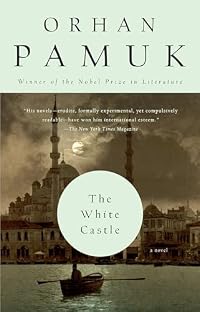
White Castle
by Orhan Pamuk
On This Page
Description
From a Turkish writer who has been compared with Borges, Nabokov, and DeLillo comes a dazzling novel that is at once a captivating work of historical fiction and a sinuous treatise on the enigma of identity and the relations between East and West. In the 17th century, a young Italian scholar sailing from Venice to Naples is taken prisoner and delivered to Constantinople. There he falls into the custody of a scholar known as Hoja--"master"--a man who is his exact double. In the years that show more follow, the slave instructs his master in Western science and technology, from medicine to pyrotechnics. But Hoja wants to know more: why he and his captive are the persons they are and whether, given knowledge of each other's most intimate secrets, they could actually exchange identities. Set in a world of magnificent scholarship and terrifying savagery, The White Castle is a colorful and intricately patterned triumph of the imagination. Translated from the Turkish by Victoria Holbrook. show lessTags
Recommendations





Member Recommendations
edwinbcn A magical story set against the background of the near-east.
Member Reviews
This story sneaks up on the reader. At the beginning it feels ordinary. We learn a young Venetian scholar is on a ship bound for Naples when it encounters the Turkish fleet which quickly captures the ship. The Turks murder some and enslave the others, including the young man. When they reach Istanbul the young man is sold to Hoja, master. The amazing thing is Hoja looks exactly like our young man, they could be twins. This sets the stage.
So far but we don't know the young man's name. It turns out we will never learn his name. Everything is done by pronouns, he, him, they, etc. At this point we know who he is. But this changes. Does he refer to the young man or to Hoja? This becomes harder and harder to determine. Hoja wants to know show more everything about the young man. At first Hoja wants to know everything the young man knows. It starts with medicine as the young man shows ability to help sick people. In a sense the young man has mastered the art of faking it till you make it. He uses the people's trust in him to help them. Hoja wants to know how. Hoja has a close relationship with the young Sultan who wants to know about animals, science, astrology and learning what his dreams mean.
We follow the young man and Hoja through many years, as they become more and more reliant on each other. The Sultan asks their help as bubonic plague rages in Istanbul. To track the Plague they count funerals in mosques throughout the city. They recommend bringing in cats. They predict the end of the plaque. The Sultan is impressed but begins to wonder whether this was Hoja's ideas or the other who looks exactly like him. This is where the story begins to change. Who is the real genius?
After planning a major fireworks display for the Sultan Hoja once again confidently asserts he can make breakthroughs in areas he has no experience. He promises to create a weapon for the Sultan. This will take several years to build as they develop new ways to fashion materials needed for a massive cannon.
As the Sultan relies more and more on Hoja enemies appear. As Hoja's assistant becomes more visible to the public they see he is not a Turk and has refused to convert to Islam. After several years the cannon is ready. There is a white castle in Poland which the Sultan's army has been unable to conquer. He decides it is time to use the cannon. Unfortunately it is so big and heavy that it sinks in a swamp before ever getting to the castle. Hoja's enemies seize upon Hoja's assistant for bringing bad luck to their efforts. Hoja asks his assistant to give him even more information and even items from his past. In the dark of night Hoja takes on his assistant's clothes and identity and leaves hoping his enemies will believe he is the assistant.
As we follow "Hoja" or rather the imposter into retirement and hear about Hoja's travels impersonating his assistant we wonder what actually happened. Did they really switch places or was that just a hoax to mislead the Sultan and Hoja's enemies. Now we really question those pronouns. Which "he" is "he".
I guess we'll never know. But perhaps that's Pamuk's intent. The reader gets to decide. Fascinating. show less
So far but we don't know the young man's name. It turns out we will never learn his name. Everything is done by pronouns, he, him, they, etc. At this point we know who he is. But this changes. Does he refer to the young man or to Hoja? This becomes harder and harder to determine. Hoja wants to know show more everything about the young man. At first Hoja wants to know everything the young man knows. It starts with medicine as the young man shows ability to help sick people. In a sense the young man has mastered the art of faking it till you make it. He uses the people's trust in him to help them. Hoja wants to know how. Hoja has a close relationship with the young Sultan who wants to know about animals, science, astrology and learning what his dreams mean.
We follow the young man and Hoja through many years, as they become more and more reliant on each other. The Sultan asks their help as bubonic plague rages in Istanbul. To track the Plague they count funerals in mosques throughout the city. They recommend bringing in cats. They predict the end of the plaque. The Sultan is impressed but begins to wonder whether this was Hoja's ideas or the other who looks exactly like him. This is where the story begins to change. Who is the real genius?
After planning a major fireworks display for the Sultan Hoja once again confidently asserts he can make breakthroughs in areas he has no experience. He promises to create a weapon for the Sultan. This will take several years to build as they develop new ways to fashion materials needed for a massive cannon.
As the Sultan relies more and more on Hoja enemies appear. As Hoja's assistant becomes more visible to the public they see he is not a Turk and has refused to convert to Islam. After several years the cannon is ready. There is a white castle in Poland which the Sultan's army has been unable to conquer. He decides it is time to use the cannon. Unfortunately it is so big and heavy that it sinks in a swamp before ever getting to the castle. Hoja's enemies seize upon Hoja's assistant for bringing bad luck to their efforts. Hoja asks his assistant to give him even more information and even items from his past. In the dark of night Hoja takes on his assistant's clothes and identity and leaves hoping his enemies will believe he is the assistant.
As we follow "Hoja" or rather the imposter into retirement and hear about Hoja's travels impersonating his assistant we wonder what actually happened. Did they really switch places or was that just a hoax to mislead the Sultan and Hoja's enemies. Now we really question those pronouns. Which "he" is "he".
I guess we'll never know. But perhaps that's Pamuk's intent. The reader gets to decide. Fascinating. show less
Alternately fascinating and frustrating. A plethora of interesting ideas and situations, but a plot that ultimately circles and never seems to go anywhere. I found myself skimming the last couple of chapters, eager to get to the end and move on. This is undoubtedly someone's cup of tea, but it definitely isn't mine.
I blow hot and cold with magical realism. This book is quite chilly.
In the seventeenth century, an Italian scholar is captured by Turks as he is travelling by ship from Venice to Naples. He is taken to Constantinople as a slave. When it is realized that he is scientifically educated he is assigned to a man who looks exactly like him. Hoja, which means master, is to create a fireworks display in honour of the young Sultan but as he is a novice with fireworks he asked for help. The Italian and Hoja go on to collaborate on many projects and, in some respects, grow very close. Hoja mentions that he would free the Italian and allow him to return to Italy but he never does so. Eventually, Hoja and the Italian join the Sultan in war to use the show more war machine Hoja invented. The machine, a huge metal soldier, is a disaster. The Sultan's advisers want the Italian killed but Hoja trades places with him and slips away from the camp, presumably to go to Italy where he will impersonate his slave.
Pamuk has won many awards for his writing including the Nobel Prize in 2006. He was accused of plagiarism for this book but he has refused to discuss the accusation. As this was his first book, perhaps his work improves with time but I'm not going to test that theory. show less
In the seventeenth century, an Italian scholar is captured by Turks as he is travelling by ship from Venice to Naples. He is taken to Constantinople as a slave. When it is realized that he is scientifically educated he is assigned to a man who looks exactly like him. Hoja, which means master, is to create a fireworks display in honour of the young Sultan but as he is a novice with fireworks he asked for help. The Italian and Hoja go on to collaborate on many projects and, in some respects, grow very close. Hoja mentions that he would free the Italian and allow him to return to Italy but he never does so. Eventually, Hoja and the Italian join the Sultan in war to use the show more war machine Hoja invented. The machine, a huge metal soldier, is a disaster. The Sultan's advisers want the Italian killed but Hoja trades places with him and slips away from the camp, presumably to go to Italy where he will impersonate his slave.
Pamuk has won many awards for his writing including the Nobel Prize in 2006. He was accused of plagiarism for this book but he has refused to discuss the accusation. As this was his first book, perhaps his work improves with time but I'm not going to test that theory. show less
This book was exactly the right length. It was refreshing to stumble upon this one as my first Pamuk read. A novel doesn’t have to be complicated to be good. All I want from a novel is an original story well-told, something that allows me to escape the mundanity of everyday life. Pamuk channeled medieval Turkey well, as he would consistently do in his other books. But this volume was not bogged down by unnecessary details. Each part of the story fed into the other parts. It was subtle and engaging. There was absolutely no dialogue from what I could tell and he blatantly violated the bogus rule of “show don’t tell.” The entire novel reads like someone telling something that happened over the course of time. It was straightforward show more and managed to seem elegant even though he didn’t do anything special. I later found out that Pamuk is at his best when he doesn’t try and do anything fancy.
I went on to read the rest of his novels (except Snow) and this is the one that stuck in my memory the most. The Black Book was more mesmerizing, but this is the one to start with if you're new to Pamuk. show less
I read a description of the scenario of this (Venetian man captured in the Mediterranean and becomes the slave of a Turkish man who is his physical double; their lives mysteriously blend) and thought it sounded fascinating, so gave it a try. I knew from the description I had read that there'd be no dialogue, but I found this made more of a problem for me than I was expecting, for this reason: everything I-the-reader experience is filtered through the consciousness of the narrator, and I find the narrator's consciousness incomprehensible, and the situation, too, a little incomprehensible.
I found myself looking for clues in the outer world of the story--the politics and intrigue of court, the growing up of the young sultan, the reactions show more of others to the things the two men (the doubles) are studying--to try to get some bearings, but meanwhile there was the relentlessness of the two men's impossibly close, impossibly difficult relationship.
I couldn't get any sense of development in their relationship or in either of their attitudes. Hoja (the Turkish man) veers this way and that in his attitudes toward his own research, his own abilities, others' approval, and the narrator. I didn't get a sense of progress. One minute it's this, then it's that, then it's back to this again. And the same with the narrator. And the narrator writes about, for example, tedious repetition of the days and months... and I was feeling that reading the book. Where was it all going? Nowhere that I understood, and not fast enough.
I felt low, giving it up. I felt like this was clearly a case of my not reading it with the right mental equipment, not looking at it through the right lens. Someone compared Orhan Pamuk's writing to Italo Calvino's and I can see this! I have some of the same sort of reaction to Calvino's stuff, but enough stuff falls on the side of accessibility for me that I can enjoy it. Here I felt just lost.
More than that, though, I just didn't like the process of getting to wherever the story was going. There's going to be some conflation, or substitution, of the one man for the other, I gather but--gah, I just wanted out of the brain of the first guy, and away from the whole situation. So I quit reading. show less
I found myself looking for clues in the outer world of the story--the politics and intrigue of court, the growing up of the young sultan, the reactions show more of others to the things the two men (the doubles) are studying--to try to get some bearings, but meanwhile there was the relentlessness of the two men's impossibly close, impossibly difficult relationship.
I couldn't get any sense of development in their relationship or in either of their attitudes. Hoja (the Turkish man) veers this way and that in his attitudes toward his own research, his own abilities, others' approval, and the narrator. I didn't get a sense of progress. One minute it's this, then it's that, then it's back to this again. And the same with the narrator. And the narrator writes about, for example, tedious repetition of the days and months... and I was feeling that reading the book. Where was it all going? Nowhere that I understood, and not fast enough.
I felt low, giving it up. I felt like this was clearly a case of my not reading it with the right mental equipment, not looking at it through the right lens. Someone compared Orhan Pamuk's writing to Italo Calvino's and I can see this! I have some of the same sort of reaction to Calvino's stuff, but enough stuff falls on the side of accessibility for me that I can enjoy it. Here I felt just lost.
More than that, though, I just didn't like the process of getting to wherever the story was going. There's going to be some conflation, or substitution, of the one man for the other, I gather but--gah, I just wanted out of the brain of the first guy, and away from the whole situation. So I quit reading. show less
Turkey
This novel may remind you a little of the Star Trek--The Original Series episode "Let That Be Your Last Battlefield" in which two people seen by others as extremely similar to each other see themselves as quite different. While this plot is not the same as the 1966 Star Trek episode's, there are some similarities. The Italian narrator describes being captured at sea, thrown into a Turkish jail, and eventually winning the favor of a powerful patron (though as a slave). He spends much time with the mysterious Hoja, who looks shockingly like him. Much of the novel describes their reciprocal psychological torments and raises questions about identity, history, and stories, both individually and at a cultural level. The plot is not show more particularly standard, and the symbolism is a little heavy. The frame story that introduces the "manuscript" seems like it ought to be more than a literary device, but that is my only clue as to how it should be understood. Still, this was an interesting novel and I'd read another by Pamuk. show less
This novel may remind you a little of the Star Trek--The Original Series episode "Let That Be Your Last Battlefield" in which two people seen by others as extremely similar to each other see themselves as quite different. While this plot is not the same as the 1966 Star Trek episode's, there are some similarities. The Italian narrator describes being captured at sea, thrown into a Turkish jail, and eventually winning the favor of a powerful patron (though as a slave). He spends much time with the mysterious Hoja, who looks shockingly like him. Much of the novel describes their reciprocal psychological torments and raises questions about identity, history, and stories, both individually and at a cultural level. The plot is not show more particularly standard, and the symbolism is a little heavy. The frame story that introduces the "manuscript" seems like it ought to be more than a literary device, but that is my only clue as to how it should be understood. Still, this was an interesting novel and I'd read another by Pamuk. show less
Orhan Pamuk has won the Nobel Prize for literature and is supposed to be the premier man of letters in contemporary Turkey. However, I noted that more than one person on my friends' list on Goodreads was less than enthused with his books. Thus, instead of reading his more famous My Name is Red or Snow, I deliberately chose the slimmest volume on the shelf for my introduction--The White Castle--a mere 161 pages--yet this couldn't hold me even that far.
Set in seventeenth century Turkey, it's the first person account of a Venetian captured and enslaved by the Turks. He comes to be owned by a master who is his physical double, who demands he teach him all he knows. Basically, what lost me was the style. And not because it was difficult or show more abstruse. Despite quotes comparing Pamuk to such writers as DeLillo, Borges, Nabokov and Proust, the prose in this novel is very simple--even simplistic. I never felt pulled in by the story or characters. The picture painted by the prose felt sketchy. There's very little dialogue, none of which is off-set. It's not so much a back and forth but rather a lot is reported or summarized. A lot of the events were summarized too rather than shown. Nothing made me feel a sense of time or place or characters in ways vivid enough to feel worth my time--so I stopped. And I think that's enough of Pamuk for me. show less
Set in seventeenth century Turkey, it's the first person account of a Venetian captured and enslaved by the Turks. He comes to be owned by a master who is his physical double, who demands he teach him all he knows. Basically, what lost me was the style. And not because it was difficult or show more abstruse. Despite quotes comparing Pamuk to such writers as DeLillo, Borges, Nabokov and Proust, the prose in this novel is very simple--even simplistic. I never felt pulled in by the story or characters. The picture painted by the prose felt sketchy. There's very little dialogue, none of which is off-set. It's not so much a back and forth but rather a lot is reported or summarized. A lot of the events were summarized too rather than shown. Nothing made me feel a sense of time or place or characters in ways vivid enough to feel worth my time--so I stopped. And I think that's enough of Pamuk for me. show less
Members
- Recently Added By
Lists

Dishonourable Mentions of 2013
189 works; 62 members

Significant works of postmodern fiction
86 works; 25 members

Books Read in 2022
5,164 works; 113 members

Reading Globally
136 works; 16 members
Author Information

107+ Works 32,900 Members
Orhan Pamuk was born in Istanbul, Turkey on June 7, 1952. After graduating from Robert College in Istanbul, he studied architecture at the Istanbul Technical University. After three years, he decided to become a writer and graduated from the Institute of Journalism at the University of Istanbul in 1976. In 1982, he published his first novel Cevdet show more Bey and His Sons, which received both the Orhan Kemal and Milliyet literary prizes. His novel, My Name Is Red, won the French Prix Du Meilleur Livre Etranger, the 2002 Italian Grinzane Cavour, and the 2003 International IMPAC Dublin Literary Award. He has received numerous Turkish and international literary awards for his works including the 2006 Nobel Prize in Literature. His recent work includes A Strangeness in My Mind. (Bowker Author Biography) Orhan Pamuk is the author of six previous novels, including "The White Castle" & "The New Life". He lives in Istanbul with his family. (Publisher Provided) show less
Some Editions
Awards and Honors
Awards
Notable Lists
Series
Belongs to Publisher Series
Work Relationships
Common Knowledge
- Canonical title
- The White Castle; White Castle
- Original title
- Beyaz Kale
- Original publication date
- 1985
- People/Characters*
- Maestro; Schiavo italiano; Mehmed IV
- Important places
- Constantinople, Ottoman Empire; Istanbul, Turkey
- Epigraph
- To imagine that a person who intrigues us has access to a way of life unknown and all the more attractive for its mystery, to believe that we will begin to live only through the love of that person – what else is this but t... (show all)he birth of great passion?
– Marcel Proust, from the mistranslation of Y. K. Karaosmanoglu - Dedication
- For Nilgun Darvinoglu
a loving sister
(1961–1980) - First words
- We were sailing from Venice to Naples when the Turkish fleet appeared.
I found this manuscript in 1982 in that forgotten 'archive' attached to the governor's office in Gebze that I used to rummage through for a week each summer, at the bottom of a dusty chest stuffed to overflowing with imperial... (show all) decrees, title deeds, court registers and tax rolls. (Preface) - Last words
- (Click to show. Warning: May contain spoilers.)A swing tied with long ropes to a high branch of a walnut-tree swayed slightly in a barely perceptible breeze.
- Blurbers
- Updike, John
- Original language
- Turkish
- Canonical DDC/MDS
- 894.3533
*Some information comes from Common Knowledge in other languages. Click "Edit" for more information.
Classifications
- Genres
- Fiction and Literature, General Fiction, Historical Fiction
- DDC/MDS
- 894.3533 — Literature & rhetoric Asian Literature Literatures of Altaic, Uralic, Hyperborean, Dravidian languages; literatures of miscellaneous languages of south Asia Turkic languages Turkish Turkish fiction 1850–2000
- LCC
- PL248 .P34 .W4713 — Language and Literature Languages and literatures of Eastern Asia, Africa, Oceania Languages of Eastern Asia, Africa, Oceania Turkic languages
- BISAC
Statistics
- Members
- 1,974
- Popularity
- 10,646
- Reviews
- 43
- Rating
- (3.35)
- Languages
- 27 — Bulgarian, Catalan, Chinese, Czech, Danish, Dutch, English, Finnish, French, German, Greek, Hebrew, Hungarian, Italian, Korean, Malayalam, Norwegian (Bokmål), Polish, Portuguese, Romanian, Russian, Serbian, Croatian, Slovenian, Spanish, Swedish, Turkish
- Media
- Paper, Audiobook, Ebook
- ISBNs
- 89
- UPCs
- 1
- ASINs
- 19