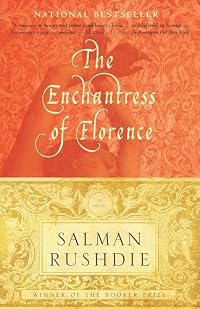
The Enchantress of Florence
by Salman Rushdie
On This Page
Description
A tall, yellow-haired young European traveller calling himself "Mogor dell'Amore," the Mughal of Love, arrives at the court of the real Grand Mughal, the Emperor Akbar, with a tale to tell that begins to obsess the whole imperial capital. The stranger claims to be the child of a lost Mughal princess, the youngest sister of Akbar's grandfather Babar: Qara Köz, 'Lady Black Eyes', a great beauty believed to possess powers of enchantment and sorcery, who is taken captive first by an Uzbeg show more warlord, then by the Shah of Persia, and finally becomes the lover of a certain Argalia, a Florentine soldier of fortune, commander of the armies of the Ottoman Sultan. When Argalia returns home with his Mughal mistress the city is mesmerised by her presence, and much trouble ensues. But is Mogor's story true? And if so, then what happened to the lost princess? And if he's a liar, must he die?--From publisher description. show lessTags
Recommendations




Member Recommendations


Member Reviews
The Enchantress of Florence begins with a mysterious yellow-haired stranger standing astride a bullock cart as he enters the domain of the emperor of India. He is godlike in stance, yet in appearance he is as a fool with his overly pretty face and particolored coat. The city to which he arrives is one of the grand cities of the world in both scale and wealth. Even the nearby lake seems to be made of gold. This of course is just an illusion brought about by the setting of the sun, but is an appropriate introduction to the story since it will become difficult to separate the real from the imagined as the story progresses.
The yellow-haired man is a teller of stories and he has arrived to tell a story to the Mughal of India that will either show more bring him fortune or cost him his life. This young man has represented himself to the Emperor Akbar as an emissary of Queen Elizabeth I. The emperor challenges the stranger's identity and would dismiss him except the yellow-haired man, who calls himself first Uccello of Florence and then Mogor dell'Amore (mogul of love), begins to weave the enchanting story of Qara Koz, the enchantress of Florence, who he claims is his mother.
But what is the Emperor to make of the stranger's story? What are we to make of the story we are reading? Identities and reality are not always clear within this magical novel. Who is the story-telling stranger? Is Qara Koz really the stranger's mother? Even the Emperor is not sure if he is simply an "I" like everyone else or a "we" of divine royalty. Reality is tenuous. Characters are imagined yet given "space" and relationship. Painters disappear into their own paintings. The story-teller feels himself fading away to nothingness when kept from telling his story. Is he merely defined by his story and without it has no existence? To add to the tenuous atmosphere created by questions of identity and reality, women are sometimes mere echoes and mirrors of someone or something else. They whisper and murmur and are ghostlike as they glide behind curtains and veils.
The author has woven layers of story around his readers, and enchants and draws us into his creation. We would come back night after night, for 1001 nights, to hear the story he has to tell. He shows us that story has power ... the power to enthrall, the power to rend apart and the power to create.
The Enchantress of Florence is first and foremost a story. It is secondarily an affirmation of the power of story. I found that I had to let go and allow Rushdie to take me where he would in order to fully enjoy this work. My criticism is limited to passages that seemed unnecessary and clumsy (e.g. the potato witches) and I wonder if the author wasn't too anxious to use as much of his extensive research as possible. The appended bibliography of works consulted is quite impressive and I look forward to reading from that list in order to expand my understanding of those historical elements that went right over my head. show less
The yellow-haired man is a teller of stories and he has arrived to tell a story to the Mughal of India that will either show more bring him fortune or cost him his life. This young man has represented himself to the Emperor Akbar as an emissary of Queen Elizabeth I. The emperor challenges the stranger's identity and would dismiss him except the yellow-haired man, who calls himself first Uccello of Florence and then Mogor dell'Amore (mogul of love), begins to weave the enchanting story of Qara Koz, the enchantress of Florence, who he claims is his mother.
But what is the Emperor to make of the stranger's story? What are we to make of the story we are reading? Identities and reality are not always clear within this magical novel. Who is the story-telling stranger? Is Qara Koz really the stranger's mother? Even the Emperor is not sure if he is simply an "I" like everyone else or a "we" of divine royalty. Reality is tenuous. Characters are imagined yet given "space" and relationship. Painters disappear into their own paintings. The story-teller feels himself fading away to nothingness when kept from telling his story. Is he merely defined by his story and without it has no existence? To add to the tenuous atmosphere created by questions of identity and reality, women are sometimes mere echoes and mirrors of someone or something else. They whisper and murmur and are ghostlike as they glide behind curtains and veils.
The author has woven layers of story around his readers, and enchants and draws us into his creation. We would come back night after night, for 1001 nights, to hear the story he has to tell. He shows us that story has power ... the power to enthrall, the power to rend apart and the power to create.
The Enchantress of Florence is first and foremost a story. It is secondarily an affirmation of the power of story. I found that I had to let go and allow Rushdie to take me where he would in order to fully enjoy this work. My criticism is limited to passages that seemed unnecessary and clumsy (e.g. the potato witches) and I wonder if the author wasn't too anxious to use as much of his extensive research as possible. The appended bibliography of works consulted is quite impressive and I look forward to reading from that list in order to expand my understanding of those historical elements that went right over my head. show less
Wonderful. I had for a while searched for a book that would reproduce the reading experience of “Seven Gothic Tales” by Isak Dinesen, but I never thought that Salman Rushdie would be the author to do it.
So much is said about Rushdie’s magic realism. But on "The Enchantress of Florence" he goes a step farther, mixing fables and history, story lines leading into story lines, creating a fantastic and sensual universe somewhere between East and West. The writing is gorgeous, but the magic narrative is what grabbed me and would not let me go.
Rushdie is undoubtedly an academic, whose writing is full of metaphor and questionings, but in this book he handles those with a master’s approach, mixing adventure and sorcery with show more questionings about power and love in such a perfect dose. Not that the characters don’t duel in philosophical considerations, just the opposite, but Rushdie manages to embed these rationalizations/meditations into the narrative without making them forceful or tiring – truly an amazing feat.
On the book jacket someone defines it as “a naughty fairy tale for grow-ups” and I could not agree more. show less
So much is said about Rushdie’s magic realism. But on "The Enchantress of Florence" he goes a step farther, mixing fables and history, story lines leading into story lines, creating a fantastic and sensual universe somewhere between East and West. The writing is gorgeous, but the magic narrative is what grabbed me and would not let me go.
Rushdie is undoubtedly an academic, whose writing is full of metaphor and questionings, but in this book he handles those with a master’s approach, mixing adventure and sorcery with show more questionings about power and love in such a perfect dose. Not that the characters don’t duel in philosophical considerations, just the opposite, but Rushdie manages to embed these rationalizations/meditations into the narrative without making them forceful or tiring – truly an amazing feat.
On the book jacket someone defines it as “a naughty fairy tale for grow-ups” and I could not agree more. show less
My experience so far with Salman Rushdie is that he is a writer for whom the whole is much less than the sum of its parts. You can be sure, too, that in a Rushdie there are always a lot of parts because, like some other contemporary writers (Jonathan Franzen comes to mind) he has a habit of throwing anything and everything into the mix. Read a history of the Medicis? Add some of that! Learn some facts about dentistry in the Ottoman Empire? Why not?! As a result, The Enchantress of Florence is a convoluted, bloated, and unfocused mess of a novel.
The story is outwardly quite simple. A strange European makes his way into the court of the Mughal king Akbar, claiming to be an emissary from Queen Elizabeth I. There are some oddities about the show more stranger's story, however, and as his story unfolds questions are raised about who he really is.
The stranger then makes the most startling claim of all: that he is connected by blood to the king. His claims set the king's harem, in particular, to recovering lost memories of a forgotten princess who, along with her servant double, had been taken as a prisoner to Florence. There, the princess had become the "Enchantress of Florence," a beauty like no other. The stranger's tale also tells the story of the male side of his Florentine ancestry, which includes tales involving the Medici family and the life of Machiavelli.
One of the recurrent features of Rushdie's fiction is his use of doubles. The princess has her beautiful servant, for example, and there are so many other Doppelgangers and foils scattered through the story that it is quite impossible to follow, let alone summarize. There are also symbolic characters like The Palace of Memory, a woman so mistreated that she roams around her own shattered mind as if it is an internal palace. There also ridiculous events in the novel, such as when all the women in the city walk around naked in order to overcome their mutual enmities.
Rushdie is far too enamored with the idea that blurring the line between reality and imagination is not an inherently interesting literary device. Such novels require discipline and careful storytelling, otherwise they quickly become boring and pretentious. There is also the problem of Rushdie's sexual politics, which are just so embarrassingly misogynistic. I realize this is a historical novel, but Rushdie seems to delight in portraying women who are objects of pure, unadulterated fantasy.
Overall, I found The Enchantress of Florence to be a convoluted mess, a novel unworthy of a writer who has been repeatedly praised as one of the best of his generation. Maybe the spell only works on others, because I have yet to feel Rushdie's work on me in any way. show less
The story is outwardly quite simple. A strange European makes his way into the court of the Mughal king Akbar, claiming to be an emissary from Queen Elizabeth I. There are some oddities about the show more stranger's story, however, and as his story unfolds questions are raised about who he really is.
The stranger then makes the most startling claim of all: that he is connected by blood to the king. His claims set the king's harem, in particular, to recovering lost memories of a forgotten princess who, along with her servant double, had been taken as a prisoner to Florence. There, the princess had become the "Enchantress of Florence," a beauty like no other. The stranger's tale also tells the story of the male side of his Florentine ancestry, which includes tales involving the Medici family and the life of Machiavelli.
One of the recurrent features of Rushdie's fiction is his use of doubles. The princess has her beautiful servant, for example, and there are so many other Doppelgangers and foils scattered through the story that it is quite impossible to follow, let alone summarize. There are also symbolic characters like The Palace of Memory, a woman so mistreated that she roams around her own shattered mind as if it is an internal palace. There also ridiculous events in the novel, such as when all the women in the city walk around naked in order to overcome their mutual enmities.
Rushdie is far too enamored with the idea that blurring the line between reality and imagination is not an inherently interesting literary device. Such novels require discipline and careful storytelling, otherwise they quickly become boring and pretentious. There is also the problem of Rushdie's sexual politics, which are just so embarrassingly misogynistic. I realize this is a historical novel, but Rushdie seems to delight in portraying women who are objects of pure, unadulterated fantasy.
Overall, I found The Enchantress of Florence to be a convoluted mess, a novel unworthy of a writer who has been repeatedly praised as one of the best of his generation. Maybe the spell only works on others, because I have yet to feel Rushdie's work on me in any way. show less
I admit I was a bit intimidated by Salman Rushdie and expected his work to be dense and deeply philosophical. I was only partly right. I did have to focus on the read but it was a pleasure to dive into his long, swirling thoughts and richly embroidered descriptions. The power of love was at times magical in a way that reminded me of Gabriel Garcia Marquez or Laura Esquivel. The intricate story traverses hundreds of years throughout Asia and Europe and as such it can be hard to follow occasionally, but it's worth the work to unravel it.
The Enchantress of Florence begins with a mysterious yellow-haired stranger standing astride a bullock cart as he enters the domain of the emperor of India. He is godlike in stance, yet in appearance he is as a fool with his overly pretty face and particolored coat. The city to which he arrives is one of the grand cities of the world in both scale and wealth. Even the nearby lake seems to be made of gold. This of course is just an illusion brought about by the setting of the sun, but is an appropriate introduction to the story since it will become difficult to separate the real from the imagined as the story progresses.
The yellow-haired man is a teller of stories and he has arrived to tell a story to the Mughal of India that will either show more bring him fortune or cost him his life. This young man has represented himself to the Emperor Akbar as an emissary of Queen Elizabeth I. The emperor challenges the stranger's identity and would dismiss him except the yellow-haired man, who calls himself first Uccello of Florence and then Mogor dell'Amore (mogul of love), begins to weave the enchanting story of Qara Koz, the enchantress of Florence, who he claims is his mother.
But what is the Emperor to make of the stranger's story? What are we to make of the story we are reading? Identities and reality are not always clear within this magical novel. Who is the story-telling stranger? Is Qara Koz really the stranger's mother? Even the Emperor is not sure if he is simply an "I" like everyone else or a "we" of divine royalty. Reality is tenuous. Characters are imagined yet given "space" and relationship. Painters disappear into their own paintings. The story-teller feels himself fading away to nothingness when kept from telling his story. Is he merely defined by his story and without it has no existence? To add to the tenuous atmosphere created by questions of identity and reality, women are sometimes mere echoes and mirrors of someone or something else. They whisper and murmur and are ghostlike as they glide behind curtains and veils.
The author has woven layers of story around his readers, and enchants and draws us into his creation. We would come back night after night, for 1001 nights, to hear the story he has to tell. He shows us that story has power ... the power to enthrall, the power to rend apart and the power to create.
The Enchantress of Florence is first and foremost a story. It is secondarily an affirmation of the power of story. I found that I had to let go and allow Rushdie to take me where he would in order to fully enjoy this work. My criticism is limited to passages that seemed unnecessary and clumsy (e.g. the potato witches) and I wonder if the author wasn't too anxious to use as much of his extensive research as possible. The appended bibliography of works consulted is quite impressive and I look forward to reading from that list in order to expand my understanding of those historical elements that went right over my head.
Advance Reader's Copy of The Enchantress of Florence graciously provided by Random House through the LibraryThing Early Reviewers program. show less
The yellow-haired man is a teller of stories and he has arrived to tell a story to the Mughal of India that will either show more bring him fortune or cost him his life. This young man has represented himself to the Emperor Akbar as an emissary of Queen Elizabeth I. The emperor challenges the stranger's identity and would dismiss him except the yellow-haired man, who calls himself first Uccello of Florence and then Mogor dell'Amore (mogul of love), begins to weave the enchanting story of Qara Koz, the enchantress of Florence, who he claims is his mother.
But what is the Emperor to make of the stranger's story? What are we to make of the story we are reading? Identities and reality are not always clear within this magical novel. Who is the story-telling stranger? Is Qara Koz really the stranger's mother? Even the Emperor is not sure if he is simply an "I" like everyone else or a "we" of divine royalty. Reality is tenuous. Characters are imagined yet given "space" and relationship. Painters disappear into their own paintings. The story-teller feels himself fading away to nothingness when kept from telling his story. Is he merely defined by his story and without it has no existence? To add to the tenuous atmosphere created by questions of identity and reality, women are sometimes mere echoes and mirrors of someone or something else. They whisper and murmur and are ghostlike as they glide behind curtains and veils.
The author has woven layers of story around his readers, and enchants and draws us into his creation. We would come back night after night, for 1001 nights, to hear the story he has to tell. He shows us that story has power ... the power to enthrall, the power to rend apart and the power to create.
The Enchantress of Florence is first and foremost a story. It is secondarily an affirmation of the power of story. I found that I had to let go and allow Rushdie to take me where he would in order to fully enjoy this work. My criticism is limited to passages that seemed unnecessary and clumsy (e.g. the potato witches) and I wonder if the author wasn't too anxious to use as much of his extensive research as possible. The appended bibliography of works consulted is quite impressive and I look forward to reading from that list in order to expand my understanding of those historical elements that went right over my head.
Advance Reader's Copy of The Enchantress of Florence graciously provided by Random House through the LibraryThing Early Reviewers program. show less
 This review was written for LibraryThing Early Reviewers.
It's the first Salman Rushdie I've ever read and I had high hopes about finding a deep, meaningful and well thought out story in carefully crafted language. The opposite was true. From the first sentence of the novel you're wading in a pool of mellifluous language and are bathing in a bubbling bath of warmly poured narrative. I'm paraphrasing the type of content you will find. The choice of language neatly fits the story of the novel, in which we follow three childhood friends from Florence during the high renaissance. Each man approaches life in a very different way and we learn how each path comes with its own rewards and punishments. Throughout this ongoing rambling there is a cast of fairy tale-like characters that interweave with show more the main narrative. A Persian emperor contemplates his power and his many splendid wives. His wives contemplate the power of the emperor and his many splendid guests, one of which is a linguistic magician from Florence who turns out to be one of our fine adventurous friends.
And then of course there is the enchantress of Florence, also the enchantress of the emperor, the enchantress of the three friends and in the end just as unenchanting and uninteresting as the rest of the people that inhabits Rushdie's world (I wonder if he wrote this after he was dumped by his supermodel wife). With this novel the author ironically falls into the same trap as many current Hollywood producers: if you go hyperbole on everything the box-office earnings will also be proportionally over the top. This might even work for the LA sharks but when it comes to a writer whom we expect to deliver amazing content, the result is rather disappointing. If you make the leading characters larger than life and spend every single sentence describing the amazing, tremendous, breathtaking, breath stopping, breath giving, life giving and most of all God/Goddess-like qualities of your protagonists, then if you want to make them seem human you will need to show an equally dark side. This Rushdie does not do and instead ends the novel by demurely describing how boring and ordinary everyone in his novel really is, something the reader has already figured out from the first page.
I was so surprised by the strangely disappointing narrative and plot of this book that I started searching for other reviews. As it turns out mine is rather nice compared to other people who do not have many nice words to say (I'm thinking of the New York Times review) It is almost as if Rushdie is either tired of writing or so over-confident that he now thinks he can get away with using all the tropes we're told we should never be using in our own writing. Weeks after I finished the book I still remember a sentence from the New York Times review in which the reviewer wondered if there was still anyone who used sentences that described someone as having a 'silvery tongue'. show less
And then of course there is the enchantress of Florence, also the enchantress of the emperor, the enchantress of the three friends and in the end just as unenchanting and uninteresting as the rest of the people that inhabits Rushdie's world (I wonder if he wrote this after he was dumped by his supermodel wife). With this novel the author ironically falls into the same trap as many current Hollywood producers: if you go hyperbole on everything the box-office earnings will also be proportionally over the top. This might even work for the LA sharks but when it comes to a writer whom we expect to deliver amazing content, the result is rather disappointing. If you make the leading characters larger than life and spend every single sentence describing the amazing, tremendous, breathtaking, breath stopping, breath giving, life giving and most of all God/Goddess-like qualities of your protagonists, then if you want to make them seem human you will need to show an equally dark side. This Rushdie does not do and instead ends the novel by demurely describing how boring and ordinary everyone in his novel really is, something the reader has already figured out from the first page.
I was so surprised by the strangely disappointing narrative and plot of this book that I started searching for other reviews. As it turns out mine is rather nice compared to other people who do not have many nice words to say (I'm thinking of the New York Times review) It is almost as if Rushdie is either tired of writing or so over-confident that he now thinks he can get away with using all the tropes we're told we should never be using in our own writing. Weeks after I finished the book I still remember a sentence from the New York Times review in which the reviewer wondered if there was still anyone who used sentences that described someone as having a 'silvery tongue'. show less
The story switches back and forth between India and Italy, and whilst I enjoyed the Indian scenes much more, the author has clearly done his research on Renaissance Italy (as a rather uncalled for bibliography at the end of the book attests). Rushdie remains a consummate wordsmith, and his sentences are filled with puns, alliterations, rhymes and rhythms that make you want to repeat them aloud and savour them. The chapter titles are the first words of its first sentence, and delightfully turn out to be constructed in metered verse.
And that's just the crispy, shiny, yummy surface of this allegoric novel. East and West are continually confronted and compared on areas such as religious fanaticism or tolerance, freedom of speech and the show more lust for power. Princess Qara Köz is the personification of the Story (or even of Rushdie's forbidden works, in a narrower interpretation), who is revered or reviled by audiences in East and West. Her name means Black Eyes, yet it also reminds one of Karagöz or Karayiozi, the folk story figure in Turkey and Greece whose stories transcend boundaries, cultures and religions. Her peregrinations lead to some deep reflections (some explicit, others implied) on the enthralling power of storytelling and the importance of the right of free speech in a world where East and West clash over their alleged absolute truths. And even if you decide not to interpret the novel at this level, it is still a delightful tale. show less
And that's just the crispy, shiny, yummy surface of this allegoric novel. East and West are continually confronted and compared on areas such as religious fanaticism or tolerance, freedom of speech and the show more lust for power. Princess Qara Köz is the personification of the Story (or even of Rushdie's forbidden works, in a narrower interpretation), who is revered or reviled by audiences in East and West. Her name means Black Eyes, yet it also reminds one of Karagöz or Karayiozi, the folk story figure in Turkey and Greece whose stories transcend boundaries, cultures and religions. Her peregrinations lead to some deep reflections (some explicit, others implied) on the enthralling power of storytelling and the importance of the right of free speech in a world where East and West clash over their alleged absolute truths. And even if you decide not to interpret the novel at this level, it is still a delightful tale. show less
Members
- Recently Added By
Published Reviews
ThingScore 63
“The Enchantress of Florence” is so pious — especially in its impiety — so pleased with itself and so besotted with the sound of its own voice that even the tritest fancies get a free pass.
added by jlelliott
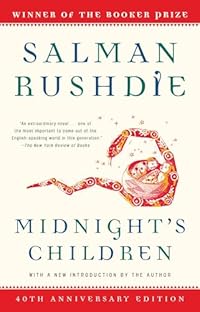
Salman Rushdie’s new novel, “The Enchantress of Florence,” reads less like a novel by the author of such magical works as “Midnight’s Children” and “The Moor’s Last Sigh” than a weary, predictable parody of something by John Barth.
added by GYKM
The essential compatibility of the realistic and the fantastic imagination may explain the success of Rushdie's sumptuous, impetuous mixture of history with fable. But in the end, of course, it is the hand of the master artist, past all explanation, that gives this book its glamour and power, its humour and shock, its verve, its glory. It is a wonderful tale, full of follies and enchantments.
added by mikeg2
Lists

Magic Realism
371 works; 51 members

Booker Prize
491 works; 62 members

Books Set in Italy
167 works; 19 members

Man Booker Prize Longlist 2008
13 works; 2 members

Books set in Firenze (Florence, Italy)
35 works; 1 member

KayStJ's to-read list
1,616 works; 11 members

Speculative Fiction from around the World
610 works; 17 members

Books We Discovered On LibraryThing
530 works; 130 members

Novels with a city or town in the title
61 works; 1 member
Author Information

90+ Works 69,685 Members
Salman Rushdie was born in India on June 19, 1947. He was raised in Pakistan and educated in England. His novels include Grimus, Shame, The Satanic Verses, Haroun and the Sea of Stories, The Moor's Last Sigh, The Ground Beneath Her Feet, Fury, Shalimar the Clown, The Enchantress of Florence, Luka and the Fire of Life, and The Golden House. His show more non-fiction works include Joseph Anton, Imaginary Homelands, The Jaguar Smile, and Step across This Line. He also wrote a collection of short stories entitled East, West. He has received numerous awards including the Whitbread Prize for Best Novel twice, the James Tait Black Prize, the French Prix du Meilleur Livre Étranger, the Booker Prize in 1981 for Midnight's Children, and the 2014 PEN/Pinter Prize. (Bowker Author Biography) show less
Some Editions
Awards and Honors
Awards
Series
Belongs to Publisher Series
Common Knowledge
- Canonical title
- The Enchantress of Florence
- Original title
- The Enchantress of Florence
- Original publication date
- 2008
- People/Characters
- Amerigo Vespucci; Niccolò Machiavelli; Emperor Akbar; Antonino Argalia; Qara Koz
- Important places
- Florence, Tuscany, Italy; Sikri, India
- Epigraph
- "Her way of moving was no mortal thing/ but of angelic form: and her speech/ rang higher than a mere human voice.// A celestial spirit, a living sun/ was what I saw..." ~ Francesco Petrarca translated by A.S. Kline
"If there is a knower of tongues here, fetch him;/ There's a stranger in the city/ And he has many things to say." ~ Mirza Ghilab translated by Shamsur Rahman Faruqi
A few liberties have been taken with the historical record in the interests of the truth. (colophon on copyright/publication data page) - Dedication
- To Bill Buford
- First words
- In the day's last light the glowing lake below the palace-city looked like a sea of molten gold.
- Last words
- (Click to show. Warning: May contain spoilers.)My love, until you're not.
- Publisher's editor
- Murphy, Will; Franklin, Dan; Nabokov, Ivan
- Blurbers
- Le Guin, Ursula K.; Cheuse, Alan; Sutherland, John; Shea, Lisa; Anderson, Hephzibah
- Original language
- English
Classifications
Statistics
- Members
- 3,728
- Popularity
- 4,266
- Reviews
- 138
- Rating
- (3.61)
- Languages
- 18 — Catalan, Czech, Danish, Dutch, English, Finnish, French, German, Hungarian, Italian, Lithuanian, Norwegian (Bokmål), Polish, Portuguese, Russian, Spanish, Swedish, Turkish
- Media
- Paper, Audiobook, Ebook
- ISBNs
- 72
- ASINs
- 24
