History of My Life, Vols. 1 & 2
by Giacomo Girolamo Casanova
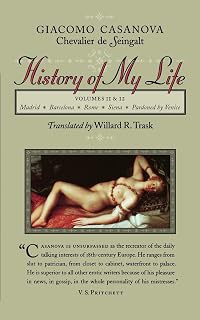
Casanova's History of My Life [Willard R. Trask Translation] (Vols. 1 & 2)
On This Page
Description
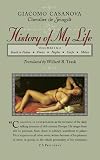
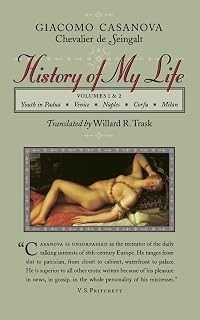
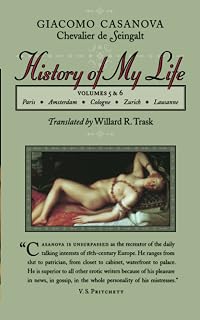
In volumes 1 and 2, Casanova tells the story of his family, his first loves, and his early travels. With the death of his grandmother, he is sent to a seminary--but is soon expelled. He is briefly imprisoned in the fortress of Sant' Andrea. After wandering from Naples to Rome in search of a patron, he enters the service of Cardinal Acquaviva. About this edition: Because every previous edition of Casanova's Memoirs had been abridged to suppress the author's political and religious views and show more tame his vivid, often racy, style, the literary world considered it a major event when Willard R. Trask's translation of the complete original text was published in six double volumes between 1966 and 1971. Trask's award-winning translation now appears in paperback for the first time. show lessTags
Recommendations


















Member Reviews
Started in on this free book (archiv.org) mistaking it at first for Cellini's autobiography. Yet it was interesting enough anyway to read through to halfway into Volume Two (out of six or eight). Would have continued but for the other 400 books on my to-read list. Including Cellini's autobiography.
This is well-written by one who did his own thinking and thought clearly, and was honest about himself as to the considerable amount he chose to tell, making no excuses for his several misfortunes except his youth, naiveté, ignorance, acquisitiveness, intellectual appetite and passion.
Edmund Wilson in "The Wound and the Bow" remarks that Casanova's aim is not so much to glorify himself as to tell us an astonishing story that illustrates how show more people behave, the way in which life works out. He suspects that if Casanova's memoirs were a novel, then he would be the greatest novelist who ever lived. And the real theme of Casanova is the many things a life may hold, the many roles a man may play and the changes brought by time. Wilson writes that the first part of the story is gay, with a Venetian carnival liveliness; the last, unbearably sad.
The best translation of the complete memoirs may be by Willard Trask. Many other editions are abridged.
Caution: some readers may be mildly titillated. Don't let that stop you. show less
This is well-written by one who did his own thinking and thought clearly, and was honest about himself as to the considerable amount he chose to tell, making no excuses for his several misfortunes except his youth, naiveté, ignorance, acquisitiveness, intellectual appetite and passion.
Edmund Wilson in "The Wound and the Bow" remarks that Casanova's aim is not so much to glorify himself as to tell us an astonishing story that illustrates how show more people behave, the way in which life works out. He suspects that if Casanova's memoirs were a novel, then he would be the greatest novelist who ever lived. And the real theme of Casanova is the many things a life may hold, the many roles a man may play and the changes brought by time. Wilson writes that the first part of the story is gay, with a Venetian carnival liveliness; the last, unbearably sad.
The best translation of the complete memoirs may be by Willard Trask. Many other editions are abridged.
Caution: some readers may be mildly titillated. Don't let that stop you. show less
Surely the most extraordinary and unlkely librarian Europe has ever seen, the self-styled Chevalier de Seingalt, born a social outcast, not only found himself a series of wealthy patrons but a series of mistresses. If he had been only a lecher no-one would now remember him, but in his extraordinary and captivating autobiography he wrote of his exploits, both amatory and social, in a rapid and attractive style to which a reasonably broadminded nun could hardly take exception. He was socially accepted in the highest circles, helped da Ponte write the text of Mozart's operas, founded two State lotteries and regularly threw all his gains away by his passion for gambling and women and an inability to avoid offending the authorities. He show more travelled Europe widely in the style of an aristocrat, visiting Russia , England and Spain, but on the death of Marco Foscarini, the the Venetian ambassador in Vienna (to whom he had been secretary) was appointed by his friend Count Waldstein librarian of his castle at Dux in Bohemia, effectively a sinecure. In 1789 Casanova began writing his memoirs there "as the only remedy to keep from going mad or dying of grief". At the time of his death in 1798 he had written of his life only up to the year 1774, but in detail. His memory for names, places and events was evidently prodigious; he had considerable insight into his own follies and failings. Willard Trask, the translator, provides comprehensive notes from which it is evident that Casanova falsified nothing deliberately, though he made mistakes, concealed identities and probably made tactful omissions as well.
The small, badly reproduced black and white illustrations add little to the text. This is a pity considering the importance which was attached to clothes, jewels and ornaments in the circles in which he moved. The design of the book is pedestrian and old-fashioned, but the interest of the narrative makes up for everything. show less
The small, badly reproduced black and white illustrations add little to the text. This is a pity considering the importance which was attached to clothes, jewels and ornaments in the circles in which he moved. The design of the book is pedestrian and old-fashioned, but the interest of the narrative makes up for everything. show less
Read the first two volumes of this work in French and did so to keep up my French, now badly decayed. I read an edited version of the autobiography in translation earlier, and knew the original would keep my interest level high. He was a man who finally fell to librarianship, after a picaresque life he remembered quite fondly. The French edition I read was eight volumes in an attractive binding, and I had hardihood enough for the first two. His french was within the grasp of a high school french, if you want to tackle that beast, but a dictionary is required for that level.
Ratings
Members
- Recently Added By
Lists

Best Biographies, Autobiographies and Memoirs
465 works; 160 members

Books Read in 2024
4,623 works; 126 members

Favorite Books in Translation
320 works; 133 members
Author Information

Some Editions
Awards and Honors
Notable Lists
Series

Common Knowledge
- Canonical title
- History of My Life, Vols. 1 & 2
- Original language
- French
Classifications
- Genres
- Biography & Memoir, Nonfiction, General Nonfiction, History
- DDC/MDS
- 940.253 — History & geography History of Europe History of Europe Europe: Renaissance, Reformation, Enlightenment, Napolean Age of Enlightenment 1648-1789 1715-1789, 18th Century
- LCC
- D285.8 .C4 .A313 — History of Europe, Asia, Africa and Oceania History (General) Modern history, 1453- 1715-1789. 18th century
- BISAC
Statistics
- Members
- 240
- Popularity
- 135,534
- Reviews
- 3
- Rating
- (4.41)
- Languages
- English, Finnish, German
- Media
- Paper
- ISBNs
- 7
- ASINs
- 1