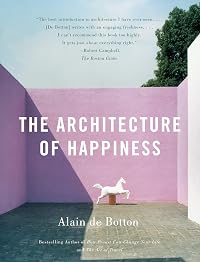
The Architecture of Happiness
by Alain de Botton
On This Page
Description
The Architecture of Happiness is a dazzling journey through the philosophy and psychology of architecture and the indelible connection between our identities and our locations. One of the great but often unmentioned causes of both happiness and misery is the quality of our environment: the kinds of walls, chairs, buildings, and streets that surround us. And yet, a concern for architecture is too often described as frivolous, even self-indulgent. Alain de Botton starts from the idea that show more where we are heavily influences who we can be, and argues that it is architecture's task to stand as an eloquent reminder of our full potential. show lessTags
Recommendations













Member Recommendations
Member Reviews
Summary: Alain de Botton explores the effect of architecture on the human condition: how it inspires us, how it enforces our ideals of beauty, and how it reflects our culture and our desires.
Review: My sister, who is starting her studies in architecture at the University of Toronto, bought this book to prepare herself. One day I had nothing to read, so she lent me her copy. It’s a slim book but it packs a lot of ideas, and it doesn’t hurt that de Botton is an elegiac, poetic writer, capable of squeezing poignancy even into the most mundane sentences. I mean it: this is a man who could write about eating toast and I would lap it all up.
His suggestions about architecture are interesting. I don’t know much about the subject so I show more can’t offer an educated opinion, but I thought he did a good job of exploring the connection between architecture and human wants and fears. It’s also good that there are photos to accompany his writing so that I can see what he means — some of the pictures took my breath away.
However, one niggling feeling ate at me the entire time I was reading, and those were De Botton's prejudices. He discusses the universals of architecture and the human condition but what he's really talking about is the West. He talks about how humans all want democracy and classical ideals and things like that, but that is only a limited view of humanity. Yes, he mentions briefly Japanese architecture and culture, but not much and a bit on Japan is hardly encompassing all non-Western cultures (as an Asian I get annoyed when Japan is always presented to the West as the model Asian nation, but that's another rant entirely). I don’t mind that he focuses on Western culture. I just wish he would clarify that more often rather than assume that the West is default. Also, he tends to revert to male as default when talking about people whose gender are unknown. This is a pet peeve. Others might not mind it but in an academic context it is like nails on a chalkboard for me.
Conclusion: A pretty book about a subject I was eager to learn more about. Ticks off a few of my buttons, but overall a good read. show less
Review: My sister, who is starting her studies in architecture at the University of Toronto, bought this book to prepare herself. One day I had nothing to read, so she lent me her copy. It’s a slim book but it packs a lot of ideas, and it doesn’t hurt that de Botton is an elegiac, poetic writer, capable of squeezing poignancy even into the most mundane sentences. I mean it: this is a man who could write about eating toast and I would lap it all up.
His suggestions about architecture are interesting. I don’t know much about the subject so I show more can’t offer an educated opinion, but I thought he did a good job of exploring the connection between architecture and human wants and fears. It’s also good that there are photos to accompany his writing so that I can see what he means — some of the pictures took my breath away.
However, one niggling feeling ate at me the entire time I was reading, and those were De Botton's prejudices. He discusses the universals of architecture and the human condition but what he's really talking about is the West. He talks about how humans all want democracy and classical ideals and things like that, but that is only a limited view of humanity. Yes, he mentions briefly Japanese architecture and culture, but not much and a bit on Japan is hardly encompassing all non-Western cultures (as an Asian I get annoyed when Japan is always presented to the West as the model Asian nation, but that's another rant entirely). I don’t mind that he focuses on Western culture. I just wish he would clarify that more often rather than assume that the West is default. Also, he tends to revert to male as default when talking about people whose gender are unknown. This is a pet peeve. Others might not mind it but in an academic context it is like nails on a chalkboard for me.
Conclusion: A pretty book about a subject I was eager to learn more about. Ticks off a few of my buttons, but overall a good read. show less
Best for: People not that familiar with architecture who are interested in learning about it in a philosophical way.
In a nutshell: Author de Botton takes the reader through a lovely journey exploring how the buildings we inhabit can help fill missing pieces in our lives, and impact how we feel.
Line that sticks with me: “The buildings we admire are ultimately those which, in a variety of ways, extol values we think worthwhile.” (p 98)
Why I chose it: I bought this long ago. It’s survived multiple book purges and moves, but I finally opened it up because I’m participating in a book challenge this summer, and one of the categories is a book about art or an artist. To avoid spending all the money, I’m checking my to read pile show more first, and came across this gem.
Review: I don’t know much (anything?) about architecture. I know that craftsman homes are popular in my current city, and that ranch-style homes were popular where I grew up. I’ve been learning a bit reading the amazing blog McMansion Hell (which I only came across recently thanks to Zillow going after the writer, then having to back off), but I’ve not been able to put my finger on why certain styles depress the hell of me (most one-story homes; any office park a la Office Space), while others bring me joy (pretty much anything in Paris).
This book has helped me to understand a bit better where my tastes lay and why. I am certain that there are architects who would disagree, but much of Mr. de Botton’s premise is that not only does style reflect the available resources and the elements that must be kept out (a house in Phoenix is probably going to look different from a house in Finland), but also the lives we are living. The greatest example of this is when he argues that people who seek out modernist homes are looking for some order in a chaotic life outside the home, whereas those dramatic palaces built in the 1600s weren’t just a fancy show of money, but also an attempt to create beauty in a time that was pretty dangerous (I mean, think about the diseases running rampant through cities).
I feel that I learned about architecture and beauty, but I also got to enjoy some gorgeous writing. The language Mr. de Botton uses throughout is lovely, a perfect accompaniment to the many examples of different styles of home and building. It can be a bit dense at time, but I think it is worth it, especially for those interested in a more philosophical examination of our built environment.
The only reason this is a 4-star book for me is because there are so many lovely pictures in this edition but they are all in black and white, which really takes away from my ability to see the detail and understand more of why they might be examples of architecture that elevates or depresses us. If not for that, this would be a 5-star read. show less
In a nutshell: Author de Botton takes the reader through a lovely journey exploring how the buildings we inhabit can help fill missing pieces in our lives, and impact how we feel.
Line that sticks with me: “The buildings we admire are ultimately those which, in a variety of ways, extol values we think worthwhile.” (p 98)
Why I chose it: I bought this long ago. It’s survived multiple book purges and moves, but I finally opened it up because I’m participating in a book challenge this summer, and one of the categories is a book about art or an artist. To avoid spending all the money, I’m checking my to read pile show more first, and came across this gem.
Review: I don’t know much (anything?) about architecture. I know that craftsman homes are popular in my current city, and that ranch-style homes were popular where I grew up. I’ve been learning a bit reading the amazing blog McMansion Hell (which I only came across recently thanks to Zillow going after the writer, then having to back off), but I’ve not been able to put my finger on why certain styles depress the hell of me (most one-story homes; any office park a la Office Space), while others bring me joy (pretty much anything in Paris).
This book has helped me to understand a bit better where my tastes lay and why. I am certain that there are architects who would disagree, but much of Mr. de Botton’s premise is that not only does style reflect the available resources and the elements that must be kept out (a house in Phoenix is probably going to look different from a house in Finland), but also the lives we are living. The greatest example of this is when he argues that people who seek out modernist homes are looking for some order in a chaotic life outside the home, whereas those dramatic palaces built in the 1600s weren’t just a fancy show of money, but also an attempt to create beauty in a time that was pretty dangerous (I mean, think about the diseases running rampant through cities).
I feel that I learned about architecture and beauty, but I also got to enjoy some gorgeous writing. The language Mr. de Botton uses throughout is lovely, a perfect accompaniment to the many examples of different styles of home and building. It can be a bit dense at time, but I think it is worth it, especially for those interested in a more philosophical examination of our built environment.
The only reason this is a 4-star book for me is because there are so many lovely pictures in this edition but they are all in black and white, which really takes away from my ability to see the detail and understand more of why they might be examples of architecture that elevates or depresses us. If not for that, this would be a 5-star read. show less
This is the third of De Botton's books that I have read. I enjoyed 'The Consolations of Philosophy', as it taught me a lot about the history of philosophy and about some of its prime movers. De Botton kept himself out of the text as much as possible, and let the philosophers' words shine on their own.
Then I had my first real meeting with Proust, in 'How Proust Can Change Your Life'. Again, it was not De Botton's writing that most impressed me, although it was good in its own way. De Botton proved a most capable gatekeeper to a writing talent I hope to enjoy some other time, but who was extremely able to express his ideas himself.
Finally, I have experienced what De Botton can do when he writes something truly his own, about people who show more certainly communicate a lot to the world, but who generally do it nonverbally - architects.
De Botton examines what it is to build, and to build beautifully. He looks to philosophy to provide answers to the questions that drive architectural fashions, and offers some insights into why beautiful buildings are beautiful and ugly ones so overwhelmingly ugly. He writes lucidly and with a personal touch that makes his essay seem almost conversational at times.
This is without a doubt the best book I have read about architecture; I learnt a lot that I am sure soon to forget, so this book will keep its place on my shelf for years and years, always ready to remind me of the secrets of the four walls around me. show less
Then I had my first real meeting with Proust, in 'How Proust Can Change Your Life'. Again, it was not De Botton's writing that most impressed me, although it was good in its own way. De Botton proved a most capable gatekeeper to a writing talent I hope to enjoy some other time, but who was extremely able to express his ideas himself.
Finally, I have experienced what De Botton can do when he writes something truly his own, about people who show more certainly communicate a lot to the world, but who generally do it nonverbally - architects.
De Botton examines what it is to build, and to build beautifully. He looks to philosophy to provide answers to the questions that drive architectural fashions, and offers some insights into why beautiful buildings are beautiful and ugly ones so overwhelmingly ugly. He writes lucidly and with a personal touch that makes his essay seem almost conversational at times.
This is without a doubt the best book I have read about architecture; I learnt a lot that I am sure soon to forget, so this book will keep its place on my shelf for years and years, always ready to remind me of the secrets of the four walls around me. show less
While I can't say that architecture is *always* meant to balance the current terrors of society, I do think de Botton is right that this is a large part of art movements. He also gives a bit of a primer on the basic art principles (balance, coherence) that are applied to architecture, and he gives many great examples with actually useful pictures. I think "close readings" of a few buildings and some more examples of the forces that motivate cross-cultural architecture would be all I would add to this book. It is very lovingly written and the language is a pleasure.
I do love architecture and frequently find myself fascinated by examples of architecture while traveling. This is a beautifully written book, sort of part philosophy and part close observation of building and design and, if you like that sort of thing, you might try this. One caveat: the section on why buildings speak to us is pure anthropomorphic blather. De Botton is better than this. You could skip it to avoid being annoyed, but the illustrations are worth a look. Regardless, I would read the book again, no problem, and recommend it to others.
Why do we like some buildings and loathe others? How much impact does architecture have on our mental and physical well being? Turns out we are surprisingly vulnerable to the aesthetics of our surroundings. The author explores this less tangible aspect of the built environment and provides an excellent dicussion on the nature of aesthetics.
At first I thought the nouns should be reversed, ie, the Happiness of Architecture. But I began to realise that the book isn't so much about architecture as it is about people and how they express themselves with architecture, as they do with other art forms. He is using architecture to explain humans. He anthropomorphises archictecture. Architecture becomes a frozen emotion. He says that “In essence, what works of design and architecture talk to us about is the kind of life that would most appropriately unfold within and around them” Design is used to show what we want to be, or what we want our values to be. It springs from “…the need for idealised forms to stand as a defence against all that remains corrupt and unimaginative show more within us.” The human psyche naturally seeks balance and ‘beautiful’ architecture provides that, a psychological balance and therefore mental well being and happiness. “In literature, too,” he says, “we admire prose in which a small and astutely arranged set of words has been constructed to carry a large consignment of ideas.” De Botton’s book is just that: a small and astutely arranged set of words that carries a large consignment of ideas. Which brought me to happiness. show less
Members
- Recently Added By
Lists

Best Architecture Books
87 works; 14 members

The Great Courses: Visual Literacy Skills
53 works; 1 member

Books Read in 2021
5,361 works; 114 members
Author Information

53+ Works 26,035 Members
Born in Zurich, Switzerland on December 20, 1969, Alain de Botton was educated at Cambridge University, England, and now divides his time between London and Washington, D.C. With the publication of his first novel, Essays in Love, de Botton quickly became one of the most talked about British novelists of the 1990s. Although the basic plot of show more Essays in Love (published in the U.S. as On Love) is a rather typical love story, de Botton presents it in a unique and humorous way. De Botton's other novels include The Romantic Movement: Sex, Shopping and the Novel, which is written in a similar style to Essays on Love, and Kiss and Tell, which follows a would-be biographer as he attempts to write the life story of the first person he encounters. The Course of Love is his latest novel and is on the bestsellers list. Alain de Botton is also the author of How Proust Can Change Your Life: Not a Novel. (Bowker Author Biography) show less
Awards and Honors
Common Knowledge
- Canonical title
- The Architecture of Happiness
- Original title
- The Architecture of Happiness
- Original publication date
- 2006
- Related movies
- The Perfect Home (2006 | IMDb)
- Dedication
- for Charlotte
- First words
- A terraced house on a tree-lined street.
- Last words
- (Click to show. Warning: May contain spoilers.)We owe it to the worms and the trees that the buildings we cover them with will stand as promises of the highest and most intelligent kinds of happiness.
- Original language
- English
Classifications
Statistics
- Members
- 2,432
- Popularity
- 8,022
- Reviews
- 45
- Rating
- (3.67)
- Languages
- 13 — Arabic, Czech, Danish, Dutch, English, French, German, Italian, Polish, Portuguese, Spanish, Swedish, Turkish
- Media
- Paper, Audiobook, Ebook
- ISBNs
- 48
- ASINs
- 15