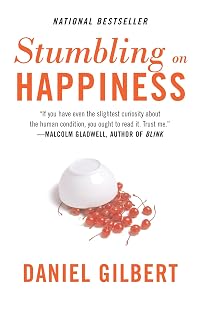
Stumbling on Happiness
by Daniel Gilbert
On This Page
Description
NATIONAL BESTSELLER • Bringing to life scientific research in psychology, cognitive neuroscience, philosophy, and behavioral economics, this witty, accessible book reveals what scientists have discovered about the uniquely human ability to imagine the future, and about our capacity to predict how much we will like it when we get there.• Why are lovers quicker to forgive their partners for infidelity than for leaving dirty dishes in the sink?
• Why will sighted people pay more to avoid show more going blind than blind people will pay to regain their sight?
• Why do dining companions insist on ordering different meals instead of getting what they really want?
• Why do pigeons seem to have such excellent aim; why can’t we remember one song while listening to another; and why does the line at the grocery store always slow down the moment we join it?
In this brilliant book, renowned Harvard psychologist Daniel Gilbert describes the foibles of imagination and illusions of foresight that cause each of us to misconceive our tomorrows and misestimate our satisfactions. With penetrating insight and sparkling prose, Gilbert explains why we seem to know so little about the hearts and minds of the people we are about to become. show less
Tags
Recommendations













Member Recommendations

Member Reviews
This is one of the better of the current glut of positive psychology books. This book is high quality because Gilbert does not focus on happiness. He rarely talks about happiness directly. He focuses on cognitive tendencies of human beings and their effects on how people interpret how they feel, remember how they felt, and anticipate how they will feel.
One cognitive trick that reoccurs throughout the book is that the brain summarizes. Memories of the past are not faithful recordings of the events but reconstructions based on a few key points. Observations of the present only gather a small part of the information around. (Side note: it is my opinion that this is why the faddish "law of attraction" seems to work. Focusing on a desire show more does not change the world, but it does change your perception of the world.)
Summarizing also applies to images of the future (although the exact word choice becomes a little odd). One's predictions tend to focus on a few key points and ignore everything else. For example, most people would feel that they will have a strong and long lasting reaction to the outcome of the next presidential election. Often, people are right about the strength of their reaction, but they are very wrong about the duration. This mistake occurs because predictions of the future leave out the details about the rest of life that tend to very quickly temper your emotions (whether your candidate wins or loses, you will still, for example, have to walk in the rain and will still get to go out to a nice dinner).
That is not all there is to this. Although people tend to over estimate their future happiness or unhappiness, the strength of their anticipation tends to color how they remember an event. Thus, if you think you will feel some amount of happiness from event and you actually feel some different amount, the amount of happiness you remember feeling will be somewhere between the two.
Gilbert does not give happiness tips, but I will take a stab at using his observations to analyze some common happiness tips. Consider the following (seemingly inconsistent) tips: live in the moment, look forward to the future, do not worry too much about the future, do not dwell on the past, cherish your happy memories. If you compare these tips with what we know about the mind, you can start to see why they all can help. Focusing on the moment raises the happiness you actually experience. Anticipation raises the happiness you will remember having experienced. Remembering past experiences provides material for your mind to use when it is making predictions about the future, so focusing on the happy memories will help you to anticipate that similar future events will bring happiness.
This book does not pretend to have all the answers. Instead, it focuses on helping you to understand how the human mind works. With these tools, you can begin to understand why certain bits of common wisdom on happiness work and why they sometimes fail. And, if you are like me, just knowing that makes you a little bit happier. show less
One cognitive trick that reoccurs throughout the book is that the brain summarizes. Memories of the past are not faithful recordings of the events but reconstructions based on a few key points. Observations of the present only gather a small part of the information around. (Side note: it is my opinion that this is why the faddish "law of attraction" seems to work. Focusing on a desire show more does not change the world, but it does change your perception of the world.)
Summarizing also applies to images of the future (although the exact word choice becomes a little odd). One's predictions tend to focus on a few key points and ignore everything else. For example, most people would feel that they will have a strong and long lasting reaction to the outcome of the next presidential election. Often, people are right about the strength of their reaction, but they are very wrong about the duration. This mistake occurs because predictions of the future leave out the details about the rest of life that tend to very quickly temper your emotions (whether your candidate wins or loses, you will still, for example, have to walk in the rain and will still get to go out to a nice dinner).
That is not all there is to this. Although people tend to over estimate their future happiness or unhappiness, the strength of their anticipation tends to color how they remember an event. Thus, if you think you will feel some amount of happiness from event and you actually feel some different amount, the amount of happiness you remember feeling will be somewhere between the two.
Gilbert does not give happiness tips, but I will take a stab at using his observations to analyze some common happiness tips. Consider the following (seemingly inconsistent) tips: live in the moment, look forward to the future, do not worry too much about the future, do not dwell on the past, cherish your happy memories. If you compare these tips with what we know about the mind, you can start to see why they all can help. Focusing on the moment raises the happiness you actually experience. Anticipation raises the happiness you will remember having experienced. Remembering past experiences provides material for your mind to use when it is making predictions about the future, so focusing on the happy memories will help you to anticipate that similar future events will bring happiness.
This book does not pretend to have all the answers. Instead, it focuses on helping you to understand how the human mind works. With these tools, you can begin to understand why certain bits of common wisdom on happiness work and why they sometimes fail. And, if you are like me, just knowing that makes you a little bit happier. show less
I literally stumbled on this book whilst browsing the library shelf and happily so! It may sound like a self-help book but thats precisely what its not.. its a primer on the quest for happiness with a mix of psychology, neuroscience, philosophy & behavioral economics.
Written in a tongue-in-cheek humorous style, from the filling-in & leaving-out tricks that our brain plays to the liberties that imagination takes without telling us about doing so.. its a mind-boggling start to the book! The author then goes on to describe how imagination leans on perception, given its own limitation to transcend boundaries of the present time, place & circumstances - what we imagine as the future is often a response to what's happening in the present; our show more present thoughts & feelings exert a strong influence on the way we think we'll feel later.
It gets further complicated when our brain gets busy looking for ways to think about the experience that will allow us to appreciate it - we build a psychological immune system that defends the mind against unhappiness in the same way that the physical immune system defends the body. To ensure our views are credible, our brain accepts what our eyes see and to ensure our views are positive, our eyes look for what our brain wants; conspiring against us in a secretive way! We are more likely to generate a positive & credible view of an action than an inaction, of a painful experience than of an annoying experience, of an unpleasant situation that we cant escape than of one we can and yet we choose the former coz we pay more attn to favorable information, surround ourselves with those who provide it and accept it uncritically.
Our memory does not serve us too well too - its less like a collection of photographs than it is like a collection of impressionist paintings by an artist who takes license with his subject and emotional experience of happiness is probably the most ambiguous of subjects. Our memory for emotional episodes is overly influenced by unusual instances, closing moments & theories of how we may have felt in past - compromising our ability to learn from personal experience.
Then what is it that still makes us lean on our own selves as the experiencer to gauge our future happiness - the self considers itself to be a very special/ unique person (psst.. ego!) for 3 reasons: a. even if we aren't special, the way we know ourselves is - we experience our own thoughts but infer those of others b. we enjoy thinking of ourselves as special and c. we overestimate everyone's uniqueness, thinking of people as more different from one another than they actually are.
Because of all the reasons above, the author goes on to offer the final solution to getting a real sense of happiness with a certain planned action - relying on the experience of an average individual going thru the same experience currently rather than imagining ourselves in the scenario. Its the surest way to get a real sense of how it would be to stumble upon happiness when undertaking that action! show less
Written in a tongue-in-cheek humorous style, from the filling-in & leaving-out tricks that our brain plays to the liberties that imagination takes without telling us about doing so.. its a mind-boggling start to the book! The author then goes on to describe how imagination leans on perception, given its own limitation to transcend boundaries of the present time, place & circumstances - what we imagine as the future is often a response to what's happening in the present; our show more present thoughts & feelings exert a strong influence on the way we think we'll feel later.
It gets further complicated when our brain gets busy looking for ways to think about the experience that will allow us to appreciate it - we build a psychological immune system that defends the mind against unhappiness in the same way that the physical immune system defends the body. To ensure our views are credible, our brain accepts what our eyes see and to ensure our views are positive, our eyes look for what our brain wants; conspiring against us in a secretive way! We are more likely to generate a positive & credible view of an action than an inaction, of a painful experience than of an annoying experience, of an unpleasant situation that we cant escape than of one we can and yet we choose the former coz we pay more attn to favorable information, surround ourselves with those who provide it and accept it uncritically.
Our memory does not serve us too well too - its less like a collection of photographs than it is like a collection of impressionist paintings by an artist who takes license with his subject and emotional experience of happiness is probably the most ambiguous of subjects. Our memory for emotional episodes is overly influenced by unusual instances, closing moments & theories of how we may have felt in past - compromising our ability to learn from personal experience.
Then what is it that still makes us lean on our own selves as the experiencer to gauge our future happiness - the self considers itself to be a very special/ unique person (psst.. ego!) for 3 reasons: a. even if we aren't special, the way we know ourselves is - we experience our own thoughts but infer those of others b. we enjoy thinking of ourselves as special and c. we overestimate everyone's uniqueness, thinking of people as more different from one another than they actually are.
Because of all the reasons above, the author goes on to offer the final solution to getting a real sense of happiness with a certain planned action - relying on the experience of an average individual going thru the same experience currently rather than imagining ourselves in the scenario. Its the surest way to get a real sense of how it would be to stumble upon happiness when undertaking that action! show less
There is a ton of hype surrounding this book. I have read several other books on happiness research, and subscribe to blog feeds on the topic. This book is referenced all the time. I guess I was expecting to have my socks blown off, but I don't feel wowed at all.
At least it is a fast read, although I didn't dig his writing style. And I did come away with some takeaway points that should serve me well. To sum up the premise in one sentence: humans are bad at predicting the future, so our imagination often leads us to make poor decisions that leave us feeling dissatisfied.
At least it is a fast read, although I didn't dig his writing style. And I did come away with some takeaway points that should serve me well. To sum up the premise in one sentence: humans are bad at predicting the future, so our imagination often leads us to make poor decisions that leave us feeling dissatisfied.
Gilbert's book is wry, funny and informative. My initial joy at finding such a book was muted as I read, finding little that I could relate to. Now, the point of the book is that the many cited studies show that everyone thinks better of themselves than they can justify, so perhaps I'm in that boat. In the end, though, I found myself frustrated by how little new knowledge I gained. True, the details behind the mechanics of thought, perception, judgement and analysis are fascinating, but only confirm what observant folks have been saying for years.A fun read, but unsatisfying.
As a book, I didn't expect this to have cutting-edge research. As a popular book, I didn't expect it to be dry and technical.
It met both of these criteria, and I can't honestly say that I was disappointed with it. It's written in an entertaining if slightly condescending style. Most of the material was not new to me—I'd done a lot of reading online about these topics already.
It did stimulate a lot of interesting thoughts during a week when I felt more like reading books than blog posts, although I'm not sure if any of them stuck. However, I can't help but feel that it should be possible to give more information about the actual studies and let the reader make up their own mind about what conclusions are warranted, even in a popular show more science book. There is little mention of how strong an effect is or whether there are other possible explanations.
The big secret advice at the end is to take an outside view—that is, assume you aren't special and are in fact equal to the statistical average of other people. (The author describes this as advice almost no one will take, even though it would make them more accurate.) Fair enough; many people probably haven't really considered the outside view. But the lack of accommodation for actual knowledge of one's own differences from the statistical average make the advice seem extreme, and I fear will lead readers to reject it wholesale.
I don't know of a better book, so I can't say reading this is a bad idea for someone who's not familiar with the research suggesting we make systematic errors in forecasting what will make us happy. Just be aware of some of the pitfalls. show less
It met both of these criteria, and I can't honestly say that I was disappointed with it. It's written in an entertaining if slightly condescending style. Most of the material was not new to me—I'd done a lot of reading online about these topics already.
It did stimulate a lot of interesting thoughts during a week when I felt more like reading books than blog posts, although I'm not sure if any of them stuck. However, I can't help but feel that it should be possible to give more information about the actual studies and let the reader make up their own mind about what conclusions are warranted, even in a popular show more science book. There is little mention of how strong an effect is or whether there are other possible explanations.
The big secret advice at the end is to take an outside view—that is, assume you aren't special and are in fact equal to the statistical average of other people. (The author describes this as advice almost no one will take, even though it would make them more accurate.) Fair enough; many people probably haven't really considered the outside view. But the lack of accommodation for actual knowledge of one's own differences from the statistical average make the advice seem extreme, and I fear will lead readers to reject it wholesale.
I don't know of a better book, so I can't say reading this is a bad idea for someone who's not familiar with the research suggesting we make systematic errors in forecasting what will make us happy. Just be aware of some of the pitfalls. show less
What we believe will make us happy will not necessarily make us happy. Moving to California, for example, is widely believed to result in a happier life, but research suggests we'd be better off staying in South Dakota and spending more time with family. Gilbert rounds up the best of the research on happiness and presents it to readers in an enjoyable book replete with witty anecdotes to illustrate ideas.
Does money make us happy? Most people behave as though it will but, beyond the level of income requisite for survival, more income does not make us happier. We would be better off working less and having more friendships.
If you distill the results of happiness research into principles for living, they bear a remarkable resemblance to show more many teachings of the great world religions. In a secular society, books like this play an important role by enlightening us rugged individualists as to why more stuff isn't helping. Derek Bok extends Gilbert's ideas into the political sphere in his book, The Politics of Happiness. What if public policy were to concern itself with happiness as a priority instead of focusing on guaranteeing the kind of economic freedom that is bound to result in misery for some and no additional happiness for it's main beneficiaries? I've found the implications of Gilbert's book as interesting as the book itself. show less
Does money make us happy? Most people behave as though it will but, beyond the level of income requisite for survival, more income does not make us happier. We would be better off working less and having more friendships.
If you distill the results of happiness research into principles for living, they bear a remarkable resemblance to show more many teachings of the great world religions. In a secular society, books like this play an important role by enlightening us rugged individualists as to why more stuff isn't helping. Derek Bok extends Gilbert's ideas into the political sphere in his book, The Politics of Happiness. What if public policy were to concern itself with happiness as a priority instead of focusing on guaranteeing the kind of economic freedom that is bound to result in misery for some and no additional happiness for it's main beneficiaries? I've found the implications of Gilbert's book as interesting as the book itself. show less
I heard about this book on the Freakonomics podcast and was instantly intrigued. This is not a self-help book on how to be happy - it’s a rigorous scientific examination of why we’re so bad at predicting what will make us happy in the future. And it’s extremely thought-provoking!
Gilbert is a fast talker, but otherwise he does an excellent job with the audio narration. He presents compelling evidence to support his ideas, and I was totally with him, point for point, until the very end, when he tries to argue that the drive to accumulate wealth and have kids is a sort of self-propagating social conspiracy basically unrelated to personal happiness. I couldn’t really get on board with that, but it’s a side argument that’s not show more critical to the main idea.
But whether you buy all of Gilbert’s arguments or not, Stumbling on Happiness is still a really interesting read, and I guarantee that you will find something in it that relates to your own experiences in some way. It’s not a long book, but it’s dense with ideas. Humor interspersed throughout keeps it from getting dry. Overall, this is a fascinating listen that I’m very glad I came across and will definitely be chewing over for a while. show less
Gilbert is a fast talker, but otherwise he does an excellent job with the audio narration. He presents compelling evidence to support his ideas, and I was totally with him, point for point, until the very end, when he tries to argue that the drive to accumulate wealth and have kids is a sort of self-propagating social conspiracy basically unrelated to personal happiness. I couldn’t really get on board with that, but it’s a side argument that’s not show more critical to the main idea.
But whether you buy all of Gilbert’s arguments or not, Stumbling on Happiness is still a really interesting read, and I guarantee that you will find something in it that relates to your own experiences in some way. It’s not a long book, but it’s dense with ideas. Humor interspersed throughout keeps it from getting dry. Overall, this is a fascinating listen that I’m very glad I came across and will definitely be chewing over for a while. show less
Members
- Recently Added By
Published Reviews
ThingScore 100
Gilbert has a serious argument to make about why human beings are forever wrongly predicting what will make them happy. Because of logic-processing errors our brains tend to make, we don't want the things that would make us happy — and the things that we want (more money, say, or a bigger house or a fancier car) won't make us happy.
added by mikeg2
Lists

Best Laugh Out Loud Books
143 works; 49 members


Psicología - Clásicos
165 works; 2 members

My List
302 works; 1 member

Books Cited in Blueprint by Nicholas Christakis
261 works; 1 member
Author Information

6+ Works 4,521 Members
Some Editions
Awards and Honors
Awards
Distinctions
Notable Lists
Common Knowledge
- Canonical title
- Stumbling on Happiness
- Original title
- Stumbling on Happiness
- Original publication date
- 2006
- Epigraph
- One cannot divine nor forecast the conditions that will make happiness; one only stumbles upon them by chance, in a lucky hour, at the world's end somewhere, and holds fast to the days, as to fortune and fame.
Will Cat... (show all)her, "Le Lavandou," 1902 - Dedication
- For Oli, under the apple tree
- First words
- Priests vow to remain celibate, physicians vow to do no harm, and letter carriers vow to swiftly complete their appointed rounds despite snow, sleet, and split infinitives.
- Quotations
- Economies thrive when individuals strive, but because individuals will only strive for their own happiness, it is essential that they mistakenly believe that producing and consuming are routes to personal well-being.
The belief-transmission network of which we are a part cannot operate without a continuously replenished supply of people to do the transmitting, thus the belief that children are a source of happiness becomes a part of our c... (show all)ultural wisdom simply because the opposite belief unravels the fabric of any society that holds it.
The fact that we often judge the pleasure of an experience by its ending can cause us to make some curious choices.
Most of us appear to believe that we are more athletic, intelligent, organized, ethical, logical, interesting, open-minded, and healthy—not to mention more attractive—than the average person.
We treat our future selves as though they were our children, spending most of the hours of most of our days constructing tomorrows that we hope will make them happy... But our temporal progeny are often thankless. We toil and... (show all) sweat to give them just what we think they will like, and they quit their jobs, grow their hair, move to or from San Francisco, and wonder how we could ever have been stupid enough to think they’d like that. We fail to achieve the accolades and rewards that we consider crucial to their well-being, and they end up thanking God that things didn’t work out according to our shortsighted, misguided plan.
Perhaps the strangest thing about this illusion of control is not that it happens but that it seems to confer many of the psychological benefits of genuine control. In fact, the one group of people who seem generally immune t... (show all)o this illusion are the clinically depressed, who tend to estimate accurately the degree to which they can control events in most situations. - Last words
- (Click to show. Warning: May contain spoilers.)Alas, we think of ourselves as unique entities—minds unlike any others—and thus we often reject the lessons that the emotional experience of others has to teach us.
- Blurbers
- Gladwell, Malcolm; Levitt, Steven D.; Godin, Seth; Goleman, Daniel; Kahneman, Daniel; Schacter, Daniel L.
- Canonical DDC/MDS
- 158
- Canonical LCC
- BF575.H27
Classifications
Statistics
- Members
- 4,530
- Popularity
- 3,244
- Reviews
- 108
- Rating
- (3.81)
- Languages
- 8 — Dutch, English, French, German, Romanian, Spanish, Swedish, Portuguese (Portugal)
- Media
- Paper, Audiobook, Ebook
- ISBNs
- 32
- ASINs
- 12