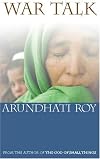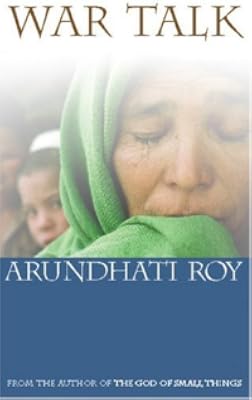
War Talk
by Arundhati Roy
On This Page
Description
"Roy's new essay collection, War Talk, highlights the global rise of militarism and religious and racial violence. Against the backdrop of nuclear brinkmanship between India and Pakistan, the horrific massacre of Muslims in Gujarat, and U.S. demands for an ever-expanding war on terror, she calls into question the equation of nation and ethnicity."--Jacket.Tags
Recommendations













Member Reviews
War Talk by Arundhati Roy is a collection of six essays concerning the state of the world at the beginning of the 21st century. The first three were published in magazines in India and were written for the Indian audience. The fourth and sixth are transcripts of speeches she gave in the United States and Brazil. The fifth is her introduction to the reprint of Noam Chomsky's book, For Reasons of State. As a result, for this reader, the book does not hold together well as a whole. There are too many overlapping themes. Since three of the essays were aimed toward a politically aware and educated Indian audience, they frequently leave the American reader without enough background information to understand some details of her message. show more
Despite this criticism, Roy's overall message is clear: corporate globalization is imperialism, the United States is an empire, and there is nothing free about free markets, free speech, or free press.
Roy is, of course, best known for her 1997 Man Booker Prize-winning novel The God Of Small Things. She hasn't written another novel since. Instead, she seems to have reinvented herself as an international political activist. Journalists often ask her if she is writing another novel. "That questions mocks me," she says. "Another book? Right now? This talk of nuclear war displays such contempt for music, art, literature, and everything else that defines civilization. So what kind of book should I write?" (p. 7)
Roy is insanely brave and scathing in her attacks. Her words are put together with such creative energy and beauty, they often leave the reader gasping. In many places around the world, this type of rhetoric would make it certain that the protester might disappear forever. Let's hope that Roy never becomes the target of an assassination attempt and that she will be able to continue her nonviolent protests in speeches, interviews, and on the printed page.
But also, let us hope that she will eventually feel comfortable enough in letting other firebrands stir up trouble...then, perhaps, she can get around to writing that next novel that we are all looking forward to so much!
Some reviewers criticize Roy for not offering solutions; yet they miss the point. The essays themselves—indeed, her current, personal, relentless focus on protest—is her solution! And that is the solution she offers us. She wants us all to reinvent ourselves as political activist...to "come up with a million ways of becoming a collective pain in the ass." (p. 112)
"Our strategy should be not only to confront Empire, but to lay siege to it. To deprive it of oxygen. To shame it. To mock it. With our art, our music, our literature, our stubbornness, our joy, our brilliance, our sheer relentlessness—and our ability to tell our own stories. Stories that are different from the ones we're being brainwashed to believe." (p. 112) show less
Despite this criticism, Roy's overall message is clear: corporate globalization is imperialism, the United States is an empire, and there is nothing free about free markets, free speech, or free press.
Roy is, of course, best known for her 1997 Man Booker Prize-winning novel The God Of Small Things. She hasn't written another novel since. Instead, she seems to have reinvented herself as an international political activist. Journalists often ask her if she is writing another novel. "That questions mocks me," she says. "Another book? Right now? This talk of nuclear war displays such contempt for music, art, literature, and everything else that defines civilization. So what kind of book should I write?" (p. 7)
Roy is insanely brave and scathing in her attacks. Her words are put together with such creative energy and beauty, they often leave the reader gasping. In many places around the world, this type of rhetoric would make it certain that the protester might disappear forever. Let's hope that Roy never becomes the target of an assassination attempt and that she will be able to continue her nonviolent protests in speeches, interviews, and on the printed page.
But also, let us hope that she will eventually feel comfortable enough in letting other firebrands stir up trouble...then, perhaps, she can get around to writing that next novel that we are all looking forward to so much!
Some reviewers criticize Roy for not offering solutions; yet they miss the point. The essays themselves—indeed, her current, personal, relentless focus on protest—is her solution! And that is the solution she offers us. She wants us all to reinvent ourselves as political activist...to "come up with a million ways of becoming a collective pain in the ass." (p. 112)
"Our strategy should be not only to confront Empire, but to lay siege to it. To deprive it of oxygen. To shame it. To mock it. With our art, our music, our literature, our stubbornness, our joy, our brilliance, our sheer relentlessness—and our ability to tell our own stories. Stories that are different from the ones we're being brainwashed to believe." (p. 112) show less
Highly recommended for all of us who need a reminder, if not a primer, on the currents of power, large scale violence, and national arrogance that buffet nations and people. As an Indian Arundhati, her perspective is both interesting and insightful, and her conclusions are both sound and disturbing.
These pieces were written between 2002-2003 and reflect that troubled time. The titular piece opens the collection and is certainly timely in light of the bellicose rhetoric between North Korea and the Oval Office. The other pieces were not as gripping. There is an interesting view of domestic India and its myriad concerns.
Ratings
Members
- Recently Added By
Lists

South End Press
35 works; 1 member
Author Information

59+ Works 29,557 Members
Suzanna Arundhati Roy, 1961 - Suzanna Roy was born November 24, 1961. Her parents divorced and she lived with her mother Mary Roy, a social activist, in Aymanam. Her mother ran an informal school named Corpus Christi and it was there Roy developed her intellectual abilities, free from the rules of formal education. At the age of 16, she left home show more and lived on her own in a squatter's colony in Delhi. She went six years without seeing her mother. She attended Delhi School of Architecture where she met and married fellow student Gerard Da Cunha. Neither had a great interest in architecture so they quit school and went to Goa. They stayed there for seven months and returned broke. Their marriage lasted only four years. Roy had taken a job at the National Institute of Urban Affairs and, while cycling down a road; film director Pradeep Krishen offered her a small role as a tribal bimbo in Massey Saab. She then received a scholarship to study the restoration of monuments in Italy. During her eight months in Italy, she realized she was a writer. Now married to Krishen, they planned a 26-episode television epic called Banyan Tree. They didn't shoot enough footage for more than four episodes so the serial was scrapped. She wrote the screenplay for the film In Which Annie Gives It Those Ones and Electric Moon. Her next piece caused controversy. It was an article that criticized Shekar Kapur's film Bandit Queen, which was about Phoolan Devi. She accused Kapur of misrepresenting Devi and it eventually became a court case. Afterwards, finished with film, she concentrated on her writing, which became the novel "A God of Small Things." It is based on what it was like growing up in Kerala. The novel contains mild eroticism and again, controversy found Roy having a public interest petition filed to remove the last chapter because of the description of a sexual act. It took Roy five years to write "A God of Small Things" and was released April 4, 1997 in Delhi. It received the Booker prize in London in 1997 and has topped the best-seller lists around the world. Roy is the first non-expatriate Indian author and the first Indian woman to win the Booker prize. (Bowker Author Biography) show less
Awards and Honors
Common Knowledge
- Original publication date
- 2003
- Important places
- India; Pakistan
- First words
- When India and Pakistan conducted their nuclear tests in 1998, even those of us who condemned them balked at the hypocrisy of Western nuclear powers.
- Last words
- (Click to show. Warning: May contain spoilers.)They need us more than we need them.
- Blurbers
- Rushdie, Salman; Chomsky, Noam; Shiva, Vandana; Zinn, Howard
Classifications
- Genres
- Nonfiction, General Nonfiction, Politics and Government
- DDC/MDS
- 327.109051 — Society, government, & culture Political science International Relations: Spies Foreign policy and specific topics in international relations Biography And History
- LCC
- D860 .R69 — History of Europe, Asia, Africa and Oceania History (General) Post-war history (1945- )
- BISAC
Statistics
- Members
- 316
- Popularity
- 101,079
- Reviews
- 3
- Rating
- (3.80)
- Languages
- English, French
- Media
- Paper
- ISBNs
- 3
- ASINs
- 1