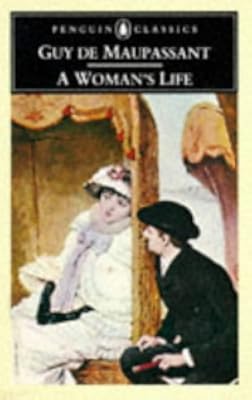
A Woman's Life
by Guy de Maupassant
On This Page
Description
`every heart imagines itself the first to thrill to a myriad sensations which once stirred the hearts of the earliest creatures and which will again stir the hearts of the last men and women to walk the earth'What is a life? How shall a storyteller conceive a life? What if art means pattern and life has none? How, then, can any story be true to life? These are some of the questions which inform the first of Maupassant's six novels, A Life (Une Vie) (1883) in which he sought to parody and show more expose thefolly of romantic illusion. An unflinching presentation of a woman's life of failure and disappointments, where fulfilment and happiness might have been expected, A Life recounts Jeanne de Lamare's gradual lapse into a state of disillusion.With its intricate network of parallels and oppositions, A Life reflects the influence of Flaubert in its attention to form and its coherent structure. It also expresses Maupassant's characteristic naturalistic vision in which the satire of bourgeois manners, the representation of the aristocracy inpathological decline, the undermining of human individuality and ideals, and the study of deterioration and disintegration, all play a role. But above all Maupassant brings to his first novel the short story writer's genius for a focused tension between stasis and change, and A Life is one of hismost compelling portraits of dispossession and powerlessness. show lessTags
Recommendations


















Member Reviews
I loved this simply told story about the life of a young aristocratic woman, Jeanne. After being brought up in a convent, she leaves at age 17 and quickly meets and falls in love with Julien de Lamare. But after a romantic holiday in Corsica (with some lovely descriptions of the island in the early 19th century, when its most famous son was still languishing in remote exile on St Helena), disillusion rapidly sets in. Jeanne must come to terms with Julien's changed character and her shocking discovery that he has fathered a child by her maid, Rosalie. She discovers around the same time that she is herself pregnant, and gives birth to a son, Paul, whom she dotes on. Later on, Julien also has an affair with the wife of another couple they show more both know, whose cuckolded husband wreaks a terrible revenge on the pair. Finally Paul deserts her, runs up huge debts and at the end of the novel, reveals by letter that he has married, but his wife has died, leaving him with a baby daughter that he expects her to raise. It all sounds like very soap opera stuff, but told in a very matter of fact French way. Good stuff. show less
This is an early work of naturalism, and is a personal rather than a political history. Through the life of one woman, we see life's pitfalls, and the unrelenting pessimism of life itself.
The novel begins as 17 year old Jeanne leaves the convent in which she has been educated to return to the family chateau high on a cliff overlooking the sea in Normandy. Contemplating her future, Jeanne can see no further than meeting the love of her life, marrying him, and living happily ever after. And in fact, within a few months of returning home Jeanne has met and married Julien, the man she thinks is her true love (Ha!). The happily ever after does not happen, however, and Jeanne's life thereafter is one disappointment and tragedy after show more another.
This seemed to me to be a book very much before its time. The scene of Jeanne's doting parents on her wedding night, with her father having to explain "the facts of life" to Jeanne because her mother was too embarrassed to do so, is both touching and humorous. And the depiction of Jeanne's sexual awakening was more frank than most novels of that day. One warning for sensitive readers: there is one scene of extreme animal cruelty involving a priest and a dog giving birth. It was hard to read, and may have reflected de Maupassant's disdain for the Church.
de Maupassant is known primarily for his short stories, but I've now read three of his novels and enjoyed each one very much. He is a writer into whose works I want to delve more deeply I highly recommend this book.
4 stars show less
The novel begins as 17 year old Jeanne leaves the convent in which she has been educated to return to the family chateau high on a cliff overlooking the sea in Normandy. Contemplating her future, Jeanne can see no further than meeting the love of her life, marrying him, and living happily ever after. And in fact, within a few months of returning home Jeanne has met and married Julien, the man she thinks is her true love (Ha!). The happily ever after does not happen, however, and Jeanne's life thereafter is one disappointment and tragedy after show more another.
This seemed to me to be a book very much before its time. The scene of Jeanne's doting parents on her wedding night, with her father having to explain "the facts of life" to Jeanne because her mother was too embarrassed to do so, is both touching and humorous. And the depiction of Jeanne's sexual awakening was more frank than most novels of that day. One warning for sensitive readers: there is one scene of extreme animal cruelty involving a priest and a dog giving birth. It was hard to read, and may have reflected de Maupassant's disdain for the Church.
de Maupassant is known primarily for his short stories, but I've now read three of his novels and enjoyed each one very much. He is a writer into whose works I want to delve more deeply I highly recommend this book.
4 stars show less
A superficially gentle little novel about the life of a naive young girl with a privileged background and indulgent parents, who finds herself having to deal with an unsatisfactory husband and a wayward son, both of whom give her more than what she considers her fair share of unhappiness.
Jeanne's maid and foster-sister, Rosalie, however, is usually on hand to remind her that people who have never had to work for their living don't know what suffering means. Maupassant sneaks in some fairly harsh social criticism and some interesting Normandy local colour, but the overall tone is a kind of romantic pessimism with a lot of weather and some Thomas-Hardy-ish moments of melodrama (watch out for that shepherd's caravan!).
Fun, but probably show more not Maupassant's finest hour. show less
Jeanne's maid and foster-sister, Rosalie, however, is usually on hand to remind her that people who have never had to work for their living don't know what suffering means. Maupassant sneaks in some fairly harsh social criticism and some interesting Normandy local colour, but the overall tone is a kind of romantic pessimism with a lot of weather and some Thomas-Hardy-ish moments of melodrama (watch out for that shepherd's caravan!).
Fun, but probably show more not Maupassant's finest hour. show less
As in other stories by Guy de Maupassant, ‘Une Vie’ impresses you with its honesty and its sometimes depressing realism. It’s not the same realism as in, say, Zola or Balzac, with grimy characters in the underbelly of France eking out miserable existences, it’s realism in the pathos of provincial characters. Jeanne is a young woman who longs for love, is euphoric when she finds it, but soon finds marriage far from what she dreamed of because of her husband’s cupidity and infidelity. She has loving parents and is reminded by her maid that she has a good life, not suffering privation, but she seems betrayed by many over the course of her life. Her husband, obviously, but also the local clergy, one of whom advises her to ignore show more her husband’s sleeping around because “everyone does it”, and the other who takes a ridiculously harsh line with the community and commits an act of unspeakable cruelty. Later, her son, who she dotes on excessively, will become a spendthrift who keeps her at arm’s reach and only writes for money.
Maupassant writes with knowledge of emotional truths, and it was quite surprising to read him describing the wedding night, and later the age-old problem of the differences in sexual desires between husband and wife. You just never see this sort of thing in 19th century literature. The extent of her “sex education” is as follows, and this from her father (wow):
“There are mysteries which are carefully kept from children, especially girls, for girls should remain pure in spirit, pure beyond reproach, until we give them into the arms of a man and their happiness passes into his keeping. It is he who will lift the veil and reveal to them what is life’s sweetest secret. Only, if they have guessed nothing of it beforehand, they often recoil from the reality, the crude facts behind their dreams. If they feel wounded in spirit as they are, indeed, in the body, they may refuse their husband what is his by law – both human and natural law – his absolute right. I cannot tell you more than this, my darling; but never forget that you belong to your husband entirely.”
The wedding night (and their subsequent marital relations) are described in just the right level of detail, and I won’t quote it, except the truism of her feeling: “The rough contact was brutal to her and her breath came fast; and she wanted above everything to escape, to run away through the house, shut herself in somewhere, get away from this man.” And some time later: “She said nothing more, but waited with eyes downcast, revolted body and soul by this continual desire of the male, submitting only with distaste, resigned but humiliated, for to her there was something bestial and degrading in it, indeed something obscene.”
I also really appreciated his little touches, such as the character of Aunt Lison, who nobody pays attention to, and the mention of whom is “as though somebody had mentioned the coffee-pot or the sugar-bowl.” He’s also good in his descriptions of nature, and it was fun to look up the elephant-like rock formation near the small port of Etretat he mentions. Lastly, he has the right sentimental touches, such as when Jeanne revisits her old house, and finds an old pin of her mother’s and sees the “curious figures that imagination often sees in the pattern of a fabric, in marble, in ceilings shaded with the dust of time.”
There are some dramatic moments, one of which is spoiled in this illustrated edition by having the event shown pictorially a few pages before it happens in the text. That’s unpardonable, but rather than penalize Maupassant with a lower rating score, I will just avoid books from ‘The Folio Society’ of London. Another of its illustrations shows up a full 15 pages before the event, which is not a spoiler, but baffling, and reflects poor editing.
Quotes:
On being alone:
“…she felt that there was a veil, a barrier, between them, as she became aware for the first time that two people can never penetrate into each other’s souls, into their inmost thoughts; and that even when they are together, side by side, sometimes interlaced, still they cannot intermingle, and the moral being of each one us remains eternally separate and alone throughout our lives.”
On religion:
“…he made obeisance to a sort of pantheistic deity, and his hackles rose at the Catholic conception of a god with a bourgeois disposition, the wrath of a Jesuit and the vengefulness of a tyrant; for God to him was a glimpse of creation in miniature, inevitable, limitless and omnipotent, the creation of life, light, earth, thought, plant, rock, man, air, beast, star, God, and insect all simultaneously, creating for the sake of creation, stronger than will, more vast than reasoning, endlessly bringing forth without object or reason in all directions and all forms throughout infinite space, in accordance with necessity as it arises and with the proximity of suns to heat the worlds.
Creation contains the seed of all things, and thought and life develop within it like flowers and fruit on the trees. Accordingly, reproduction was a general law, a divine act, sacred and praiseworthy, fulfilling the obscure, eternal will of the Universal Being.”
And this one:
“Jeanne, feeling herself under attack, retorted: ‘Is it not possible to believe in God without attending Mass?’
The marquise answered: ‘No, Madame; the faithful go to the church to pray to God, just as we go to visit people in their own homes.’
Jeanne was nettled, and replied: ‘God is everywhere, Madame. For my part, I believe in His goodness from the bottom of my heart, and when certain priests come between Him and me I lose the sense of His presence.’”
On a sunset at sea:
“It seemed that a boundless calm had stilled the air, creating a space of quiet about that meeting of the elements; the curve of the sea beneath the sky was like the lustrous liquid belly of some giant bride waiting for her fiery lover to descend on her. He came down in a swift rush, purple as though with ardour to embrace her. Sea and sun became one; and gradually she engulfed him.
Now a chill rose from the horizon; a ripple ran over the heaving bosom of the waters, wrinkling the surface, as though the star they had absorbed sighed out its contentment over the world.” show less
Maupassant writes with knowledge of emotional truths, and it was quite surprising to read him describing the wedding night, and later the age-old problem of the differences in sexual desires between husband and wife. You just never see this sort of thing in 19th century literature. The extent of her “sex education” is as follows, and this from her father (wow):
“There are mysteries which are carefully kept from children, especially girls, for girls should remain pure in spirit, pure beyond reproach, until we give them into the arms of a man and their happiness passes into his keeping. It is he who will lift the veil and reveal to them what is life’s sweetest secret. Only, if they have guessed nothing of it beforehand, they often recoil from the reality, the crude facts behind their dreams. If they feel wounded in spirit as they are, indeed, in the body, they may refuse their husband what is his by law – both human and natural law – his absolute right. I cannot tell you more than this, my darling; but never forget that you belong to your husband entirely.”
The wedding night (and their subsequent marital relations) are described in just the right level of detail, and I won’t quote it, except the truism of her feeling: “The rough contact was brutal to her and her breath came fast; and she wanted above everything to escape, to run away through the house, shut herself in somewhere, get away from this man.” And some time later: “She said nothing more, but waited with eyes downcast, revolted body and soul by this continual desire of the male, submitting only with distaste, resigned but humiliated, for to her there was something bestial and degrading in it, indeed something obscene.”
I also really appreciated his little touches, such as the character of Aunt Lison, who nobody pays attention to, and the mention of whom is “as though somebody had mentioned the coffee-pot or the sugar-bowl.” He’s also good in his descriptions of nature, and it was fun to look up the elephant-like rock formation near the small port of Etretat he mentions. Lastly, he has the right sentimental touches, such as when Jeanne revisits her old house, and finds an old pin of her mother’s and sees the “curious figures that imagination often sees in the pattern of a fabric, in marble, in ceilings shaded with the dust of time.”
There are some dramatic moments, one of which is spoiled in this illustrated edition by having the event shown pictorially a few pages before it happens in the text. That’s unpardonable, but rather than penalize Maupassant with a lower rating score, I will just avoid books from ‘The Folio Society’ of London. Another of its illustrations shows up a full 15 pages before the event, which is not a spoiler, but baffling, and reflects poor editing.
Quotes:
On being alone:
“…she felt that there was a veil, a barrier, between them, as she became aware for the first time that two people can never penetrate into each other’s souls, into their inmost thoughts; and that even when they are together, side by side, sometimes interlaced, still they cannot intermingle, and the moral being of each one us remains eternally separate and alone throughout our lives.”
On religion:
“…he made obeisance to a sort of pantheistic deity, and his hackles rose at the Catholic conception of a god with a bourgeois disposition, the wrath of a Jesuit and the vengefulness of a tyrant; for God to him was a glimpse of creation in miniature, inevitable, limitless and omnipotent, the creation of life, light, earth, thought, plant, rock, man, air, beast, star, God, and insect all simultaneously, creating for the sake of creation, stronger than will, more vast than reasoning, endlessly bringing forth without object or reason in all directions and all forms throughout infinite space, in accordance with necessity as it arises and with the proximity of suns to heat the worlds.
Creation contains the seed of all things, and thought and life develop within it like flowers and fruit on the trees. Accordingly, reproduction was a general law, a divine act, sacred and praiseworthy, fulfilling the obscure, eternal will of the Universal Being.”
And this one:
“Jeanne, feeling herself under attack, retorted: ‘Is it not possible to believe in God without attending Mass?’
The marquise answered: ‘No, Madame; the faithful go to the church to pray to God, just as we go to visit people in their own homes.’
Jeanne was nettled, and replied: ‘God is everywhere, Madame. For my part, I believe in His goodness from the bottom of my heart, and when certain priests come between Him and me I lose the sense of His presence.’”
On a sunset at sea:
“It seemed that a boundless calm had stilled the air, creating a space of quiet about that meeting of the elements; the curve of the sea beneath the sky was like the lustrous liquid belly of some giant bride waiting for her fiery lover to descend on her. He came down in a swift rush, purple as though with ardour to embrace her. Sea and sun became one; and gradually she engulfed him.
Now a chill rose from the horizon; a ripple ran over the heaving bosom of the waters, wrinkling the surface, as though the star they had absorbed sighed out its contentment over the world.” show less
Une vie was Guy de Maupassant's first long-form fiction/novel, and already it shows a great flair for realism and for heartbreaking clarity of vision that at its best rivals his own ideal, Gustave Flaubert. Une vie is a novel which in many respects resembles Madame Bovary, but whereas Emma in that novel at least lived a fairly turbulent and active life and managed to claim a kind of martyrdom for herself in the end, Jeanne in this tale is perhaps a much sadder figure for how one wrong decision sets her on a long train of sadness and despairs which crush her sensitive and sentimental soul under their hammer blows. Rather than flaring out, we see as the ennui and inability to forge an identity for herself separate from that of first her show more husband and then later her son constrain her world and turn a happy, hopeful young girl into an embittered woman, prematurely aged and utterly resigned to a kind of dark fatalism about her own chances in life. There is a note of hope in the end, a kind of authorial act of mercy which lifts the shadow a little but it's still an overwhelmingly sad tale and one that made me ponder how cruel the world is for dreamers and idealists. Do wish this was a little more psychologically detailed as Jeanne doesn't really develop very much as character and there's only hints with some of the underlying factors motivating her mindset but on the other hand the occasions where it does delve there are really excellent.
Otherwise of note: was surprised by how explicit this got in some of its depictions of sex/eroticism for a novel of its era and not just in an isolated passage here or there either.
_______
As a French reading experience, this went quite smoothly although still slowish for how detailed the prose becomes. Often lavish description is a big hindrance to me but when it's as well done as it is here I can't say I mind (and the constant implied analogies between the weather/seasons/countryside, always in vivid detail, and the life of our protagonist added a great deal). Still feel like I missed details here and there but there were parts where I felt I was gliding through with great fluency so progress nonetheless. show less
Otherwise of note: was surprised by how explicit this got in some of its depictions of sex/eroticism for a novel of its era and not just in an isolated passage here or there either.
_______
As a French reading experience, this went quite smoothly although still slowish for how detailed the prose becomes. Often lavish description is a big hindrance to me but when it's as well done as it is here I can't say I mind (and the constant implied analogies between the weather/seasons/countryside, always in vivid detail, and the life of our protagonist added a great deal). Still feel like I missed details here and there but there were parts where I felt I was gliding through with great fluency so progress nonetheless. show less
Why would anyone want to read a 19th century novel? And, why do good writers bring up the name Guy de Maupassant as an example of a great writer? This book answers both questions. Yes, a quick description of the story – a young, naïve girl marries wrong and tragedies ensue - sounds like fodder for soap operas or romance novels. But it is in the telling of the story and the handling of the characters that de Maupassant’s true writing talent comes through. Our heroine Jeanne could come off as a guileless wimp who we get sick of quickly. Yet, de Maupassant’s talents as a writer manage to bring her off as sympathetic, even though much of her plight is because of her blithe acceptance of what life dishes her. And, even with our show more jaundiced 21st century views, we can still sympathize with these characters and the burdens they faced because of the roles thrust upon them. show less
Part of that most interesting genre, the unhappy marriage, De Maupassant's novel is a veritable masterpiece. It follows the doomed relationship of naive Jeanne and tightfisted, arrogant Julien - but then it goes further, looking at what happens when a person's dreams for life lie shattered before them.
Members
- Recently Added By
Lists

1001 Books You Must Read Before You Die
1,448 works; 1,137 members

Best of French Literature
138 works; 27 members

Favourite 19th century fiction
257 works; 62 members

Favourite Books
1,820 works; 310 members
Books I've Read More Than Once
602 works; 49 members

French Books
102 works; 15 members

1,001 BYMRBYD Concensus
723 works; 27 members
Literature About Women and Girls
426 works; 40 members
Talk Discussions
Past Discussions
Folio Archives 274: Une Vie by Guy de Maupassant 1981 in Folio Society Devotees (June 2022)
Maupassant - Une Vie (A Life) in Author Theme Reads (March 2013)
Author Information

2,537+ Works 26,785 Members
Henry-René-Albert-Guy de Maupassant was born on August 5, 1850 in France. He was schooled at a seminary in Yvetot and Le Harve. He fought in the Franco-German War, then held civil service posts with the Ministry of the Navy and the Ministry of Public Instruction. He also worked with Gustave Flaubert, who helped him develop his writing talent and show more introduced him to many literary greats. During his lifetime, he wrote six novels, three travel books, one book of verse, and over 300 short stories. He is considered one of the fathers of the modern short story. His works include The Necklace, A Piece of String, Mademoiselle Fifi, Miss Harriet, My Uncle Jules, Found on a Drowned Man, and The Wreck. He suffered from mental illness in his later years and attempted suicide on January 2, 1892. He was committed to a private asylum in Paris, where he died on July 6, 1893. (Bowker Author Biography) show less
Some Editions
Awards and Honors
Series
Belongs to Publisher Series
Drei Türme Bücher (33)
BTJ Klassikot (11)
Work Relationships
Is contained in
Is abridged in
Has as a study
Has as a student's study guide
Common Knowledge
- Canonical title
- A Woman's Life
- Original title
- Une vie
- Alternate titles*
- Die Brautnacht
- Original publication date
- 1883
- People/Characters
- Jeanne Le Perthuis des Vauds; Julien de Lamare; Baron Simon-Jacques; Baroness Adelaide; Rosalie; Paul
- Important places*
- Tourville-sur-Arques, Normandie, France; France
- Related movies*
- Naiskohtaloita (1947 | IMDb); One Life (1958 | IMDb)
- Dedication*
- A Madame Brainne
Hommage d'un ami dévoué,
et en souvenir d'un ami mort,
Guy de Maupassant - First words
- Her trunks packed, Jeanne walked over to the window, but it had not stopped raining.
- Last words
- (Click to show. Warning: May contain spoilers.)'You see, life's never as good or bas as we think.'
- Blurbers
- James, Henry
- Original language
- French
*Some information comes from Common Knowledge in other languages. Click "Edit" for more information.
Classifications
Statistics
- Members
- 1,685
- Popularity
- 13,298
- Reviews
- 33
- Rating
- (3.82)
- Languages
- 14 — Czech, Dutch, English, Finnish, French, German, Hebrew, Hungarian, Italian, Russian, Spanish, Swedish, Turkish, Portuguese (Portugal)
- Media
- Paper, Audiobook, Ebook
- ISBNs
- 133
- UPCs
- 1
- ASINs
- 79