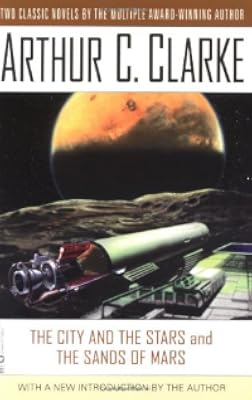
The City and the Stars [and] the Sands of Mars
by Arthur C. Clarke
On This Page
Description
Two classic novels are collected in this volume that includes a new introduction written by the author. In The City and the Stars, the only man born among immortals wants to find out what lies beyond the city. And in The Sands of Mars, a science-fiction writer visits a research colony on Mars and discovers the perils of survival on another world.Tags
Recommendations







Member Reviews
This is a collection of two unrelated novels. The City and the Stars is one of my favorite Clarke novels. It centers on Alvin, the first child born in ten million years in Diaspar, the city of the title, the last city on Earth. He's a "unique" rather than someone reborn from the Hall of Creation, and unique in wanting to go beyond the bounds of the city. Diaspar is a completely enclosed and stagnant culture, on an Earth so old the oceans are gone and there's no longer a moon. In paperback this is a slim, fast reading book of 196 pages. It’s well-written, thought-provoking and makes a good introduction to Clarke. It deals with a lot of his trademark themes of transcendence, immortality and exploration and is interesting and unusual in show more treating of a far future Earth. I actually prefer this book to more famous Clarke novels such as Childhood's End and Rendezvous with Rama.
The Sands of Mars centers on Martin Gibson, a science fiction writer who visits the Martian colony. Published in 1951 naturally a lot of the scientific details are dated--we know much more about Mars today, on which we currently have a robotic presence. And I don't think this book excels in memorable characters or plot. But Clarke is good at making you feel a sense of awe and enthusiasm at the exploration of space. So it's a readable book, but not comparable to The City and the Stars, Childhood's End or a collection of his short fiction as an introduction to him. show less
The Sands of Mars centers on Martin Gibson, a science fiction writer who visits the Martian colony. Published in 1951 naturally a lot of the scientific details are dated--we know much more about Mars today, on which we currently have a robotic presence. And I don't think this book excels in memorable characters or plot. But Clarke is good at making you feel a sense of awe and enthusiasm at the exploration of space. So it's a readable book, but not comparable to The City and the Stars, Childhood's End or a collection of his short fiction as an introduction to him. show less
All through the reading of this book, I felt like I was watching a 1950s Sci Fi movie, with scientists in white lab coats. Not to be as one translates to the habits of people 50+ years later. Clarke has envisioned a future that is not yet here...but may be some day. Once man gets into interplanetary travel and its institutional. Point taken, Mr Clarke. But, finding Martian life after a "plane" crash--not so fast!
The City and The Stars had some great ideas - that mankind evolved into 2 camps - one that never left it's own city and one that rarely spoke but used telepathy instead, but I found the ending just dragged on....and on.
Pretty interesting but it didn’t really go anywhere. It was interesting at the beginning and then there was some action. And a little trip out to other worlds — fairly short though. Then the wrap up was just dull.
Ratings
Members
- Recently Added By
Author Information

846+ Works 130,497 Members
Arthur C. Clarke was born in Minehead, Somerset, England, on December 16, 1917. During World War II, he served as a radar specialist in the RAF. His first published piece of fiction was Rescue Party and appeared in Astounding Science, May 1946. He graduated from King's College in London with honors in physics and mathematics, and worked in show more scientific research before turning his attention to writing fiction. His first book, Prelude to Space, was published in 1951. He is best known for his book 2001: A Space Odyssey, which was later turned into a highly successful and controversial film under the direction of Stanley Kubrick. His other works include Childhood's End, Rendezvous with Rama, The Garden of Rama, The Snows of Olympus, 2010: A Space Odyssey II, 2062: Odyssey III, and 3001: The Final Odyssey. During his lifetime, he received at least three Hugo Awards and two Nebula Awards. He died of heart failure on March 19, 2008 at the age of 90. (Bowker Author Biography) show less
Work Relationships
Is contained in
Common Knowledge
Classifications
Statistics
- Members
- 295
- Popularity
- 109,232
- Reviews
- 4
- Rating
- (3.96)
- Languages
- English
- Media
- Paper, Ebook
- ISBNs
- 3