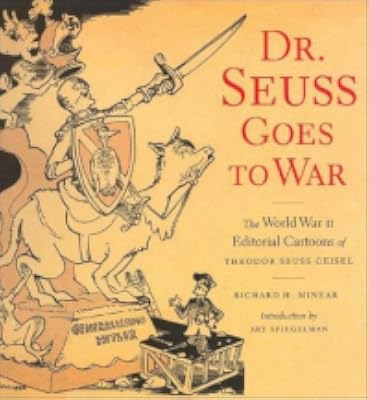
Dr. Seuss Goes to War: The World War II Editorial Cartoons of Theodor Seuss Geisel
by Richard H. Minear
On This Page
Description
For decades, readers throughout the world have enjoyed the marvelous stories and illustrations of Theodor Seuss Geisel, better known as Dr. Seuss. But few know the work Geisel did as a political cartoonist during World War II, for the New York daily newspaper PM. In these extraordinarily trenchant cartoons, Geisel presents "a provocative history of wartime politics" (Entertainment Weekly). Dr. Seuss Goes to War features handsome, large-format reproductions of more than two hundred of show more Geisel's cartoons, alongside "insightful" (Booklist) commentary by the historian Richard H. Minear that places them in the context of the national climate they reflect. Pulitzer Prize-winner Art Spiegelman's introduction places Seuss firmly in the pantheon of the leading political cartoonists of our time. show lessTags
Recommendations





















Member Reviews
Before he was a beloved children's author, Dr Seuss was a political cartoon. Those are words to inspire terror, because we all no that there is no such thing as A Good Cartoon, and that in the infinite parade of Lesters, McCoys, Asays, and Ramirezes, There is Always More and it is Always Worse. Thank the almighty Bors that Seuss remains Seussian, even when dealing with various serious subjects like Hitler and WW2.
Really, there is nothing as delightfully Suessian as Hitler's dachsund powered war machine stalling in the Russian winter, or Benito Mussolini as a propped up, battered, relic addressing an empty square. Seuss goes after fascists overseas and at home, excoriating isolationists like Charles Limbaugh for abandoning the world to show more monsters, while at the same time demanding an all-out effort to win the war, by bringing Labor and African Americans into the war effort. The only sour note are the depictions of the Japanese. It's a shame that a man could produce a cartoon about driving out the bug of racial prejudice one week, and then show the Japanese as slant-eyed monkey devils the next. But that's why history is history. An essential book for adult lovers of Dr Seuss, political cartoon aficionados, and WW2 buffs. show less
Really, there is nothing as delightfully Suessian as Hitler's dachsund powered war machine stalling in the Russian winter, or Benito Mussolini as a propped up, battered, relic addressing an empty square. Seuss goes after fascists overseas and at home, excoriating isolationists like Charles Limbaugh for abandoning the world to show more monsters, while at the same time demanding an all-out effort to win the war, by bringing Labor and African Americans into the war effort. The only sour note are the depictions of the Japanese. It's a shame that a man could produce a cartoon about driving out the bug of racial prejudice one week, and then show the Japanese as slant-eyed monkey devils the next. But that's why history is history. An essential book for adult lovers of Dr Seuss, political cartoon aficionados, and WW2 buffs. show less
As we sit on the brink of WWIII (or far in its depths according to some sources) reading this collection of Dr. Seuss's editorial cartoons from the WWII era is especially poignant. Written and illustrated during the mid-point of his career they come as no surprise , I'm sure, to any reader of his books with half a brain - tepid children's stories they are not (always) and his comics provide a medium for even more pointed jabs at the establishment, the status quo, and the general laziness in society. Unfortunately, hindsight may be 20/20, but we don't seem to have learned much...
From January 1941 to January 1943, Dr. Seuss drew hundreds of cartoons for PM, a left-wing New York daily paper. The style is familiar Dr. Seuss, but the subject is the war, and the content highly political. The book is divided into a few themes, with commentary at the beginning of each chapter, followed by a series of cartoons. Margin notes indicate which cartoons are referenced in the commentary. The format requires a lot of flipping back and forth between the words and the cartoons, but allows for greater visual impact by giving each cartoon its own page. Minear provides a good historical background for each cartoon, and ties them together in a continuous narrative. He explains all the elements in the cartoons, often pointing out show more details that I might have missed. Of course, that attention to detail sometimes leads to over-analysis, but overall the commentary is well balanced. I like this book both as WWII history and as an art collection. show less
The political comics of Theodor Geisel are presented in this book with enough background, commentary, and context to be really appreciated. The political points being promoted by each comic aren't always obvious, and Richard Minear's elaborations are as illuminating as they are concise.
He also doesn't sugar-coat or excuse the problems of Mr. Geisel's work, pointing out how Geisel addressed racism against Jewish and Black people while also being unselfconsciously racist against Japanese people (including Japanese-Americans).
I really enjoyed reading this book, and I learned much more about World War II (and especially domestic US politics at the time) from it than I had expected to.
He also doesn't sugar-coat or excuse the problems of Mr. Geisel's work, pointing out how Geisel addressed racism against Jewish and Black people while also being unselfconsciously racist against Japanese people (including Japanese-Americans).
I really enjoyed reading this book, and I learned much more about World War II (and especially domestic US politics at the time) from it than I had expected to.
With few exceptions, this is quite an excellent collection. It's also one hell of a condemnation of American's pre-1941 apathy towards Hitler and his victims. Americans still view brutal dictators as "not their problem" until the problem is more direct to their own interests, so his cartoons are still relevant in this way.
I love this book, it melds education and fun into one! Dr. Suesss, aka Theodor Geisel, began his career as not just a cartoonist but a political cartoonist. After a few illustrations selling various items, he became involved in political cartoons for PM magazine urging the US to get involved in the war prior to Pearl Harbor. While his Hitler, Mussolini, Stalin, Ito and Tojo are reminiscient of Cat in the Hat and Hoton Hear a Who the cartoon like drawings contained jabs at both foreign and domestic issues of the day. The commentary by Minear sets a timeline and historical background so all can enjoy- history buff or not! I highly recommend!
Meme-propaganda executed by an actual artist. During WW2! Interesting how close it is to modern political satire. Also, I didn’t realize how much of a leftist/communist he was, and it is interesting to see what contemporary pro-Stalin comments looked like.
Members
- Recently Added By
Lists

Top Five Books of 2020
982 works; 350 members

Best Satire
188 works; 28 members
Author Information

6+ Works 1,031 Members
Richard H. Minear is a professor of history at the University of Massachusetts, Amherst, and one of the country's leading historians of Japan during World War II.
Common Knowledge
- Alternate titles
- Dr. Seuss Goes to War
- Original publication date
- 1999
- People/Characters
- Theodor Seuss Geisel (aka Dr. Seuss); Dr. Seuss
- First words
- Theodor Seuss Geisel was born in 1904 in Springfield, Massachusetts.
- Last words
- (Click to show. Warning: May contain spoilers.)Dr. Seuss's wartime cartoons are important in their own right, as cartoons.
Classifications
Statistics
- Members
- 907
- Popularity
- 29,795
- Reviews
- 15
- Rating
- (4.20)
- Languages
- English
- Media
- Paper, Ebook
- ISBNs
- 6
- ASINs
- 11