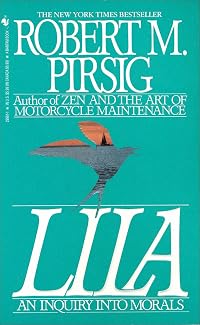
Lila: An Inquiry Into Morals
by Robert M. Pirsig
On This Page
Description
Phaedrus has traded in his motor cycle for a sailboat, his traveling companion, son Chris, for Lila, a woman he met in a bar, and his focus on values for a concentration on morals.Tags
Recommendations





























Member Reviews
This is my favorite book, and somewhat of a personal obsession of mine, so I disagree completely with Arctic-Stranger's review. Lila is in no way a 'postscript' to Zen and the Art of Motorcycle Maintenance (ZAMM). Pirsig almost completely takes back the ideas put forth in that book, apart from the concept of 'undefined Quality'. To quote him:
"Zen and the Art of Motorcycle Maintenance was like a first child. Maybe that will always be the best-loved one. But this second child is the bright one. I think a lot of people will argue with the ideas in Lila. There may be controversy. But if people are still reading these two books a hundred years from now, I predict Lila will be the one they consider the most important."
I read ZAMM when I was show more 15, and loved it, but it has serious flaws, which Pirsig obviously realized himself, over the 18 years it took him to write another book. Although ZAMM is considered by some to be a difficult read, it was a bestseller. Lila is *much* more difficult to appreciate, and if it hadn't been for the popularity of the first book it would have sunk like a stone in the market. Over the years, I have given away numerous copies, and hardly anyone even managed to finish it. There are a number of reasons why this is so, and I want to point out a few.
First, the meat of the philosophical discussion which hangs on the storyline is extremely dense. Pirsig's writing style is very plain, with short sentences, and little ornament. (This fact is actually relevant to some of the ideas he puts forth about how Native Americans speak: "... not like some fancy college professor, but Plains spoken; laconic, understated, very little tonal change..."). As such, it is deceptively simple, and unless the reader is careful, it is easy to skim over the text without understanding it at all. Unfortunately, like reading a book on mathematics, if you haven't grasped the earlier points, you will be completely lost later in the book.
Second, he takes some very unpopular, and even apparently 'politically incorrect' positions regarding sex, culture, and even race. How popular is it at this point in history (except with the religious right) to say that unlimited sexual licence isn't a good idea? Or that black people in America should take responsibility for the lack of moral structures in their culture which leads to crime? Or that there is something to be said for big corporations? It provokes a knee-jerk reaction from the very readership that would pick up a book by Pirsig in the first place, many of whom are expecting a 'feel-good mystical book', and entirely miss the points he makes (which are far from know-nothing social conservatism) because they are intellectually hard to understand. However, if you make the effort to understand his system of metaphysics, you will see that he explains those socio-political conflicts in amazingly novel and enlightening ways!
Third, as a personality, Pirsig is both a 'nerd intellectual' and an 'outsider' par excellence. He found out as an adult that he had been 'tracked' by an IQ research program because he scored 170 at the age of 9 on the Stanford-Binet test. (See this interesting biographical site: http://www.psybertron.org/timeline.html). He discusses the case of James Sidis, who had the highest recorded IQ in history, at length in the book. He makes the case that intellect has a certain 'disgust' towards society and it's values. Sounds like a sympathetic character to the warm and fuzzy new-age types, right?! But wait, there's more. You would think he might get a sympathetic hearing from the academics, but no, he takes pains to criticize them relentlessly, and all the 'philosophologists' who teach philosophy! If that wasn't enough, he also talks about the value of psychedelic drugs and parapsychological perceptions, the mere mention of which is well known to destroy academic careers forever. So it's a *sure thing* that Lila won't be admitted to the academy for the forseeable future.
As I think I have demonstrated, there are a host of reasons why Lila has never been a popular book - except among a few who 'get it'. Its 'unread' tag here is quite *unsurprisingly* large!! The question that the book hangs on is 'Does Lila (the female character in the book) have Quality'? The question here is 'Does Lila (the book) have Quality?' Obviously, many people don't think so. However, it has spawned an enthusiastic community of admirers, and even a collaborative book, published with Pirsig's approval. The website is here: www.moq.org .
So, does Lila have Quality? I've been telling people since I first read it that it's one of the most important books written in the 20th century, and may not be widely appreciated for another hundred years.
Read it. Not once, not twice, but several times. It'll change your world, if you let it........... show less
"Zen and the Art of Motorcycle Maintenance was like a first child. Maybe that will always be the best-loved one. But this second child is the bright one. I think a lot of people will argue with the ideas in Lila. There may be controversy. But if people are still reading these two books a hundred years from now, I predict Lila will be the one they consider the most important."
I read ZAMM when I was show more 15, and loved it, but it has serious flaws, which Pirsig obviously realized himself, over the 18 years it took him to write another book. Although ZAMM is considered by some to be a difficult read, it was a bestseller. Lila is *much* more difficult to appreciate, and if it hadn't been for the popularity of the first book it would have sunk like a stone in the market. Over the years, I have given away numerous copies, and hardly anyone even managed to finish it. There are a number of reasons why this is so, and I want to point out a few.
First, the meat of the philosophical discussion which hangs on the storyline is extremely dense. Pirsig's writing style is very plain, with short sentences, and little ornament. (This fact is actually relevant to some of the ideas he puts forth about how Native Americans speak: "... not like some fancy college professor, but Plains spoken; laconic, understated, very little tonal change..."). As such, it is deceptively simple, and unless the reader is careful, it is easy to skim over the text without understanding it at all. Unfortunately, like reading a book on mathematics, if you haven't grasped the earlier points, you will be completely lost later in the book.
Second, he takes some very unpopular, and even apparently 'politically incorrect' positions regarding sex, culture, and even race. How popular is it at this point in history (except with the religious right) to say that unlimited sexual licence isn't a good idea? Or that black people in America should take responsibility for the lack of moral structures in their culture which leads to crime? Or that there is something to be said for big corporations? It provokes a knee-jerk reaction from the very readership that would pick up a book by Pirsig in the first place, many of whom are expecting a 'feel-good mystical book', and entirely miss the points he makes (which are far from know-nothing social conservatism) because they are intellectually hard to understand. However, if you make the effort to understand his system of metaphysics, you will see that he explains those socio-political conflicts in amazingly novel and enlightening ways!
Third, as a personality, Pirsig is both a 'nerd intellectual' and an 'outsider' par excellence. He found out as an adult that he had been 'tracked' by an IQ research program because he scored 170 at the age of 9 on the Stanford-Binet test. (See this interesting biographical site: http://www.psybertron.org/timeline.html). He discusses the case of James Sidis, who had the highest recorded IQ in history, at length in the book. He makes the case that intellect has a certain 'disgust' towards society and it's values. Sounds like a sympathetic character to the warm and fuzzy new-age types, right?! But wait, there's more. You would think he might get a sympathetic hearing from the academics, but no, he takes pains to criticize them relentlessly, and all the 'philosophologists' who teach philosophy! If that wasn't enough, he also talks about the value of psychedelic drugs and parapsychological perceptions, the mere mention of which is well known to destroy academic careers forever. So it's a *sure thing* that Lila won't be admitted to the academy for the forseeable future.
As I think I have demonstrated, there are a host of reasons why Lila has never been a popular book - except among a few who 'get it'. Its 'unread' tag here is quite *unsurprisingly* large!! The question that the book hangs on is 'Does Lila (the female character in the book) have Quality'? The question here is 'Does Lila (the book) have Quality?' Obviously, many people don't think so. However, it has spawned an enthusiastic community of admirers, and even a collaborative book, published with Pirsig's approval. The website is here: www.moq.org .
So, does Lila have Quality? I've been telling people since I first read it that it's one of the most important books written in the 20th century, and may not be widely appreciated for another hundred years.
Read it. Not once, not twice, but several times. It'll change your world, if you let it........... show less
In societies that criminalize rather than attempt to understand mental illness, artists and philosophers may be the first to have the guts to discuss the topic 'publicly' or sympathetically. Such societies may first approach understanding mental illness through art rather than through education, medicine or philanthropy, let alone helpful 'treatment'.
For women w/mental illness, societal support toward a true understanding of mental health may be even slower coming than for men, if a male perspective is the society's metric for truth/sanity women's experience will always be a bit aberrant/suspect.
Pirsig differentiates Lila's madness from Phædrus' in his first book and proposes a new way forward.
In [b:Zen and the Art of Motorcycle show more Maintenance: An Inquiry Into Values|629|Zen and the Art of Motorcycle Maintenance An Inquiry Into Values|Robert M. Pirsig|https://d.gr-assets.com/books/1410136019s/629.jpg|175720] the narrator/protagonist, like the author himself, is diagnosed/characterized as schizophrenic and institutionalized. He receives electric shock treatments but the 'treatment' is no "cure" just a means to an end, a way of going back into hiding in plain sight.
Like Pirsig, Phædrus eventually is able to leave institutionalized mental care not because he is cured but because he elects to behave as he expects the staff want a healing patient to behave, by speaking as the staff hope he will etc.
From Lila:
"He saw that the sane always know they are good because their culture tells them so. Anyone who tells them otherwise is sick, paranoid, and needs further treatment. To avoid that accusation Phædrus had had to be very careful of what he said when he was in the hospital. He told the sane what they wanted to hear and kept his real thoughts to himself."
In Lila, as he considers options for ways forward for this female character heading toward insanity, the Phædrus character recalls his own previous non-cure:
"In time this strategy had brought Phædrus enough smiles to get out. It made him less honest and it made him more of a conformist to the current cultural status quo but that is what everyone really wanted. It got him out and back to his family and a job and a place in the world again and this new personality of a conforming, role-playing, ex-mental patient who knew how to do as he was told without protest became a sort of permanent stage personality that he never dropped."
"It wasn't a happy solution, to always role-play with people he had once been honest with. It made it impossible to ever really share anything with them. Now he was more isolated than he had been in the insane asylum but there was nothing he could do about it. "
"Her second alternative, he thought, would be to cave in to whatever it was she was fighting, and learn to "adjust." She'd probably go into some kind of cultural dependency, with recurring trips to a psychiatrist or some kind of "social counselor" for "therapy," accept the cultural "reality" that her rebellion was no good, and live with it. In this way she'd continue to lead a "normal" life, continuing her problem, whatever it was, within conventional cultural limits."
"The trouble was, he didn't really like that solution much better than the first."
"And Lila's battle is everybody's battle, you know? Sometimes the insane and the contrarians and the ones who are the closest to suicide are the most valuable people society has. They may be precursors of social change. They've taken the burdens of the culture onto themselves, and in their struggle to solve their own problems they're solving problems for the culture as well."
Pirsig posits that a new way of conceptualizing mental health is necessary: "The way to really deal with insanity, he thought, is to turn the tables and talk about truth instead. Insanity's a medical subject that everyone agrees is bad. Truth's a metaphysical subject that everyone disagrees about. There are lots of different definitions of truth and some of them could throw a whole lot more light on what was happening to Lila than a subject—object metaphysics does."
He goes on to argue that "The Metaphysics of Quality suggests that in addition to the customary solutions to insanity—conform to cultural patterns or stay locked up—there is another one. This solution is to dissolve all static patterns, both sane and insane, and find the base of reality, Dynamic Quality, that is independent of all of them".
This notion of Dynamic Quality -Pirsig's consideration and definition of the concept is where [b:Lila: An Inquiry Into Morals|31093|Lila An Inquiry Into Morals|Robert M. Pirsig|https://d.gr-assets.com/books/1346459192s/31093.jpg|2374212] purports to take the reader . . . now 25? years later in an era when discussions of mental health are more likely to be about insurance coverage, access, and Rx's rather than talk therapy, when only the rich or the convicted criminal are likely to find themselves in an institution unless they're there for addiction how does Lila read? Does Pirsig's way forward still look like a door people are likely to open? show less
For women w/mental illness, societal support toward a true understanding of mental health may be even slower coming than for men, if a male perspective is the society's metric for truth/sanity women's experience will always be a bit aberrant/suspect.
Pirsig differentiates Lila's madness from Phædrus' in his first book and proposes a new way forward.
In [b:Zen and the Art of Motorcycle show more Maintenance: An Inquiry Into Values|629|Zen and the Art of Motorcycle Maintenance An Inquiry Into Values|Robert M. Pirsig|https://d.gr-assets.com/books/1410136019s/629.jpg|175720] the narrator/protagonist, like the author himself, is diagnosed/characterized as schizophrenic and institutionalized. He receives electric shock treatments but the 'treatment' is no "cure" just a means to an end, a way of going back into hiding in plain sight.
Like Pirsig, Phædrus eventually is able to leave institutionalized mental care not because he is cured but because he elects to behave as he expects the staff want a healing patient to behave, by speaking as the staff hope he will etc.
From Lila:
"He saw that the sane always know they are good because their culture tells them so. Anyone who tells them otherwise is sick, paranoid, and needs further treatment. To avoid that accusation Phædrus had had to be very careful of what he said when he was in the hospital. He told the sane what they wanted to hear and kept his real thoughts to himself."
In Lila, as he considers options for ways forward for this female character heading toward insanity, the Phædrus character recalls his own previous non-cure:
"In time this strategy had brought Phædrus enough smiles to get out. It made him less honest and it made him more of a conformist to the current cultural status quo but that is what everyone really wanted. It got him out and back to his family and a job and a place in the world again and this new personality of a conforming, role-playing, ex-mental patient who knew how to do as he was told without protest became a sort of permanent stage personality that he never dropped."
"It wasn't a happy solution, to always role-play with people he had once been honest with. It made it impossible to ever really share anything with them. Now he was more isolated than he had been in the insane asylum but there was nothing he could do about it. "
"Her second alternative, he thought, would be to cave in to whatever it was she was fighting, and learn to "adjust." She'd probably go into some kind of cultural dependency, with recurring trips to a psychiatrist or some kind of "social counselor" for "therapy," accept the cultural "reality" that her rebellion was no good, and live with it. In this way she'd continue to lead a "normal" life, continuing her problem, whatever it was, within conventional cultural limits."
"The trouble was, he didn't really like that solution much better than the first."
"And Lila's battle is everybody's battle, you know? Sometimes the insane and the contrarians and the ones who are the closest to suicide are the most valuable people society has. They may be precursors of social change. They've taken the burdens of the culture onto themselves, and in their struggle to solve their own problems they're solving problems for the culture as well."
Pirsig posits that a new way of conceptualizing mental health is necessary: "The way to really deal with insanity, he thought, is to turn the tables and talk about truth instead. Insanity's a medical subject that everyone agrees is bad. Truth's a metaphysical subject that everyone disagrees about. There are lots of different definitions of truth and some of them could throw a whole lot more light on what was happening to Lila than a subject—object metaphysics does."
He goes on to argue that "The Metaphysics of Quality suggests that in addition to the customary solutions to insanity—conform to cultural patterns or stay locked up—there is another one. This solution is to dissolve all static patterns, both sane and insane, and find the base of reality, Dynamic Quality, that is independent of all of them".
This notion of Dynamic Quality -Pirsig's consideration and definition of the concept is where [b:Lila: An Inquiry Into Morals|31093|Lila An Inquiry Into Morals|Robert M. Pirsig|https://d.gr-assets.com/books/1346459192s/31093.jpg|2374212] purports to take the reader . . . now 25? years later in an era when discussions of mental health are more likely to be about insurance coverage, access, and Rx's rather than talk therapy, when only the rich or the convicted criminal are likely to find themselves in an institution unless they're there for addiction how does Lila read? Does Pirsig's way forward still look like a door people are likely to open? show less
Robert Pirsig's previous book ZEN AND THE ART OF MOTORCYCLE MAINTENANCE is a profoundly influential book in my own life. I have probably given copies of it as gifts to more people than any other book except my own. It is a powerful examination of the meaning of life in a pseudo-novelistic framework that makes the philosophical explorations both more palatable and more understandable. Pirsig's sequel, LILA, is an attempt to follow up and expand on the discoveries of the first book. While it is not an unsuccessful book, it is in large far less compelling, far less easily understood, and far less magical than ZEN.... The philosophy Pirsig explores is deeply complex and intricate, something that the first book managed to overcome. In LILA, show more there is some very rough slogging. The novelistic approach, in which the philosophy is presented as it bears on a presumably fictional story of a mentally ill young woman who falls into the company of the author's alter ego, Phaedrus, on a boat journey down the Hudson River. But only in the latter stages of this book does that story become fascinating, and in the meantime a great deal of effort must be made by minds no more advanced than mine to parse and come to grips with the ruminations on Pirsig's ideas about the Metaphysics of Quality. Pirsig wants to create a new understanding of morality, of good, and his arguments are often convincing, if confusing. Occasionally, some of his insights are riveting, as when he explains the real meaning and ramifications of Victorian morality. But for all its intelligence and eloquence, I fear this will be something of a disappointment to all but the most intellectual fans of ZEN AND THE ART OF MOTORCYCLE MAINTENANCE, which, still, 30 years after I first read it, is one of the most meaningful books in my life. show less
Re-read 3/11/13:
I got a strange urge to re-read this book as I've been delving into some interesting social criticism of late (Chomsky's [b:Necessary Illusions|848628|Necessary Illusions Thought Control in Democratic Societies|Noam Chomsky|http://d.gr-assets.com/books/1348036055s/848628.jpg|865795] being the most mind-blowing). In picking it up again, I realize just how much of my present-day outlook was shaped by Pirsig's ideas. Granted, I was very impressionable toward the close of my college career, but it's alternately shocking, worrying and reassuring to remember just how much I assimilated his fascinating Metaphysics of Quality as presented here. That said, I changed my original 5-star rating to 4 stars because I was able to read show more it with a more critical eye almost 10 years later, and I found the writing occasionally stilted and self-congratulatory, more often the latter than the former.
Pirsig's first major philosophical step in this book is to separate his Quality (as sort of not-defined in [b:Zen and the Art of Motorcycle Maintenance|629|Zen and the Art of Motorcycle Maintenance An Inquiry Into Values|Robert M. Pirsig|http://d.gr-assets.com/books/1349023774s/629.jpg|175720]) into two types of Quality: static and dynamic. With this basic division of reality he aims to supplant the more-traditional-though now-fairly-outdated separation of reality into subject and object (or mind and matter). Thus his two forms of Quality either take the shape of static, traditional patterns of moral value or of dynamic, immediate, nirvana-like perception of pure Reality.
One of the best illustrations he uses to explain this division is in listening to a great new song. The first time you hear it you are blown away by the newness, every note seems earth-shattering, and you can't get enough of it. Gradually, however, that feeling wears away, and though you still recognize the song as "good" it's not likely to make you drop everything just to listen to it, to hang on every note. Dynamic is new and exciting, static is oldie-but-goodie. Pirsig eventually explains how each type of Quality depends on the other, and how one of them without the other will quickly lead to disaster -- wild degeneracy in the case of the former, and stale, suffocating rot in the case of the latter.
Besides this interesting and useful division, the two main ideas I took away when I originally read it (and the two that continue to seem to be the most important ideas of his MoQ) are difficult to separate from one another. First you have the idea of purpose- or goal-driven evolution, which is anathema to most biologists. Coupled very closely with this idea of intentional evolution is Pirsig's separation of levels of organization into four different systems: inorganic, biological, social, and intellectual.
What this means essentially is that when inorganic particles and elements originally combined to make organic compounds, this was an evolution toward Value or Quality, or in other words a moral movement. Eventually these inorganic compounds, through the initiative of Dynamic Quality, organized to a higher level of evolution and formed a biological organism. Eventually biological organisms, likewise inspired by Dynamic Quality or "moral" movement toward higher Quality, organized to form societies. And similarly, societies eventually evolved in the direction of Dynamic Quality and created intellectual patterns of thought, reason, and logic, by which we can analyze and govern our lives.
This idea really gets interesting when Pirsig discusses how all of these levels of Quality are actually in conflict with each other. This is because once a new level of organization is created on top of an old one, that new level, while dependent on the effective aspiration toward Quality of the level beneath it, will have its own goals and aims that are not necessarily in line with its foundation. In this way, a virus will have conflicting motives with a biological organism, and an organism can be in conflict with the greater good of society. Perhaps most applicably, an individual's ideas can be in conflict with society pressures.
Here, Pirsig proposes and (IMO) pulls off a neat trick by looking at these conflicts through the lens of morality. Because he has already proposed the division of Quality and because he has already explained how Quality has evolved from a very low level to a very high level, and continues to evolve, he can now say that any time the lower levels of Quality impinge on the higher levels of Quality, that is an immoral act. Thus he can philosophically explain why it is immoral that someone abuses drugs to the point that they must steal from or injure others in society, and why it was immoral for society to persecute Galileo and Copernicus.
This system also explains why laws that inhibit individuals from indulging in their unfettered biological impulses are moral. If you look at those impulses from the perspective of biology, they are completely moral because they feel good. However, from the perspective of society they are dangerous and degenerate. . . it is moral for a higher evolutionary system to judge that those impulses must be kept in check. Of course, a still-higher evolutionary system (that of the intellect) can then later develop and notice that, "Hey, society is unreasonably and unfairly suppressing certain biological values (for example, premarital sex and marijuana use), and we should really rethink that." That's when you will get a battle between the intellectual and societal notion of value. That is the stage that we have been struggling with for most of the 20th and 21st centuries.
There's a lot of different ways you can go with this, and Pirsig goes in a lot of them. That's part of the drawback to the writing, how disperse it is and how daunting the entire system ends up seeming (although it is quite easy to understand in the way he explains it). Around this part of the book it seemed to me that the system he had developed begged the question of what sort of level of organization may lie beyond the intellectual pattern of value. This question never seems to occur to Pirsig, who sticks with his four levels plus the highest good of all: Dynamic Quality.
I haven't studied enough philosophy to know how new these ideas are. Pirsig seems to give a lot of credit to William James for developing a similar framework. When I explained it to my philosopher wife she said it sounded like Hegel and didn't sound too impressed. She also cautioned that any time you have someone setting up an absolute morality or objective Truth or Value, you encounter a dangerous arrogance that threatens to overwhelm any culture that doesn't buy into the paradigm. Specifically in this case, despite Pirsig's cautioning against the over-reliance on rationality and science, his system is still one that is very much grounded in the Western paradigm of reason/logic/rationality. He admits as much.
Without being a cultural relativist, you can acknowledge how dangerous it might be to invalidate any non-rational way of perceiving truth. . . mysticism, for example, or the shamanistic rites of certain non-Westernized tribes. I could be wrong, but it seems like Pirsig would have to say that those societies are less moral because they don't perceive Truth intellectually. . . they still operate completely in the social level of value. I actually argued about this with my wife, because I happen to agree with that statement. In my own view of the evolution of consciousness, or enlightenment, or whatever, I think it is necessary to pass through rational thought and analysis -- to know the extreme, as it were -- before you can truly know what it's like to reject that extreme and embrace the mystical nature of the universe. My wife, on the other hand, pretty much thinks I'm a chauvinist.
Anyway, this is getting way too long. I will say that Pirsig's book has greatly informed my own outlook on life. Additionally, this go-round I was really able to appreciate how he weaved his philosophy into the narrative. The first time I read it I didn't notice the meta-book in here, how Pirsig explains to us how he's struggling to organize these thoughts and then divulges the thoughts at the same time he's looking at the "slips" that he's trying to organize. Another example occurs in the end, when he talks about how he must remember to tie his book back into the Native-Americans (of course just be mentioning them in the reminder he is doing that). It's pretty ingenious.
Additionally, the creation of the character of Lila and Rigel was a nifty way to illustrate several of the more obscure ideas in his metaphysics. The way he describes Lila's detour into insanity is captivating and totally organic. If you think about it you will perhaps find yourself in the strange position of feeling lucky that Pirsig himself went crazy so that he is able to explain it so authentically. The fact that the narrative drags at points as he tries to cram a lot of tangential information into the story does not detract from the overall seamless way that he weaves it all together.
It's an impressive achievement, and I wish Pirsig had more mainstream recognition. Despite the book not being as perfect as I remember, I am glad to say that most of the impressive points he makes still seem to hold up. My opinion of Pirsig as one of the most refreshing and innovative thinkers in recent history is corroborated. I highly recommend both this and Zen. show less
I got a strange urge to re-read this book as I've been delving into some interesting social criticism of late (Chomsky's [b:Necessary Illusions|848628|Necessary Illusions Thought Control in Democratic Societies|Noam Chomsky|http://d.gr-assets.com/books/1348036055s/848628.jpg|865795] being the most mind-blowing). In picking it up again, I realize just how much of my present-day outlook was shaped by Pirsig's ideas. Granted, I was very impressionable toward the close of my college career, but it's alternately shocking, worrying and reassuring to remember just how much I assimilated his fascinating Metaphysics of Quality as presented here. That said, I changed my original 5-star rating to 4 stars because I was able to read show more it with a more critical eye almost 10 years later, and I found the writing occasionally stilted and self-congratulatory, more often the latter than the former.
Pirsig's first major philosophical step in this book is to separate his Quality (as sort of not-defined in [b:Zen and the Art of Motorcycle Maintenance|629|Zen and the Art of Motorcycle Maintenance An Inquiry Into Values|Robert M. Pirsig|http://d.gr-assets.com/books/1349023774s/629.jpg|175720]) into two types of Quality: static and dynamic. With this basic division of reality he aims to supplant the more-traditional-though now-fairly-outdated separation of reality into subject and object (or mind and matter). Thus his two forms of Quality either take the shape of static, traditional patterns of moral value or of dynamic, immediate, nirvana-like perception of pure Reality.
One of the best illustrations he uses to explain this division is in listening to a great new song. The first time you hear it you are blown away by the newness, every note seems earth-shattering, and you can't get enough of it. Gradually, however, that feeling wears away, and though you still recognize the song as "good" it's not likely to make you drop everything just to listen to it, to hang on every note. Dynamic is new and exciting, static is oldie-but-goodie. Pirsig eventually explains how each type of Quality depends on the other, and how one of them without the other will quickly lead to disaster -- wild degeneracy in the case of the former, and stale, suffocating rot in the case of the latter.
Besides this interesting and useful division, the two main ideas I took away when I originally read it (and the two that continue to seem to be the most important ideas of his MoQ) are difficult to separate from one another. First you have the idea of purpose- or goal-driven evolution, which is anathema to most biologists. Coupled very closely with this idea of intentional evolution is Pirsig's separation of levels of organization into four different systems: inorganic, biological, social, and intellectual.
What this means essentially is that when inorganic particles and elements originally combined to make organic compounds, this was an evolution toward Value or Quality, or in other words a moral movement. Eventually these inorganic compounds, through the initiative of Dynamic Quality, organized to a higher level of evolution and formed a biological organism. Eventually biological organisms, likewise inspired by Dynamic Quality or "moral" movement toward higher Quality, organized to form societies. And similarly, societies eventually evolved in the direction of Dynamic Quality and created intellectual patterns of thought, reason, and logic, by which we can analyze and govern our lives.
This idea really gets interesting when Pirsig discusses how all of these levels of Quality are actually in conflict with each other. This is because once a new level of organization is created on top of an old one, that new level, while dependent on the effective aspiration toward Quality of the level beneath it, will have its own goals and aims that are not necessarily in line with its foundation. In this way, a virus will have conflicting motives with a biological organism, and an organism can be in conflict with the greater good of society. Perhaps most applicably, an individual's ideas can be in conflict with society pressures.
Here, Pirsig proposes and (IMO) pulls off a neat trick by looking at these conflicts through the lens of morality. Because he has already proposed the division of Quality and because he has already explained how Quality has evolved from a very low level to a very high level, and continues to evolve, he can now say that any time the lower levels of Quality impinge on the higher levels of Quality, that is an immoral act. Thus he can philosophically explain why it is immoral that someone abuses drugs to the point that they must steal from or injure others in society, and why it was immoral for society to persecute Galileo and Copernicus.
This system also explains why laws that inhibit individuals from indulging in their unfettered biological impulses are moral. If you look at those impulses from the perspective of biology, they are completely moral because they feel good. However, from the perspective of society they are dangerous and degenerate. . . it is moral for a higher evolutionary system to judge that those impulses must be kept in check. Of course, a still-higher evolutionary system (that of the intellect) can then later develop and notice that, "Hey, society is unreasonably and unfairly suppressing certain biological values (for example, premarital sex and marijuana use), and we should really rethink that." That's when you will get a battle between the intellectual and societal notion of value. That is the stage that we have been struggling with for most of the 20th and 21st centuries.
There's a lot of different ways you can go with this, and Pirsig goes in a lot of them. That's part of the drawback to the writing, how disperse it is and how daunting the entire system ends up seeming (although it is quite easy to understand in the way he explains it). Around this part of the book it seemed to me that the system he had developed begged the question of what sort of level of organization may lie beyond the intellectual pattern of value. This question never seems to occur to Pirsig, who sticks with his four levels plus the highest good of all: Dynamic Quality.
I haven't studied enough philosophy to know how new these ideas are. Pirsig seems to give a lot of credit to William James for developing a similar framework. When I explained it to my philosopher wife she said it sounded like Hegel and didn't sound too impressed. She also cautioned that any time you have someone setting up an absolute morality or objective Truth or Value, you encounter a dangerous arrogance that threatens to overwhelm any culture that doesn't buy into the paradigm. Specifically in this case, despite Pirsig's cautioning against the over-reliance on rationality and science, his system is still one that is very much grounded in the Western paradigm of reason/logic/rationality. He admits as much.
Without being a cultural relativist, you can acknowledge how dangerous it might be to invalidate any non-rational way of perceiving truth. . . mysticism, for example, or the shamanistic rites of certain non-Westernized tribes. I could be wrong, but it seems like Pirsig would have to say that those societies are less moral because they don't perceive Truth intellectually. . . they still operate completely in the social level of value. I actually argued about this with my wife, because I happen to agree with that statement. In my own view of the evolution of consciousness, or enlightenment, or whatever, I think it is necessary to pass through rational thought and analysis -- to know the extreme, as it were -- before you can truly know what it's like to reject that extreme and embrace the mystical nature of the universe. My wife, on the other hand, pretty much thinks I'm a chauvinist.
Anyway, this is getting way too long. I will say that Pirsig's book has greatly informed my own outlook on life. Additionally, this go-round I was really able to appreciate how he weaved his philosophy into the narrative. The first time I read it I didn't notice the meta-book in here, how Pirsig explains to us how he's struggling to organize these thoughts and then divulges the thoughts at the same time he's looking at the "slips" that he's trying to organize. Another example occurs in the end, when he talks about how he must remember to tie his book back into the Native-Americans (of course just be mentioning them in the reminder he is doing that). It's pretty ingenious.
Additionally, the creation of the character of Lila and Rigel was a nifty way to illustrate several of the more obscure ideas in his metaphysics. The way he describes Lila's detour into insanity is captivating and totally organic. If you think about it you will perhaps find yourself in the strange position of feeling lucky that Pirsig himself went crazy so that he is able to explain it so authentically. The fact that the narrative drags at points as he tries to cram a lot of tangential information into the story does not detract from the overall seamless way that he weaves it all together.
It's an impressive achievement, and I wish Pirsig had more mainstream recognition. Despite the book not being as perfect as I remember, I am glad to say that most of the impressive points he makes still seem to hold up. My opinion of Pirsig as one of the most refreshing and innovative thinkers in recent history is corroborated. I highly recommend both this and Zen. show less
I preferred this over the prequel Zen and the Art of Motorcycle Maintenance. I found the storyline in between the philosophy much more interesting and thus made the philosophy much more relatable and interesting. I felt Phaedrus was more himself and more relatable as he had found a way to live and think as himself while bring accepted in society more than his previous character. This made him relatable. Definitely a book a would recommend to anyone interested in analyzing themselves or the world around them
I took quite some time to get into this book. I found the story of Lila itself quite intriguing, and while I wish he had gotten deeper into the story, maybe it is best that he left it that way.
For the first half of the book, I must say that I was not quite taken up by the musings of Robert Pirsig. They came to life, for me, in the second half of the book. This is when I thought that he had started to get into the whole topic of morality in a most remarkable manner.
I think he is a bit confused by Hindu-Vedic thought, in the sense that Vedic philosophy preceded Hindu philosophy in India. However, maybe he just used the term 'Hindu' loosely to avoid confusing readers. If so, this would be sad.
A good book indeed, however. It is quite show more deep, and one needs to read it slowly. It would be advisable to read a few passages several times, to allow them to sink in.
For me, however, 'Zen & The Art of Motorcycle Maintenance' is still his masterpiece. show less
For the first half of the book, I must say that I was not quite taken up by the musings of Robert Pirsig. They came to life, for me, in the second half of the book. This is when I thought that he had started to get into the whole topic of morality in a most remarkable manner.
I think he is a bit confused by Hindu-Vedic thought, in the sense that Vedic philosophy preceded Hindu philosophy in India. However, maybe he just used the term 'Hindu' loosely to avoid confusing readers. If so, this would be sad.
A good book indeed, however. It is quite show more deep, and one needs to read it slowly. It would be advisable to read a few passages several times, to allow them to sink in.
For me, however, 'Zen & The Art of Motorcycle Maintenance' is still his masterpiece. show less
Seventeen years after the publication of his still-popular road story/philosophical meditation, Zen and the Art of Motorcycle Maintenance , Pirsig offers another lengthy and absorbing investigation of how we can live well and rightly. Phaedrus, the one-named narrator "who had written a whole book on values," is sailing down the Hudson River when he meets Lila Blewitt, an unapologetically sexual, psychologically unstable woman whom a mutual friend warns him against. But Phaedrus is drawn to her physically and interested in her intellectually, finding her "a culture of one" in whom he discerns an unexpected "Quality." Sailing with him to Manhattan, where her mental state deteriorates further, Lila prompts Phaedrus to explore conflicts of show more values like those between Native Americans and Europeans or between the insane and the normal. Finally, after years of struggling, he formulates his "Metaphysics of Quality" which offers a system of understanding--and evaluating--actions according to a hierarchy of four evolutionary realms (natural, biological, social and intellectual). Though Lila's fate is left unresolved, Pirsig's wide-ranging philosophical explorations will provoke and engage readers. show less
Members
- Recently Added By
Lists

Tonikat reading completed on Librarything journals
329 works; 2 members

Pulitzer Prize for Fiction - Finalists
88 works; 9 members
Author Information

10+ Works 23,149 Members
Robert Maynard Pirsig was born in Minneapolis, Minnesota on September 6, 1928. While serving in the Army, he visited Japan on a leave and became interested in Zen Buddhism. After his service, he received bachelor's and master's degrees in journalism from the University of Minnesota. He later studied philosophy at the University of Chicago and at show more Banaras Hindu University in India. He taught writing at Montana State University in Bozeman and the University of Illinois at Chicago. He was also a freelance writer and editor for corporate publications and technical magazines. His first novel, Zen and the Art of Motorcycle Maintenance: An Inquiry Into Values, was published in 1974. His follow-up novel, Lila: An Inquiry Into Morals, was published in 1991. He died on April 24, 2017 at the age of 88. (Bowker Author Biography) show less
Some Editions
Awards and Honors
Distinctions
Series
Belongs to Publisher Series
Phaedrus (2)
Work Relationships
Common Knowledge
- Canonical title*
- Lila
- Original title
- Lila: An Inquiry Into Morals
- Alternate titles*
- Lila : een onderzoek naar zeden
- Original publication date
- 1991
- Dedication
- To Wendy and Nell
- First words
- Lila didn't know he was here.
- Quotations
- Getting drunk and picking up bar-ladies and writing metaphyisics is a part of life.
'In de metafysica van de Kwali¬teit doet zich dit dilemma (tussen vrije wil en determinisme-JV) niet voor. Voor zover iemands gedrag wordt beheerst door statische kwali-teitspatronen, is er geen sprake van keuzen. Maar voor ... (show all)zover men Dynamische Kwaliteit nastreeft, en die is onde¬finieerbaar, is het gedrag vrij.'(p.¬170)
'Je kunt je van statische patronen bevrijden door ze in slaap te sussen. Dat wil zeggen, dat je ze zo voortreffelijk beheerst dat ze een onbewust onderdeel van je natuur worden. Je raakt er zo aan gewend dat je ze volslagen v... (show all)ergeet en dan zijn ze weg. In het middelpunt van de grootste saaiheid van statische ritualistische patronen kan de Dynamische vrijheid worden gevon¬den.'(p.414) - Last words
- (Click to show. Warning: May contain spoilers.)Of course, the ultimate Quality isn't a noun or an adjective or anything else definable, but if you had to reduce the whole Metaphysics of Quality to a single sentence, that would be it.
- Original language
- English
*Some information comes from Common Knowledge in other languages. Click "Edit" for more information.
Classifications
Statistics
- Members
- 2,351
- Popularity
- 8,375
- Reviews
- 28
- Rating
- (3.60)
- Languages
- 13 — Czech, Danish, Dutch, English, Finnish, French, German, Hungarian, Italian, Spanish, Swedish, Turkish, Portuguese (Portugal)
- Media
- Paper, Audiobook, Ebook
- ISBNs
- 35
- ASINs
- 13