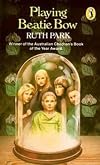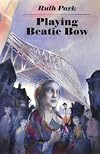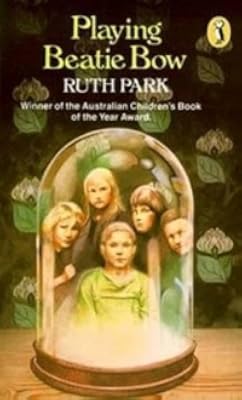
Playing Beatie Bow
by Ruth Park
On This Page
Description
A lonely Australian girl from a divided family is transported back to the 1880's and an immigrant family from the Orkney Islands.Tags
Recommendations



















Member Recommendations

Member Reviews
There is something delightful about this novel, that just makes you want to fold yourself into the pages. For Playing Beatie Bow, enables the reader to escape into a world that is both harsh and wonderous. Abigail is a wilful, opinionated teenager who is angry at her father for leaving the 4 years ago and angry at her mother as she wants to reconcile. Abigail also just does not fit into the Australian school norms all the girls are talking boys and she has her head in a book. One day she takes Netty, the young girl next door at the park and they both see a strange girl hanging on the edge of the playground. When Abigail next confronts her, they girl races off and she follows. That takes Abigail back in time and on a journey where you show more see the harshness of living in early Australia and the huge amount of kindness that existed.
Park is able to draw you so easily into the world and all the characters are realistic as they are flawed. One moment you pray they will do right and the next you smack your head in frustration. It is an Australian classic, and deservedly so. Read this book and be truly transported. show less
Park is able to draw you so easily into the world and all the characters are realistic as they are flawed. One moment you pray they will do right and the next you smack your head in frustration. It is an Australian classic, and deservedly so. Read this book and be truly transported. show less
I loved this book almost as much as the previous Ruth Park I read (Pink Flannel). Playing Beatie Bow works on several levels. First, it offers great entertainment just for the plot: Abigail, 14, a contemporary Sydney resident, travels in time back to 1873. There she becomes entwined in the life of a family from the Orkney Islands. Second, it is a coming-of-age novel that adults can enjoy as much as the target juvenile/YA audience. Abigail grows both physically and emotionally over the course of the story. Third, Abigail's thoughtful reflections on the differences in past and contemporary Sydney, both socially and physically, are fascinating.
An Australian YA book from the 80's, this was a RL book club read. Though not science-fiction so much as historical time-travel, the book feels akin to the Australian equivalent of A Wrinkle in Time.
Abigail is an unhappy 14 year old, bitter and bratty after her parents' separation. She spends time with her next-door neighbour, Justine, helping her out by taking Justine's two kids to the playground, where the youngest, Natalie, likes to watch the other kids play a game called 'Beatie Bow'; a cross between Bloody Mary and tag. Natalie and Abigail notice another child that only watches, the 'furry girl' that stands in the shadows. One day, Abigail sees the girl and approaches her, then gives chase as the girl runs away. As she runs down show more the street, she suddenly finds herself in 1873, stuck there until she helps the furry girl, who turns out to be Beatie Bow, and her family figure out how to save the family 'Gift'.
More than a few of my friends here consider this a beloved classic, so imagine my chagrin when I showed up to book club and had to admit I didn't like it. Fortunately, I wasn't alone. The book has a lot going for it: the writing is beautiful, the setting evocative; Park puts you in Sydney in 1873, and let me tell you, it's filthy. Park won the Australian Book of the Year Award in 1981 and it was well deserved.
But...I don't like time travel books, I'm not a fan of the dark edge so prevalent in even Australian YA, and most unfortunate of all, I didn't like a single character in this book. Abigail was a spoiled, whiney, brat; Beattie Bow was too ornery to be considered charming and the rest didn't get enough page time to be anything other that friendly shadows. Abigail's first love was just too trite; I couldn't buy it, it was all too neat and pat (although to be fair, I might have totally bought it when I was 12).
The book is a worthy read, I just wasn't the right audience for it. show less
Abigail is an unhappy 14 year old, bitter and bratty after her parents' separation. She spends time with her next-door neighbour, Justine, helping her out by taking Justine's two kids to the playground, where the youngest, Natalie, likes to watch the other kids play a game called 'Beatie Bow'; a cross between Bloody Mary and tag. Natalie and Abigail notice another child that only watches, the 'furry girl' that stands in the shadows. One day, Abigail sees the girl and approaches her, then gives chase as the girl runs away. As she runs down show more the street, she suddenly finds herself in 1873, stuck there until she helps the furry girl, who turns out to be Beatie Bow, and her family figure out how to save the family 'Gift'.
More than a few of my friends here consider this a beloved classic, so imagine my chagrin when I showed up to book club and had to admit I didn't like it. Fortunately, I wasn't alone. The book has a lot going for it: the writing is beautiful, the setting evocative; Park puts you in Sydney in 1873, and let me tell you, it's filthy. Park won the Australian Book of the Year Award in 1981 and it was well deserved.
But...I don't like time travel books, I'm not a fan of the dark edge so prevalent in even Australian YA, and most unfortunate of all, I didn't like a single character in this book. Abigail was a spoiled, whiney, brat; Beattie Bow was too ornery to be considered charming and the rest didn't get enough page time to be anything other that friendly shadows. Abigail's first love was just too trite; I couldn't buy it, it was all too neat and pat (although to be fair, I might have totally bought it when I was 12).
The book is a worthy read, I just wasn't the right audience for it. show less
I will forever remember the moment I first encountered this book. After a particularly mundane school day I plonked myself down in the backseat of our car and prepared for the drive home. However, instead of starting the engine my mother turned around and said, "I've got a small surprise for you. I was at a bookshop today and thought you might enjoy this." She then proceeded to hand me a copy of Playing Beatie Bow. Getting a book as a surprise gift truly made my day, I was almost giddy with anticipation to read it. I was nine years old, and although I liked it, I don't think I really understood it all.
Reading it as an adult I have a completely different appreciation of it.
I found it to be an easy, quick read. The events unfolded much show more faster given that my grown up brain was able to digest the themes of supernatural time travel, period English language, brothels and complicated emotional feelings much easier.
I still like Abigail and still found Beatie to be a little brat. The story moved at a quick pace and changed enough to keep you interested. I also appreciated the ending despite it's sappiness and that it 'tied everything up neatly'.
Upon re-reading I'm not sure I would give it to a 9 year old to read as it does peek into somewhat adult themes, but then again those themes flew right over my head back then and I loved the book. show less
Reading it as an adult I have a completely different appreciation of it.
I found it to be an easy, quick read. The events unfolded much show more faster given that my grown up brain was able to digest the themes of supernatural time travel, period English language, brothels and complicated emotional feelings much easier.
I still like Abigail and still found Beatie to be a little brat. The story moved at a quick pace and changed enough to keep you interested. I also appreciated the ending despite it's sappiness and that it 'tied everything up neatly'.
Upon re-reading I'm not sure I would give it to a 9 year old to read as it does peek into somewhat adult themes, but then again those themes flew right over my head back then and I loved the book. show less
Ruth Park is one of those authors I'm embarrassed not to have read before. I've known of her for years, since primary school when her novels were very popular, but somehow she didn't make it onto my bookshelves until recently with this Penguin Australia Popular Penguins edition.
What a great story! Although YA-aimed, I found this book eminently readable as a adult. Almost girls-own-adventure-ish, the "boy who doesn't really fit in is actually somebody very special" is in this case a feisty and intelligent 14-year-old girl living in 1980s Sydney who is drawn into a coming-of-age time-travel adventure.
I read compulsively and the 1/2 point off perfection is only because I found some of the plot points a little predictable. Perhaps if I'd show more read this 30 years or so ago things would have seemed less obvious.
Marvellous stuff, and I'll be seeking out more of her writing in the near future. show less
What a great story! Although YA-aimed, I found this book eminently readable as a adult. Almost girls-own-adventure-ish, the "boy who doesn't really fit in is actually somebody very special" is in this case a feisty and intelligent 14-year-old girl living in 1980s Sydney who is drawn into a coming-of-age time-travel adventure.
I read compulsively and the 1/2 point off perfection is only because I found some of the plot points a little predictable. Perhaps if I'd show more read this 30 years or so ago things would have seemed less obvious.
Marvellous stuff, and I'll be seeking out more of her writing in the near future. show less
Abigail is dismayed to learn that her mother and father are contemplating getting back together and moving to another country to make a fresh start. She can’t understand why her mother would agree to take her father back, after he left her mother and the family for a young woman he met at work. Then Abigail suddenly and unexpectedly finds that she has traveled back in time to 1870’s Australia. After befriending people in the earlier time, Abigail is finally able to return to her own time with a deeper understanding of relationships.
The details of life in Australia almost a hundred and fifty years ago were fascinating. The speech patterns author Ruth Park used for her characters from the 1870’s were especially compelling. Though show more the story could have easily been a Sassy-Teen-Learns-Her-Lesson-and-Becomes-Nicer, Park went beyond stereotypes to make her characters nicely flawed and realistic. I enjoyed this first venture into Aussie August a lot. show less
The details of life in Australia almost a hundred and fifty years ago were fascinating. The speech patterns author Ruth Park used for her characters from the 1870’s were especially compelling. Though show more the story could have easily been a Sassy-Teen-Learns-Her-Lesson-and-Becomes-Nicer, Park went beyond stereotypes to make her characters nicely flawed and realistic. I enjoyed this first venture into Aussie August a lot. show less
I was surprised to find that this was a time travel story.
Fourteen year old Abigail lives in an apartment building with her mother, Kathy. She often takes the neighbours young children down to the playground. While watching them play she observes a waif like girl hiding in the shadows. One day she decides to follow this girl and suddenly finds herself in a strange but familiar location, the streets surrounding her home, but the year is 1873. She is taken in by the girl’s family as she has sprained her ankle and ends up trapped there for months until she is assisted back to the future. After being away from her parents and the comforts of modern day life she is now happy to fall in with their future plans.
I think this book is aimed at show more children and young adults. It was a fairly simple and predictable storyline which created vivid images of family life on The Rocks in Sydney in the late nineteenth century.
I found this interesting as I will be staying in this area in November. However I preferred The Power of Roses by this author as it didn't use the time travel gimmick, but then the young would enjoy this, probably. show less
Fourteen year old Abigail lives in an apartment building with her mother, Kathy. She often takes the neighbours young children down to the playground. While watching them play she observes a waif like girl hiding in the shadows. One day she decides to follow this girl and suddenly finds herself in a strange but familiar location, the streets surrounding her home, but the year is 1873. She is taken in by the girl’s family as she has sprained her ankle and ends up trapped there for months until she is assisted back to the future. After being away from her parents and the comforts of modern day life she is now happy to fall in with their future plans.
I think this book is aimed at show more children and young adults. It was a fairly simple and predictable storyline which created vivid images of family life on The Rocks in Sydney in the late nineteenth century.
I found this interesting as I will be staying in this area in November. However I preferred The Power of Roses by this author as it didn't use the time travel gimmick, but then the young would enjoy this, probably. show less
Members
- Recently Added By
Lists

Favorite Childhood Books
1,651 works; 519 members

Best Time Travel Novels
165 works; 125 members

A Child's Book Tour of Australia
61 works; 5 members

Time travel, historical fiction -- children's/young adult fiction
94 works; 8 members

Time travel -- children's/young adult fiction
231 works; 11 members
Author Information

67+ Works 3,889 Members
Ruth Park was born in Auckland, New Zealand in 1917. Park began writing early, regularly contributing poems and stories to the New Zealand Herald's children's page, as well as the Auckland Star and overseas newspapers such as the San Francisco Chronicle and the San Francisco Examiner. She attended secondary school by means of a National show more Scholarship. she was offered a copyholder's job in the proofreading department of the Auckland Star. Park met and married D'Arcy Niland and after their marriage the Nilands travelled through the outback of Australia for a time before settling in Surry Hills in Sydney where they earned a living writing full-time. While still in the outback they received news that the Australian Broadcasting Commission (ABC) had accepted a series of radio plays as well as Park's stories about a mouse for the Children's Session, thus beginning their long association with ABC radio. Park has written books for children of all ages; novels for adults; well-researched documentaries of place; scripts for film, television and, in greatest number, radio; articles for journals and newspapers, especially for the women's page of the Sydney Morning Herald; three autobiographies; plays and short stories; a biography of Les Darcy and an informative guide to Australia for German readers. Much of her work has been translated into other languages, some novels have been produced for stage, television and film and she has won numerous awards. Her most famous books are the trilogy of Missus, The Harp in the South and Poor Man's Orange, along with Swords and Crowns and Rings which won the Miles Franklin Award in 1977. She passed away in 2010. (Bowker Author Biography) show less
Some Editions
Awards and Honors
Awards
Distinctions
Work Relationships
Is contained in
Has the adaptation
Common Knowledge
- Canonical title
- Playing Beatie Bow
- Original title
- Playing Beatie Bow
- Original publication date
- 1980
- People/Characters
- Abigail Kirk; Beatie Bow; Judah Bow; Granny Tallisker; Dovey Tallisker
- Important places
- Australia; New South Wales, Australia; Sydney, New South Wales, Australia; The Rocks, Sydney, New South Wales, Australia
- Related movies
- Playing Beatie Bow (1986 | IMDb)
- First words
- In the first place, Abigail Kirk was not Abigail at all.
- Last words
- (Click to show. Warning: May contain spoilers.)She knew her mother did not understand, but that didn't matter. Robert did.
- Original language
- English
Classifications
Statistics
- Members
- 774
- Popularity
- 36,338
- Reviews
- 16
- Rating
- (3.90)
- Languages
- 5 — Danish, English, German, Norwegian (Bokmål), Swedish
- Media
- Paper, Audiobook, Ebook
- ISBNs
- 39
- ASINs
- 11