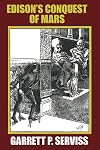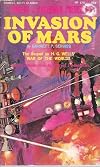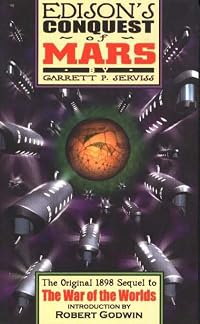
Edison's Conquest of Mars
by Garrett P. Serviss
On This Page
Description
Though he first gained acclaim as a popular lecturer and public speaker who traveled the country teaching audiences about astronomy, author Garrett P. Serviss also produced a body of engrossing science fiction. Edison's Conquest of Mars was heavily influenced by H.G. Wells' The War of the Worlds, and it's packed with interstellar action and adventure..
Tags
Recommendations





















Member Reviews
Red-blooded Victorian pulp sci-fi — that's how I would label this 1898 tale of interplanetary imperialism that sought to capitalize on the popularity of H.G. Wells' The War of the Worlds by imagining a Yankee-led counterstroke against the wicked Martians. Electricity is the do-it-all technology in this scenario, and Thomas Edison is the can-do wizard who dominates the story. In a matter of weeks Edison perfects electric spaceships and disintegrator guns that can outdo anything the Martians have, and soon the cream of the world's scientists are off on a combined scientific expedition and war to annihilate alien savages. (Edward Said fans, take note.) Serviss, an astronomer and science popularizer who came of age just after the American show more Civil War, combines his optimistic scientism with pseudo-science (alien pyramid builders, physiognomy as a guide to psychology), sentimentality (an earthling damsel in Martian distress), and white supremacy (inviting the reader to celebrate the "Aryan" racial qualities of a happy couple formed by the adventure). Since the author's death in 1929 the story has been anthologized and reprinted, usually after heavy abridgement of some of the more self-indulgent or embarrassingly racist passages. show less
It's a little-known fact that after the New York Evening Journal and Boston Post ended their unauthorized reprints of The War of the Worlds (under the title Fighters from Mars), which changed the location of the story to their respective sites of publication, it was immediately followed by an equally unauthorized sequel, written by Serviss, the Journal's science correspondent. In this story, Earth strikes back against the Martians with the power of electricity, under the fearless leadership of Thomas Edison himself. It's more interesting than good, unfortunately. Robert Godwin, the editor of the only uncut collected edition, tries to defend it on the basis of its ideas, and admittedly it has some great/important ones (Serviss was the show more first person to use oxygen pills, spacesuits, asteroid mining, aliens building the pyramids, alien abductions, ship-to-ship combat in outer space, and disintegrator guns in fiction), but the plot itself is pretty terrible. The characters take forever to get going, and once they do, they keep on being side-tracked by irrelevancies. And their plan is nonexistent; only a hundred ships are sent to fight all of Mars, over half of which are lost. The humans only win through a convenient discovery of really stupid aqueduct construction. And of course, Serviss totally misses the point of Wells's novel. (Though admittedly, he might do this on purpose.) It should be a lot of fun, and large parts of it are, but not even ridiculously over-the-top electrical imperialistic optimism can sustain 250 pages of poor plot before it wears out its welcome. show less
This was an American sequel to H G Wells' War of the Worlds, or to be more precise a sequel to an unauthorised American version of the novel, with the action transferred from suburban London to Boston, Massachusetts. This sequel was also published in 1898 soon after Wells' novel. In fear of a second Martian invasion, and having studied Martian technology from the wreckage of the first invasion, the nations of the world come together under US leadership (with scarcely any objections!) to send an expedition to Mars to stop a recurrence. The mission is led by none other than the inventor Thomas Edison, with participation of other scientists such as Lord Kelvin. So far, this description comes across as more Jules Verne than H G Wells. The show more author was a journalist with scientific training, so the science in it is, for the most part, very accurate, at least according to the state of knowledge of the time, and this is also apparently the first SF novel to depict men in space suits and an interplanetary battle between fleets of spaceships. Mars here, though, possesses the watery canals that it was believed to possess at the time, and the Martians themselves are giant humanoids whose appearance, according to the illustrations, owe more to fantasy than Wells' vision. Serviss is quite a good descriptive writer, though there is far too much showing rather than telling of the most potentially dramatic action. He is no H G Wells. So overall 3/5 show less
Intriguing but disappointing. Serviss does come up with a lot of concepts that are, if not entirely brand-new to SF, then at least new enough to feel really innovative. And the sheer lunacy of the plot paired with the dry journalistic I-swear-I'm-an-actual-scientist prose does lead to some chuckles. But the complete lack of any characters whatsoever, the tendency to solve any problem by simply having Edison magically invent something like he's Dr Snuggles, and the... shall we say less-than-well-aged discourse on the supremacy of the Aryan race really drag it down.
A historical curiousity, that ought to be read on that basis. It was influential in the genre, even more so when you consider that a young Robert Goddard was inspired by both War of the Worlds and its 'sequel', reading a copy of the latter as late as 1929. Not a great book, certainly; but read and taken in context, one that has some merits.
https://fromtheheartofeurope.eu/edisons-conquest-of-mars-by-garrett-p-serviss/
This is a rollicking 1898 Edison fanfic sequel to The War of the Worlds, in which the nations of the earth, shocked by a Martian attack on New York, fund a retaliatory mission to Mars led by Thomas A. Edison and Lord Kelvin, with the author putting himself in first person in the middle of the fray. Edison has conveniently invented both a disintegration ray and an anti-gravity drive, so the large Earth expedition is ultimately successful despite tribulations along the way. (This is not a spoiler – the end of the story is given away by the title of the book.)
There’s an amusing fantasy diplomacy bit at the beginning with the rulers of the world converging on show more Washington and Queen Victoria dancing with President McKinley (she turned 79 that year). The cliches of space travel and war with other planets are explored here for the first time; the Martians are subhuman savages, with all that that implies; there is a beautiful human hostage, the last of her kind; and Thomas Edison wins the war, for humanity. (Apparently he was consulted about being made the hero of the book, and consented.)
The Project Gutenberg version is enlivened by the illustrations created by Bernard Manley, Jr, for the 1947 printing of the story. show less
This is a rollicking 1898 Edison fanfic sequel to The War of the Worlds, in which the nations of the earth, shocked by a Martian attack on New York, fund a retaliatory mission to Mars led by Thomas A. Edison and Lord Kelvin, with the author putting himself in first person in the middle of the fray. Edison has conveniently invented both a disintegration ray and an anti-gravity drive, so the large Earth expedition is ultimately successful despite tribulations along the way. (This is not a spoiler – the end of the story is given away by the title of the book.)
There’s an amusing fantasy diplomacy bit at the beginning with the rulers of the world converging on show more Washington and Queen Victoria dancing with President McKinley (she turned 79 that year). The cliches of space travel and war with other planets are explored here for the first time; the Martians are subhuman savages, with all that that implies; there is a beautiful human hostage, the last of her kind; and Thomas Edison wins the war, for humanity. (Apparently he was consulted about being made the hero of the book, and consented.)
The Project Gutenberg version is enlivened by the illustrations created by Bernard Manley, Jr, for the 1947 printing of the story. show less
When you consider when this was written it is just incredible. Spaceships, spacesuits, lasers etc. Great fun, if not a little tub-thumping. No relation to the War of the Worlds, mind, but a fantastically readable adventure all the same.
Members
- Recently Added By
Lists

372 Pages We'll Never Get Back
37 works; 3 members
Author Information

35+ Works 345 Members
Some Editions
Work Relationships
Is contained in
Is a (non-series) sequel to
Common Knowledge
- Canonical title
- Edison's Conquest of Mars
- Alternate titles
- Invasion of Mars (abridged) (abridged)
- Original publication date
- 1898-02
- People/Characters
- Thomas Edison (in fiction); William McKinley; Victoria, Queen of the United Kingdom (in fiction); Wilhelm II, German Kaiser and King of Prussia (in fiction)
- Important places
- Mars
- First words
- It is impossible that the stupendous events which followed the disastrous invasion of the earth by the Martians should go without record, and circumstances having placed the facts at my disposal, I deem it a duty, both to pos... (show all)terity and to those who were witnesses of and participants in the avenging counterstroke that the earth dealt back at its ruthless enemy in the heavens, to write down the story in a connected form.
- Last words
- (Click to show. Warning: May contain spoilers.)And thus was united, for all future time, the first stem of the Aryan race, which had been long lost, but not destroyed, with the latest offspring of that great family, and the link which had served to bring them together was the far-away planet of Mars.
Classifications
Statistics
- Members
- 97
- Popularity
- 333,922
- Reviews
- 8
- Rating
- (3.10)
- Languages
- English
- Media
- Paper, Ebook
- ISBNs
- 31
- ASINs
- 9