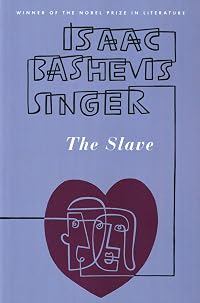
The Slave
by Isaac Bashevis Singer
On This Page
Description
Four years after the Chmielnicki massacres of the seventeenth century, Jacob, a slave and cowherd in a Polish village high in the mountains, falls in love with Wanda, his master's daughter. Even after he is ransomed, he finds he can't live without her, and the two escape together to a distant Jewish community. Racked by his consciousness of sin in taking a Gentile wife and by the difficulties of concealing her identity, Jacob nonetheless stands firm as the violence of the era threatens to show more destroy the ill-fated couple. show lessTags
Recommendations

























Member Reviews
"His name was Jacob also; he too had lost a beloved wife, the daughter of an idolater, among strangers; Sarah too was buried by the way and had left him a son. Like the biblical Jacob, he was crossing the river, bearing only a staff, pursued by another Esau. Everything remained the same: the ancient love, the ancient grief. Perhaps four thousand years would again pass; somewhere, at another river, another Jacob would walk mourning another Rachel. Or who knew, perhaps it was always the same Jacob and the same Rachel. Well, but the Redemption has to come. All of this can't last forever.
Jacob lifted his gaze: Lead, God, lead. It is thy world."
The Cossacks killed Jacob's wife and children and placed him into captivity. He finds himself in show more love with a woman who brings him bread and the war between his flesh and his faith, which does not allow such pairing, are a daily endurance. His faith is all the slave has to call his own and, lost in a land of pagans, Jacob clings to it hard. Does he trust his God to bring him through this captivity? Does he believe his faith will sustain him if being an abused cow-herd is all there is for the rest of his years?
I was surprised at how fast of a read [The Slave] turned out to be. Jewish/Gentile relationships are a subject I find myself coming back to and even though that's a big part of the book, it's not the entirety. I really felt myself going on this journey of faith with Jacob. I'll have to look for more of Singer. show less
Jacob lifted his gaze: Lead, God, lead. It is thy world."
The Cossacks killed Jacob's wife and children and placed him into captivity. He finds himself in show more love with a woman who brings him bread and the war between his flesh and his faith, which does not allow such pairing, are a daily endurance. His faith is all the slave has to call his own and, lost in a land of pagans, Jacob clings to it hard. Does he trust his God to bring him through this captivity? Does he believe his faith will sustain him if being an abused cow-herd is all there is for the rest of his years?
I was surprised at how fast of a read [The Slave] turned out to be. Jewish/Gentile relationships are a subject I find myself coming back to and even though that's a big part of the book, it's not the entirety. I really felt myself going on this journey of faith with Jacob. I'll have to look for more of Singer. show less
The opening setting of The Slave is the remote rural mountains of southern Poland in the late 17th Century in the years immediately following the Chmielnicki (often spelled Khmelnytsky) Uprising, an invasion by Cossack forces in rebellion against Polish domination. In Jewish history, these events are known as the Chmielnicki Massacres, as the Cossack forces, aided often by the Poles themselves, perpetrated widespread and massive pogroms. Whole villages were essentially obliterated. Our protagonist, Jacob, is a survivor of one such attack on his native village, Josefov. His wife and three children, he believes, have been murdered, but instead of being killed himself, Jacob is captured and sold into slavery to Jan Bzik, a farmer in remote show more mountain town. Escape into the mountains, whose ways are unknown to him, means certain death, and the villages have sworn to kill Jacob on sight if he is spotted on the wrong side of the river that borders Bzik's land. Bzik himself, it should be noted, is not portrayed as a cruel man.
For five years Jacob spends his winters in a high mountain cabin tending to Bzik's cattle. His only source of food and water is what is brought up the mountain to him daily by Bzik's daughter, Wanda. Far from Jewish community and the holy books he loves, Jacob strives to maintain a pious Jewish life as best he can, and that include resisting the strong physical attraction that Jacob and Wanda feel for each other. Jacob would surely be excommunicated by the rabbis for cohabitating with a Gentile, and either or both of the two could be burned alive by the Church. Marriage is out of the question. Well, but as we know, such temptation cannot be resisted forever, and certainly not in fiction.
Well, I don't want to give away any plot developments.The storyline drew me in and made The Slave an active, enjoyable reading experience for me. As is often the case with Singer, although not as strongly as in others of his novels, there is a touch of magical realism, at least as seen though the characters' eyes, and there is also a bit of a fable like quality. Wanda and Jacob's love, and the peril it brings them, provides the momentum. The Jewish community rebounds from the massacres, but goes quickly back to its former, all too human ways, scrupulously following the slightest rabbinical dicta regarding dress, prayer and diet while ignoring biblical commandments about how to treat one's neighbors. Singer, examines this phenomenon in depth through Jacob and Wanda, who experience it all first hand. And though Singer's (and Jacob's) observations are often scathing (Singer himself turned from religious Judaism to a much more secular philosophy and lifestyle in early adulthood), nevertheless he retains an underlying compassionate perspective on both the frailties of humanity and the value of faith.
As The Slave was published in 1962, the resonance of the Holocaust and its aftermath within the narrative is unmistakable. Singer weaves together themes of identity, isolation, faith, religion, superstition, love, cruelty and compassion, separation and renewal into a rich and memorable novel.
Here is a quote I like:
"Ceaselessly he had prayed for death; he had even contemplated self-destruction. But now that mood had passed, and he had become inured to living among strangers, distant from his home, doing hard labor. As he drowsed, he heard pine cones falling and the coo of a cuckoo in the distance. He opened his eyes. The web of branches and pine needles strained the sunlight like a sieve, and the reflected light became a rainbow-colored mesh. A last drop of dew flamed, glistened, exploded into thin moten fibers. There was not a cloud to sully the perfect blue of the sky. It was difficult to believe in God’s mercy when murderers buried children alive. But God’s wisdom was evident everywhere." show less
For five years Jacob spends his winters in a high mountain cabin tending to Bzik's cattle. His only source of food and water is what is brought up the mountain to him daily by Bzik's daughter, Wanda. Far from Jewish community and the holy books he loves, Jacob strives to maintain a pious Jewish life as best he can, and that include resisting the strong physical attraction that Jacob and Wanda feel for each other. Jacob would surely be excommunicated by the rabbis for cohabitating with a Gentile, and either or both of the two could be burned alive by the Church. Marriage is out of the question. Well, but as we know, such temptation cannot be resisted forever, and certainly not in fiction.
Well, I don't want to give away any plot developments.The storyline drew me in and made The Slave an active, enjoyable reading experience for me. As is often the case with Singer, although not as strongly as in others of his novels, there is a touch of magical realism, at least as seen though the characters' eyes, and there is also a bit of a fable like quality. Wanda and Jacob's love, and the peril it brings them, provides the momentum. The Jewish community rebounds from the massacres, but goes quickly back to its former, all too human ways, scrupulously following the slightest rabbinical dicta regarding dress, prayer and diet while ignoring biblical commandments about how to treat one's neighbors. Singer, examines this phenomenon in depth through Jacob and Wanda, who experience it all first hand. And though Singer's (and Jacob's) observations are often scathing (Singer himself turned from religious Judaism to a much more secular philosophy and lifestyle in early adulthood), nevertheless he retains an underlying compassionate perspective on both the frailties of humanity and the value of faith.
As The Slave was published in 1962, the resonance of the Holocaust and its aftermath within the narrative is unmistakable. Singer weaves together themes of identity, isolation, faith, religion, superstition, love, cruelty and compassion, separation and renewal into a rich and memorable novel.
Here is a quote I like:
"Ceaselessly he had prayed for death; he had even contemplated self-destruction. But now that mood had passed, and he had become inured to living among strangers, distant from his home, doing hard labor. As he drowsed, he heard pine cones falling and the coo of a cuckoo in the distance. He opened his eyes. The web of branches and pine needles strained the sunlight like a sieve, and the reflected light became a rainbow-colored mesh. A last drop of dew flamed, glistened, exploded into thin moten fibers. There was not a cloud to sully the perfect blue of the sky. It was difficult to believe in God’s mercy when murderers buried children alive. But God’s wisdom was evident everywhere." show less
This is a stunning work. I can't do it justice. But I'll try with what enfeebled abilities I have. But first the whole story I got this book and took too long to read it.
I first became a "serious reader" in my mid to late high school years. I remember it was George Orwell and Anthony Burgess who, first, introduced to me the idea that books could be more than just fodder thrown by unfulfilled public school teachers at a sneering and half conscious student body to keep them busy and adhere to arbitrary academic standards. Orwell's "Animal Farm" and "1984" as well as Burgess' "A Clockwork Orange" were the first novels to evidence the ability of literature to cut deep and excite, to teach and to terrify, and, most profoundly, entertain and show more revivify.
From there I slowly made my winding way through the annals of many books. Not as many as I'd like, not as many as some friends (both current and former) but many enough to whittle away hours, months, days, years. And amid all that I took slow steps into the realm of Jewish Fiction. There was no direction, no guiding ethos, I just read what I could find and what was recommended to me. Philip Roth was a perverted and neurotic maestro of prose, Saul Bellow was a bloviating dilettante not without his share of genius, Kafka was the patron saint of Jewish misery and 'the guilt without source'. Of course Norman Mailer was the robber baron of arrogance and unparalleled literary ambition. And then the Jews of European and Israeli origins. The list goes on. But with all of that the name Isaac Bashevis Singer popped up in random spots, a soft whisper resonant of a Jewish life and mentality that had all but ceased to be. This need be evidenced no more than by his choice (and superb ability) to write in Yiddish. Not English, not German, not Hebrew, but Yiddish; a writer of the old language, emblematic of diaspora and all that came with it. And that he was awarded the nobel prize of literature and a Jew of orthodoxy (and a vegetarian to boot!) only added to his mystique and appeal.
So I read Singer's "Gimpel the Fool" and enjoyed it. Much later I read "The Penitent" which, while skillfully written, was unfortunately brought down by the noxious pedantry and sententious elitism of its protagonist. But all along his novel "The Slave" remained on the backburner. A more or less self-published novelist, an American Jew living in Israel who become very religious and conservative, derided the novel as well written but borderline pornographic. Having been at the stage where I was just simply angry, I bought the book almost as an act of spite against a man I'd never met but who seemed to embody the worst of my then current neuroses and shortcomings, and dreams and aspirations as well. But years have gone by and my obsessions and weaknesses have shifted. And still "The Slave" remained on my perpetual 'to read' pile.
When I finally sat down to read the book I consumed it quickly and deeply. The story of Jacob the Polish Jew who is sold into slavery after a horrific pogrom that leaves most of his family dead and his village destroyed, is told in bitter but never embittered terms. It's a superb recitation of a black historical incident. Jacob is exiled to the Polish mountains where he barely ekes out an existence among people who, at best, distrust him, and, at worst, want him dead for the crime of living. But still Jacob maintains, to the best of his ability, his religious Jewish life. This would have been and could have been a monastic tale of personal strength in a time of diaspora but Singer introduces the love interest: the non-Jewish Polish woman Wanda, who proves to be the impetus for Jacob's transformation into one the most tragic, beautiful, and fully realized protagonists in world Jewish literature.
Singer pulls no punches here. The non-Jewish Poles are depicted in various states of savagery and depredation, as well as with spots of humanity belying their downtrodden circumstances. Jacob's fellow Jews are trenchantly delineated with a similarly even hand, showing both the beauty and the hypocrisy inherent within the Jewish religious lifestyle under the aegis of ambivalent (at times) and evil (at times) host culture. The true characters in this work are Jacob and Wanda (later Sarah) who, through their doomed love and passionate dedication to each other, create a tableau of such meaning and profundity that's hard to believe this book isn't at the top of more 'best of' lists.
Jacob and Wanda, for me, represent the ethereal and complex, the damning and revelatory aspects of love better than anything I've yet read. They aren't meant to be. And they will be torn from each other and destroyed. But like a postlapsarian Adam and Eve, theirs is a love of creation amid a dark world of Lilith and Satan, a fire to be snuffed but to shine brilliantly while it can.
This is a sad novel. But it possesses a nobility and an elan in form I've never seen before. It's human. It's love made real in all its maddening perplexities and hypocrisies. Read this if you want a taste of what it is to love, be damned by that love, but to love anyway, because it's human, and the joy is the misery is the joy. show less
I first became a "serious reader" in my mid to late high school years. I remember it was George Orwell and Anthony Burgess who, first, introduced to me the idea that books could be more than just fodder thrown by unfulfilled public school teachers at a sneering and half conscious student body to keep them busy and adhere to arbitrary academic standards. Orwell's "Animal Farm" and "1984" as well as Burgess' "A Clockwork Orange" were the first novels to evidence the ability of literature to cut deep and excite, to teach and to terrify, and, most profoundly, entertain and show more revivify.
From there I slowly made my winding way through the annals of many books. Not as many as I'd like, not as many as some friends (both current and former) but many enough to whittle away hours, months, days, years. And amid all that I took slow steps into the realm of Jewish Fiction. There was no direction, no guiding ethos, I just read what I could find and what was recommended to me. Philip Roth was a perverted and neurotic maestro of prose, Saul Bellow was a bloviating dilettante not without his share of genius, Kafka was the patron saint of Jewish misery and 'the guilt without source'. Of course Norman Mailer was the robber baron of arrogance and unparalleled literary ambition. And then the Jews of European and Israeli origins. The list goes on. But with all of that the name Isaac Bashevis Singer popped up in random spots, a soft whisper resonant of a Jewish life and mentality that had all but ceased to be. This need be evidenced no more than by his choice (and superb ability) to write in Yiddish. Not English, not German, not Hebrew, but Yiddish; a writer of the old language, emblematic of diaspora and all that came with it. And that he was awarded the nobel prize of literature and a Jew of orthodoxy (and a vegetarian to boot!) only added to his mystique and appeal.
So I read Singer's "Gimpel the Fool" and enjoyed it. Much later I read "The Penitent" which, while skillfully written, was unfortunately brought down by the noxious pedantry and sententious elitism of its protagonist. But all along his novel "The Slave" remained on the backburner. A more or less self-published novelist, an American Jew living in Israel who become very religious and conservative, derided the novel as well written but borderline pornographic. Having been at the stage where I was just simply angry, I bought the book almost as an act of spite against a man I'd never met but who seemed to embody the worst of my then current neuroses and shortcomings, and dreams and aspirations as well. But years have gone by and my obsessions and weaknesses have shifted. And still "The Slave" remained on my perpetual 'to read' pile.
When I finally sat down to read the book I consumed it quickly and deeply. The story of Jacob the Polish Jew who is sold into slavery after a horrific pogrom that leaves most of his family dead and his village destroyed, is told in bitter but never embittered terms. It's a superb recitation of a black historical incident. Jacob is exiled to the Polish mountains where he barely ekes out an existence among people who, at best, distrust him, and, at worst, want him dead for the crime of living. But still Jacob maintains, to the best of his ability, his religious Jewish life. This would have been and could have been a monastic tale of personal strength in a time of diaspora but Singer introduces the love interest: the non-Jewish Polish woman Wanda, who proves to be the impetus for Jacob's transformation into one the most tragic, beautiful, and fully realized protagonists in world Jewish literature.
Singer pulls no punches here. The non-Jewish Poles are depicted in various states of savagery and depredation, as well as with spots of humanity belying their downtrodden circumstances. Jacob's fellow Jews are trenchantly delineated with a similarly even hand, showing both the beauty and the hypocrisy inherent within the Jewish religious lifestyle under the aegis of ambivalent (at times) and evil (at times) host culture. The true characters in this work are Jacob and Wanda (later Sarah) who, through their doomed love and passionate dedication to each other, create a tableau of such meaning and profundity that's hard to believe this book isn't at the top of more 'best of' lists.
Jacob and Wanda, for me, represent the ethereal and complex, the damning and revelatory aspects of love better than anything I've yet read. They aren't meant to be. And they will be torn from each other and destroyed. But like a postlapsarian Adam and Eve, theirs is a love of creation amid a dark world of Lilith and Satan, a fire to be snuffed but to shine brilliantly while it can.
This is a sad novel. But it possesses a nobility and an elan in form I've never seen before. It's human. It's love made real in all its maddening perplexities and hypocrisies. Read this if you want a taste of what it is to love, be damned by that love, but to love anyway, because it's human, and the joy is the misery is the joy. show less
High up in the mountains sits Jacob, a Polish Jew, the last of his family following the latest in a series of massacres. No, it's not the 1940s, it's mid-17th century, though obviously the still-recent memories of WWII were at the back of Singer's mind when he wrote the novel. Anyway, Jacob is a slave, which is of course officially immoral and illegal, but he's a Jew in a country where that's enough reason to kill you so who is he to argue? Alone in the mountains, herding a Christian farmer's cows, he has time to think, to try and piece Judaism back together in his own head from what he remembers of it, hundreds of commandments and prayers and dates and words...
And there he might have stayed, a man alone with his God, if not for Wanda - show more the farmer's daughter who brings him milk and bread. They're both widowed, they're both young and attracted to each other, and after all it's not good for man to be alone. But as mentioned, this is 17th-century Poland, torn by war and religious differences, and the idea of a Jewish man and a Christian woman marrying is impossible; if the Christians find out, they'll have them both executed, and if the Jews find out they'll cast them out for fear of harbouring criminals - pogroms have started over far less...
Singer paints the 17th century in simple but detailed images, never making the fact that it's a 20th century novel too obvious in the thoughts and acts of its characters. The Slave is a historical novel about love, about sex, about trying to survive in a world where revealing who you are, slipping up for just a second, can get you killed. But obviously, it's also a novel about faith (not necessarily for or against it, about it) and its repercussions in life. If not for his belief, Jacob might (or might not) have lost himself there in the mountains; but there's also a lot of people - Catholic, Protestant, Orthodox, Jewish - in it who are happy to declare themselves true believers and praise God and their own piety, but often use it to judge and condemn those immoral, evil bastards on the other side. It's a novel written shortly after WWII and taking place shortly after the 30 Years' War, after all, and everyone's on edge and afraid of each other. As Jacob notes: it's funny how many people find it easy to follow the commandments towards God (keeping kosher, converting heathens) but show little consideration for those that ask them to show compassion, consideration and mercy to others. Jacob is freed from formal slavery early on, but that's still the title of the novel.
Somehow The Slave, despite its (actual and metaphorical) setting, manages to be a bittersweet novel, with an ending that grants eternal life - maybe in heaven, but definitely in the memories of others. Which may, perhaps, be the most important thing. Along the way, though, it asks some pretty big questions, and as utterly horriffic it is at times and as heartwarming as it is at others, it's hopefully those that stay with the reader. show less
And there he might have stayed, a man alone with his God, if not for Wanda - show more the farmer's daughter who brings him milk and bread. They're both widowed, they're both young and attracted to each other, and after all it's not good for man to be alone. But as mentioned, this is 17th-century Poland, torn by war and religious differences, and the idea of a Jewish man and a Christian woman marrying is impossible; if the Christians find out, they'll have them both executed, and if the Jews find out they'll cast them out for fear of harbouring criminals - pogroms have started over far less...
Singer paints the 17th century in simple but detailed images, never making the fact that it's a 20th century novel too obvious in the thoughts and acts of its characters. The Slave is a historical novel about love, about sex, about trying to survive in a world where revealing who you are, slipping up for just a second, can get you killed. But obviously, it's also a novel about faith (not necessarily for or against it, about it) and its repercussions in life. If not for his belief, Jacob might (or might not) have lost himself there in the mountains; but there's also a lot of people - Catholic, Protestant, Orthodox, Jewish - in it who are happy to declare themselves true believers and praise God and their own piety, but often use it to judge and condemn those immoral, evil bastards on the other side. It's a novel written shortly after WWII and taking place shortly after the 30 Years' War, after all, and everyone's on edge and afraid of each other. As Jacob notes: it's funny how many people find it easy to follow the commandments towards God (keeping kosher, converting heathens) but show little consideration for those that ask them to show compassion, consideration and mercy to others. Jacob is freed from formal slavery early on, but that's still the title of the novel.
Somehow The Slave, despite its (actual and metaphorical) setting, manages to be a bittersweet novel, with an ending that grants eternal life - maybe in heaven, but definitely in the memories of others. Which may, perhaps, be the most important thing. Along the way, though, it asks some pretty big questions, and as utterly horriffic it is at times and as heartwarming as it is at others, it's hopefully those that stay with the reader. show less
The Slave is the heartwrenching tale of Jacob, a seventeenth century survivor of the nightmarish Cossacks attacks that killed tens of thousands of Jews in Poland. After his family is brutally murdered, Jacob flees the terror only to find himself a slave to backcountry gentile villagers. Against his better judgment and strict Torah upbringing, he allows himself to fall in love with Wanda, the daughter of his Polish owner. The unlikely couple escape the mountains to forge an unassuming life in a remote Jewish village.
Jacob struggles throughout the story with his deep faith in the tenets of Judaism, while searching for meaning in his own suffering and the brutal treatment of his fellow Jews at the hands of their many persecutors. He also show more struggles with personal inner demons, trying to find a balance between adherence to religious law and an intense attraction to and love for his non-Jewish wife.
This was a beautiful story which unfolded like a fable. The narrative flowed at a brisk enough pace to keep most readers interested, and was quite suspenseful. I liked that nothing was left hanging at the end, and while sad, The Slave was overall an optimistic book. I will definitely read it again someday. show less
Jacob struggles throughout the story with his deep faith in the tenets of Judaism, while searching for meaning in his own suffering and the brutal treatment of his fellow Jews at the hands of their many persecutors. He also show more struggles with personal inner demons, trying to find a balance between adherence to religious law and an intense attraction to and love for his non-Jewish wife.
This was a beautiful story which unfolded like a fable. The narrative flowed at a brisk enough pace to keep most readers interested, and was quite suspenseful. I liked that nothing was left hanging at the end, and while sad, The Slave was overall an optimistic book. I will definitely read it again someday. show less
This was a beautiful, touching story. It had the romance and tragedy of a love across cultures as well as an obscure historical setting and the enthralling minutae of the religious rites that Jacob, the main character, tried to follow in his enslavement in Poland. Having read the Old Testament, I was very interested to read about all the efforts he made to keep up his religion. I also cried bucketloads at the ending- which is one of my expressions of appreciation of great art :)-
This is the first Isaac Bashevis SInger novel I have ever read and I was surprised that it was racier than I was expecting. It gave an interesting view of both Jewish and non-Jewish life in prewar Poland. I didn't love the translation, however. It used words like Pentecost instead of Shavuot and phylactery instead of tefillin.
Members
- Recently Added By
Lists

Jewish Books
367 works; 24 members
Author Information

389+ Works 24,060 Members
Isaac Bashevis Singer (1904-91) was the author of many novels, stories, children's books, and memoirs. He received the Nobel Prize in Literature in 1978. (Publisher Provided) Isaac Bashevis Singer was born in Radzymin, Poland on July 14, 1904. He received a traditional Jewish education, including training at the rabbinical seminary in Warsaw. He show more began writing in Hebrew while he worked for 10 years as a proofreader and translator in Warsaw. In 1935, he immigrated to New York, where he became a journalist for the Daily Forward, America's largest Yiddish newspaper. Most of his stories were originally published in this newspaper in serial form. His first novel, The Family Moskat, was published in 1950. His other works include The Magician of Lublin, The Spinoza of Market Street, The Slave, and A Friend of Kafka. A Day of Pleasure: Stories of a Boy Growing Up in Warsaw won the National Book Award for children's literature. He received numerous awards during his lifetime including the Nobel Prize for Literature in 1978 and the Gold Medal for Fiction in 1989. He died after suffering a series of strokes on July 24, 1991. (Bowker Author Biography) show less
Some Editions
Awards and Honors
Series
Belongs to Publisher Series
Work Relationships
Is contained in
Common Knowledge
- Canonical title
- The Slave
- Original title
- Der knekht
- Original publication date
- 1962 (English) (English)
- People/Characters
- Jacob; Isaac Bashevis Singer; Wanda
- Important places
- Poland
- Original language
- Yiddish
Classifications
- Genres
- General Fiction, Fiction and Literature, Historical Fiction
- DDC/MDS
- 839.133 — Literature & rhetoric German & related literatures Other Germanic literatures Yiddish literature Fiction 1860-1945
- LCC
- PZ3 .S61657 .S — Language and Literature Fiction and juvenile belles lettres Fiction and juvenile belles lettres Fiction in English
- BISAC
Statistics
- Members
- 1,085
- Popularity
- 23,660
- Reviews
- 10
- Rating
- (4.14)
- Languages
- 19 — Bulgarian, Czech, Dutch, English, Estonian, Finnish, French, German, Hebrew, Hungarian, Italian, Norwegian (Bokmål), Polish, Romanian, Russian, Serbian, Spanish, Swedish, Yiddish
- Media
- Paper, Audiobook, Ebook
- ISBNs
- 60
- ASINs
- 26