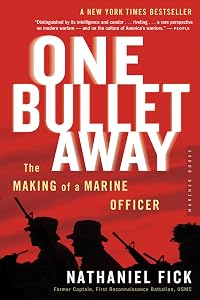
One Bullet Away: The Making of a Marine Officer
by Nathaniel Fick
On This Page
Description
A former captain in the Marines' First Recon Battalion, who fought in Afghanistan and Iraq, reveals how the Corps trains its elite and offers a point-blank account of twenty-first-century battle. Only one Marine in a hundred qualifies for Recon, charged with working clandestinely, often behind enemy lines. Fick's training begins with a hellish summer at Quantico, and advances to the pinnacle--Recon--four years later, on the eve of war with Iraq. Along the way, he learns to shoot a man a mile show more away, stays awake for seventy-two hours straight, endures interrogation and torture, learns to swim with Navy SEALs, and much more. His vast skill set puts him in front of the front lines. Fick unveils the process that makes Marine officers such legendary leaders and shares his hard-won insights into the differences between the military ideals he learned and military practice, which can mock those ideals. show lessTags
Recommendations

Member Reviews
After being introduced to Fick via Generation Kill and being quite intrigued by this earnest young officer, it was interesting to explore his experiences is this detail and depth. His romanticisation of bygone eras of military greatness adds an interesting element to his tale, settling it in a clear framework of challenge, honour and comradeship that he struggles (although usually succeeds) in maintaining throughout each of his missions. His candour throughout is wonderful - to admit to fears and tears and frustrations requires as much courage as war itself (although his image of big burly marines getting all squeamish about deadly creatures in Australia simply made me laugh). Fick is an engaging and intelligent writer - I want to show more criticise him for a few platitudes, cliches and general naivete but even this old cynic ultimately found his earnestness a little disarming. Ultimately, this is an interesting account of a young officer's experiences that asks its reader to think about some of the challenges and complexities of contemporary warfare and military culture. show less
Many people go to war. Many people write books. Only a few people go to war and write books about it, and among those books, One Bullet Away is a masterpiece. Insightful, well-crafted, bring into focus the mind and soul of a modern warrior, and the endless screw-ups of war. This book is probably the best way to get a sense of the Marines, short of joining up.
Nathan Fick takes us from OCS in the peaceful days of 1998, through the invasions of Iraq and Afghanistan. In the process, he discuss the energy and discipline need to impose order on chaos of battle, lead men to victory, and bring them all home. At the same time, no matter how professional a leader is, they can't account for the stupidity of their superiors, the human limitations show more of their men, or the fatal lottery of combat.
The primary lesson every Marine Lieutenant learns is "If you fuck up, your men die." Too bad that somewhere between bars and stars, that lesson is lost. show less
Nathan Fick takes us from OCS in the peaceful days of 1998, through the invasions of Iraq and Afghanistan. In the process, he discuss the energy and discipline need to impose order on chaos of battle, lead men to victory, and bring them all home. At the same time, no matter how professional a leader is, they can't account for the stupidity of their superiors, the human limitations show more of their men, or the fatal lottery of combat.
The primary lesson every Marine Lieutenant learns is "If you fuck up, your men die." Too bad that somewhere between bars and stars, that lesson is lost. show less
http://www.andalittlewine.blogspot.com/2012/08/book-review-one-bullet-away-by.ht...
In his memoir One Bullet Away, Nate Fick shares his story of joining the Marine Corps as an officer, and deploying just before the September 11th terrorist attacks.
Fick's story, told in ways that are both too glib and too frank, confuses the hell out of me.
I understand the call to serve. I understand the frustration that clearly mounts as he is thrust into war zones, in Afghanistan and again in Iraq, that his training did not fully prepare him for by commanders more interested in jockeying for promotion than in the safety of Fick's platoon.
But I don't understand who Fick was writing for. Who does he think will love his book?
Fick starts off with a show more glorification of war, of the Marines, of martial life that is, to me, off-putting. "The grunt life was untainted," he writes. "Being a Marine... was a rite of passage in a society becoming so soft and homogenized that the very concept was often sneered at." I could spend all day trying to unpack what Fick means by "soft," but I think the quote shares the flavor of the opening chapters, and the hard-soft motif resurfaces throughout the memoir's nearly 400 pages.
Fick handles death lightly. All of his platoon members survive his tour in Iraq, though some are wounded or killed later. The people who die are enemies, othered, and largely nondescript. Threats among the Marines to kill each other if they screw up, as Fick does when one of his men offers to blow an undetonated bomb, are common. But the story lacks the grittiness, the nastiness of military memoirs that have lately been turned into successful movies.
But as much as Fick loves the Marines, his platoon, his life as a soldier, he ultimately leaves the Corps because of its seemingly mindless bureaucracy. He leaves because he can't imagine putting himself back in harms way if he is surrounded by the kind of people he served his first Iraq deployment with- the idiots who drive down every road with guns blazing, endangering allies and civilians, or the ladder climbing fools who want to call in air support strikes simply become another company had called one earlier. So the book is not written, I think, for the military enthusiast.
Fick makes a compelling case for the re-assessment of American readiness. "I was noticing a trend in my career: train to lead a rifle platoon, but get a weapons platoon; train to raid the coastline in rubber boats, but go to war in a landlocked country; train to jump into patrols via parachute, but use boots or Humvees in the real world." Fick chooses to see this train for Plan A, fight with Plan B as "a tribute to flexibility," but given the dysfunction evident throughout his dealings with military command, it smacks of mismanagement. show less
In his memoir One Bullet Away, Nate Fick shares his story of joining the Marine Corps as an officer, and deploying just before the September 11th terrorist attacks.
Fick's story, told in ways that are both too glib and too frank, confuses the hell out of me.
I understand the call to serve. I understand the frustration that clearly mounts as he is thrust into war zones, in Afghanistan and again in Iraq, that his training did not fully prepare him for by commanders more interested in jockeying for promotion than in the safety of Fick's platoon.
But I don't understand who Fick was writing for. Who does he think will love his book?
Fick starts off with a show more glorification of war, of the Marines, of martial life that is, to me, off-putting. "The grunt life was untainted," he writes. "Being a Marine... was a rite of passage in a society becoming so soft and homogenized that the very concept was often sneered at." I could spend all day trying to unpack what Fick means by "soft," but I think the quote shares the flavor of the opening chapters, and the hard-soft motif resurfaces throughout the memoir's nearly 400 pages.
Fick handles death lightly. All of his platoon members survive his tour in Iraq, though some are wounded or killed later. The people who die are enemies, othered, and largely nondescript. Threats among the Marines to kill each other if they screw up, as Fick does when one of his men offers to blow an undetonated bomb, are common. But the story lacks the grittiness, the nastiness of military memoirs that have lately been turned into successful movies.
But as much as Fick loves the Marines, his platoon, his life as a soldier, he ultimately leaves the Corps because of its seemingly mindless bureaucracy. He leaves because he can't imagine putting himself back in harms way if he is surrounded by the kind of people he served his first Iraq deployment with- the idiots who drive down every road with guns blazing, endangering allies and civilians, or the ladder climbing fools who want to call in air support strikes simply become another company had called one earlier. So the book is not written, I think, for the military enthusiast.
Fick makes a compelling case for the re-assessment of American readiness. "I was noticing a trend in my career: train to lead a rifle platoon, but get a weapons platoon; train to raid the coastline in rubber boats, but go to war in a landlocked country; train to jump into patrols via parachute, but use boots or Humvees in the real world." Fick chooses to see this train for Plan A, fight with Plan B as "a tribute to flexibility," but given the dysfunction evident throughout his dealings with military command, it smacks of mismanagement. show less
In sharp contrast to Buzzell’s Gen X rock and roll version of war, Fick is a red blooded dude who joined the Marine Corps so he could struggle his way into the toughest jobs inside an already tough organization. This is red meat for those who served, and well-written enough to carry along everyone else. The story covers Fick’s training, and takes the reader through the early days of the March 2003 invasion. Elements of distrust, signs of poor leadership and acts of laziness that cause Fick to question the value of what he was doing at times read better knowing how hard it was for the author to admit the ideals he ascribed to his organization were not always upheld by all of its members.
One Bullet Away is perhaps the most detailed and complete record of a combat tour in Iraq that I have yet read. Fick must have kept daily notes or a diary. In fact the accumulation of day to day details becomes a bit repetitious and almost tedious at times. Lt Fick's dedication to his trade and affection and concern for his men become obvious in the course of his narrative, and you cannot help but admire him for any number of reasons. He is articulate and thoughtful throughout the book, a reflection of his education at Dartmouth, where he studied the Greeks and Romans. The one thing that bothered me here was the fact that, although I understand Fick was raised Catholic and was, like me, an altar boy, there is almost no mention of God or show more of praying during these extremely stressful and often frightening days. There is one mention of attending Mass, but otherwise nada. They say there are no atheists in foxholes, but I wonder. Was Fick the exception. It would be interesting to talk with him about this. But maybe that's just me. This is a darn bood book. I'm glad the author survived and made it back home to tell the tale. I will recommend his memoir highly. show less
Nathaniel Fick decided while he was in college that he was going to join the Marines. He served as an Infantry Officer and later as a Recon Marine. During that time, he saw a good chunk of what the world had to offer, both good and bad. One Bullet Away is Fick’s account of the things he faced during those years.
I first became aware of Nathaniel Fick’s story when I read Generation Kill by Evan Wright a few years back. While I enjoyed Wright’s book, I have a different appreciation for One Bullet Away because of the different perspective. To read the account of someone who actually trained and served and couldn’t just go home after spending a while in a war zone is rather humbling.
One of the major pluses for One Bullet Away is the show more amount of ground that Fick covers. By that I mean that it’s not just a story about the gruesome aspects of war. Fick talks a lot about how he made the decision to join the Marines, what he went through in order to join, and the training he had to go through once he did get in and how that helped him to become the person he is. In addition, he mentions coming home from war and what it’s like adapting to civilian life again. He also discusses his decision to leave the Corps – how he went from believing the Corps would be his career to realizing that he needed to get out. He talks about all of this, and war, in such an honest and personal manner that it’s hard not to be captivated by his story.
In One Bullet Away Fick isn’t afraid to be candid about all things. He talks about himself, his feelings, his feelings about others and how things were done in a very straightforward manner. One Bullet Away is well written and easy to read. I didn’t want to put it down when I read it because I was so hooked by his story.
Bottom line, I honestly don’t have a bad thing to say about this book. People who serve in the armed forces endure a lot of things and that holds true for Nathaniel Fick and the men and women he served with. Definitely a great read. show less
I first became aware of Nathaniel Fick’s story when I read Generation Kill by Evan Wright a few years back. While I enjoyed Wright’s book, I have a different appreciation for One Bullet Away because of the different perspective. To read the account of someone who actually trained and served and couldn’t just go home after spending a while in a war zone is rather humbling.
One of the major pluses for One Bullet Away is the show more amount of ground that Fick covers. By that I mean that it’s not just a story about the gruesome aspects of war. Fick talks a lot about how he made the decision to join the Marines, what he went through in order to join, and the training he had to go through once he did get in and how that helped him to become the person he is. In addition, he mentions coming home from war and what it’s like adapting to civilian life again. He also discusses his decision to leave the Corps – how he went from believing the Corps would be his career to realizing that he needed to get out. He talks about all of this, and war, in such an honest and personal manner that it’s hard not to be captivated by his story.
In One Bullet Away Fick isn’t afraid to be candid about all things. He talks about himself, his feelings, his feelings about others and how things were done in a very straightforward manner. One Bullet Away is well written and easy to read. I didn’t want to put it down when I read it because I was so hooked by his story.
Bottom line, I honestly don’t have a bad thing to say about this book. People who serve in the armed forces endure a lot of things and that holds true for Nathaniel Fick and the men and women he served with. Definitely a great read. show less
As memoirs go, you have to take in all the written details with a grain of salt. The perceptions of the author aren't always shared by others who witnessed the same event or shared the same ordeal in the same place at the same moment. That is, after all, how history has always been recorded: different points of view and opinions shape one single action into a complete story. However, it doesn't mean that every view is accurate, but each one still contributes significantly to the historical record if it's remembered a hundred years from now.
Last year I read Generation Kill by Evan Wright, and I liked it very much because it was straightforward and uncensored. Then I discovered that one of the Marine officers that Wright had met while show more embedded with the First Recon Battalion had also written a book, and I was finally able to buy it last week. Well, let me tell you - One Bullet Away by Nathaniel Fick is damn good reading.
Wright and Fick's separate accounts do complement one another, even from their different angles. One of the most amusing similarities both share is the caricature of the incompetent Bravo Company commander and the equally idiotic battalion second-in-command, the sergeant major. Of course, there was also Major "Benelli," another Officer Dufus. All three of these gentlemen remain "anonymous" in both books, or are given mocking nicknames to reflect the disgust and dislike of the Marines under their command by the time they pulled out of Iraq.
Anyway, I can't recommend Fick's book highly enough. Five stars. show less
Last year I read Generation Kill by Evan Wright, and I liked it very much because it was straightforward and uncensored. Then I discovered that one of the Marine officers that Wright had met while show more embedded with the First Recon Battalion had also written a book, and I was finally able to buy it last week. Well, let me tell you - One Bullet Away by Nathaniel Fick is damn good reading.
Wright and Fick's separate accounts do complement one another, even from their different angles. One of the most amusing similarities both share is the caricature of the incompetent Bravo Company commander and the equally idiotic battalion second-in-command, the sergeant major. Of course, there was also Major "Benelli," another Officer Dufus. All three of these gentlemen remain "anonymous" in both books, or are given mocking nicknames to reflect the disgust and dislike of the Marines under their command by the time they pulled out of Iraq.
Anyway, I can't recommend Fick's book highly enough. Five stars. show less
Members
- Recently Added By
Lists

LtGen James Mattis' Reading List
58 works; 2 members

Books Read in 2009
464 works; 11 members

Books Read in 2010
631 works; 10 members
Author Information

1 Work 1,074 Members
Some Editions
Awards and Honors
Common Knowledge
- Canonical title
- One Bullet Away: The Making of a Marine Officer
- Original publication date
- 2005
- People/Characters
- Nathaniel Fick; Brad Colbert; Rudy Reyes; Patrick English; Jim Beal; Tony Espera (show all 7); Mike Wynn
- Important places
- Afghanistan; Iraq; Baghdad, Iraq
- Important events
- Afghan Wars (2001- ); Iraq War (2003 | 2004)
- Related movies
- Generation Kill (2008 | IMDb)
- Epigraph
- We should remember that one man is much the same as another, and that he is best who is trained in the severest school. -- Thucydides
Archidamus gave a great defeat to the Arcadians, in the fight known by the name of the Tearless Battle, in which there was a great slaughter of the enemy without the loss of one Spartan... The old me and the women marched out... (show all) as far as the river Eurotas, lifting up their hands, and thanking the gods that Sparta was now cleared again of the disgrace and indignity that had befallen her, and once more saw the light of day. -- Plutarch
Anyone who looks with anguish on evils so great must acknowledge the tragedy of it all; and if anyone experiences them without anguish, his condition is even more tragic, since he remains serene by losing his humanity. -- Aug... (show all)ustine of Hippo - Dedication
- TO CAPTAIN BRENT MOREL
Bravo Company, First Reconnaissance Battalion, First Marine Division. Killed in Action 7 April 2004. Al Anbar Province, Iraq
AND
THE BRAVE MOTHERS OF THE UNITED STATES MARINES - First words
- Fifteen of us climbed aboard the ancient white school bus.
- Last words
- (Click to show. Warning: May contain spoilers.)I am proud.
- Blurbers
- Clarke, Richard A.; Zinni, Anthony C.; Pressfield, Steven; Ricks, Tom; Fallows, James; Trainor, Bernard E.
- Disambiguation notice
- Full title (2005): One bullet away : the making of a Marine officer / Nathaniel Fick
Classifications
Statistics
- Members
- 1,074
- Popularity
- 23,963
- Reviews
- 22
- Rating
- (4.11)
- Languages
- English
- Media
- Paper, Audiobook, Ebook
- ISBNs
- 17
- UPCs
- 2
- ASINs
- 12