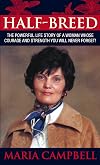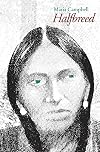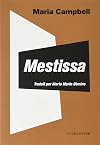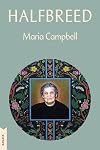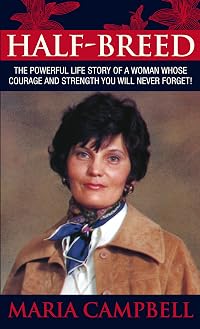
Halfbreed
by Maria Campbell 
On This Page
Description
A new, fully restored edition of the essential Canadian classic. An unflinchingly honest memoir of her experience as a Métis woman in Canada, Maria Campbell's Halfbreed depicts the realities that she endured and, above all, overcame. Maria was born in Northern Saskatchewan, her father the grandson of a Scottish businessman and Métis woman--a niece of Gabriel Dumont whose family fought alongside Riel and Dumont in the 1885 Rebellion; her mother the daughter of a Cree woman and show more French-American man. This extraordinary account, originally published in 1973, bravely explores the poverty, oppression, alcoholism, addiction, and tragedy Maria endured throughout her childhood and into her early adult life, underscored by living in the margins of a country pervaded by hatred, discrimination, and mistrust. Laced with spare moments of love and joy, this is a memoir of family ties and finding an identity in a heritage that is neither wholly Indigenous or Anglo; of strength and resilience; of indominatable spirit. This edition of Halfbreed includes a new introduction written by Indigenous (Métis) scholar Dr. Kim Anderson detailing the extraordinary work that Maria has been doing since its original publication 46 years ago, and an afterword by the author looking at what has changed, and also what has not, for Indigenous people in Canada today. Restored are the recently discovered missing pages from the original text of this groundbreaking and significant work. show lessTags
Recommendations






Member Reviews
Maria Campbell's "Halfbreed" tells her life story growing up as a Métis woman in northern Saskatchewan and the legacy of colonialism on her own psyche, that of her family and her community at large. The narrative starts with her childhood and goes up to 1966, as Native organizations work to address the legacy of colonialism in Canada. This work provides a fascinating memoir of Campbell's life and family, and how a Métis woman percieved events around her in the 40s-60s. This 1973 work is a fantastic foundational piece of Indigenous - and specifically, Métis - literature. I highly recommend it to anyone interested in Métis social history and life.
Maria Campbell is a Métis activist, author, playwright, and more. You can read about many of her accomplishments and important works on her Goodreads page.
Knowing about her accomplishments makes this memoir an interesting read--today's reader knows what the author herself did not yet know when this was first published in 1973. In this book she describes her childhood as the oldest child in her family. Poor but happy, their lives went downhill when her father lost his job and then her mother passed away. She tried to keep the family together as her dad worked, or drank, and she tried to attend school while doing the cooking and cleaning and childminding It didn't work. Marrying young as another way to keep them together, it also doesn't show more work. She has several children, moves around, is abandoned by her husband, discovers alcohol and drugs, holds various illegal jobs, and finally makes it back to see her grandmother and father and most of her siblings. She can't believe her people's situation seems even worse.
Campbell illustrates her struggles and readily admits to her failures, and you can see what she has learned, and how she matures. He frustration, shame, fear, and anger are palpable.
She also begins work that will lead to her later successes. She describes the supports for Native women that she thinks should exist. She herself later succeeded in establishing such supports.
I found the writing a little awkward, but this book is not about the writing. It's about a community that was (and still is) poorly treated and struggling, and about how one woman fought her way out of her early struggles to begin the career she had dreamed of. Though she mentions possibly writing another volume, I am not sure she has (yet?). Because it is time! show less
Knowing about her accomplishments makes this memoir an interesting read--today's reader knows what the author herself did not yet know when this was first published in 1973. In this book she describes her childhood as the oldest child in her family. Poor but happy, their lives went downhill when her father lost his job and then her mother passed away. She tried to keep the family together as her dad worked, or drank, and she tried to attend school while doing the cooking and cleaning and childminding It didn't work. Marrying young as another way to keep them together, it also doesn't show more work. She has several children, moves around, is abandoned by her husband, discovers alcohol and drugs, holds various illegal jobs, and finally makes it back to see her grandmother and father and most of her siblings. She can't believe her people's situation seems even worse.
Campbell illustrates her struggles and readily admits to her failures, and you can see what she has learned, and how she matures. He frustration, shame, fear, and anger are palpable.
She also begins work that will lead to her later successes. She describes the supports for Native women that she thinks should exist. She herself later succeeded in establishing such supports.
I found the writing a little awkward, but this book is not about the writing. It's about a community that was (and still is) poorly treated and struggling, and about how one woman fought her way out of her early struggles to begin the career she had dreamed of. Though she mentions possibly writing another volume, I am not sure she has (yet?). Because it is time! show less
Very insightful on the psychological effects of being considered second class people. A very different legacy came down in part of my Missouri family. From the 1850s, leaving her culture behind, the sliver of Native DNA that came down was seen as pride. Little left by the time it reached me, only got 3% DNA according to National Geographic’s Genographic Project.
So the bigotry Ms Campbell describes is distressing. We must stand tall and shake off all preconceptions.
So the bigotry Ms Campbell describes is distressing. We must stand tall and shake off all preconceptions.
A deeply harrowing book. Campbell's direct, simple style conveys the intensity of her experiences without self-pity or drama.
I found this terribly difficult to read. I suspect it has permanently changed my understanding of native and Métis issues. I wouldn't say I was surprised by the life she relates, though I did learn many new things about our government's treatment of the first nations community, but everything was brought home to me viscerally, with a new intensity.
I found this terribly difficult to read. I suspect it has permanently changed my understanding of native and Métis issues. I wouldn't say I was surprised by the life she relates, though I did learn many new things about our government's treatment of the first nations community, but everything was brought home to me viscerally, with a new intensity.
The author grew up in Saskatchewan; she is Metis (or “halfbreed” is the word she uses: part Cree (indigenous), and part European), descended from Gabriel Dumont. Her family was poor and she never really got out of the poverty, even as she married, had kids, moved to B.C. and Alberta, etc. She also ended up drinking, doing drugs… I think prostitution, too, but (unless I missed it), she only hinted at it.
I maybe made a mistake in listening to the audio. Maria herself read it, but she has a very monotone voice. I thought that I was still able to focus in the first half or so of the book, but I did miss things as the book continued, and I suspect I missed more earlier in the book than I originally thought.
I maybe made a mistake in listening to the audio. Maria herself read it, but she has a very monotone voice. I thought that I was still able to focus in the first half or so of the book, but I did miss things as the book continued, and I suspect I missed more earlier in the book than I originally thought.
First, I'll say that my students love reading this book in class. As Aboriginal students, this book reminds them of their history and the acculturation that their people experienced. They find Campbell'w writing to be human, engaging, and triumphant.
Second, I also enjoy this book. Perhaps not as much as my students do, but I still like it. I think Campbell's memoir is moving, and is a perfect way to introduce someone to Aboriginal and Metis rights. It is also a perfect way to have Canadians learn a little bit more of their country's history that is rarely talked about.
Second, I also enjoy this book. Perhaps not as much as my students do, but I still like it. I think Campbell's memoir is moving, and is a perfect way to introduce someone to Aboriginal and Metis rights. It is also a perfect way to have Canadians learn a little bit more of their country's history that is rarely talked about.
A revolting métis autobiographic story told with nerve, graciousness, patience, dignity and commitment.
Members
- Recently Added By
Lists

Favorite Memoirs
64 works; 13 members

500 Great Books by Women
507 works; 60 members

CBC's Great Canadian Reading List
149 works; 5 members
Author Information
8+ Works 480 Members
Maria Campbell is a LibraryThing Author, an author who lists their personal library on LibraryThing.
Some Editions
Awards and Honors
Notable Lists
Common Knowledge
- Original publication date
- 1973
- People/Characters
- Maria Campbell
- Important places
- Saskatchewan, Canada; Vancouver, British Columbia, Canada
Classifications
- Genres
- Biography & Memoir, Nonfiction, General Nonfiction, History
- DDC/MDS
- 970.00497 — History & geography History of North America History of North America North America Ethnic and National Groups Native Americans
- LCC
- E99 .C88 .C254 — History of the United States America Indians of North America Indian tribes and cultures
- BISAC
Statistics
- Members
- 339
- Popularity
- 93,073
- Reviews
- 8
- Rating
- (3.68)
- Languages
- Catalan, English, French
- Media
- Paper, Audiobook, Ebook
- ISBNs
- 17
- ASINs
- 9