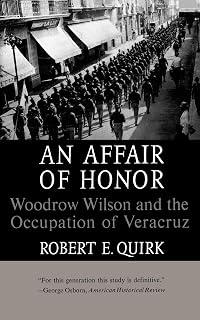
An Affair of Honor: Woodrow Wilson and the Occupation of Veracruz
by Robert E. Quirk
On This Page
Description
In April 1914 three minor incidents occurred in Mexico: the arrest of several American sailors, the detention of a mail courier, and the delay of an official Department of State dispatch. Less than two weeks later, United States military forces landed at Veracruz and remained to occupy it for more than six months. What were the causes underlying this action, and what was the United States trying to achieve? Robert Quirk examines the motives which led Woodrow Wilson to this decision, the show more reasons for its failure, and its consequences for the United States' relations with Latin America. show lessTags
Recommendations


























Member Reviews
Most Americans follow what our country does overseas lightly if at all. This is certainly true of our occupation of the Mexican port of Veracruz in 1914 and, yet as Mr Quirk tells us, this is still remembered with rage and bitterness to many Mexicans. What started as a protective action of US citizens and interests around oil fields resulting in some incidents that seemed unimportant to local US authorities became a full blown diplomatic trauma partly the reader is told because of President Wilson's not abiding Huerta and his dictatorial ways. Then after the initial bloodshed of the occupation the US had on its hands a city it could not easily be rid of. Mr. Quirk tells this with just the right amount of details and human interest and a show more fairness to all. One takes away the reminder, maybe unintentional on the authors' part, that we can not entirely trust what our Presidents give as reasons for our foreign engagements.
Quotes: (preface) “It is ironic that this moral imperialism led the idealistic Wilson to use the club of armed intervention more frequently than any other American president. His biographers agree that his motives were exalted- and it is true that Veracruz, Santo Domingo, Haiti, and Nicaragua all benefited materially from American occupation. Roads were built. Sanitation was improved...Yet the gains were accompanied by suspension of constitutions and the suppression of civil rights....This irony may explain the phenomenon so strange to many Americans: that Mexicans, in writing their histories, have been less bitter about the war with the United States of 1846 than the intervention n Veracruz in 1914...Why, then, the more intense bitterness about the infinitely less damaging Veracruz occupation? To the Mexicans, Manifest Destiny was a harsh policy,but one which sprang from realistic and understandable motives. Wilson, however, clothed American aggression with the sanctimonious raiment of idealism. In insisting upon the morality of his acts, he aroused both the hatred and the scorn of the Mexicans-hated over the invasion but a deep scorn for what they saw as his hypocrisy.”
(page 56) “In making an issue of the supposed arrest, Wilson demonstrated conclusively that he did not know what was happening in Mexico. He was completely unaware of the story in the Herald, which had appeared three days earlier (It was, after all, an opposition newspaper), and he did not see the dispatches from Fletcher, which proved Canada's account to be erroneous. Worst of all, Wilson misread what little evidence he did have. He said that the orderly had been 'put into jail,' which Canada had never said.”
(page 171) “As for the Americans, the occupation experience was proof that Wilson's determination to recognize only good and moral governments, while admirable in the abstract, was impossible in practice. Thereafter, Washington would grant recognition to any regime, however corrupt or authoritarian, capable of maintaining itself in power. That this course has also worked evils- witness the too-close ties with Trujillo, Batista, and Perez Jimenez- does not negate the axiom: Wilson's policy, whatever his intention, was a form of dictation completely unacceptable to the Latin American people.” show less
Quotes: (preface) “It is ironic that this moral imperialism led the idealistic Wilson to use the club of armed intervention more frequently than any other American president. His biographers agree that his motives were exalted- and it is true that Veracruz, Santo Domingo, Haiti, and Nicaragua all benefited materially from American occupation. Roads were built. Sanitation was improved...Yet the gains were accompanied by suspension of constitutions and the suppression of civil rights....This irony may explain the phenomenon so strange to many Americans: that Mexicans, in writing their histories, have been less bitter about the war with the United States of 1846 than the intervention n Veracruz in 1914...Why, then, the more intense bitterness about the infinitely less damaging Veracruz occupation? To the Mexicans, Manifest Destiny was a harsh policy,but one which sprang from realistic and understandable motives. Wilson, however, clothed American aggression with the sanctimonious raiment of idealism. In insisting upon the morality of his acts, he aroused both the hatred and the scorn of the Mexicans-hated over the invasion but a deep scorn for what they saw as his hypocrisy.”
(page 56) “In making an issue of the supposed arrest, Wilson demonstrated conclusively that he did not know what was happening in Mexico. He was completely unaware of the story in the Herald, which had appeared three days earlier (It was, after all, an opposition newspaper), and he did not see the dispatches from Fletcher, which proved Canada's account to be erroneous. Worst of all, Wilson misread what little evidence he did have. He said that the orderly had been 'put into jail,' which Canada had never said.”
(page 171) “As for the Americans, the occupation experience was proof that Wilson's determination to recognize only good and moral governments, while admirable in the abstract, was impossible in practice. Thereafter, Washington would grant recognition to any regime, however corrupt or authoritarian, capable of maintaining itself in power. That this course has also worked evils- witness the too-close ties with Trujillo, Batista, and Perez Jimenez- does not negate the axiom: Wilson's policy, whatever his intention, was a form of dictation completely unacceptable to the Latin American people.” show less
Written in 1961 it is a little dated, but still a concise account of the American invasion of Veracruz, Mexico in 1914. The author is not a fan of Woodrow Wilson, for sure, whom he depicts as disinterested, impulsive, and blinded by hostility towards Mexico and its president. The invasion led to a pointless loss of life, destabilized Mexico, and left a lasting legacy of bitterness towards the United States. I found it interesting how the Germans and British cooperated in Mexico just months before World War I broke out. In the preface (written in 1962) Quirk ties together the 1914 Veracruz invasion and the 1961 Bay of Pigs invasion as emanating from the same domineering and imperialist attitudes and assumptions.
A fairly concise account of the 1914 occupation of Veracruz. This is told, of course, from the American point of view. However, I don't feel that the author was too terribly biased.
The literary style was rather bland. Although it kept my interest, I think that was due more to the fact that it was less than 200 pages. I found myself not caring about any of the characters in the book. If anything, I came away with a less than favorable opinion of Woodrow Wilson. This is good for a quick overview of the Veracruz occupation and the troubles in Tampico that proceeded it, but don't expect a long drawn out story.
The literary style was rather bland. Although it kept my interest, I think that was due more to the fact that it was less than 200 pages. I found myself not caring about any of the characters in the book. If anything, I came away with a less than favorable opinion of Woodrow Wilson. This is good for a quick overview of the Veracruz occupation and the troubles in Tampico that proceeded it, but don't expect a long drawn out story.
Ratings
Members
- Recently Added By
Author Information
10 Works 177 Members
Awards and Honors
Awards
Common Knowledge
- Canonical title
- An Affair of Honor: Woodrow Wilson and the Occupation of Veracruz
- Original publication date
- 1962
- People/Characters
- Woodrow Wilson
- Important places
- Veracruz, Mexico
Classifications
Statistics
- Members
- 58
- Popularity
- 531,505
- Reviews
- 3
- Rating
- (3.38)
- Languages
- English
- Media
- Paper
- ISBNs
- 1
- ASINs
- 1