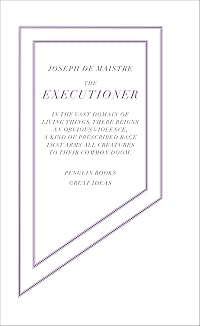
The Executioner
by Joseph de Maistre
On This Page
Description
Since their first publication in 1821, de Maistre's dark writings have fascinated and appalled critics, with their relentless hatred of the Enlightenment and view of humans as murderous beasts who can only be controlled by the threat of overwhelming punishment. Terrifying and bizarre,The Executioneris a meditation on human evil like no other.Tags
Recommendations








Member Reviews
Knowing de Maistre, and knowing the topic of this selection of excerpts (taken from the ‘St. Petersburg Dialogues’) I expected ‘The Executioner’ to be the Count at his darkest. Actually, this is mostly very sensible and rational, reactionary to the core but not disagreeable, infact it almost has a proto-sociological thing going on. I read ‘Considerations on France’ prior (still the best reactionary text I’ve ever read) and I have to say that one’s much darker and more controversial than the content of The Executioner, and I assume the St. Petersburg Dialogues as a whole.
It starts off a lot more interesting than it finishes, discussing the thorny issue of why bad things happen to good people (and why bad people often get show more away with their crimes). Considering de Maistre is the prime spokesperson of anti-rationalist reactionary thought, his analysis is extremely rational by my estimation, regardless of whether or not you share his Catholic outlook. We then proceed onto the prime contradiction that this Penguin edition is centered on, the question of why soldiers (who kill masses of innocent people) are hailed as heroes whilst executioners (who kill only the guilty) are popularly reviled. It gets a little less interesting towards the end as we get into discussions of the psalms and other aspects of the bible, but overall this work is still really worth reading.
Still, if you’re new to de Maistre I’d start with the classic ‘Considerations on France’, a book I keep returning to with an unquenchable fascination. This one is actually less political, and more centered on philosophy and religion, though still very worthwhile. show less
It starts off a lot more interesting than it finishes, discussing the thorny issue of why bad things happen to good people (and why bad people often get show more away with their crimes). Considering de Maistre is the prime spokesperson of anti-rationalist reactionary thought, his analysis is extremely rational by my estimation, regardless of whether or not you share his Catholic outlook. We then proceed onto the prime contradiction that this Penguin edition is centered on, the question of why soldiers (who kill masses of innocent people) are hailed as heroes whilst executioners (who kill only the guilty) are popularly reviled. It gets a little less interesting towards the end as we get into discussions of the psalms and other aspects of the bible, but overall this work is still really worth reading.
Still, if you’re new to de Maistre I’d start with the classic ‘Considerations on France’, a book I keep returning to with an unquenchable fascination. This one is actually less political, and more centered on philosophy and religion, though still very worthwhile. show less
The Executioner consists of a series of theological dialogues. This Penguin Great Ideas version includes the First dialogue, extracts from the Second, and the Seventh.
The First dialogue is primarily a discussion over the question of why some good men suffer, while some evil men live well, and God in relation to this question. It is here that 'the executioner' is spoken of, as being the man who society doesn't like to think or talk of, but upon whose shoulders all of law and order rests.
The Second dialogue discusses the notion of original sin and evil, and the interlocutor's unique beliefs about these, such as in the general decline of man since the ancients, and his utter distaste for 'savages', who are people 'detatched from the great show more tree of civilisation by some transgression'.
In the Seventh dialogue questions are asked of the reverence for soldiers who kill men who they have no quarrel with versus the infamy of the executioner who purges society of condemned evil-doers. This dialogue goes on to discussion of war, the influence of God in war, and finally, the Psalms written by David. show less
The First dialogue is primarily a discussion over the question of why some good men suffer, while some evil men live well, and God in relation to this question. It is here that 'the executioner' is spoken of, as being the man who society doesn't like to think or talk of, but upon whose shoulders all of law and order rests.
The Second dialogue discusses the notion of original sin and evil, and the interlocutor's unique beliefs about these, such as in the general decline of man since the ancients, and his utter distaste for 'savages', who are people 'detatched from the great show more tree of civilisation by some transgression'.
In the Seventh dialogue questions are asked of the reverence for soldiers who kill men who they have no quarrel with versus the infamy of the executioner who purges society of condemned evil-doers. This dialogue goes on to discussion of war, the influence of God in war, and finally, the Psalms written by David. show less
Ratings
Members
- Recently Added By
Lists

Best of French Literature
138 works; 27 members
Author Information

68+ Works 632 Members
Joseph de Maistre (1753-1821) was a philosopher, writer, lawyer, and diplomat most known for his public support for restoring the French monarchy directly after the French Revolution. He argued that this was the only form of stable government and also believed that the Catholic Church should receive state recognition. Some of his most famous show more writings translated into English include Memoir on the Union of Savoy and Switzerland and The Pope: Considered in His Relations with the Church, Temporal Sovereignties, Separated Churches and the Cause of Civilization. Jack Lively, who passed away in 1998, was professor of politics at Warwick University. His work focused on Enlightenment and post-Enlightenment thought, the study of democracy, and the defense of liberal values of rational political engagement. Some of his works include The Social and Political Thought of Alexis de Tocqueville, Democracy, and Utilitarian Logic and Politics. show less
Series
Belongs to Publisher Series
Penguin Great Ideas (69)
Common Knowledge
- Canonical title
- The Executioner
- Original publication date
- 1821 [Original French]; 1993 [Richard A. Lebrun English translation]; 2009 [Edited Penguin 'Great Ideas' version]
- Important places
- St. Petersburg, Russia
- First words
- At the end of a very warm day in the month of July 1809, I was returning up the Neva in a launch with Privy Councillor T***, a member of the Senate of St. Petersburg, and Chevalier B***, a young Frenchman who had been driven ... (show all)to this capital by the storms of the revolution in his country and by a series of bizarre events.
- Last words
- (Click to show. Warning: May contain spoilers.)To your honour!
Classifications
Statistics
- Members
- 47
- Popularity
- 639,238
- Reviews
- 2
- Rating
- (4.00)
- Languages
- English
- Media
- Paper, Ebook
- ISBNs
- 2
- ASINs
- 1