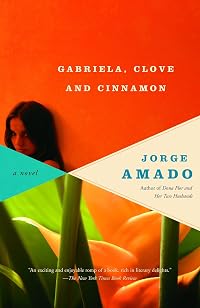
Gabriela, Clove and Cinnamon
by Jorge Amado
On This Page
Description
Story of cacao and cuckoldry in a Bahian seaport in the 1920's, and of a Brazilian jungle beauty who changes the mores of the town.Tags
Recommendations


















Member Recommendations

tcw as much as Gabriela, Clove and Cinnamon portrays the sultry lazy way of a life long since past, The Two deaths of Qunicas Wateryell shows Amado's delicious sense of humor. Read them both!
20
Member Reviews
Gabriela is a force of nature. Originally from the backlands of Brazil, she treks barefoot with a group of people to the port town of Ilheus to seek work. She is hired by Nacib Saad, whose parents were Syrian immigrants, to cook first for him (to test her out) and then for his bar, because his previous cook has just left on the eve of a major dinner he is holding to celebrate the creation of a bus line between Ilheus and other places. When she cleans herself up, she is stunningly beautiful, and Nacib soon finds her way into her bed. She turns out to be not only a star at cooking but also a star in the bedroom.
But this is not just a book about Gabriela; it is first and foremost a book about the town of Ilheus: its cacao colonels and show more their wives and mistresses and children, its politics, its economy, its classes, its romances and trysts, and its reformers. Much of the plot revolves around a go-getter named Mundinho, who has come from Rio after a tragic romance, and challenges the reigning colonel by first getting someone in Rio to agree to send an engineer to evaluate removing the sandbar in the port that interferes with big ships entering it (the colonel had previously failed at this task) and later challenging him politically.
The cast is large and extends beyond Mundinho, the colonel, Nacib, and Gabriela, although Gabriela wafts through the novel and the town like a breath of fresh air. The reader gets a vivid picture of life in the town of Ilheus in the mid-1920s when change -- economic, technological, and political -- was coming. Of course, since this is Amado, there is a lot of interest in sexual and romantic interludes. In fact, the novel opens with a colonel who kills his wife and her lover when he surprises them together, an action which is widely approved of, and this hangs over the novel until its end when a surprise occurs. The romance of Nacib and Gabriela is not uneventful, but unlike some Amado novels, this has a happy ending, and not just in the romance department.
I am an Amado fan, and this is one of my favorite novels of his. show less
But this is not just a book about Gabriela; it is first and foremost a book about the town of Ilheus: its cacao colonels and show more their wives and mistresses and children, its politics, its economy, its classes, its romances and trysts, and its reformers. Much of the plot revolves around a go-getter named Mundinho, who has come from Rio after a tragic romance, and challenges the reigning colonel by first getting someone in Rio to agree to send an engineer to evaluate removing the sandbar in the port that interferes with big ships entering it (the colonel had previously failed at this task) and later challenging him politically.
The cast is large and extends beyond Mundinho, the colonel, Nacib, and Gabriela, although Gabriela wafts through the novel and the town like a breath of fresh air. The reader gets a vivid picture of life in the town of Ilheus in the mid-1920s when change -- economic, technological, and political -- was coming. Of course, since this is Amado, there is a lot of interest in sexual and romantic interludes. In fact, the novel opens with a colonel who kills his wife and her lover when he surprises them together, an action which is widely approved of, and this hangs over the novel until its end when a surprise occurs. The romance of Nacib and Gabriela is not uneventful, but unlike some Amado novels, this has a happy ending, and not just in the romance department.
I am an Amado fan, and this is one of my favorite novels of his. show less
Amado is an excellent story-teller. "Gabriela" has enough drama and pace to be readable amidst noisy distractions and does not waste time with throw-away characters or descriptive flourish. The turn of the century, back country Brazil is ribald, gossipy, comical, obsessed with political intrigue and prepared for great violence. The book is on a mission to praise open-handed, casual and lusty sex—not just because of its frequent reference to brothel/cabarets but at its structural core and in its own method of bringing resolution (very much in opposition to the standard marriage-brings-closure model). Jealousy, pride and possession get blasted throughout.
Amado’s case was perfectly convincing for me; though Gabriela’s simple show more childishness is a little bit overdone. Some readers will get irritated when Amado drops his normal prose style in an attempt to convey the “I don’t get it” inner monologue of an otherwise magnetic and seductive character. For instance, “Why did he have to marry her? It was awful being married, she didn’t like it at all . . . she couldn’t do any of the things she liked. She couldn’t play merry-go-round in the square . . . she couldn’t walk barefoot on the sidewalk in front of the house. She couldn’t run on the beach . . . she mustn’t do such things. It was bad to be married.” Giving Gabriela idiot diction and seven word sentences, deploying obvious bird in cage, tight shoe, flower in a vase metaphors to suggest her free-spiritedness and referring to her as a child was simply not convincing.
But, I still enjoyed every minute of reading this book. The attention to generations and whole-town atmosphere is not unlike Garcia Marquez; but this book is lighter, less deliberate and totally rooted in reality. show less
Amado’s case was perfectly convincing for me; though Gabriela’s simple show more childishness is a little bit overdone. Some readers will get irritated when Amado drops his normal prose style in an attempt to convey the “I don’t get it” inner monologue of an otherwise magnetic and seductive character. For instance, “Why did he have to marry her? It was awful being married, she didn’t like it at all . . . she couldn’t do any of the things she liked. She couldn’t play merry-go-round in the square . . . she couldn’t walk barefoot on the sidewalk in front of the house. She couldn’t run on the beach . . . she mustn’t do such things. It was bad to be married.” Giving Gabriela idiot diction and seven word sentences, deploying obvious bird in cage, tight shoe, flower in a vase metaphors to suggest her free-spiritedness and referring to her as a child was simply not convincing.
But, I still enjoyed every minute of reading this book. The attention to generations and whole-town atmosphere is not unlike Garcia Marquez; but this book is lighter, less deliberate and totally rooted in reality. show less
An entertaining romp through the moment in time of Brazil's history where the lawlessness of plantation owners makes way for modernity. I thought the book enjoyable and light. Amado's portrays the conflict between the old ways and the new both through the fierce politics of the town and through the everyday life of a bar owner and the woman he falls in love with.
I've always enjoyed novels where the tension between rules, breaking them and flaunting them comes into play and is resolved in new modern ways without abandoning the old. Amado does this wonderfully.
I've always enjoyed novels where the tension between rules, breaking them and flaunting them comes into play and is resolved in new modern ways without abandoning the old. Amado does this wonderfully.
Sadly I lost my review of this book in the Great Deleting Every File in My Documents Error of 2003. I remember liking this book, although the characterization of Gabriela verged on the borderline between empowered woman testing the social norms and sexist pornographic fantasy. I decided that Gabriel personified the quote from many a bumper sticker "Well behaved women rarely make history." This was a good book about changes coming to a traditional Brazilian community.
Jorge Amado's novel "Gabriela, Clove and Cinnamon" is the story of a Brazilian town going through its growing pains. I liked the book, but didn't love it.... the story was a little simple though the characters were interesting enough to keep things going.
Ilheus is a growing town -- its character changing from a wild west type place where men had to carve their cacao plantations out of deep groves to a booming metropolis that, with removal of a sandbar in its port, will be able to trade directly with European cities. In the midst of this, a migrant worker arrives named Gabriela, who symbolizes all that was wild and free about the area in the past.
The book has a whole town of characters, who are varying and interesting. The "romance" show more aspect of this book actually kind of bogged it down for me, surprisingly, but I found the town politics and characters more interesting. show less
Ilheus is a growing town -- its character changing from a wild west type place where men had to carve their cacao plantations out of deep groves to a booming metropolis that, with removal of a sandbar in its port, will be able to trade directly with European cities. In the midst of this, a migrant worker arrives named Gabriela, who symbolizes all that was wild and free about the area in the past.
The book has a whole town of characters, who are varying and interesting. The "romance" show more aspect of this book actually kind of bogged it down for me, surprisingly, but I found the town politics and characters more interesting. show less
While I found it a difficult to read in the beginning as several characters were introduced, I eventually found myself loving this book. Nacib and Gabriela are the main protagonists, but yet each character plays a role that is above that of sidekick. As I turned each page, I started to enjoy reading more about the others in Ilhèus, especially Josuè and Gloria. The only irritating thing I found was Gabriela's naivetè. After a while, she became tiresome and I really wanted her to wake up and understand everything around her. Finally, I realized that she did understand, but in her own way. The good definitely outweighed the bad and I would recommend this book to anyone.
A life-changer. I read this book for the first time in 1976, in Brazil, on a two-month vacation with a former flame. We spent a week in Ilheus. He's gone now, but the magic of this story has never paled. I re-read it often. Still my favorite of all Amado's astonishing novels.
Members
- Recently Added By
Lists

1001 Books You Must Read Before You Die
1,448 works; 1,134 members

Magic Realism
371 works; 52 members

Canon de la narrativa universal del siglo XX
254 works; 6 members

1950s
340 works; 22 members

Latin American Literature
50 works; 11 members

Maybe This Year? Books to Look Forward To
412 works; 9 members

My TBR
371 works; 3 members
Speculative Fiction from around the World
610 works; 18 members
Canon de la narrativa universal del s. XX (cicutadry)
499 works; 3 members

The 10 greatest novels ever in portuguese language
10 works; 1 member

Greatest brazilian novels of 20th century
50 works; 2 members
Talk Discussions
Past Discussions
Group Read, May 2016: Gabriela, Cinnamon and Clove in 1001 Books to read before you die (May 2016)
Author Information

152+ Works 10,840 Members
Jorge Amado, August 10, 1912 - August 6, 2001 Elected to the Brazilian Academy of Letters, Jorge Amado possesses a talent for storytelling as well as a deep concern for social and economic justice. He was born in Bahia, Brazil, in 1912. Some critics claim that his early works suffer from his politics. Others commonly express reservations show more concerning Amado's sentimentality and erotico-mythic stereotyping. In the works represented in English translation, his literary merits prevail. The Violent Land (1942) chronicles the development of Brazilian territory and struggles for its resources, memorializing the deeds of those who built the country. Gabriela, Clove and Cinnamon (1958), which achieved critical and popular success in both Brazil and the United States, tells a sensual love story of a Syrian bar owner and his beautiful cook. Home Is the Sailor (1962) introduces Captain Vasco Moscoso de Aragao, a comic figure in the tradition of Don Quixote. In Dona Flor and Her Two Husbands (1966), Amado introduced the folk culture of shamans and Yorube gods. The protagonists of Shepherds of the Night (1964) are Bahia's poor. (Bowker Author Biography) Jorge Amado has been called the greatest twentieth-century Brazilian novelist. He was born in 1912 in Ilheus, in the northeastern-most state of Bahai. This area serves as the backdrop for most of Amado's work, which reflects a deep appreciation of the Brazilian essence. Amado's works have made him a national figure in Brazil. Amado's early novels were shaped by a belief in Marxism, and relate the sufferings of humble fishermen and cocoa plantation workers. By the 1950s, he had turned his attention to the plight of middle-class Bahains. This more jovial approach brought him worldwide acclaim, and his keen comic sense and appreciation of the common man have drawn comparisons to the novels of Charles Dickens. Music, cuisine, and passion figure prominently in Amado's literary output. Amado's works have been translated from Portuguese into more than forty languages, have sold over fifty million copies worldwide, and have been reworked for film, television, and stage. His portraits of commanding female characters, including Gabriela from Gabriela, Clove and Cinnamon, and Dona Flor from Dona Flor and Her Two Husbands, have been adapted to the screen, and actress Sonia Braga earned her initial success in these roles. Other titles include The Sand Captains; Memory of a Child; The War of the Saints; and Home Is the Sailor. (Bowker Author Biography) show less
Some Editions
Awards and Honors
Awards
Distinctions
Notable Lists
Series
Belongs to Publisher Series
Work Relationships
Common Knowledge
- Canonical title
- Gabriela, Clove and Cinnamon
- Original title
- Gabriela, cravo e canela
- Alternate titles*
- Gabriela, passie en politiek
- Original publication date
- 1958
- People/Characters*
- Gabriela; Nacib Saad; Mundhinho Falcao; Ramiro Bastos
- Important places
- Ilhéus, Brazil
- Related movies*
- Gabriela (1983 | IMDb); Gabriela (2012 | IMDb); Gabriela (1975 | IMDb)
- Epigraph
- Color of cinnamon,
Clove's sweet smell,
I've come a long way
To see Gabrielle.
Song of the cacao region - First words
- On a bright spring day, old Filomena finally carried out her long-standing threat. (Foreword)
In that year of 1925, when the idyll of the mulatto girl Gabriela and Nacib the Arab began, the rains continued long beyond the proper and necessary season.
Some time afterwards, Colonel Jesuino Mendonca stood before a jury, accused of having shot to death his wife, Sinhazinha Guedes Mendonca, and the dental surgeon, Osmundo Pimental, for reasons of jealousy. (Postscript) - Last words
- (Click to show. Warning: May contain spoilers.)Thus it has always been, in every society. (Foreword)
(Click to show. Warning: May contain spoilers.)And so ends the story of Nacib and Gabriela, with the flame of love born anew from its own ashes.
(Click to show. Warning: May contain spoilers.)For the first time in the history of Ilhéus, a cacao colonel found himself sentenced to prison for having murdered his adulterous wife and her lover. (Postscript) - Publisher's editor*
- Circulo do livro
- Blurbers
- Dahl, Roald
- Original language
- Portuguese
*Some information comes from Common Knowledge in other languages. Click "Edit" for more information.
Classifications
- Genres
- General Fiction, Fiction and Literature, Romance
- DDC/MDS
- 813 — Literature & rhetoric American literature in English American fiction in English
- LCC
- PQ9697 .A647 .G313 — Language and Literature French, Italian, Spanish and Portuguese literatures Portuguese literature Provincial, local, colonial, etc. Brazil
- BISAC
Statistics
- Members
- 1,698
- Popularity
- 13,107
- Reviews
- 26
- Rating
- (3.94)
- Languages
- 19 — Catalan, Czech, Danish, Dutch, English, Estonian, Finnish, French, German, Hebrew, Hungarian, Italian, Romanian, Russian, Slovak, Spanish, Swedish, Turkish, Portuguese (Brazil)
- Media
- Paper, Audiobook, Ebook
- ISBNs
- 86
- ASINs
- 39