The Double Death of Quincas Water-Bray
by Jorge Amado
On This Page
Description
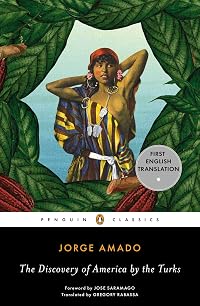
"Along with The Discovery of America by the Turks, two masterworks by the greatest Brazilian novelist of the twentieth century, published for the centennial of his birth. Widely considered the greatest work by the foremost Brazilian author of the twentieth century, The Double Death of Quincas Water-Bray comes to Penguin Classics in a new translation by the dean of Portuguese-language translators, Gregory Rabassa. It tells the story of Joaquim Soares da Cunha, who drops dead after he abandons show more his life of upstanding citizenship to assume the identity of Quincas Water-Bray, a "champion drunk" and bum who is whisked along on a postmortem journey that climaxes in his loss at sea"-- show lessTags
Recommendations

























Member Recommendations

tcw as much as Gabriela, Clove and Cinnamon portrays the sultry lazy way of a life long since past, The Two deaths of Qunicas Wateryell shows Amado's delicious sense of humor. Read them both!
Member Reviews
Quincas Wateryell’s double life, his wife and children prayed for him after he called them vipers and, without so much as a glance over his shoulder, walked out of his respectable middle-class home forever. And to think, such an obedient, meek husband and father, a former exemplary employee of the State Rent Board; the derelicts, tramps, hobos, gamblers and prostitutes in the squalid neighborhoods of his second life all loved him, their first and foremost shinning star of seedy bar and sailor skiff (Quincas’ great-great grandfather was a captain and Quincas could feel the sea in his blood), through ten glorious years of carousing, marathon card games, rum drinking and thousands of debaucheries, their leader, Daddy, great pal and show more hero would spin his new life around a squalid flophouse where he would occasionally crash in his bare, dingy room furnished with sagging, moth-eaten cot; leader and pal, Daddy and hero (did I previously mention his roles? If so, it bears repeating), his arms always spread wide, embracing down-and-outers against all odds, his open heart, his warm smile, rum-fueled fire sparkling in his eyes - all this is noble, splendid, spirited, liberating and caused his family endless embarrassment and shame.
A friend recently wrote me saying how another world-renowned author from Brazil couldn’t hold a candle to the storytelling of Jorge Amado. It’s hard to argue with this statement since Jorge's nearly thirty novels, astonishing literary masterpieces loved by millions of readers, from intellectuals and esteemed critics to workers in the field, prove Jorge to be among the world’s foremost storytelling giants.
And please do not underestimate this Jorge Amado novella under review – its less than one hundred pages contain more sheer energy, excitement and euphoria, joy and jubilance than an entire shelf of works many times its length penned by a good number of other authors.
The spirit of wild, intoxicated Dionysius has an undeniable presence on every single page. If you are not yet acquainted with the author, this little gem is the perfect place to imbibe some Jorge Amado storytelling splendor. Set your spirit free! show less
Amado packs quite a bit to think about in these few pages. Life. Death. Appearances. Love. Duty. Friendship. Families. Freedom. Choices. Dreams. A little bit funny & irreverent; a bit bittersweet too. It's not quite surreal, but there is a mystical or mysterious element to it.
[Fyi, the review from The Millions (which I read after finishing the story), points out a few disturbing things about the author which may or may not sway your decision to read him.]
[Fyi, the review from The Millions (which I read after finishing the story), points out a few disturbing things about the author which may or may not sway your decision to read him.]
One day, Joaquim Soares da Cunha, up until that point a somewhat retiring but completely respectable civil servant, left his completely respectable family, calling them "vipers," and started living with the desperately poor residents of Bahia, getting drunk on cachcaca and consorting with prostitutes. He took on a new name, Quincas, to which the epithet "Water-Bray" was added as a result of a memorable incident, and became beloved as the "king of the tramps" (although I don't like the translator's use of the word "tramps," which suggests to me someone on the move, while Quincas stays in a shabby apartment).
As this novella opens, Quincas has died, and someone from the neighborhood goes to notify his family: his daughter Vanda, her show more husband, and Quincas/Joaquim's brother and sister. This puts them in an awkward position. While they are glad that his death puts an end to their embarrassment, they feel compelled to bury him properly so that nobody can say they didn't but on't want to spend a lot of money or call attention to the funeral. Thus they decide to provide him with some decent clothes and a coffin, but leave him in the room he rented until the funeral the next day. (The son-in-law is miffed that the dead man gets a new pair of shoes while he could only afford to resole an old pair, and they skimp by not buying the corpse underwear.) They promise themselves they will stay with the body until the funeral: the women during the day and the men at night (because it's a "bad" neighborhood).
While they are watching the body (which seems to talk to the daughter occasionally), four of Quincas's friends arrive. Needless to say, the groups do not mix, and eventually the brother, the only one still there, leaves, on the promise that the friends will stay with the body. The friends are disturbed that the family has not provided any chairs, food, or drink for the people who come to pay their respects, and go out for primarily liquid refreshment. Clearly they are the ones who really love Quincas (indeed, the whole community does), although this doesn't stop two of them from arguing heatedly about who should inherit his favorite woman, one of the local prostitutes. Thinking the corpse seems unhappy, they change his clothes back to his old ones, prop him up, offer him drinks, and end up taking him around the neighborhood, until he ends up having his "second" death.
This is a really fun satire, skewering the pretensions of the oh-so-proper family and providing a larger-than-life experience. show less
As this novella opens, Quincas has died, and someone from the neighborhood goes to notify his family: his daughter Vanda, her show more husband, and Quincas/Joaquim's brother and sister. This puts them in an awkward position. While they are glad that his death puts an end to their embarrassment, they feel compelled to bury him properly so that nobody can say they didn't but on't want to spend a lot of money or call attention to the funeral. Thus they decide to provide him with some decent clothes and a coffin, but leave him in the room he rented until the funeral the next day. (The son-in-law is miffed that the dead man gets a new pair of shoes while he could only afford to resole an old pair, and they skimp by not buying the corpse underwear.) They promise themselves they will stay with the body until the funeral: the women during the day and the men at night (because it's a "bad" neighborhood).
While they are watching the body (which seems to talk to the daughter occasionally), four of Quincas's friends arrive. Needless to say, the groups do not mix, and eventually the brother, the only one still there, leaves, on the promise that the friends will stay with the body. The friends are disturbed that the family has not provided any chairs, food, or drink for the people who come to pay their respects, and go out for primarily liquid refreshment. Clearly they are the ones who really love Quincas (indeed, the whole community does), although this doesn't stop two of them from arguing heatedly about who should inherit his favorite woman, one of the local prostitutes. Thinking the corpse seems unhappy, they change his clothes back to his old ones, prop him up, offer him drinks, and end up taking him around the neighborhood, until he ends up having his "second" death.
This is a really fun satire, skewering the pretensions of the oh-so-proper family and providing a larger-than-life experience. show less
"Novella" is an overstatement for the length of this book, about 50 normally formatted pages. But it is a gross understatement of the epic scope and depth of humanity it portrays. The main character, Joaquim Soares da Cunha or Quincas Water-Bray, is dead for the entire book. But he is also fuller and more alive than most fictional creations.
The plot is simple enough: Quincas, dubbed "the king of the tramps of Bahia" by the newspapers, is found dead. A formerly respectable civil servant, he has spent the last decade drinking rum, gambling, consorting with prostitutes, and living under a different name apart from his family. His respectable daughter, brother, and their spouses claim the body and prepare it for a respectable burial. But show more then his tramp friends come, take the body out for one last night on the town, pour liquor down its throat, carry it around as if its drunk, refer to it as if its alive, and ultimately it "chooses" to jump off a boat and be buried at sea.
But in the course of this, reflected through the perceptions and memories of others, you get a glimpse of a larger-than-life charismatic figure in the slums and the contradictory ways in which he is viewed and processed by two sets of people. Plus it is also humorous and humane--albeit not exactly in a laugh-out-loud sort of a way. show less
The plot is simple enough: Quincas, dubbed "the king of the tramps of Bahia" by the newspapers, is found dead. A formerly respectable civil servant, he has spent the last decade drinking rum, gambling, consorting with prostitutes, and living under a different name apart from his family. His respectable daughter, brother, and their spouses claim the body and prepare it for a respectable burial. But show more then his tramp friends come, take the body out for one last night on the town, pour liquor down its throat, carry it around as if its drunk, refer to it as if its alive, and ultimately it "chooses" to jump off a boat and be buried at sea.
But in the course of this, reflected through the perceptions and memories of others, you get a glimpse of a larger-than-life charismatic figure in the slums and the contradictory ways in which he is viewed and processed by two sets of people. Plus it is also humorous and humane--albeit not exactly in a laugh-out-loud sort of a way. show less
"Novella" is an overstatement for the length of this book, about 50 normally formatted pages. But it is a gross understatement of the epic scope and depth of humanity it portrays. The main character, Joaquim Soares da Cunha or Quincas Water-Bray, is dead for the entire book. But he is also fuller and more alive than most fictional creations.
The plot is simple enough: Quincas, dubbed "the king of the tramps of Bahia" by the newspapers, is found dead. A formerly respectable civil servant, he has spent the last decade drinking rum, gambling, consorting with prostitutes, and living under a different name apart from his family. His respectable daughter, brother, and their spouses claim the body and prepare it for a respectable burial. But show more then his tramp friends come, take the body out for one last night on the town, pour liquor down its throat, carry it around as if its drunk, refer to it as if its alive, and ultimately it "chooses" to jump off a boat and be buried at sea.
But in the course of this, reflected through the perceptions and memories of others, you get a glimpse of a larger-than-life charismatic figure in the slums and the contradictory ways in which he is viewed and processed by two sets of people. Plus it is also humorous and humane--albeit not exactly in a laugh-out-loud sort of a way. show less
The plot is simple enough: Quincas, dubbed "the king of the tramps of Bahia" by the newspapers, is found dead. A formerly respectable civil servant, he has spent the last decade drinking rum, gambling, consorting with prostitutes, and living under a different name apart from his family. His respectable daughter, brother, and their spouses claim the body and prepare it for a respectable burial. But show more then his tramp friends come, take the body out for one last night on the town, pour liquor down its throat, carry it around as if its drunk, refer to it as if its alive, and ultimately it "chooses" to jump off a boat and be buried at sea.
But in the course of this, reflected through the perceptions and memories of others, you get a glimpse of a larger-than-life charismatic figure in the slums and the contradictory ways in which he is viewed and processed by two sets of people. Plus it is also humorous and humane--albeit not exactly in a laugh-out-loud sort of a way. show less
Às vezes me pergunto se o Jorge Amado é pra mim, mas dessa novelinha curtíssima eu gostei. Acho que gostei mesmo porque me lembrou muito o caso hollywoodiano de quando o Errol Flynn roubou o corpo do John Barrymore, dois notórios alcoolistas, e o levou para uma última rodada.
Da austero, rispettabile e sottomesso marito e padre di famiglia a vagabondo, ubriacone e idolo delle prostitute, la parabola gloriosa di Quincas, detto l'acquaiolo per il suo disgusto nei confronti dell'acqua come bevanda.
Una celebrazione della doppia natura dell'uomo e del meticciato culturale baiano, in un romanzo breve che contiene moltissimi degli argomenti più cari ad Amado.
Una celebrazione della doppia natura dell'uomo e del meticciato culturale baiano, in un romanzo breve che contiene moltissimi degli argomenti più cari ad Amado.
Members
- Recently Added By
Lists

20th Century Literature
1,161 works; 55 members

Short and Sweet
246 works; 24 members

Best Literature in Portuguese
15 works; 2 members

Want To Read
5 works; 1 member
Author Information

165+ Works 10,949 Members
Jorge Amado, August 10, 1912 - August 6, 2001 Elected to the Brazilian Academy of Letters, Jorge Amado possesses a talent for storytelling as well as a deep concern for social and economic justice. He was born in Bahia, Brazil, in 1912. Some critics claim that his early works suffer from his politics. Others commonly express reservations show more concerning Amado's sentimentality and erotico-mythic stereotyping. In the works represented in English translation, his literary merits prevail. The Violent Land (1942) chronicles the development of Brazilian territory and struggles for its resources, memorializing the deeds of those who built the country. Gabriela, Clove and Cinnamon (1958), which achieved critical and popular success in both Brazil and the United States, tells a sensual love story of a Syrian bar owner and his beautiful cook. Home Is the Sailor (1962) introduces Captain Vasco Moscoso de Aragao, a comic figure in the tradition of Don Quixote. In Dona Flor and Her Two Husbands (1966), Amado introduced the folk culture of shamans and Yorube gods. The protagonists of Shepherds of the Night (1964) are Bahia's poor. (Bowker Author Biography) Jorge Amado has been called the greatest twentieth-century Brazilian novelist. He was born in 1912 in Ilheus, in the northeastern-most state of Bahai. This area serves as the backdrop for most of Amado's work, which reflects a deep appreciation of the Brazilian essence. Amado's works have made him a national figure in Brazil. Amado's early novels were shaped by a belief in Marxism, and relate the sufferings of humble fishermen and cocoa plantation workers. By the 1950s, he had turned his attention to the plight of middle-class Bahains. This more jovial approach brought him worldwide acclaim, and his keen comic sense and appreciation of the common man have drawn comparisons to the novels of Charles Dickens. Music, cuisine, and passion figure prominently in Amado's literary output. Amado's works have been translated from Portuguese into more than forty languages, have sold over fifty million copies worldwide, and have been reworked for film, television, and stage. His portraits of commanding female characters, including Gabriela from Gabriela, Clove and Cinnamon, and Dona Flor from Dona Flor and Her Two Husbands, have been adapted to the screen, and actress Sonia Braga earned her initial success in these roles. Other titles include The Sand Captains; Memory of a Child; The War of the Saints; and Home Is the Sailor. (Bowker Author Biography) show less
Some Editions
Awards and Honors
Notable Lists
Series
Belongs to Publisher Series
Work Relationships
Is contained in
Has the adaptation
Common Knowledge
- Canonical title
- The Double Death of Quincas Water-Bray
- Original title
- A Morte e a Morte de Quincas Berro Dágua
- Alternate titles
- The Two Deaths of Quincas Wateryell
- Original publication date
- 1959
- Important places
- São Salvador da Bahia de Todos os Santos, Brazil
- Dedication*
- Für Laís und Rui Antunes mit ihren
pernambucanisch-brüderlichen Haus, in dessen
freundschaftlicher Wärme Quincas und sein
Anhang entstanden. - First words*
- Bis heute herrscht Verwirrung über die Todesart des Quincas Berro Dágua, des Jochen Wasserbrüller.
- Original language
- Portuguese
*Some information comes from Common Knowledge in other languages. Click "Edit" for more information.
Classifications
- Genres
- Fiction and Literature, General Fiction
- DDC/MDS
- 869.3 — Literature & rhetoric Spanish Literature Literatures of Portuguese and Galician languages Portuguese fiction
- LCC
- PQ9697 .A647 .M613 — Language and Literature French, Italian, Spanish and Portuguese literatures Portuguese literature Provincial, local, colonial, etc. Brazil
- BISAC
Statistics
- Members
- 466
- Popularity
- 65,563
- Reviews
- 19
- Rating
- (4.10)
- Languages
- 12 — English, Esperanto, Estonian, Finnish, French, German, Hebrew, Icelandic, Italian, Portuguese, Spanish, Turkish
- Media
- Paper, Audiobook, Ebook
- ISBNs
- 19
- ASINs
- 6