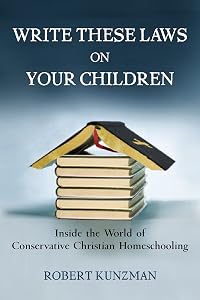
Write These Laws on Your Children: Inside the World of Conservative Christian Homeschooling
by Robert Kunzman
On This Page
Description
Homeschooling is a large and growing phenomenon in American society--between 1999 and 2003 it grew at ten times the rate of public school enrollments. Current estimates suggest that about two million kids are homeschooled, but information about them is incomplete. Here, educator Robert Kunzman uses his unprecedented access to six conservative Christian homeschooling families to explore this elusive world, from the day-to-day lives of its adherents to its broader aspirations to transform show more American culture and politics. He shows us what their homeschooling experience looks like firsthand, what their political and religious beliefs are, and what their kids learn about democratic citizenship and engaging with people with different beliefs. Woven throughout Kunzman's narrative are larger questions about the purpose of public education, what makes an educated citizenry--and how American political and intellectual life could change as conservative Christian homeschooled children reach adulthood.--From publisher description. show lessTags
Recommendations


Member Reviews
Excellent qualitative case study analysis of American conservative Christian homeschoolers. The social scientist in me was disappointed at the lack of comprehensive data on this population, but this isn't Kunzman's fault; the movement resists data collection and participation in studies, so case studies are our best window into this population.
I found this book quite even-handed, with criticisms of homeschooling and public schooling alike, and many times reflecting on whether particular types of students or issues would really be better served by public schools. It's a question he addresses. It's true that Kunzman is not converted to the homeschooling bandwagon after his research concludes, but that hardly indicates he's a demagogue. show more The negative reviews I've seen are all reactionary from homeschoolers. It's a heavily politicized issue, sure. But there's good information in here regardless, and the reflection they may not like -- for instance, in highly patriarchal Christian families who limit daughters' educational opportunities -- is a true one.
Recommended. show less
I found this book quite even-handed, with criticisms of homeschooling and public schooling alike, and many times reflecting on whether particular types of students or issues would really be better served by public schools. It's a question he addresses. It's true that Kunzman is not converted to the homeschooling bandwagon after his research concludes, but that hardly indicates he's a demagogue. show more The negative reviews I've seen are all reactionary from homeschoolers. It's a heavily politicized issue, sure. But there's good information in here regardless, and the reflection they may not like -- for instance, in highly patriarchal Christian families who limit daughters' educational opportunities -- is a true one.
Recommended. show less
I’ll say upfront that I don’t believe I’m the target audience of Write These Laws on Your Children. Rather than being an outside observer, or a curious bypasser who wonders about the conservative Christian homeschooling movement, I’m a member of it. As a result, my take on Robert Kunzman’s work is going to be a bit different.
Setting out with the goal to ‘get inside of’ the Christian homeschooling movement, Kunzman embarked on a year’s journey (funded by the National Academy of Education – this should be a bit of a hint about the book’s contents) to spend time visiting American homeschoolers, observing their days and analyzing them.
Kunzman appears to be a thinker; a former of ideas about educational policy and show more philosophy. Throughout his work it’s quite obvious that he’s rather pleased with the status quo of the public educational system, as that seems to be his yardstick for comparison when it comes to reflecting upon the education homeschoolers are receiving. What he clearly isn’t is someone who can deeply understand the convictions of conservative homeschoolers, he also lacks an ability to understand the differences in the priorities in education between a public school and a typical Christian homeschool.
Write These Laws On Your Children is however, quite well written, and as a homeschooler myself, I’m always eager to take a peek into the lives of other home educators to see how they work things for their family. The family portraits are certainly very interesting, but are always viewed very heavily through Kunzman’s own set of educational priorities, which focus strongly upon formal academics and teaching pluralism.
He is quick to point out the flaws he finds in the families he meets with – a mother who snaps at her child (yes, parents ARE more likely to do this than paid professionals, homeschooling is LIFE after all, but what of the child in a public school who is repeatedly told they are stupid?), a child who struggles with mastering their math facts at an age when Kunzman believes they should be mastered (what of the mathematically illiterate adults the public school systems have been producing for decades?), and so on.
Unfortunately I’m not sure that his faultfinding is truly accurate or well placed. Without understanding the ins-and-outs of each child and their educational history it’s hard to say whether the child who struggles with math would not also be struggling at public school (we ALL know children who do or have failed to learn in a public setting.) Perhaps this child simply struggles with math and isn’t particularly gifted in this area? We all have strengths and weaknesses. There may even be a learning difficulty at work in this area, again, I don’t know enough to say, and I don’t believe Kunzman does either.
I’m left with the feeling that Kunzman’s work is intended more for policy makers and public educators than it is general members of the public. It certainly won’t resonate with homeschoolers who - if they are of the conservative Christian variety that Kunzman seeks to examine – will not sympathize with his worldview or ultimately agree with, or be swayed by his conclusions.
Reviewed at quiverfullfamily.com show less
Setting out with the goal to ‘get inside of’ the Christian homeschooling movement, Kunzman embarked on a year’s journey (funded by the National Academy of Education – this should be a bit of a hint about the book’s contents) to spend time visiting American homeschoolers, observing their days and analyzing them.
Kunzman appears to be a thinker; a former of ideas about educational policy and show more philosophy. Throughout his work it’s quite obvious that he’s rather pleased with the status quo of the public educational system, as that seems to be his yardstick for comparison when it comes to reflecting upon the education homeschoolers are receiving. What he clearly isn’t is someone who can deeply understand the convictions of conservative homeschoolers, he also lacks an ability to understand the differences in the priorities in education between a public school and a typical Christian homeschool.
Write These Laws On Your Children is however, quite well written, and as a homeschooler myself, I’m always eager to take a peek into the lives of other home educators to see how they work things for their family. The family portraits are certainly very interesting, but are always viewed very heavily through Kunzman’s own set of educational priorities, which focus strongly upon formal academics and teaching pluralism.
He is quick to point out the flaws he finds in the families he meets with – a mother who snaps at her child (yes, parents ARE more likely to do this than paid professionals, homeschooling is LIFE after all, but what of the child in a public school who is repeatedly told they are stupid?), a child who struggles with mastering their math facts at an age when Kunzman believes they should be mastered (what of the mathematically illiterate adults the public school systems have been producing for decades?), and so on.
Unfortunately I’m not sure that his faultfinding is truly accurate or well placed. Without understanding the ins-and-outs of each child and their educational history it’s hard to say whether the child who struggles with math would not also be struggling at public school (we ALL know children who do or have failed to learn in a public setting.) Perhaps this child simply struggles with math and isn’t particularly gifted in this area? We all have strengths and weaknesses. There may even be a learning difficulty at work in this area, again, I don’t know enough to say, and I don’t believe Kunzman does either.
I’m left with the feeling that Kunzman’s work is intended more for policy makers and public educators than it is general members of the public. It certainly won’t resonate with homeschoolers who - if they are of the conservative Christian variety that Kunzman seeks to examine – will not sympathize with his worldview or ultimately agree with, or be swayed by his conclusions.
Reviewed at quiverfullfamily.com show less
Ratings
Members
- Recently Added By
Lists

Books With Complete Sentence Titles
502 works; 17 members
Author Information
2+ Works 48 Members
Robert Kunzman is associate professor at the Indiana University School of Education and the author of Grappling with the Good: Talking about Religion and Morality in Public Schools.
Classifications
Statistics
- Members
- 37
- Popularity
- 782,367
- Reviews
- 2
- Rating
- (3.70)
- Languages
- English
- Media
- Paper, Ebook
- ISBNs
- 3
- ASINs
- 1