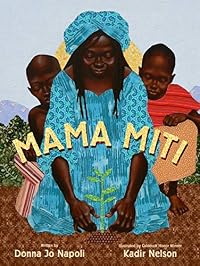
Mama Miti: Wangari Maathai and the Trees of Kenya
by Donna Jo Napoli
On This Page
Description
The story of Wangari Maathai, who in 1977 founded the Green Belt Movement, an African grassroots organization, and in 2004 was the first African woman to be awarded the Nobel Peace Prize.Tags
Recommendations


















Member Reviews
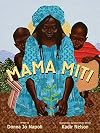
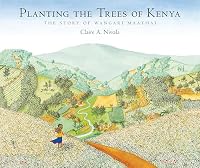
Napoli adopts a folkloric narrative technique to showcase the life work of Wangari Maathai, whose seminal role in Kenya’s reforestation earned her the Nobel Peace Prize in 2004. When, one after the other, women journey to Maathai to seek counsel about scarce food, disappearing firewood and ailing animals, she tells them, “Plant a tree….Thayu nyumba—peace, my people.” Specific tree species and their utility are mentioned in the text and reiterated in a glossary. Nelson’s pictures, a jaw-dropping union of African textiles collaged with oil paintings, brilliantly capture the villagers’ clothing and the greening landscape. The richly modulated oils portray the dignified, intent gazes of Maathai and other Kenyans, and the show more illustrator’s signature use of perspective suggests the everyday heroism of his subjects. In addition to incorporating the fabric collages (and some whimsy in his animal depictions), the artist newly focuses on landscape, with many double-page spreads depicting undulating fields, distant mountains and a white-hot sky. Deserving of a special place with Claire Nivola’s Planting the Trees of Kenya (2008), this is, in a word, stunning. (Picture book. 4-8)
-Kirkus Review show less
-Kirkus Review show less
Author Donna Jo Napoli and illustrator Kadir Nelson join forces in this picture-book examination of the activism of Wangari Maathai, founder of Kenya's tree-planting Green Belt Movement, and winner of the 2004 Nobel Peace Prize. Having grown up with a great respect for the mugumo, or spreading fig tree, Maathai eventually became a veterinary doctor, a university professor, and a woman who encouraged other women to plant trees, thereby combatting the deforestation of her country, and all the ills it brought. Eventually she gained the title 'Mama Miti,' or mother of trees...
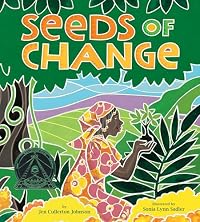
Mama Miti: Wangari Maathai and the Trees of Kenya is the fourth picture-book biography I have read of Maathai, following upon Claire A. Nivola's Planting the Trees of show more Kenya: The Story of Wangari Maathai, Jeanette Winter's Wangari's Trees of Peace: A True Story from Africa and Jen Cullerton Johnson and Sonia Lynn Sadler's Seeds of Change: Wangari's Gift to the World. I read these other books some years ago, in 2010 and 2011, when all of these titles were first being publishers, but somehow I never got to this one. I'm glad I've rectified that omission, as I think it is an inspiring and beautiful book. The narrative here is less of a biography proper, and more of a description of various women seeking Maathai's aid for various problems - sick goats, a lack of firewood, and so on - and her advice to each seeker, to plant trees. Fuller biographical details are given in the after matter. Kadir Nelson's artwork, done in oil paint and fabric, is boldly colorful and immensely striking - well worth seeking out, for its own sake. I don't know that this is a favorite, of the books I have read on this subject - I tend to prefer the Nivola, or the Johnson/Sadler - but it has undeniable worth. Recommended to young tree lovers and environmental activists, and to picture-book readers in the market for inspiring true stories. show less
Mama Miti: Wangari Maathai and the Trees of Kenya is the fourth picture-book biography I have read of Maathai, following upon Claire A. Nivola's Planting the Trees of show more Kenya: The Story of Wangari Maathai, Jeanette Winter's Wangari's Trees of Peace: A True Story from Africa and Jen Cullerton Johnson and Sonia Lynn Sadler's Seeds of Change: Wangari's Gift to the World. I read these other books some years ago, in 2010 and 2011, when all of these titles were first being publishers, but somehow I never got to this one. I'm glad I've rectified that omission, as I think it is an inspiring and beautiful book. The narrative here is less of a biography proper, and more of a description of various women seeking Maathai's aid for various problems - sick goats, a lack of firewood, and so on - and her advice to each seeker, to plant trees. Fuller biographical details are given in the after matter. Kadir Nelson's artwork, done in oil paint and fabric, is boldly colorful and immensely striking - well worth seeking out, for its own sake. I don't know that this is a favorite, of the books I have read on this subject - I tend to prefer the Nivola, or the Johnson/Sadler - but it has undeniable worth. Recommended to young tree lovers and environmental activists, and to picture-book readers in the market for inspiring true stories. show less
Mama Miti tells the story about a community in Africa that need Wangari Muta Maathai, also known as Mama Miti, to show them how to use trees as a means for a variety of resources. This contemporary realistic fiction follows Mama Miti on her journey to helping others. As people in the community run into problems, they call for Mama Miti to help them. For example, "Wangari told women to plant murigono, whose branches make good stakes for training yam vines. She told them to plant muhuti as a living fence around their animal yards. She told them to plant muigoya, whose leaves could be wrapped around bananas to ripen them. She told them to plant muringa for the pure joy of their white flowers." I liked how the book incorporated the names of show more the trees and showed that the different types of trees are used for different reasons. I also liked the unique style of the illustrations. I noticed that the pictures were created by different patterned colors for the grass, sky, clothing. For example, the grass had swirls and Mama Miti's sweater had a crosshatch pattern, but the people themselves were realistically painted. I liked that after every time Mama Miti had helped someone, she always said the phrase, "Thayu nyumba", meaning peace, my people. The author added in a translation to add in more culture and allow readers to learn new words. The main idea that I got from this reading is to stay peaceful and recognize the importance and resources, nature has to offer us. show less
Mama Miti is a wonderfully written and illustrated picture book biography that tells the story of Wangari Maathai. The story is about how many different village women would come to her for advice and help with different situations. Her advice always leads the people to planting trees. The illustrations were beautiful. I would sometimes find myself staring at them because they always drew my eyes away.
Mama Miti tells the true story of Kenya’s Greenbelt movement in a way that will engage children and parents through the use of folk-tale-like structure and bright, sophisticated illustrations. The book portrays the leadership of Wangari Maathai, who inspired her community to improve their lives and their country by planting trees, leading to a national movement that earned Maathai a Nobel Prize in 2004. Though detailed information is provided in an afterword, the text of the story has a simple and repetitive structure that will allow for better comprehension. The text includes several Kikuyu words that children will enjoy learning, and parents will appreciate the opportunity to expose their children to a new language. The show more illustrations, oil paint and textile collages, call back to Kenyan culture with their rich colors and contrasting prints. The images do not advance the story’s plot, but their portrayals of lush greenery and strong, empowered people lend a celebratory tone that complements the text. A list of resources for learning about the Greenbelt movement is provided in the afterword. Mama Miti is the story of people who solve a daunting problem little by little, and would be an excellent tool for teaching children about Africa and about the importance of nature, community and perseverance. Glossary. Highly Recommended. Grades 1-3 show less
In my opinion this is a good biography novel that successful told the story of Wangari Maathai and the tree planting in Kenya. This story's unique illustrations and the way the story was organized were the two main reasons I like this book. The illustrations caught the readers eyes with their unique utilization of "fabric swatches" to make up most of the picture, such as different green fabrics making up the beautiful landscape of Kenya and colorful fabrics to show the headpieces the people wore. Also, I believe the author did a nice job of organizing the story through the repetitive theme of telling different accounts, back to back, of how Wangari Maathai helped different struggling families through the planting of different trees. show more This clearly presented the information of all Wangari Maathai did to help Kenya, while also creating an enjoyable story with a nice flow. This structure also made apparent the message of the story through Wanagari repeatedly telling the families of the importance of peace and compassion to create positive change. show less
Mama Miti tells the story of Wangari Muta Maathai, who just died on September 25, 2011. She was a Nobel Peace Laureate - the first African women to win the Nobel peace prize. In awarding Maathai the Nobel peace prize in 2004, the Nobel committee said that her "unique forms of action have contributed to drawing attention to political oppression – nationally and internationally."
Maathai was the first woman in east and central Africa to obtain a PhD. She was also the first woman professor the University of Nairobi, where she taught veterinary medicine and eventually became head of the faculty.
While serving on the National Council of Women of Kenya, she became dedicated to helping with the struggles of women in rural Kenya. Noticing how show more the rapid environmental degradation was affecting women's lives, she encouraged them to plant trees to ensure future supplies of firewood and to protect water sources and crops. To that end, she founded the Green Belt Movement in 1977, which led to the planting of more than thirty million trees.
Maathai's agenda widened as she joined efforts to stop powerful politicians grabbing land, especially forests. This brought her into conflict with the authorities, and she was beaten and arrested numerous times. Her bravery and defiance made her a hero in Kenya.
Napoli’s book was written in 2010, before Maathai’s passing. It focuses on the way “Wangari changed a country, tree by tree. She taught her people the ancient wisdom of peace with nature….She is known these days as Mama Miti – the mother of trees.”
Napoli’s prose is spare but beautiful, and conveys the struggles of women to survive in a harsh environment. But it is the amazing oil and fabric collage illustrations of Kadir Nelson that make this book exceptional. Bright and beautiful, each one could grace anyone’s wall at home.
An Afterword gives the facts of Maathai’s life, a list of further resources, and a glossary of African words and phrases used in the text.
Evaluation: This is a book that will inspire all ages. Highly recommended. show less
Maathai was the first woman in east and central Africa to obtain a PhD. She was also the first woman professor the University of Nairobi, where she taught veterinary medicine and eventually became head of the faculty.
While serving on the National Council of Women of Kenya, she became dedicated to helping with the struggles of women in rural Kenya. Noticing how show more the rapid environmental degradation was affecting women's lives, she encouraged them to plant trees to ensure future supplies of firewood and to protect water sources and crops. To that end, she founded the Green Belt Movement in 1977, which led to the planting of more than thirty million trees.
Maathai's agenda widened as she joined efforts to stop powerful politicians grabbing land, especially forests. This brought her into conflict with the authorities, and she was beaten and arrested numerous times. Her bravery and defiance made her a hero in Kenya.
Napoli’s book was written in 2010, before Maathai’s passing. It focuses on the way “Wangari changed a country, tree by tree. She taught her people the ancient wisdom of peace with nature….She is known these days as Mama Miti – the mother of trees.”
Napoli’s prose is spare but beautiful, and conveys the struggles of women to survive in a harsh environment. But it is the amazing oil and fabric collage illustrations of Kadir Nelson that make this book exceptional. Bright and beautiful, each one could grace anyone’s wall at home.
An Afterword gives the facts of Maathai’s life, a list of further resources, and a glossary of African words and phrases used in the text.
Evaluation: This is a book that will inspire all ages. Highly recommended. show less
Members
- Recently Added By
Lists

A Child's Book Tour of East Africa ::: Ethiopia, Kenya, Sudan, Uganda
68 works; 4 members
Author Information

116+ Works 14,403 Members
Donna Jo Napoli was born on February 28, 1948. She received a B.A. in mathematics, an M.A. in Italian literature, and a Ph.D. in general and romance linguistics from Harvard University. She has taught on the university level since 1970, is widely published in scholarly journals, and has received numerous grants and fellowships in the area of show more linguistics. In the area of linguistics, she has authored five books, co-authored six books, edited one book, and co-edited five books. She is also a published poet and co-editor of four volumes of poetry. Her first middle grade novel, Soccer Shock, was published in 1991. Her other novels include the Zel, Beast, The Wager, Lights on the Nile, Skin, Storm, Hidden, and Dark Shimmer. She is also the author of several picture books including Flamingo Dream, The Wishing Club: A Story About Fractions, Corkscrew Counts: A Story About Multiplication, The Crossing, A Single Pearl, and Hands and Hearts. She has received several awards including the New Jersey Reading Association's M. Jerry Weiss Book Award for The Prince of the Pond and the Golden Kite Award for Stones in Water. (Bowker Author Biography) show less
All Editions
Awards and Honors
Awards
Common Knowledge
- Original publication date
- 2010-01-05
Classifications
- Genres
- Nonfiction, Picture Books
- DDC/MDS
- 333.72092 — Society, Government, and Culture Economics Economics of land and energy Conservation, Alternative Energy Sources Conservation & protection Biography And History Biography
- LCC
- SB63 .M22 .N37 — Agriculture Horticulture. Plant propagation. Plant breeding Plant culture
- BISAC
Statistics
- Members
- 452
- Popularity
- 67,364
- Reviews
- 47
- Rating
- (4.06)
- Languages
- English
- Media
- Paper, Ebook
- ISBNs
- 3
- ASINs
- 3