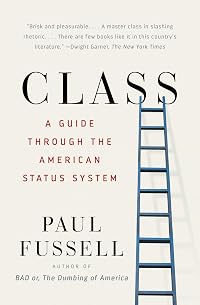
Class: A Guide Through the American Status System
by Paul Fussell
On This Page
Description
"Paul Fussell explodes the sacred American myth of social equality ... guide to the signs, symbols, and customs of the American class system ... Fussell shows us how our status is revealed by everything we do, say, and own. He describes the houses, objects, artifacts, speech, clothing styles, and intellectual proclivities of American classes from the top to the bottom"--Back coverTags
Recommendations






















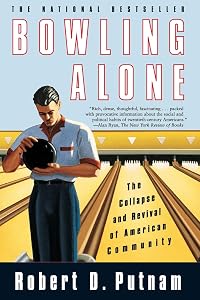






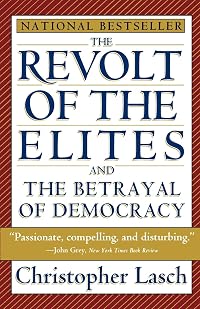


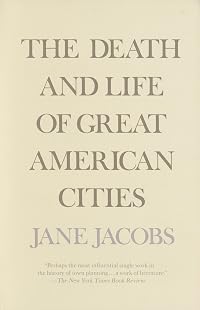
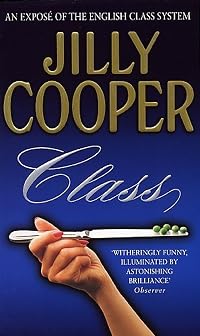



Member Recommendations
bluepiano One a guide to the US status sytem, one to the British. Like Fussell, Cooper is often dead-on but her tone is less earnest and her examples more amusing. Both books are great fun.

AfroFogey Equally funny and infinitely more snarky than the OPHB. Great observations and even quotes the Preppy handbook.
12
Member Reviews
This book I first read in the mid-80's (at a time when the author was teaching at the University, whose campus I worked on) and I while it all was funny, I was really attached to the final chapter about the "X Class" which I immediately connected with (or at least with a portion of it). That was where my affinities lay. I later learned that Douglas Coupland, the author of the novel "Generation X" got that name (not from the punk band) but from reading Fussell's "Class" and extrapolated some of the same vibes I was getting. I sensed that, at the time, but only got the confirmation from an interview I read years later. Some of the observations in this book are slightly dated, but in essence, it's a humorous book that has a fair amount of show more truth within it's pages. show less
First off, Paul Fussell’s book probably makes a lot of people angry and he admits that much in the very beginning. Twenty years later and Americans still don’t like to think that there are castes here. Some of his observations are still sadly true, other observations are just plain stereotyping. Something I wanted to read more about, but that Fussell only touched on, was the different perceptions of class. What distinguishes one class from another? He summed up the criteria according to what each class judged important -Class their defining element for determining one’s statuslower moneymiddle occupationupper taste, styleI think that’s still too general. I think class is judged individually, each person having a very personal show more idea of status… much like our very personal, highly charged ideas of ethics or morals. For example, when Fussell describes the upper class as never reading, and “never saying anything intelligent or original” (p. 32), I would immediately consider that the lowest of low class no matter how much money was involved.But then Fussell ends with chapter 9, “The X Way Out.” He describes the X class as the people who are outside the whole heirarchy schemata, unconcerned with status and all that nonsense. Freethinking, traveling, quasi-hippie wonders. This chapter was so unlike the rest of the book, stood out so much, that I had to wonder where it came from. Was this upon an editor’s/publisher’s insistence… add some saving grace? Was this a crumb of optimism thrown out for his U Penn students? An offering of an escape?Or did Fussell perhaps write this chaper first? Was all the preceeding stuff only there to bring us to the X class? Is this what he had been wanting to say all along? It really makes me suspect that this last chapter was actually the seed for the whole book. show less
Inspired to read this by a recent review in the Atlantic. Coincidentally, it turned out that I had just read an excerpt from his ex-wife's memoir (in a foodie anthology) and thus had insight on his own lifestyle relative to what he was describing and mocking. Overall, it was actually a fun book. And I really don't think it was intended to be at all serious. He made regular reference to The Preppie Handbook, which had recently made a killing (I feel so old for remembering it, too) and he seemed to mainly be trying to ride its economic coattails. He mocked his own lifestyle (without admitting it was his own) just as much as the rest. And it was interesting to see exactly what got mocked. It wasn't basic cruel snobbery. The very rich were show more treated much more cruelly than the very poor. Very much in the Paris Hilton model, the lot of them. He was remarkably sympathetic to the poor (proles), pointing out their understandable frustrations (like demeaning jobs) as an explanation of some of their tackier tendencies. And his biggest criticism of the middle class was that they are too hung up on what other people think of them, and that is really not an insult. Or, at the very least, it's very constructive criticism. (Although I'm still smarting at the repeated digs about New Yorker readers of course.) A lot of what he was describing was aspirational marketing, which consumers are more conscious of today than they were back then. Also, he made some perfectly valid (even today) observations about the major shortcomings of U.S. higher education. Overall, I don't feel compelled to try to move from middle class to 'X,' although that was his actual goal with the book. (Being that generation is enough. Confusing!) Really, they're their own kind of shallow. And grimy! Finally, his praise at the end for the bohemian lifestyle, with such attention paid to their free love practices when he hadn't addressed relationships at any point prior, makes a lot more sense when you know why his marriage crashed and burned. show less
Started out as a funny field guide to the American class system. Written in 1983 it’s astonishingly up-to-date, although of course a few things have changed. But it’s really wild how much is still exactly the same. Anyway, it started out funny but as it went on it just started seeming nastier and repetitive. If you can find it, you may enjoy the first few chapters, but you may as well bail out halfway through.
ADDED: Well this is just plain weird, the day after I review this obscure 37 year old book, it gets mentioned in a NYTimes opinion piece (great essay BTW): https://www.nytimes.com/2020/10/10/opinion/television-culture.html?referringSour...
ADDED: Well this is just plain weird, the day after I review this obscure 37 year old book, it gets mentioned in a NYTimes opinion piece (great essay BTW): https://www.nytimes.com/2020/10/10/opinion/television-culture.html?referringSour...
Paul Fussell has made a career as a social critic, or as a man with the definitions that really seem to be correct. His book seems to me accurate, and should be read by non-Americans before venturing into the Great Republic. It will help with social success, and be a good guide as to which Americans you may feel comfortable with. I wonder how PF has fared in the age of the tea-party?
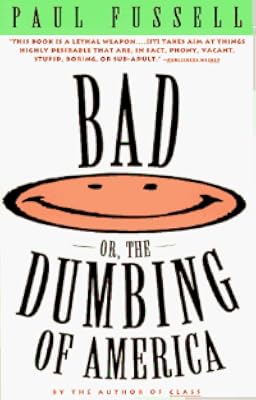
Class: a guide through the America Status System was a complete change in direction from my last few books, which made for a refreshing change of pace. Fussell is just as delightfully cranky as he was in BAD: the Dumbing of America, which I reviewed a few entries back. He is also, unfortunately, just as dated. In Class, he delineates, and then skewers, the various methods that Americans have of broadcasting social class, sparing no group his scorn. Many of his observations are as true today as when he wrote the book (1982), but others are sadly out of touch. His comments on home ownership (though by using that term I have no doubt lowered my own class in his venerable eyes), for example, seem strangely antiquated, given the current show more market. Other comments, such as those on the quality of food found in restaurants, also seem out of touch, given the changes seen in dining out in the last twenty-odd years. However, it was still fun to read, and I've been enjoying trying to identify my own class, as well as the classes of my friends and family, at least according to his scheme. One warning: don't read this if you are easily offended by pretense/pomposity. Fussell's full of both, and my boyfriend would become enraged whenever I read something out of here to him. Oops. show less
This book is full of interesting insights about social class in the US. The beginning was very informative, then it turns into a long series of examples of social class, ending with the artificial X group (which was fun to read). Among the interesting tidbits of information is the social status granted by owning a Mercedes-Benz which, remarkably, the author says was very negative in Germany. According to this author (in 1983), Mercedes-Benz was a car
"'which the intelligent young in West Germany regard, quite correctly, as 'a sign of high vulgarity, a car of the kind owned by Beverly Hills dentists or African cabinet ministers.' The worst kind of upper-middle-class types own Mercedes, (…) Speeders are either young non-Anglo-Saxon show more high-school proles hoping to impress girls of a similar sort, or insecure, status-anxious middle-class men (…) The requirements of class dictate that you drive slowly, steadily, and silently, and as near the middle of the road as possible.'" (91–92)
I am reminded that Mercedes-Benz cars were popular in the 1980’s among rulers such as Ceauşescu, Mugabe, Idi Amin, and Ferdinand Marcos. It was also in a Mercedes-Benz that the president of Deutsche Bank, Alfred Herrhausen, was killed by a bomb which resulted "in a mass of copper being projected toward the car at a speed of nearly two kilometers per second, effectively penetrating the armoured Mercedes.” (Wikipedia) Perhaps, back in 1983, all this made Fussell think Germans did not think highly of owning a Mercedes-Benz car. However, a quick glance through Google does not give me any hint that Fussell’s interpretation of the view that Germans had on Mercedes-Benz is valid today. show less
"'which the intelligent young in West Germany regard, quite correctly, as 'a sign of high vulgarity, a car of the kind owned by Beverly Hills dentists or African cabinet ministers.' The worst kind of upper-middle-class types own Mercedes, (…) Speeders are either young non-Anglo-Saxon show more high-school proles hoping to impress girls of a similar sort, or insecure, status-anxious middle-class men (…) The requirements of class dictate that you drive slowly, steadily, and silently, and as near the middle of the road as possible.'" (91–92)
I am reminded that Mercedes-Benz cars were popular in the 1980’s among rulers such as Ceauşescu, Mugabe, Idi Amin, and Ferdinand Marcos. It was also in a Mercedes-Benz that the president of Deutsche Bank, Alfred Herrhausen, was killed by a bomb which resulted "in a mass of copper being projected toward the car at a speed of nearly two kilometers per second, effectively penetrating the armoured Mercedes.” (Wikipedia) Perhaps, back in 1983, all this made Fussell think Germans did not think highly of owning a Mercedes-Benz car. However, a quick glance through Google does not give me any hint that Fussell’s interpretation of the view that Germans had on Mercedes-Benz is valid today. show less
Members
- Recently Added By
Published Reviews
ThingScore 100
For readers who somehow missed this snide, martini-dry American classic, do have your assistant Tessa run out and get it immediately (Upper), or at least be sure to worriedly skim this magazine summary over a low-fat bagel (Middle), because Fussell’s bibelot-rich tropes still resonate...
The experience of reading (and re-reading) Class is akin to wiping goggles one didn’t know were fogged. show more Fussell’s methodology settles into the brain like a virus; one soon cannot stop nanocategorizing one’s world. A quarter century later, most of Fussell’s categories live on—if with some fiscal damage. Fussell’s topmost denizens were “out of sight” in hilltop manses at the end of long, curving driveways. The billionaires in Michael Tolkin’s hilariously mordant The Return of the Player are even farther out, prow-jousting at sea in their satellite-technology-equipped yachts. show less
The experience of reading (and re-reading) Class is akin to wiping goggles one didn’t know were fogged. show more Fussell’s methodology settles into the brain like a virus; one soon cannot stop nanocategorizing one’s world. A quarter century later, most of Fussell’s categories live on—if with some fiscal damage. Fussell’s topmost denizens were “out of sight” in hilltop manses at the end of long, curving driveways. The billionaires in Michael Tolkin’s hilariously mordant The Return of the Player are even farther out, prow-jousting at sea in their satellite-technology-equipped yachts. show less
added by SnootyBaronet
Lists

Read This Next
120 works; 3 members

culture
320 works; 1 member
Author Information

24+ Works 7,316 Members
Paul Fussell Jr. was born in Pasadena, California on March 22, 1924. He was drafted into the Army in 1943 while attending Pomona College. During his tour of duty, he won the Bronze Star and two Purple Hearts. He returned to college in 1945. He received a bachelor of arts degree from Pomona College in 1947 and a master's degree and a doctorate in show more English from Harvard University. He taught English at Connecticut College for Women, Rutgers University, and the University of Pennsylvania. During this time he wrote several books on literary topics including The Rhetorical World of Augustan Humanism: Ethics and Imagery from Swift to Burke, Poetic Meter and Poetic Form, and Samuel Johnson and the Life of Writing. In 1975, he published The Great War and Modern Memory, which was a study of World War I and how its horrors fostered a disillusioned modernist sensibility. This book won both the National Book Critics Circle Award for Criticism and the National Book Award for Arts and Letters. His other works include Abroad: British Literary Traveling Between the Wars, Class: A Guide Through the American Status System, Wartime: Understanding and Behavior in the Second World War, BAD: Or, the Dumbing of America, and Doing Battle: The Making of a Skeptic. He died of natural causes on May 23, 2012 at the age of 88. (Bowker Author Biography) show less
Awards and Honors
Common Knowledge
- Original publication date
- 1983
- Dedication
- To Tucky and Sam
- First words
- Although most Americans sense that they live within an extremely complicated system of social classes and suspect that much of what is thought and done here is prompted by considerations of status, the subject has remained mu... (show all)rky.
- Last words
- (Click to show. Warning: May contain spoilers.)It could be larger, for many can join who've not yet understood that they have received an invitation.
- Blurbers
- Alison Lurie
- Canonical DDC/MDS
- 305.50973
- Canonical LCC
- HN90.S6
Classifications
- Genres
- Sociology, Nonfiction, General Nonfiction
- DDC/MDS
- 305.50973 — Society, government, & culture Social sciences, sociology & anthropology Social group - Age, Gender, Ethnicity People by social and economic levels History, geographic treatment, biography North America United States
- LCC
- HN90 .S6 — Social sciences Social history and conditions. Social problems. Social reform Social history and conditions. Social problems. By region or country
- BISAC
Statistics
- Members
- 1,461
- Popularity
- 16,031
- Reviews
- 22
- Rating
- (3.94)
- Languages
- Chinese, English, German, Hungarian
- Media
- Paper, Audiobook
- ISBNs
- 11
- ASINs
- 5