On This Page
Description
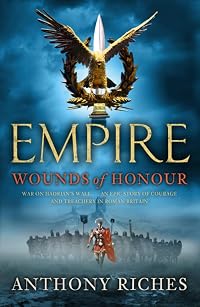
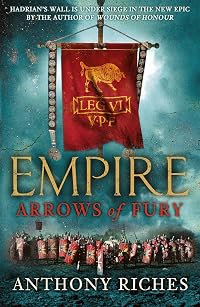
Marcus Valerius Aquila has scarcely landed in Britannia when he has to run for his life--condemned to dishonorable death by power-crazed emperor Commodus. The plan is to take a new name, serve an obscure regiment on Hadrian's Wall and lie low until he can hope for justice. Then a rebel army sweeps down from the wastes north of the Wall, and Marcus has to prove he's hard enough to lead the front line of a brutal, violent war.Tags
Recommendations
















Member Reviews
This is a real Roman hum-dinger. A magnificent slap in the face, reality check of a Historical Fiction novel. A fresh, no-nonsense, take no prisoners, exciting, testosterone-driven assault on the Historical Fiction senses. It’s one that should be listed at the top under the Wikipedia entry for ‘couldn’t put it down.’ Really good.
According to the dust jacket, Anthony Riches holds a degree in Military Studies and it shows. He knows his stuff, but doesn’t shove it in your face the whole time, like one Mr Sidebottom can tend to do. He’s gone for the angle that life and behaviour in the army, and on the parade ground, has largely been the same down the ages. And that Roman soldiers act mostly the same as their modern show more counterparts. Only the names of the god(s) they pray to and the weapons they use, have been changed. That and being able to look into the eyes of the person trying to kill you. I think what Anthony seems to be saying here is; what makes an army function well today is precisely what made an army function well back then. Training, routine, comradeship, loyalty to each other and the cause you’re fighting for and teamwork drilled in so much that it becomes unthinking second nature. The Roman Army was a professional fighting machine, just like ours are today. What I got from it was also the message that even though there’s close on two thousand years between us, we’re not that different now as people, to how they were then. It helps the reader relate to the characters and the situations. Obviously I can’t really relate to a Roman soldier facing death at the end of a blue-painted Pict’s spear, but by thinking he’s no different to me basically, I am in a better position to perhaps care a bit more about what he must have been going through. A bit more than endless chapters of political manoeuvring, debauchery and feeding people to the lions. You can’t get away with that sort of behaviour nowadays, not even here in Harlev, East Jutland. I feel closer, more of a kinship to these characters, I’m trying to say. I have really no idea of the truth of course, but reading a book like this, I’m more than prepared to say ‘ok, that’s how it was.’ It really is a down and dirty close look at life in the Roman Army and is absolutely enthralling for that alone.
The story is a tight one, honing in on life during wartime on Hadrian’s Wall, the northern part of Britannia, in the late second century AD. Our main character is one Marcus Valerius Aquila, who arrives at the wall as a way to disappear from the fatal attractions of the Emperor Commodus back in Rome. He goes ‘undercover' somewhat, to disguise his high-born background, assumes a new name and identity and joins the ordinary soldiers on the wall. Of course, some of his secrets do ‘escape' and treachery - or at least the threat of it - is never far away. Luckily, for me anyway, the intrigue and decadence and if he does this, what does Whatshisnameus Maximus think of all this over there in Whereveritwas, that usually has me sighing with ‘here we go again'-itis, is pretty much absent from 'Wounds of Honour.' Whilst there are hints of things going on 'backstage' the book concentrates on a relatively small field of operations, and a small number of characters, just behind and just in front of, Hadrian's Wall.
Of course, I don’t really care, being a man, but it’s is certainly a man’s, man’s, man’s world in the Roman Army and ‘Empire.' A macho man’s world at that. Not much time for women. Unless they’re being paid for ‘relaxation’, or held-captive, or tending to wounds. I think there’s only one woman character in the first 150-odd pages. And that was a wife of a senator, who had nothing to do with anything. Like I say, no problem for me, but I’d rather hope that in subsequent stores from the ‘Empire’ world, Anthony can find a way to introduce more women. I’m not necessarily wanting ‘love interest’, that isn’t what these sort of books are all about, but the nuances female characters would create wouldn’t go a miss. Not the least for increasing his readership market by about a half and hopefully helping with purging Goodreads and Amazon of their derivative, lazy, bodice-ripping, Mills & Boon crap that masquerades as Historical Fiction, but is really 'Love Actually' set three hundred years ago again and again and again.
For me, I’d consider it high praise indeed to be compared favourably to Douglas Jackson's first (well, the first Roman-period novel of his that I read, anyway). And thats what I’m doing. Favourably compared, but in no way overshadowed. I really was impressed all the way up to to stunned, and am having to hold myself back from rushing head-long into the rest of the series (I have taken the precaution of collecting the whole of Anthony’s Empire series (so far) before reading the first one, don’t ask me why). I’m really not sure why I should feel so impressed, if you understand what I mean, as I’d come across Anthony Riches and the exalted Romanesque on-line company he keeps, so it was easy to figure that 'Wounds of Honour' would be good. How good it was, I suppose I really wasn’t prepared for. show less
According to the dust jacket, Anthony Riches holds a degree in Military Studies and it shows. He knows his stuff, but doesn’t shove it in your face the whole time, like one Mr Sidebottom can tend to do. He’s gone for the angle that life and behaviour in the army, and on the parade ground, has largely been the same down the ages. And that Roman soldiers act mostly the same as their modern show more counterparts. Only the names of the god(s) they pray to and the weapons they use, have been changed. That and being able to look into the eyes of the person trying to kill you. I think what Anthony seems to be saying here is; what makes an army function well today is precisely what made an army function well back then. Training, routine, comradeship, loyalty to each other and the cause you’re fighting for and teamwork drilled in so much that it becomes unthinking second nature. The Roman Army was a professional fighting machine, just like ours are today. What I got from it was also the message that even though there’s close on two thousand years between us, we’re not that different now as people, to how they were then. It helps the reader relate to the characters and the situations. Obviously I can’t really relate to a Roman soldier facing death at the end of a blue-painted Pict’s spear, but by thinking he’s no different to me basically, I am in a better position to perhaps care a bit more about what he must have been going through. A bit more than endless chapters of political manoeuvring, debauchery and feeding people to the lions. You can’t get away with that sort of behaviour nowadays, not even here in Harlev, East Jutland. I feel closer, more of a kinship to these characters, I’m trying to say. I have really no idea of the truth of course, but reading a book like this, I’m more than prepared to say ‘ok, that’s how it was.’ It really is a down and dirty close look at life in the Roman Army and is absolutely enthralling for that alone.
The story is a tight one, honing in on life during wartime on Hadrian’s Wall, the northern part of Britannia, in the late second century AD. Our main character is one Marcus Valerius Aquila, who arrives at the wall as a way to disappear from the fatal attractions of the Emperor Commodus back in Rome. He goes ‘undercover' somewhat, to disguise his high-born background, assumes a new name and identity and joins the ordinary soldiers on the wall. Of course, some of his secrets do ‘escape' and treachery - or at least the threat of it - is never far away. Luckily, for me anyway, the intrigue and decadence and if he does this, what does Whatshisnameus Maximus think of all this over there in Whereveritwas, that usually has me sighing with ‘here we go again'-itis, is pretty much absent from 'Wounds of Honour.' Whilst there are hints of things going on 'backstage' the book concentrates on a relatively small field of operations, and a small number of characters, just behind and just in front of, Hadrian's Wall.
Of course, I don’t really care, being a man, but it’s is certainly a man’s, man’s, man’s world in the Roman Army and ‘Empire.' A macho man’s world at that. Not much time for women. Unless they’re being paid for ‘relaxation’, or held-captive, or tending to wounds. I think there’s only one woman character in the first 150-odd pages. And that was a wife of a senator, who had nothing to do with anything. Like I say, no problem for me, but I’d rather hope that in subsequent stores from the ‘Empire’ world, Anthony can find a way to introduce more women. I’m not necessarily wanting ‘love interest’, that isn’t what these sort of books are all about, but the nuances female characters would create wouldn’t go a miss. Not the least for increasing his readership market by about a half and hopefully helping with purging Goodreads and Amazon of their derivative, lazy, bodice-ripping, Mills & Boon crap that masquerades as Historical Fiction, but is really 'Love Actually' set three hundred years ago again and again and again.
For me, I’d consider it high praise indeed to be compared favourably to Douglas Jackson's first (well, the first Roman-period novel of his that I read, anyway). And thats what I’m doing. Favourably compared, but in no way overshadowed. I really was impressed all the way up to to stunned, and am having to hold myself back from rushing head-long into the rest of the series (I have taken the precaution of collecting the whole of Anthony’s Empire series (so far) before reading the first one, don’t ask me why). I’m really not sure why I should feel so impressed, if you understand what I mean, as I’d come across Anthony Riches and the exalted Romanesque on-line company he keeps, so it was easy to figure that 'Wounds of Honour' would be good. How good it was, I suppose I really wasn’t prepared for. show less
Once again we have the journey of a young man ill-prepared for the trials of life as a legionnaire come of age rather rapidly in this instance. Riches brings us to the time of Emperor Commodus who was rather well manipulated by those who wished power and our hero in this series is caught in the middle of such a power struggle.
That he is rather well prepared, perhaps too well prepared, we keep seeing revealed more and more. Nearly at every turn he saves himself, or is saved by those around him. That makes the tale rather less compelling. Too many men are willing to aid our hero out of altruistic means, or our hero seems to read people so well that he can tell when a quartermaster is fleecing so outrageously that the Veterans whom our show more hero trusts and are quite competent miss it.
Thus in making our hero overly heroic, Riches misses things that should have been tighter. The Hero has noting to learn, only what he can teach at 19, so wise that he acts like he is near 40. Older writers can miss that difference, that age and experience truly has the edge over youth and inexperience the key word is experience
The author evokes a tougher life in Briton than we have seen in Scarrows excellent series. And that along with a way to write combat (though focus and POV have problems here) provides an action packed read well worth the time for those who like Military Fiction of the Roman genre. show less
That he is rather well prepared, perhaps too well prepared, we keep seeing revealed more and more. Nearly at every turn he saves himself, or is saved by those around him. That makes the tale rather less compelling. Too many men are willing to aid our hero out of altruistic means, or our hero seems to read people so well that he can tell when a quartermaster is fleecing so outrageously that the Veterans whom our show more hero trusts and are quite competent miss it.
Thus in making our hero overly heroic, Riches misses things that should have been tighter. The Hero has noting to learn, only what he can teach at 19, so wise that he acts like he is near 40. Older writers can miss that difference, that age and experience truly has the edge over youth and inexperience the key word is experience
The author evokes a tougher life in Briton than we have seen in Scarrows excellent series. And that along with a way to write combat (though focus and POV have problems here) provides an action packed read well worth the time for those who like Military Fiction of the Roman genre. show less
"Slow and steady wins the race."
This phrase describes my "relationships" with this book in the best way possible. It took me nine days to finish it.
I liked the book on the whole, but there were some problems that prevented me from enjoying it 100%.
The main problem of it - grammatical errors or the lack of editing. For me, as I'm not the native English speaker it was an obstacle. Sometimes, I had to re-read sentences or even passages, just to understand it.
Concerning main characters of the book - I liked almost all of them, except Senior Tribune Titus Tigidius Perennis.. And I was glad that in the end he was killed.
This phrase describes my "relationships" with this book in the best way possible. It took me nine days to finish it.
I liked the book on the whole, but there were some problems that prevented me from enjoying it 100%.
The main problem of it - grammatical errors or the lack of editing. For me, as I'm not the native English speaker it was an obstacle. Sometimes, I had to re-read sentences or even passages, just to understand it.
Concerning main characters of the book - I liked almost all of them, except Senior Tribune Titus Tigidius Perennis.. And I was glad that in the end he was killed.
Set in AD 181. It follows the early exploits of Marcus Valerius Aquila in Britannia. Before long he is arrested and running for his life. He takes on a new identity and this book follows his early adventures. It is a good read, but a bit stilted in places. Having said that I would be kenn to read his continuing adventures in book 2 and 3 in the Empire Series. Would give it 3 1/2 stars if possible.
Re-rated up to 4 Stars on my second read of the book, prior to reading the next book in the series.
Re-rated up to 4 Stars on my second read of the book, prior to reading the next book in the series.
A good look at the auxiliary forces set up by the Romans and used to guard Hadrian's Wall. The Auxiliaries were looked down upon by the Legions but probably wrongly so. Perhaps it was simply because the Auxiliaries were formed of local men. In any case they had roman officers at the top (similar to our having white officers at the top of our negro battalions in the second world war) and so we get the whiff of Roman Emperor's meddlinjg in the daily activities of the men on the fornt lines.
One thing I noted was that the author used terms of rank for officers in the units that I had never heard of before. The first was Captain, which, so far as I know, was not used until the mid 1500's or so. Second was the term "Chosen Man." Again not a show more term I thought to be used before the Napoleonicv wars. But then I am not a great historian, just an avid reader of the Roman era. show less
One thing I noted was that the author used terms of rank for officers in the units that I had never heard of before. The first was Captain, which, so far as I know, was not used until the mid 1500's or so. Second was the term "Chosen Man." Again not a show more term I thought to be used before the Napoleonicv wars. But then I am not a great historian, just an avid reader of the Roman era. show less
I finished it to find out what finally happened. Altogether too coarse and vulgar for me. Too much profanity. Soldiers were modern GIs [or squaddies] in Roman uniform. Love interest clumsy.
I did like the male bonding theme. Overall, it was dreadful; dialogue was very puerile. After the next in the series, a slight improvement, I'm avoiding the rest in the series, like the plague.
I did like the male bonding theme. Overall, it was dreadful; dialogue was very puerile. After the next in the series, a slight improvement, I'm avoiding the rest in the series, like the plague.
Easy to predict mindless action, great way to kill a Sunday afternoon.
Members
- Recently Added By
Lists

Best historical fiction set in the ancient world
126 works; 40 members
Author Information

45 Works 1,028 Members
Some Editions
Series

Common Knowledge
- Canonical title
- Wounds of Honour
- Original title
- Empire - Wounds of Honour
- Original publication date
- 2009
- Important places
- Ancient Rome
- Dedication
- To Helen, for unfailing patience and encouragement.
And above all else, for Silloth. - Publisher's editor*
- Milbacher, Róbert
- Original language*
- English
*Some information comes from Common Knowledge in other languages. Click "Edit" for more information.
Classifications
Statistics
- Members
- 246
- Popularity
- 131,737
- Reviews
- 7
- Rating
- (3.73)
- Languages
- 6 — Dutch, English, German, Hungarian, Italian, Spanish
- Media
- Paper, Audiobook, Ebook
- ISBNs
- 15
- ASINs
- 4